
Ancient Nanfeng Kiln is located at No.6 Gaomiao Road, Shiwan Subdistrict, Chancheng District, Foshan City, Guangdong Province. Situated in Shiwan, known as the "Ceramic Capital of the South", it is a national 4A-level tourist attraction built around key cultural relic protection sites including Nanfeng Kiln, Gao Kiln, Gaomiao Temple and Lin Family Hall. Integrating tourism, sightseeing, production, art learning, research, hands-on experience and shopping, the scenic area fully preserves the architectural style and layout developed since the Ming and Qing dynasties. Within the zone lie Nanfeng Kiln and Gao Kiln — two dragon kilns hailed as the "living fossils" of ceramics — as well as well-preserved ancient architectural complexes from the Ming and Qing periods and the Shiwan Ceramic Culture Park.
The Ancient Nanfeng Kiln Tourism and Leisure Block was established in January 2008. It is transformed and combined from the AAAA-level Ancient Nanfeng Kiln Scenic Area and four disused ceramic factories, covering an area of about 124.5 mu. The block consists of five old industrial workshops with a construction area of around 160,000 square metres, and now hosts more than 600 cultural and creative merchants. Centered on the two Ming-dynasty dragon kilns, the scenic spot is a new cultural industrial park integrating ceramic culture display, intangible cultural heritage inheritance, ceramic art experience and cultural and creative consumption. It has successively been named a Guangdong Cultural Industry Demonstration Park and a Guangdong Cultural-Tourism Integration Demonstration Zone. In 2023, it was listed among the National Tourism and Leisure Blocks, becoming the first one of its kind in Foshan.
History and Culture
Shiwan has been a vital ceramic base in Lingnan since ancient China with a long pottery-making history. Geometric stamped pottery shards unearthed from the Hedang Shell Mound Site in Shiwan bear witness to its ceramic history dating back more than 5,000 years to the Neolithic Age. Excavations at the Dawugang Tang and Song Kiln Sites confirm that Shiwan had already become a pottery production base in Lingnan during the Tang and Song dynasties. By the Ming dynasty, Shiwan earned the reputation "Shiwan tiles are second to none under heaven". At its ceramic industry peak, there were 107 dragon kilns employing over 60,000 workers. The Ming dragon kilns represented by Ancient Nanfeng Kiln and Gao Kiln mark a milestone in the advancement of Shiwan ceramic technology and serve as important testimony to the inheritance and development of ceramic production techniques in southern China.
Nanfeng Kiln was built during the Zhengde reign of the Ming dynasty (1506–1521), and Gao Kiln during the Wanli reign of the Ming dynasty. For five centuries, the fires in both dragon kilns have never been extinguished and production has never stopped. They are recorded in the Guinness World Records as "the best-preserved traditional wood-fired dragon kilns with the longest continuous service time", and praised as "living cultural relics" and "immovable national treasures". Since their founding, Ancient Nanfeng Kiln mainly produced ceramic daily utensils. During the Qing dynasty and the Republic of China era, its products were sold far to Southeast Asia, forming an important part of Foshan’s Maritime Silk Road. On 25 June 2001, Ancient Nanfeng Kiln and Gao Kiln were designated Major Historical and Cultural Sites Protected at the National Level by the State Council as Ming-dynasty relics. In December 2019, Ancient Nanfeng Kiln was recognised as one of the Third Batch of National Industrial Heritage Sites. Its core heritage components include the main structures of the Shiwan dragon kilns of Nanfeng Kiln and Gao Kiln: foundations, burners, kiln chambers, kiln tails and kiln sheds.
After the founding of the People’s Republic of China, Shiwan, home to Ancient Nanfeng Kiln, developed China’s modern ceramic industry and grew rapidly amid the Reform and Opening-up. Shiwan once became the country’s largest and most technologically advanced ceramic industrial base. Today, drawing on the core spirit of the two dragon kilns, Ancient Nanfeng Kiln builds a global platform for ceramic cultural exchange, a gathering place for ceramic artists and a cultural industrial base focused on ceramic culture through integrated development of culture, industry, tourism and commerce. Shiwan now boasts more than one hundred ceramic masters at all levels, forming a talent pool covering senior, middle-aged and young artisans. The scenic area has opened to visitors since 2000. Through kiln-opening ceremonies, antique markets, intangible cultural heritage research courses and other activities, this precious ceramic heritage is continuously protected and revitalised.
Major Attractions
Nanfeng Kiln
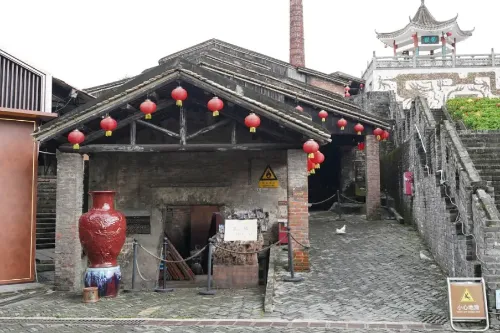
Built in the Zhengde reign of the Ming dynasty (1506–1521), Nanfeng Kiln has a history of over 500 years. It is a Major Historical and Cultural Site Protected at the National Level and one of the oldest surviving wood-fired dragon kilns still in use worldwide. Stretching south along the terrain close to the Dongping River, the kiln is 34.4 metres long externally and 30.87 metres internally. It resembles a long dragon sloping downhill, and locals in Shiwan call it a "zao" (kiln stove). Since its opening faces south and the kiln tail is shaded by banyan trees, cool breezes blow through in summer, hence the name "Nanfeng Kiln" (Southern Breeze Kiln). Wood is used as fuel; one firing cycle takes roughly three days, known locally as "three-day fire". The combustion chamber at the front is called the burner for preheating, and multiple kiln gates are set along the body for loading and unloading wares.

Gao Kiln
Gao Kiln dates back to the Wanli reign of the Ming dynasty, with a history of more than 400 years and a total length of 32 metres. It is also a Major Historical and Cultural Site Protected at the National Level. Its structure and operation are identical to Nanfeng Kiln. It is named Gao Kiln (Tall Kiln) because it stands behind Gaomiao Temple; the kiln owner hoped it could receive the prosperous blessings of the temple. Nanfeng Kiln and Gao Kiln take turns in operation all year round, and traditional wood-firing techniques are still adopted to make pottery here.
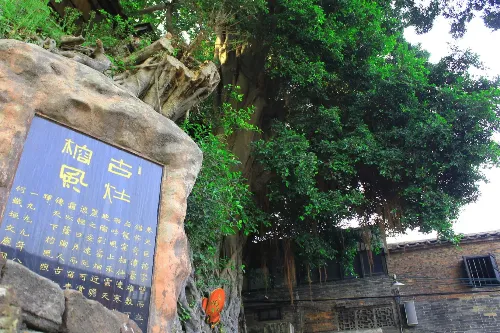
Ancient Banyan of the Kiln
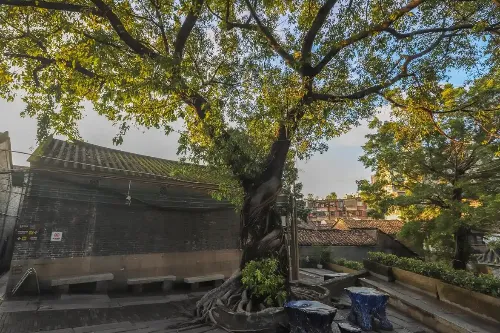
The Ancient Banyan of the Kiln grows near the tail of Nanfeng Kiln. Its roots twist around the kiln wall, and its canopy spreads over the dragon kiln like a giant umbrella. Paired with weathered kiln walls and square chimneys, it forms a classic photo spot in the scenic area. A local saying goes: "Touch the banyan root, and worry will leave you". The shade under the tree is a favourite resting and photography spot for visitors.
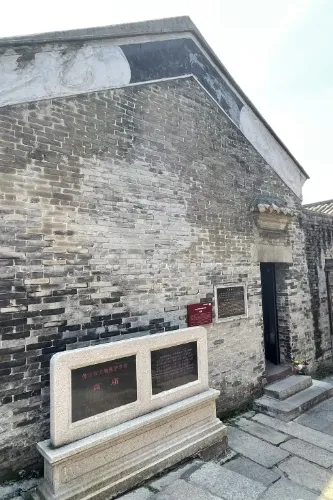
Gaomiao Temple
Gaomiao Temple was first built in the Qing dynasty, also known as Fushan Ancestral Hall. It enshrines Zhenwu Emperor of the North Pole, and historically enjoyed equal fame with Lingying Ancestral Hall (Ancestral Temple) in Foshan. The temple preserves 12 stele inscriptions recording reconstructions of Fushan Ancestral Hall during the Shunzhi, Kangxi, Qianlong, Jiaqing and Daoguang reigns of the Qing dynasty, serving as physical evidence of Shiwan Town’s historical development. Most of the temple was destroyed by fire, and only its side hall remains today.
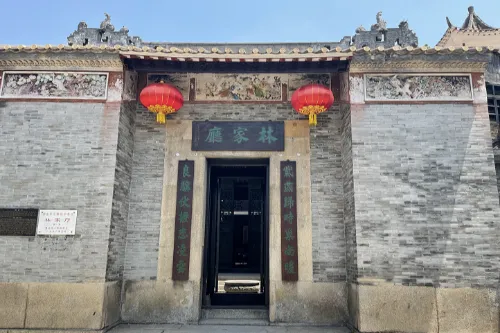
Lin Family Hall
Lin Family Hall was constructed in the Ming dynasty, originally as the ancestral hall of the Lin clan. During the Jiaqing reign of the Qing dynasty (1796–1820), three brothers Lin Shaoguang, Lin Longguang and Lin Jinguang converted the ancestral hall into a residence, which became known as Lin Family Hall. The building has three bays, with courtyards, towers and side rooms. It is a distinctive compound combining an ancestral hall and dwelling, and an important specimen for studying Lingnan clan architecture and residential forms.
Ming and Qing Ancient Architectural Complex
The ancient residential cluster near Lin Family Hall consists of Ming and Qing buildings featuring Lingnan folk architectural characteristics. A heritage of ancient construction civilisation, it remains well-preserved and was listed as a Guangdong Provincial Cultural Relic Protection Unit in 2002. An International Artists Village has been set up in the block, where many renowned artists from home and abroad live and create works inside these old houses.
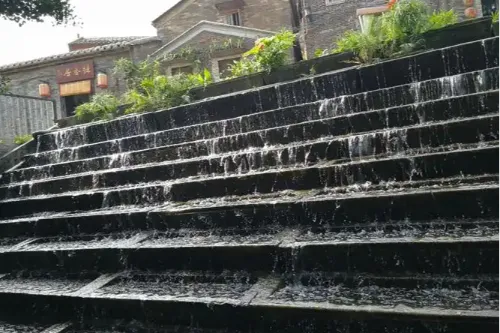
Trough Waterfall
Trough Waterfall, also called Big Jar Waterfall, is stacked with hundreds of ancient ceramic jars. Water cascades down layer by layer between the jars, creating a cool and quiet waterscape. The combination of pottery jars and running water retains the traditional pottery craft features of Shiwan, and is a lesser-known scenic spot ideal for photography.
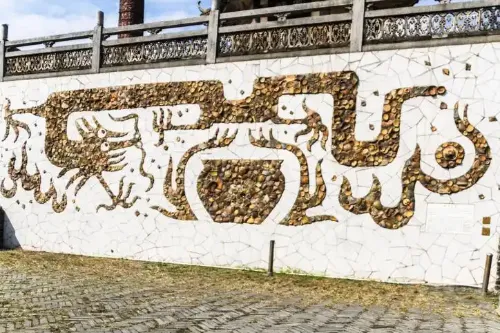
Wall Mural: Auspicious Dragon Presenting Treasures
Auspicious Dragon Presenting Treasures is a large ceramic mural in the scenic area. Made with Shiwan pottery sculpture techniques, it depicts the traditional theme of an auspicious dragon offering treasures. Together with the ancient kilns, old banyan trees and alleys, the mural forms the iconic landscape of Ancient Nanfeng Kiln.
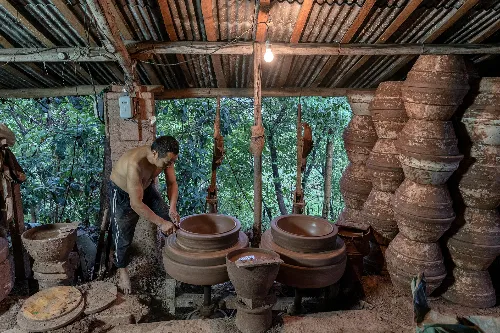
Kiln-Tail Big Jar Workshop
Situated at the tail of Nanfeng Kiln, the Kiln-Tail Big Jar Workshop mainly displays pottery-making procedures including jar forming, mould printing and glazing. Dragon kiln artisans in the workshop perform live demonstrations of shaping big jars. With skilled hands and years of experience, they turn clay into large dragon-kiln jars step by step. Visitors can also view unique moulds exclusive to Ancient Nanfeng Kiln for making various wares, which then go through glazing, air-drying and finally wood firing in the dragon kiln.
Ancient Kiln Vision Exhibition Hall
Covering over 400 square metres, Ancient Kiln Vision Exhibition Hall adopts a retro, nostalgic Lingnan style. It preserves the authentic pottery-making workplace of the old kilns to reflect the profound ceramic culture. The hall is divided into four sections: ceramic art gallery, performance hall, ancient tile waterfall and waterside rest area. It presents traditional pottery craftsmanship to visitors, realising the shift from backstage production to frontstage display, and includes interactive activities for tourists.
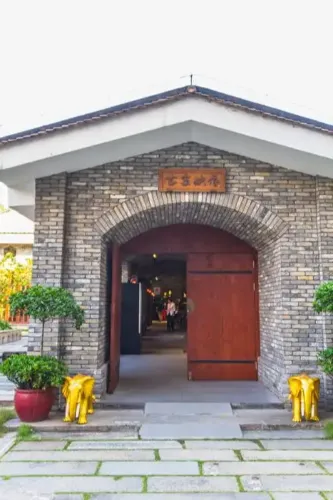
Pottery Art Centre
The Pottery Art Centre spans more than 3,000 square metres and is equipped with professional rooms for wheel throwing, painting, sculpting and glazing. It is a distinctive Lingnan base for ceramic art training and interaction, as well as an international centre for ceramic cultural and artistic exchange. Local and foreign ceramic artists provide on-site guidance. Visitors can throw pots to create ceramic wares of different shapes, or customise Dream Bricks, which can be fired in the ancient dragon kiln. Ceramic art experiences require separate payment.

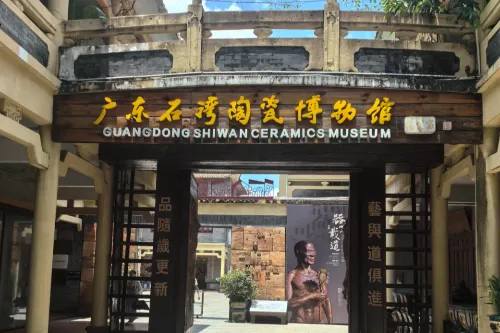
Guangdong Shiwan Ceramics Museum
Guangdong Shiwan Ceramics Museum stands beside the Ancient Nanfeng Kiln block, systematically showing the historical evolution of Shiwan’s ceramic industry. Its exhibitions are split into six sections: Ceramic Fragments, The Formation of Pottery, The Evolution of Kilns, The Twenty-Four Trades of Shiwan, Shiwan Ceramic Art and Ceramic Development. The Twenty-Four Trades of Shiwan is the highlight, introducing the origin of Shiwan ceramic industry from the Ming dynasty to the Republic of China era.
Pottery Figurine Street
Pottery Figurine Street is a lane inside the scenic area dedicated to displaying and selling Shiwan pottery figurines, ceramic bracelets, necklaces, fridge magnets and other ceramic cultural souvenirs. It hosts numerous ceramic studios and creative shops. Visitors can buy handmade pottery and experience the down-to-earth charm of Shiwan pottery sculpture.

Suggested Tour Route
Entrance ticket check → Nanfeng Kiln & Gao Kiln Ancient Dragon Kilns → Ancient Banyan of the Kiln → Trough Waterfall → Lin Family Hall & Ming and Qing Ancient Architectural Complex → Kiln-Tail Big Jar Workshop → Ancient Kiln Vision Exhibition Hall → Ceramic experience at Pottery Art Centre → Pottery Figurine Street for souvenirs → Guangdong Shiwan Ceramics Museum
Tour Tips
- Set aside 2–3 hours for sightseeing. If you plan DIY activities including wheel throwing, hand modelling and glazing, reserve an extra hour.
- The dragon kilns are not fired every day. The schedules for firing and kiln-opening ceremonies are irregular. Check the official notices before your trip so you will not miss the kiln-opening event.
- Your finished ceramic works can be mailed home by the workshop; you do not need to wait on site.
- Pottery markets and antique markets are often held on weekends and holidays, ideal for picking handmade trinkets.
- If time permits, visit the adjacent Guangdong Shiwan Ceramics Museum to learn the full history of Shiwan ceramics.
- Ancient alleys, grey-brick wok-ear houses and dragon kilns make excellent photo backdrops; Hanfu and neo-Chinese style outfits suit the scenery well.
Notes
- Pottery clay sticks easily during throwing and hand modelling. Wear clothes that tolerate dirt; avoid white or valuable garments.
- Kiln bodies, walls and workshop tools may be hot or rough. Follow on-site instructions and do not touch kilns or wares being fired.
- Ancient dwellings and alleys are paved with blue bricks or stone slabs, with steps and slopes along the way. Wear comfortable non-slip trainers.
- Prepare sun protection and mosquito repellent in summer. Mosquitoes are common around the banyan tree and waterscapes.
- Visitors enjoying discounted or free tickets must carry original valid ID documents for entry.
- Real-time firing schedules, performances and opening status are subject to on-site notices on the day.
Transportation
- Metro: Take Foshan Metro Line 2 to Shiwan Station, exit at Exit D and walk for roughly 8–10 minutes. Travellers from Guangzhou can transfer to Foshan Metro Line 2 via Guangfo Line.
- Bus: Take buses 109, 120, 137, 155, 171, 178A, 169 or 185C to Zhongxin Market (Ancient Nanfeng Kiln) Stop and walk to the scenic spot.
- Bus: You may also take buses 101, 134, 150 or G9 to Taodu Stop and walk onward.
- Self-driving: Navigate to "Ancient Nanfeng Kiln Car Park" or Heping Road Car Park (No.12 Heping Road). Parking spaces are available around the site, though limited on holidays. Public transport is recommended.
Opening Hours
Ancient Nanfeng Kiln opens for day visits from 08:30 to 17:30; entry stops at 17:00. The Pottery Art Centre opens from 09:00 to 17:30. Actual opening hours, firing arrangements and performances are subject to on-site notices on the day.
Tickets
The adult ticket for Ancient Nanfeng Kiln costs 25 RMB per person. Search the official WeChat service account "南风古灶" for the latest updates.
Online Booking
Click here to jump to the Trip.com ticketing platform for ticket purchase.