
Tianma Mountain Park is located at No. 460 Liujiashan Village, Sheshan Town, Songjiang District, Shanghai, about 7 kilometers southwest of Sheshan. It is an important part of Sheshan National Forest Park, a national-level forest park. The scenic area features "the highest mountain on Shanghai's land" and "the world's first leaning tower", combining natural mountain scenery and thousands of years of cultural heritage. Tianma Mountain stands at 99.8 meters above sea level, the highest peak in Shanghai’s land area, with a total area of 44.47 hectares. The core building, Huguangzhu Pagoda, is a seven-story octagonal brick-and-wood structure, 18.82 meters high, with an inclination of 6°51′52″. There are also ancient ginkgo trees over 700 years old, the tombs of the Three Gao Scholars of the Yuan Dynasty, and other cultural relics. With a high vegetation coverage dominated by evergreen broad-leaved forests and bamboo forests, it is an ideal destination for climbing, sightseeing, and eco‑leisure in the suburbs of Shanghai.
History and Culture
Tianma Mountain was anciently called Gan Mountain. According to legend, Gan Jiang and Mo Xie, famous swordsmiths in the Spring and Autumn Period, cast swords here, adding profound legendary color to the mountain. In ancient times, numerous Buddhist temples stood on the mountain with prosperous incense, so it was also known as Incense Burning Mountain. Later, it was officially named Tianma Mountain because its two peaks look like a flying horse.
Huguangzhu Pagoda was first built in 1079 (the 2nd year of the Yuanfeng reign of the Northern Song Dynasty) by Xu Wenquan, a local resident. It once housed five‑color Buddhist relics given by Emperor Gaozong of the Song Dynasty, hence its name. In 1788 (the 53rd year of the Qianlong reign of the Qing Dynasty), the pagoda was burned down, leaving only the brick body. Later, people removed bricks to search for treasures, causing the pagoda to tilt severely, exceeding the Leaning Tower of Pisa and becoming a world architectural wonder.
The Yuan Dynasty was a prosperous cultural period for Tianma Mountain. Three famous scholars, Yang Weizhen, Qian Weishan, and Lu Juren, retired here and were buried together at the eastern foot of the mountain after death, known as the "Tombs of the Three Gao Scholars", a symbol of the scholarly spirit in the Jiangnan region. During the Ming and Qing dynasties, Tianma Mountain was an important Buddhist sacred land among the Nine Peaks of Songjiang. Many scenic spots recorded in historical records have gradually disappeared due to erosion and wars. In 1993, Tianma Mountain was included in Sheshan National Forest Park and officially opened to the public in 1998, with its ancient relics systematically protected and displayed.
Main Attractions
Huguangzhu Pagoda (Leaning Tower)
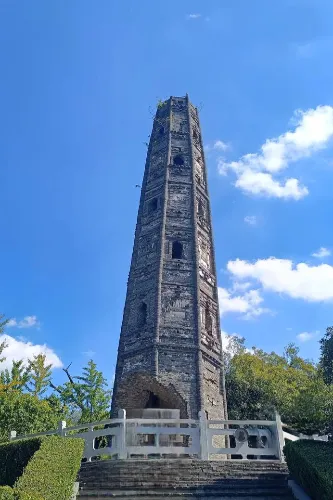
Huguangzhu Pagoda is the landmark of Tianma Mountain, built in 1079 during the Northern Song Dynasty. It is a seven‑story octagonal pavilion‑style brick‑and‑wood structure, 18.82 meters high. After a fire in the Qing Dynasty, only the brick tower remained. Due to later brick removal, the tower leans 6°51′52″ to the southeast, even more than the Leaning Tower of Pisa, known as "the world’s first leaning tower". There is a large hole at the northwest corner of the tower base and an ancient well beside it. Visitors can view the leaning tower closely but are not allowed to climb it.
Tombs of the Three Gao Scholars
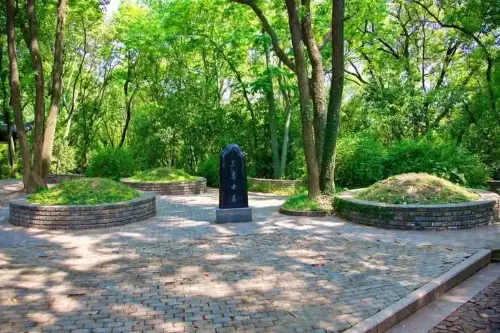
The Tombs of the Three Gao Scholars are located at the eastern foot of Tianma Mountain, the joint burial site of three great literati of the Yuan Dynasty: Yang Weizhen, Qian Weishan, and Lu Juren. The cemetery includes a pavilion, stone archway, and three tombs arranged in a line. Surrounded by green pines and cypresses, it is a quiet and respectful place to understand the culture of Jiangnan scholars in the Yuan Dynasty and pay tribute to ancient sages.
Ancient Ginkgo Tree
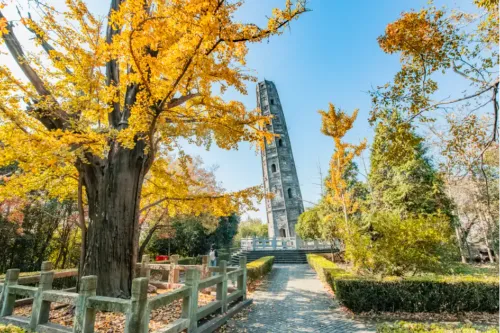
The ancient ginkgo tree stands about 20 meters east of Huguangzhu Pagoda, with a history of more than 700 years and is listed as a famous ancient tree in Shanghai. It is about 20 meters tall with a thick trunk and powerful branches. One branch resembles a dragon’s claw, and local legend says it supports the leaning pagoda and keeps it standing for a thousand years. In late autumn, golden ginkgo leaves contrast beautifully with the ancient leaning tower, making it a popular photo spot.
The Fourth Spring Under Heaven (Zhuoyue Spring)
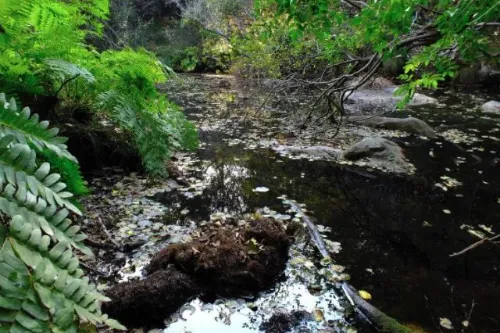
Zhuoyue Spring, also known as the Fourth Spring Under Heaven, was rated by Lu Yu, the Sage of Tea. The spring is located deep in a mountain stream with a stone‑lined pool. The water is clear and sweet, abundant in the rainy season and less in the dry season. Stone inscriptions beside the spring record its history and legends, making it a quiet attraction for those who enjoy exploring ancient sites.
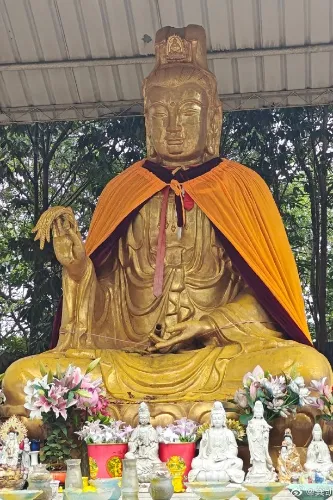
Bronze Guanyin Statue
The Bronze Guanyin Statue stands at the site of the former Yuanzhi Temple. The statue is 3 meters high and weighs about 3600 jin, with a dignified shape and exquisite craftsmanship. Yuanzhi Temple was once the main temple on Tianma Mountain; now only the site and the statue remain. Surrounded by lush woods, it is a peaceful spot for rest and blessing during the climb.
Kanjian Pavilion
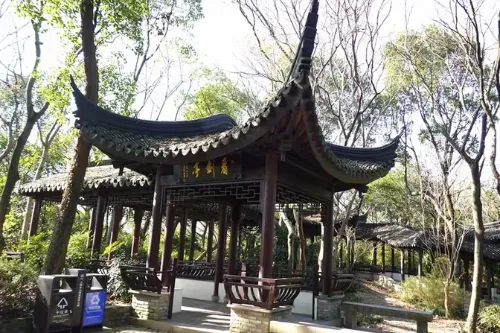
Kanjian Pavilion was built in memory of the legend of Gan Jiang casting swords. It is a traditional Chinese hexagonal pavilion beside the mountain path. Inside are stone tables and benches for visitors to rest and overlook the forest. Surrounded by pines and bamboo, it creates a quiet and elegant atmosphere reminiscent of ancient legends.
Visiting Route
A recommended loop route with no backtracking is about 2.8 kilometers and takes about 2 hours. Enter from the East Gate, walk up the main stone steps to Liuyunge Pavilion in about 5 minutes, then continue to the Tombs of the Three Gao Scholars in about 10 minutes. Walk southwest to the Bronze Guanyin Statue and Yuanzhi Temple site in about 12 minutes, then reach Huguangzhu Pagoda and the ancient ginkgo tree in about 8 minutes. Descend along the west path to Zhuoyue Spring and Kanjian Pavilion in about 15 minutes, and return to the East Gate via the footpath. The route is gentle with only a few steps, suitable for most visitors. A longer 3‑hour tour can include the north peak for more natural scenery.
Visiting Tips
- Best seasons: Autumn (mid‑to‑late October to November), when the ancient ginkgo turns golden, with temperatures between 15–22°C, ideal for climbing and photography. Spring (March–April) offers fresh air and blooming wildflowers.
- Duration: About 2 hours for the classic loop; about 3 hours for a full tour including the north peak.
- Preparation: Wear non‑slip shoes and bring 500ml of water. In summer, use sun protection and insect repellent. In winter, bring a light jacket as the mountain is 2–3°C cooler than the city.
- Photography: The best light for Huguangzhu Pagoda and the ginkgo tree is 9–10 am or 3–4 pm.
- Food: There are few shops in the park; bring snacks and water.
Notes
- Huguangzhu Pagoda is a protected cultural relic. Climbing, touching, carving, or damaging the tower is strictly prohibited.
- Some paths have steep steps and become slippery on rainy days. Walk carefully. Side paths have no lighting; descend before closing time.
- Smoking and open flames are forbidden to protect the forest.
- Do not pick plants, catch wild animals, or carve on relics and trees.
- Pets are not allowed.
- Children under 1.3 meters and the elderly must be accompanied by adults. For emergencies, contact staff or call emergency services.
Transportation
- Metro: Take Metro Line 9 to Dongjing Station (Exit 4), transfer to Bus Songjiang 99 to Tianma Mountain Park Station, then walk about 500 meters to the East Gate.
- Bus: Take Bus Songjiang 90, Songjiang 99, or Huchen Line to Tianma Mountain Station or Tianma Mountain Park Station, then walk 5–8 minutes to the East Gate.
- Self‑driving: Navigate to "Tianma Mountain Park East Gate Parking Lot". Parking is limited; on weekends you may park along Longquan South Road and walk about 300 meters.
- Shared bikes: May be parked at the designated area at the East Gate; riding inside the park is prohibited.
Opening Hours
From May 1 to October 7: 8:30–17:00, last entry at 16:00. From October 8 to April 30: 8:30–16:30, last entry at 16:00. Open all year round but may close temporarily due to extreme weather such as typhoons, heavy rain, or snowstorms. Please check the official notice of Sheshan National Forest Park for updates.
Ticket
Ticket price: 10 yuan per person.
Online Booking
Click here to jump to the Trip.com ticketing platform for ticket purchase.