
Shamian Island is located along the Bai'e Tan in Liwan District, Guangzhou City, Guangdong Province. It is an alluvial sandbar in the Pearl River, formerly known as Shicui Zhou. It is a Major Historical and Cultural Site Protected at the National Level, a National Historical and Cultural Street, and a Provincial Tourism & Leisure Block. The scenic area covers a total land area of 0.3 square kilometers, equivalent to 330 mu. Inside the island lies a checkerboard street layout with three horizontal and five vertical lanes. There are 169 European-style buildings preserved, including Neo-Baroque, Neo-Gothic, Veranda, Neoclassical, and Sino-Western integrated styles, among which 54 buildings are listed as Major Historical and Cultural Sites Protected at the National Level. The island boasts high vegetation coverage with more than 700 arbors and 137 registered ancient and famous trees, making it one of the central urban areas of Guangzhou with the highest density of ancient trees. Centered on century-old modern concession buildings, Shamian is hailed as an open-air museum of global architecture. It integrates historical relics of modern diplomacy, finance and trade, and offers multiple tourism values including riverside leisure, artistic photography and historical research. The whole island features flat barrier-free roads, suitable for walking tours, family trips and visits by elderly tourists.
History & Culture
As early as the Song Dynasty, Shamian served as an important foreign trade hub in Lingnan. It continued to handle transit of foreign merchants' goods through the Song, Yuan and Ming dynasties. The Huajie Pavilion was built here in the Ming Dynasty to specially manage inbound and outbound foreign merchant ships. In the mid-Qing Dynasty, the government constructed the Xigu Fort on Shamian as a riverside military stronghold defending Guangzhou. During the First and Second Opium Wars, the fort took part in battles against foreign invasions. Two ancient Qing cannons were unearthed during infrastructure construction on the island in 1963.
In 1857, British and French allied forces captured Guangzhou. In 1858, relevant treaties were signed and Shamian was selected as a residential zone for foreigners. The government dug the Shaji Rivulet to separate the sandbar from the mainland, forming an independent island surrounded by water. The whole area was divided into British Concession and French Concession: the western 44 acres belonged to Britain, and the eastern 11 acres belonged to France. On September 3, 1861, Britain, France and China signed the 99-year Shamian Lease Agreement, officially turning Shamian into a concession exclave. Afterwards, nine countries including Britain, France, the United States, Germany, Japan and Russia set up consulates here. Nine foreign banks and dozens of foreign firms also settled down. European-style buildings, roads, embankments and parks were planned and built uniformly, forming a complete Western town layout.
In 1946, the Shamian Concession was formally recovered and sovereignty returned to China. In 1959, Premier Zhou Enlai inspected Shamian and issued clear instructions to fully preserve the original appearance of historical buildings on the island and retain physical witnesses of modern foreign exchange history. In 1996, the Shamian Building Complex was included in the 4th batch of Major Historical and Cultural Sites Protected at the National Level by the State Council. It was listed as a National Historical and Cultural Street in 2013 and awarded the title of Provincial Tourism & Leisure Block in 2024. Local authorities carry out continuous renovation of buildings, maintenance of ancient trees and improvement of block environment, balancing cultural relic protection and cultural tourism opening.
Main Attractions
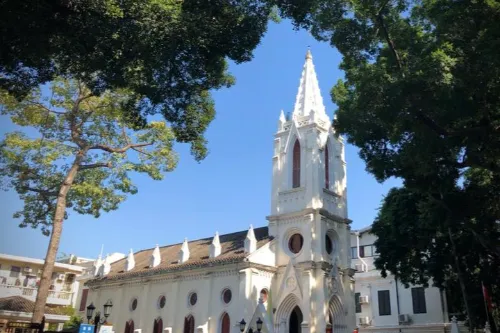
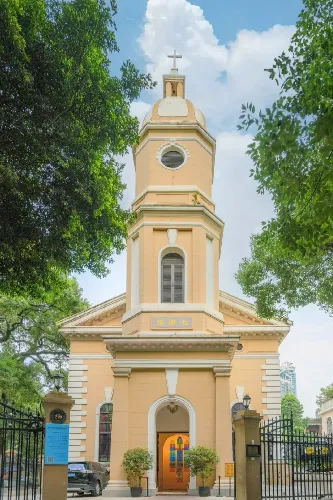
Our Lady of Lourdes Catholic Church
Located at No.14 Shamian South Street, completed in 1890, it is a typical Neo-Gothic two-story building equipped with towering spires and arched stained-glass windows. Its walls are decorated with beige exterior walls and reddish-brown window frames. Inside, stained glass windows and a statue of the Virgin Mary are preserved, making it a landmark photo spot on Shamian. The outdoor area of the church is open to visitors all day. The interior can be visited in an orderly manner during mass hours. Visitors entering the interior must follow dress codes and are prohibited from taking photos with flash.
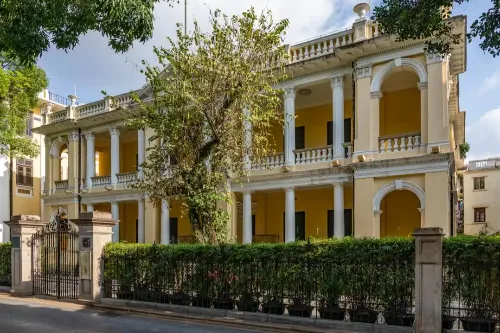
Guangdong Foreign Affairs Museum (Former French Consulate)
Situated at No.20 Shamian South Street, first built in 1890, it is a two-story Baroque main building with auxiliary annexes. Arcaded corridors and carved decorations decorate its facade, and it once served as the office of the French Consulate in Guangzhou. The museum displays cultural relics including modern diplomatic documents, old photos and artifacts, recording the history of Sino-foreign exchanges from the late Qing Dynasty to the Republic of China. Visitors need to register with ID cards. It closes every Monday with opening hours from 9:00 to 17:00.
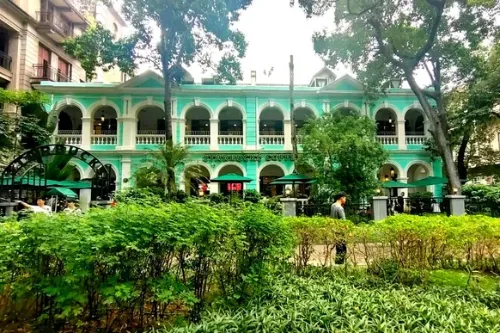
Former British Consulate
Located at No.44 and 46 Shamian South Street, initially constructed in 1865 and reconstructed in 1923, it is an eclectic building consisting of a two-story main building and two two-story annexes. Its facade adopts a three-section composition with continuous arcades on the ground floor and recessed balconies on the second floor. The walls adopt washed stone imitation stone craftsmanship. It is the earliest consulate building completed on Shamian and now serves as office space. Only the exterior is accessible to visitors; entry into the interior is not allowed without permission.
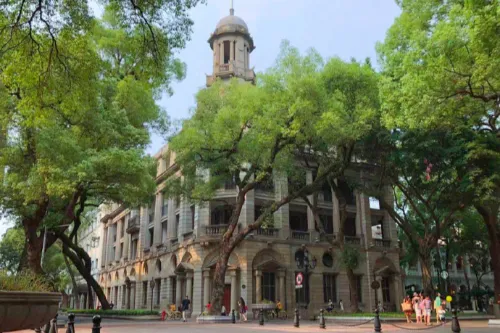
Former HSBC Bank Building
Situated at No.54 Shamian Main Street, completed in 1918, it is a four-story Neoclassical financial building with a symmetrical regular facade decorated with giant Roman columns, a solid base and arched doors and windows. It used to be the largest foreign bank outlet in modern South China. Its exterior fully retains the style of century-old financial architecture, free photo-taking is allowed outside, while the interior remains closed to visitors.
Shamian Christ Church (Former Anglican Church)
Address: No.60 Shamian South Street, built in 1865. It features a simple Western church style with mint green exterior walls and long arched windows without complicated spire decorations, presenting a minimalist and fresh look. Surrounded by ancient banyan trees, it is a popular spot for artistic shooting, with outdoor areas open all day.
Shamian Park
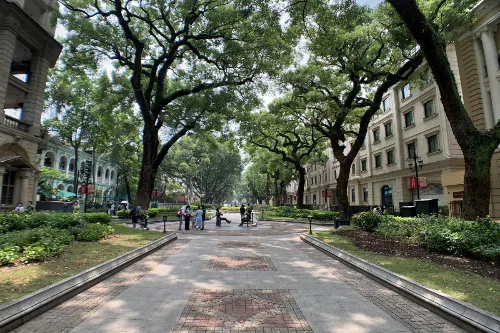
Located at the southern end of Shamian Island adjacent to the Bai'e Tan of the Pearl River, it covers an area of approximately 0.06 square kilometers. Inside the park stand Western-style pavilions, fountains, landscape walkways and riverside benches. Along the embankment, visitors can overlook Pearl River cruise ships, the People's Bridge and the distant city skyline. It is the core spot for watching sunsets in the evening, dotted with century-old banyan trees and complete green landscapes.
Circular Stone Embankment & Ancient Stone Landing Stages
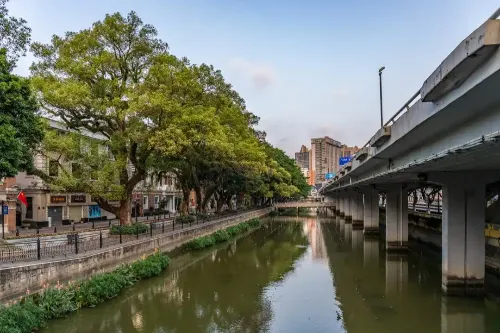
Constructed alongside the whole island of Shamian and finished simultaneously with concession construction in 1859, the entire stone embankment is laid with granite slabs, equipped with multiple ancient stone landing stages for water transportation. It is a historical structure separating the island from the river and listed under cultural relic protection. Walking along the embankment allows full views of the riverside scenery surrounding the island.
Tour Routes
Classic Half-Day Walking Route: Huangsha Metro Station Exit F → Pedestrian Overpass → Entrance of West Shamian Bridge → Popular Floral Wall → Our Lady of Lourdes Catholic Church → Heart-shaped Ancient Banyan Tree → Starbucks Reserve → Former HSBC Bank Building → Shamian Christ Church → Guangdong Foreign Affairs Museum → Riverside Walkway of Shamian Park → East Shamian Bridge → Cultural Park Metro Station
In-depth Historical Research Route: Cultural Park Metro Station Exit E → East Shamian Bridge → Guangdong Foreign Affairs Museum → Former British Consulate → Western-style Buildings along Shamian Main Street → Former HSBC Bank Building → Our Lady of Lourdes Catholic Church → Circular Stone Embankment Walkway → Hometown Water Scenery of White Swan Hotel → Sunset Viewing Platform of Shamian Park → Exit via West Bridge
Travel Tips
- The recommended visiting duration is 2.5 to 4 hours. The best visiting hours are 9:00-11:00 in the morning and 16:00-18:00 in the afternoon, with soft light and fewer tourists ideal for photographing buildings and river views.
- Visits on workdays are recommended. Weekends and holidays see peak passenger flow from 10:00 to 16:00, leading to poor visiting experience.
- Light-colored, retro and French-style outfits are recommended for shooting against European buildings. The whole route has stone roads with protruding tree roots, so flat anti-slip shoes are preferred; high heels are not advised.
- Plan your visit by sections: buildings, exhibition halls and riverside park. You may take a short break at street cafes to refill drinking water halfway.
- Extend your itinerary to Yongqing Fang and Shangxiajiu Pedestrian Street for a one-day Xiguan tour.
- Bring sun hats and handheld fans in summer. The riverside breeze turns cool in spring and autumn, so a thin coat is recommended.
Precautions
- The island has dense greenery with numerous mosquitoes. Mosquito repellent spray and cream are essential.
- Shared bicycles and electric scooters are banned on the whole island. No sightseeing vehicles are available; the entire tour must be completed on foot.
- All historical buildings are protected cultural relics. Climbing walls, window sills and columns, as well as carving or smearing walls are prohibited.
- Some Western-style buildings now serve as office premises and private residences. Do not push doors open arbitrarily or make loud noises.
- Tripods and flash photography are forbidden inside churches. Avoid off-shoulder and ultra-short outfits and keep quiet during visits.
- Convenience stores are scarce on the island. Prepare drinking water and snacks in advance.
- Parking spaces for self-driving vehicles are limited, so self-driving is not recommended.
- Take good care of accompanying children. The embankment has no fully enclosed railings; avoid chasing and playing near the water.
Transportation
- Metro: Take Line 1 or Line 6 to Huangsha Station Exit E/F, cross the pedestrian overpass and walk 3 minutes via West Bridge to the island. Take Line 6 or Line 8 to Cultural Park Station Exit D/E, walk 5 minutes via East Bridge to enter Shamian.
- Bus: Alight at Liuer San Road Stop or Guangzhou Hospital of Traditional Chinese Medicine Stop. Available bus routes include No.1, 38, 57 and 75. Walk 5 to 8 minutes to reach the island entrance.
- Water Bus: Take water bus from Tianzi Wharf to Xidi Wharf, then walk 5 minutes to the entrance of Shamian South Street with river views along the way.
- Island Access: The whole island is only accessible on foot with flat roads. Strollers and wheelchairs can pass smoothly with good barrier-free facilities.
Opening Hours
The outdoor blocks, Shamian Park and circular walkways of Shamian Island are open to visitors 24 hours a day all year round. Indoor venues follow separate opening schedules. Guangdong Foreign Affairs Museum opens daily from 9:00 to 17:00 and closes every Monday for maintenance. The outdoor zone of Our Lady of Lourdes Catholic Church is open all day, while interior visits are only permitted during mass hours. The exteriors of other former banks and consulates can be viewed anytime, but their interiors remain closed without fixed visiting hours.
Tickets
Admission is free. Charges apply for professional guided tours. Search the WeChat official account "发现沙面" to get the latest updates.
Online Booking
Click here to jump to the Trip.com ticketing platform for ticket purchase.