
Guangfulin Cultural Relics Site is located in Guangfulin Subdistrict, Songjiang District, Shanghai, in the northern part of Songjiang New Town, adjacent to East China University of Political Science and Law, Shanghai University of Engineering Science and other universities. It is a cultural scenic spot integrating profound historical and cultural heritage with natural scenery, and a national 4A-level tourist attraction. Famous for its unique "Underwater Museum" landscape, the scenic spot also integrates the cultural remains of the Liangzhu Culture, Maqiao Culture and the Ming and Qing dynasties, forming a distinct feature of "ancient culture and modern architecture contrasting finely with each other, and water town scenery and cultural landscapes complementing one another". In terms of architectural data, the core buildings in the scenic spot include the Guangfulin Culture Exhibition Hall (Underwater Museum), Fulin Pagoda, City God Temple, and Zhiye Chan Temple. Among them, the Guangfulin Culture Exhibition Hall covers a construction area of about 17,000 square meters, adopting a sunken architectural design with its main body hidden underwater, only the antique-style roof exposed, making it a landmark building of the scenic spot; Fulin Pagoda is a Tang-style building with a height of about 50 meters and seven floors, serving as the commanding height and viewing landmark of the scenic spot. The total planned area of the scenic spot is about 1.3 square kilometers, with the core tourist area covering about 0.6 square kilometers and the water area accounting for about 30%. Surrounded by a large area of green space and water systems, it creates a quiet and distant historical atmosphere, and is an important destination for exploring ancient culture and leisure vacation in Shanghai.
History and Culture
The history of Guangfulin Cultural Relics Site can be traced back to the late Neolithic Age about 4300 to 3900 years ago. As an important prehistoric archaeological culture in the lower reaches of the Yangtze River in China, it was named "Guangfulin Culture", filling an important gap in the prehistoric cultural development sequence of the Taihu Lake area. In 1958, local villagers first discovered the ancient cultural remains of the Guangfulin Site while digging a river. Since then, after many archaeological excavations, hundreds of various relics have been exposed, and a large number of pottery, stone tools, jade artifacts, bone artifacts and animal and plant remains have been unearthed. These cultural relics clearly show the production and living methods, social organizational structure and cultural exchange of the ancestors at that time.
The core feature of Guangfulin Culture lies in its integration. It not only retains some traditions of the local Liangzhu Culture in the Taihu Lake area, but also absorbs a lot of elements from the Longshan Culture in the Yellow River Basin. Especially the pottery types such as li tripods and yan steamers all reflect the influence of northern culture, which indicates that there were close cultural exchanges and population migrations between the lower reaches of the Yangtze River and the Yellow River Basin in the prehistoric period. Archaeological research shows that the ancestors of Guangfulin mainly engaged in agricultural production, supplemented by fishing, hunting and handicrafts, and had mastered relatively mature pottery making and jade carving techniques, with social development entering the embryonic stage of civilization.
Entering the historical period, the Guangfulin area has always been a gathering place of talents. During the Shang and Zhou dynasties, this place belonged to the Wu and Yue cultural circle, continuing the prehistoric cultural context; after the Qin and Han dynasties, with the establishment of the centralized feudal dynasty, the Guangfulin area was brought under the jurisdiction of the Central Plains dynasty, and its economy and culture developed further; during the Ming and Qing dynasties, Guangfulin became an important village in Songjiang Prefecture, with a large number of residential buildings, temples, ancestral halls and other structures emerging, and a group of literati and poets appearing, leaving many poems and historical legends. Among them, the City God Temple and Zhiye Chan Temple have a history of hundreds of years, becoming important carriers of local folk culture and religious culture. In modern and contemporary times, after systematic archaeological excavation, protection and restoration, the Guangfulin Site has gradually transformed from an archaeological site into a cultural scenic spot open to the public, allowing more people to experience the charm of prehistoric culture and the long history of Chinese civilization up close.
Main Attractions
Guangfulin Culture Exhibition Hall (Underwater Museum)
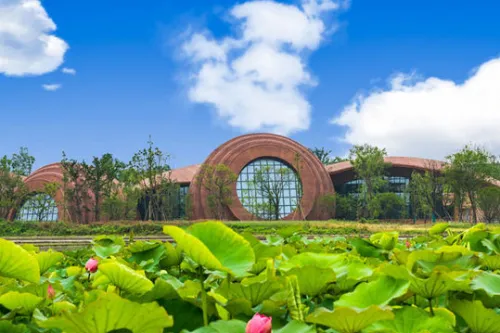
As the core attraction of Guangfulin Cultural Relics Site, the Guangfulin Culture Exhibition Hall is a rare underwater antique building in China. Covering a construction area of about 17,000 square meters, its main body is sunken underground, with only a group of antique-style building roofs and eaves exposed on the ground, floating on a lake surface of about 20,000 square meters. From a distance, it is like a "millennium ancient city floating on water", with a strong visual impact. Inside the exhibition hall, through various forms such as restored archaeological excavation sites, cultural relic displays, multimedia interactions and scene reproductions, it systematically shows the excavation process, cultural characteristics, life of the ancestors and relevant archaeological research results of Guangfulin Culture. Among the precious cultural relics on display are sandy brown pottery li tripods, clay gray pottery dou stemmed bowls, stone axes, jade ornaments of the Guangfulin Culture period, as well as a large number of cultural relics and materials reflecting the living customs of the Guangfulin area in the Ming and Qing dynasties. The "Time and Space Tunnel" exhibition area in the hall uses advanced audio-visual and electronic technology to take visitors through thousands of years of history, allowing them to experience the changes of Guangfulin from a prehistoric village to a modern scenic spot in an immersive way, which is a must-visit place to understand Guangfulin Culture.

Fulin Pagoda
Located in the core area of Guangfulin Cultural Relics Site, adjacent to the Underwater Museum, Fulin Pagoda is a landmark viewing building of the scenic spot. It is a seven-story pavilion-style pagoda with Tang architectural style, with a total height of about 50 meters and an octagonal body. Each floor is equipped with a corridor and viewing windows, and the exterior facade is built with blue bricks, matched with bright red doors, windows and brackets, with a simple and elegant shape and a magnificent momentum. The first floor of Fulin Pagoda is an exhibition hall, showing the construction history of the pagoda and the ancient pagoda culture of the Guangfulin area. The second floor and above are viewing floors. Visitors can climb up along the spiral staircase, and from the top, they can overlook the whole view of Guangfulin Cultural Relics Site, with the lake surface, antique dwellings and green space all in sight. Especially in the early morning and evening, Fulin Pagoda and the Underwater Museum set off each other in the glow of the sunrise and sunset, forming a stunning ancient-style picture.

Zhiye Chan Temple
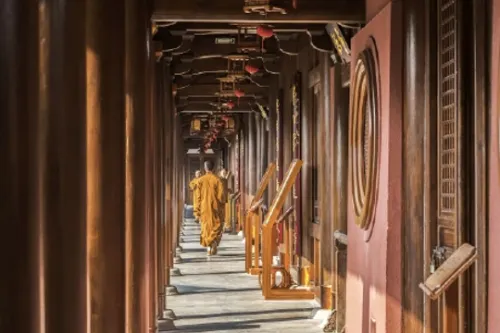
Located on the east side of Guangfulin Cultural Relics Site, Zhiye Chan Temple is a reconstructed Buddhist temple with Tang architectural style. Its predecessor was Guangfulin Chan Temple built in the Southern Song Dynasty, which was repeatedly destroyed and rebuilt due to historical changes. The existing Zhiye Chan Temple was completed in 2012, covering a land area of about 5000 square meters and a construction area of about 2000 square meters. Following the architectural regulations of Tang Dynasty temples as a whole, the temple faces south with its main entrance to the north, arranged symmetrically along the central axis, with the Mountain Gate, Heavenly King Hall, Mahavira Hall, Scripture Collection Building and other buildings distributed in sequence. On both sides are auxiliary buildings such as the Bell and Drum Tower, wing rooms and meditation rooms. All buildings adopt wooden structure style with overhanging eaves and exquisitely carved beams and painted rafters, fully showing the grandeur and magnificence of Tang Dynasty Buddhist architecture. The temple enshrines Sakyamuni Buddha, Amitabha Buddha, Medicine Buddha and other Buddha statues, and also collects some Buddhist scriptures and cultural relics, with incense curling all year round, making it an important place for believers to worship Buddha and pray for blessings, and for visitors to experience Buddhist culture. In addition, a large number of pine, cypress, lotus and other plants are planted in the temple courtyard, creating a quiet and peaceful environment that relaxes people's body and mind.
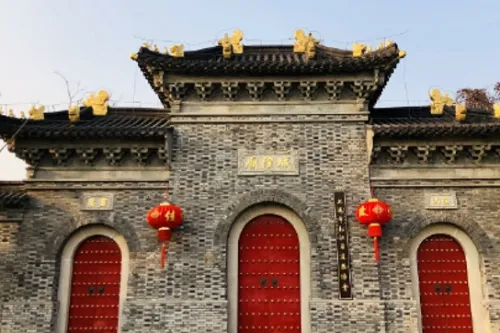
Guangfulin City God Temple
Located in the northwest of the scenic spot, Guangfulin City God Temple is an ancient building complex with Ming and Qing architectural styles. Originally located in the inner city of Songjiang Prefecture, it was moved to Guangfulin Cultural Relics Site as a whole for protection and display, covering a land area of about 3000 square meters and a construction area of about 1500 square meters. As a place for worshipping the City God in ancient China, the City God Temple has the values of religious belief, folk culture and architectural art. Guangfulin City God Temple has a rigorous overall layout, with the Screen Wall, Mountain Gate, Instrument Gate, Main Hall, Rear Hall distributed in sequence on the central axis, and east and west wing rooms, side halls and other buildings on both sides. The exterior facade of the building is built with blue bricks and gray tiles, and the doors and windows are carved with exquisite patterns of flowers, birds and figures, with typical Jiangnan architectural style of the Ming and Qing dynasties. The Main Hall enshrines the statue of the City God of Songjiang Prefecture, which is solemn and dignified, with statues of civil and military officials on both sides. Many plaques and couplets are hung on the beams and pillars in the hall, recording the history and culture of the City God Temple. In addition, the City God Temple regularly holds folk activities such as temple fairs and prayer ceremonies, reproducing the folk customs of the Ming and Qing dynasties and allowing visitors to experience the charm of traditional folk culture.
Guangfulin Ancient Village
Located in the southern part of the scenic spot, Guangfulin Ancient Village is a restored Jiangnan ancient village landscape, covering an area of about 0.2 square kilometers. It consists of dozens of Jiangnan dwellings with Ming and Qing architectural styles, some of which are restored on the original site and some are ancient buildings protected by relocation from other places. All adopt the structure of blue bricks, gray tiles and wooden mortise and tenon, built against the mountain and beside the water, scattered in a picturesque disorder. The streets and lanes in the village crisscross, with bluestone roads winding and turning. Traditional farm tools such as stone mills and stone mortars are placed in front of the dwellings on both sides. The living scenes of Jiangnan people in the Ming and Qing dynasties are restored inside the houses, showing the daily necessities such as furniture, kitchen utensils and clothes at that time, allowing people to intuitively experience the living customs of Jiangnan ancient villages. In addition, there are teahouses, wine workshops, handicraft workshops and other places in the village. Visitors can taste traditional Jiangnan tea and food, experience traditional crafts such as hand-made pottery and weaving. At the same time, the village is surrounded by water systems and green space, with black-awning boats gliding slowly on the water, fully showing the gentle and elegant charm of the Jiangnan water town.

Ancient Pottery Art Museum
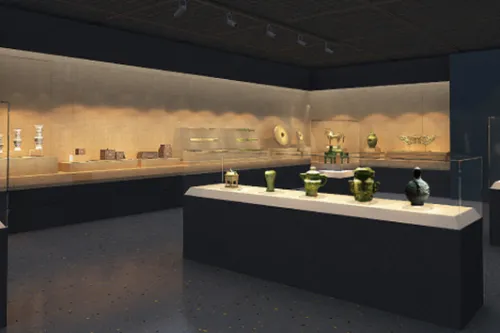
An Ancient Pottery Art Museum is designed in the underground space connecting the underground palace of Fulin Pagoda, displaying more than 500 exquisite ancient pottery works. The exhibits are provided by the Xiayu Ancient Pottery Collection Hall affiliated to the Shanghai Collectors Association, including representative ancient pottery works of different periods such as the Dawenkou Culture, Liangzhu Culture, Majiabang Culture, Longshan Culture, Xindian Culture, as well as the Xia, Shang and Zhou dynasties, Spring and Autumn and Warring States Periods, Qin and Han dynasties, Wei, Jin, Southern and Northern Dynasties, Sui, Tang and Song dynasties.
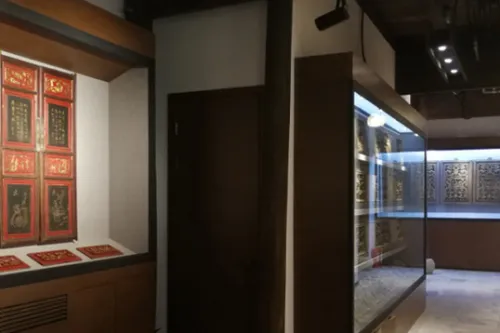
Wood Art Exhibition Hall
Centering on traditional and modern wood art culture, the hall focuses on showing the inheritance and innovation of Chinese woodworking skills. It collects more than 300 pieces including beam purlins, corbels, horizontal lintels, doors, windows and various types of Chinese classical furniture.
Archaeological Site Exhibition Hall
It displays a carefully selected collection of representative precious cultural relics unearthed from the Guangfulin archaeological discoveries, with some exhibits provided by the Shanghai Museum. In addition to exhibiting and displaying the treasures unearthed from Guangfulin, this hall also serves as a venue for cultural exchanges and exhibitions with world-class museums.
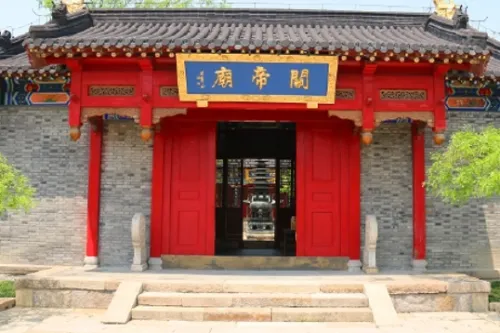
Guandi Temple
It is a temple dedicated to Guan Yu, a famous general of the Three Kingdoms Period, carrying a profound culture of loyalty and righteousness and historical memories. Guan Di, namely Guan Yu, a famous general of the Three Kingdoms Period, is respected by the people as the "Martial Saint", and "Lord Guan" is the patron saint of the ancestors of Guangfulin.
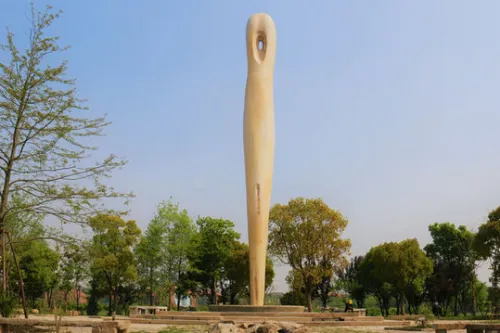
Bone Needle Square
It is the core landmark of Guangfulin Cultural Relics Site. A bone needle, a tool symbolizing the ancestors' weaving of clothes, quilts and fishing nets, stands in the middle, which is one of the most representative relics unearthed from Guangfulin.
Tour Route
A classic tour route taking about 4-5 hours is recommended, which can fully cover the core attractions of the scenic spot and balance historical and cultural experience with leisure sightseeing. First, enter from the main gate (East Gate) of the scenic spot, walk straight about 200 meters after entering to reach the first attraction - the Guangfulin Culture Exhibition Hall (Underwater Museum). Spend about 1.5 hours here to carefully visit the archaeological cultural relics and multimedia displays in the hall, and have an in-depth understanding of the history and connotation of Guangfulin Culture. After visiting the Underwater Museum, turn right and walk about 50 meters to Fulin Pagoda, spend about 30 minutes climbing the pagoda to overlook the whole scenic spot and take stunning scenic photos. After coming down from Fulin Pagoda, walk about 100 meters west along the lakeside trail to Guangfulin City God Temple, spend about 40 minutes visiting the ancient building complex with Ming and Qing styles and experiencing traditional folk culture. Then, walk about 150 meters south from the City God Temple to Guangfulin Ancient Village, spend about 1 hour wandering on the bluestone roads, visiting ancient dwellings, experiencing traditional handicraft workshops, tasting characteristic Jiangnan food and feeling the charm of the Jiangnan water town. Finally, walk about 200 meters east from the ancient village to Zhiye Chan Temple, spend about 30 minutes visiting the Tang-style temple buildings, take a short rest in the quiet courtyard and worship Buddha for blessings, then leave the scenic spot from the exit (South Gate) near the temple to end the tour. If time permits, you can also stay for a while in the lakeside green space of the scenic spot to enjoy the lakes and mountains and feel the quiet historical atmosphere.
Travel Tips
- The recommended travel duration is 4-6 hours. If you want to have an in-depth experience of folk activities and handicrafts, you can reserve a full day.
- The best travel seasons are spring (March to May) and autumn (September to November). In spring, the scenic spot is full of blooming flowers; in autumn, the sky is clear and the air is fresh with pleasant scenery. Avoid the high temperature in summer and the severe cold in winter.
- When visiting the Guangfulin Culture Exhibition Hall, it is recommended to rent an electronic interpreter or follow the official explanation team of the scenic spot to have a deeper understanding of the historical stories behind the cultural relics.
- In Guangfulin Ancient Village, you can try local characteristic foods such as Songjiang perch, Guangfulin Zhuangyuan Cake and Jiangnan Green Rice Cakes to experience the local catering culture.
- For visitors who like taking photos, it is recommended to bring a camera. The best photo spots are the lake surface of the Underwater Museum, the top floor of Fulin Pagoda, the bluestone roads of the ancient village and the courtyard of Zhiye Chan Temple, with better shooting effects in the early morning and evening.
- If traveling with the elderly and children, it is recommended to wear comfortable flat shoes. Some sections of the scenic spot are bluestone roads, so pay attention to walking safety. At the same time, there are rest areas and mother-and-baby rooms in the scenic spot for you to stay and rest at any time.
- There are many cultural and creative stores in the scenic spot, where you can buy cultural and creative products related to Guangfulin Culture such as cultural relic replicas, bookmarks and postcards as souvenirs.
Notes
- Smoking is prohibited in the scenic spot. It is strictly forbidden to bring flammable and explosive materials and pets (except guide dogs) into the core tourist area. Abide by the fire safety regulations of the scenic spot.
- When visiting indoor attractions such as the Guangfulin Culture Exhibition Hall and the City God Temple, do not touch cultural relics and exhibits, do not take photos with flash, keep quiet in the venues and do not make noise or frolic.
- The lake in the scenic spot is quite deep. Do not climb or play in the water near the lakeside guardrails. Take good care of children to prevent safety accidents.
- Respect religious beliefs. When visiting Zhiye Chan Temple, do not touch Buddha statues and religious artifacts at will, abide by the relevant regulations in the temple and do not disturb believers from worshipping Buddha.
- Take good care of the scenic spot environment. Do not litter, pick flowers and trees, or damage the buildings and facilities of the scenic spot. Jointly maintain the cleanness and integrity of the scenic spot.
- The stairs of some attractions in the scenic spot (such as Fulin Pagoda) are steep. The elderly and children need to be accompanied when climbing, pay attention to walking safety and avoid crowding.
- The scenic spot is crowded with tourists during holidays. It is recommended to book tickets in advance through official channels and travel during off-peak hours to avoid long queues.
- The prices of catering and commodities in the scenic spot are slightly higher than those outside. You can bring an appropriate amount of drinking water and snacks according to your own needs.
Transportation
- Public Transportation - Subway: Take Shanghai Metro Line 9 to Songjiang University Town Station (Exit 4), transfer to Songjiang Bus Line 15 after exiting the station, get off at Guangfulin Road Longyuan Road Station, and walk about 500 meters to the East Gate of the scenic spot.
- Public Transportation - Bus: In addition to Songjiang Bus Line 15, you can also take Songjiang Bus Line 24, 33 and 95, get off at Guangfulin Cultural Relics Site Station, which is directly at the gate of the scenic spot.
- Self-driving: Starting from downtown Shanghai, you can take the Shanghai-Kunming Expressway (G60) and exit at Songjiang New Town, then drive along South Jiashan Road and Guangfulin Road to reach the scenic spot. There is a special parking lot in the scenic spot.
- Taxi/Ride-hailing: Taking a taxi from Songjiang University Town Metro Station to Guangfulin Cultural Relics Site is about 5 kilometers; taking a taxi from Shanghai People's Square to the scenic spot is about 40 kilometers.
Opening Hours
Regular hours (Monday to Friday, non-statutory holidays): 9:00 - 17:00, entry stops at 16:00 and the scenic spot starts to clear visitors at 17:00; Weekends (Saturday and Sunday) and statutory holidays: 9:00 - 18:00, entry stops at 17:00 and the scenic spot starts to clear visitors at 18:00.
Tickets
The scenic spot is open to the public free of charge, but a ticket is required to visit the exhibition halls, starting from 5 RMB per person. You can search for the official WeChat service account "广富林文化遗址服务号" to get the latest news or buy tickets online.
Online Booking
Click here to jump to the Trip.com ticketing platform for ticket purchase.