
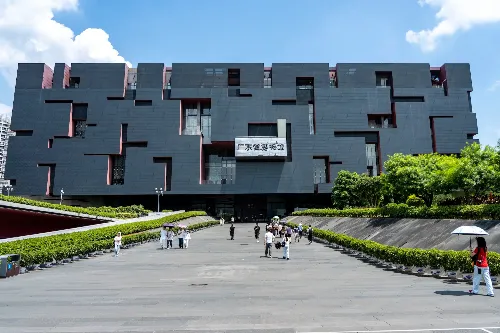
The Guangdong Museum is located at No.2 Zhujiang East Road, Tianhe District, Guangzhou City, Guangdong Province, on the east side of Huacheng Square in the southern section of the central axis of Zhujiang New Town. It is the only provincial comprehensive museum in Guangdong, rated a National First-Class Museum, and one of the first national off-campus research and practice education bases for primary and secondary school students. Admission is free to the public. The construction of the new venue broke ground in December 2004 and was officially opened to visitors on May 18, 2010. Its architectural design draws inspiration from Lingnan hollow carved ivory treasure boxes, featuring a hollow treasure box silhouette that makes it one of the landmark cultural buildings in Guangzhou’s Zhujiang New Town. The new building covers a total land area of 41,027 square meters with a total construction area of 69,724 square meters, including 21,000 square meters of exhibition space. The building has five floors above ground and one basement floor, housing functional zones such as collection storerooms, an academic lecture hall, a youth activity center and cultural and creative service areas. The storerooms span 8,873 square meters, and dedicated spaces for educational activities cover 4,726 square meters. The museum preserves over 260,000 cultural relics (sets), among which 20,843 pieces (sets) are classified as precious relics. Its collections cover Lingnan historical artifacts, export artworks, Duan ink slabs, Chaozhou wood carvings, ceramics, paleontological fossils, animal, plant and mineral specimens. Integrating displays of Guangdong regional history, maritime trade, traditional crafts and natural ecology, the museum serves multiple functions including historical research, science popularization education and cultural exhibitions, receiving more than 3 million visitors annually.
History and Culture
The preparation work for the Guangdong Museum launched in June 1957, with its original site on Wenming Road, Guangzhou. The premises included cultural heritage sites such as the Guangdong Imperial Examination Hall of the Qing Dynasty and the former site of the First National Congress of the Kuomintang. It officially opened to the public on October 1, 1959, and concurrently managed the Lu Xun Memorial Hall of Guangzhou. The old venue occupied a land area of 43,000 square meters, with its initial exhibition building covering approximately 14,000 square meters. In its early years, exhibitions centered on local archaeological findings and regional revolutionary history of Guangdong, with themed displays such as Cultural Relics of the Xisha Islands and Archaeological Achievements of Guangdong launched successively, forming an exhibition system rooted in Lingnan regional culture. After the reform and opening-up, the old venue could no longer accommodate expanding collections and visitor demand, with severe shortages of exhibition space and cultural relic storage facilities, prompting Guangdong Province to launch planning and approval procedures for a new museum building.
In 2004, the new Guangdong Museum was listed among Guangdong’s Ten Key Cultural Projects. Construction broke ground on the Zhujiang New Town plot in December the same year and took six years to complete. The venue opened officially on May 18, International Museum Day, 2010, bringing substantial upgrades to hardware facilities, exhibition scale and relic preservation conditions. The new museum features four permanent exhibition zones integrating history, natural science, traditional crafts and temporary special exhibition spaces, supported by professional constant-temperature constant-humidity relic storerooms, multimedia digital exhibition systems and youth research classrooms. It also improved public services including barrier-free passages, luggage storage and guided tours. After 2020, the venue continuously upgraded digital display technology, adding AR relic restoration and online panoramic exhibition halls to expand cultural communication models combining online and offline experiences, establishing itself as a core cultural institution showcasing Lingnan culture and Maritime Silk Road civilizations.
The museum’s collection system fully documents millions of years of human history in Guangdong, ranging from Maba Man fossils and bronze wares of the Nanyue Kingdom to Tang and Song export porcelain, Ming and Qing Guangdong-style crafts, and modern trade and revolutionary artifacts. These pieces trace the complete historical thread of Lingnan origins, maritime commerce, three major ethnic cultures and modern revolutionary history. The museum holds a nationally leading quantity of Lingnan intangible cultural heritage crafts including Chaozhou wood carvings, Duan ink slabs, Guangzhou ivory carvings and Shiwan ceramics. A large number of cultural relics unearthed from the Nanhai No.1 shipwreck, export wallpapers and Western custom Guangcai porcelain directly verify Guangdong’s core status on the Maritime Silk Road over more than two thousand years. Meanwhile, its paleontological, marine animal and plant specimens fully record Lingnan’s geological evolution and ecological characteristics, combining dual cultural functions of humanistic history and natural science popularization. It is a core physical archive for researching the historical culture of the Guangdong-Hong Kong-Macao Greater Bay Area.
Main Attractions
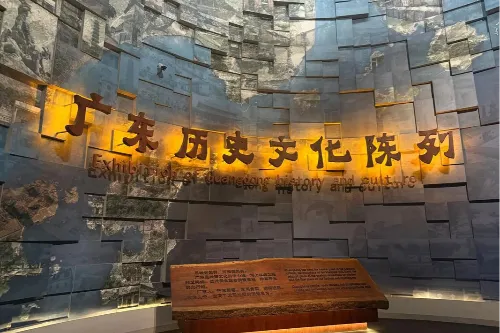
Permanent Exhibition of Guangdong History and Culture
Located on the fourth floor of the venue, this exhibition hall spans over 4,000 square meters and displays more than 1,500 cultural relics (sets) alongside over 300 historical photographs, forming the core permanent exhibition of the entire museum. Arranged chronologically, the exhibition is divided into four chapters: Origins of Lingnan, Sailing to the World, Carrying Forward the Past, and Flames of Guangdong Coast, presenting the full history of Guangdong from the primitive civilization of the Maba Man to the founding of the People’s Republic of China. Highlights include a complete 40-meter Liede Dragon Boat, China’s only complete set of Qing-dynasty Guangzhou export wallpapers, a Western Zhou bronze he vessel with beast-face patterns, gold ornaments recovered from Nanhai No.1, and Zhan Tianyou’s personal photo albums. Complemented by large marine and land-themed murals, restored folk scenes and multimedia interactive displays, the exhibition clearly illustrates the integration of Cantonese, Hakka and Chaoshan ethnic groups and the development of maritime trade.
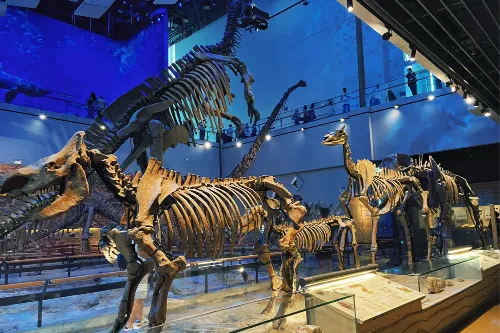
Permanent Exhibition of Guangdong Natural Resources
Situated on the fourth floor adjacent to the History and Culture Exhibition Hall, this space covers seven themed zones: geological landforms, mineral gemstones, Chinese herbal medicine, terrestrial wild animals, marine life and paleontology, with a total floor area exceeding 4,000 square meters and tens of thousands of mineral, animal, plant and paleontological specimens. The hall houses a complete giant Mamenchisaurus skeleton and an adult baleen whale skeleton, alongside the internet-famous Guangning jade carving of sliced chicken. The gemstone zone showcases Lingnan characteristic crystals and jade ores, while the marine zone uses immersive blue lighting to display hundreds of deep-sea fish, coral and shell specimens. Boasting outstanding science popularization value, it is a popular zone for family visits that fully demonstrates Guangdong’s geological changes and the full spectrum of terrestrial and marine ecological resources.
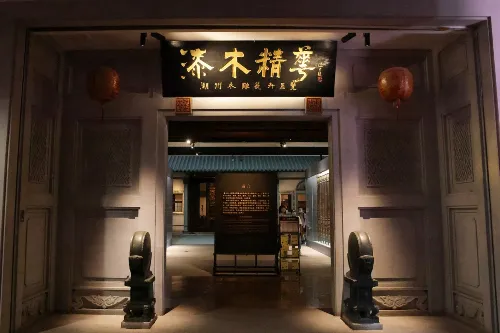
Essence of Lacquered Wood – Exhibition of Chaozhou Wood Carving Art
This exhibition hall sits on the third floor, displaying over 200 wood carving artifacts including gilded shrines, longevity screens, hollow crab baskets and traditional wedding utensils, with the Qing-dynasty Yongqing Hall gilded wood carving grand shrine as the museum’s national treasure-level highlight. The hall recreates authentic scenes of halls, studies and bedrooms in traditional Chaoshan dwellings to show how wood carvings were used in folk rituals and daily life. Featuring multi-layer hollow carving and painted gilding craftsmanship, the exhibits clearly trace the evolution of Chaozhou wood carving from practical folk utensils to top-tier fine arts, fully presenting the intangible heritage carving techniques of Chaoshan.
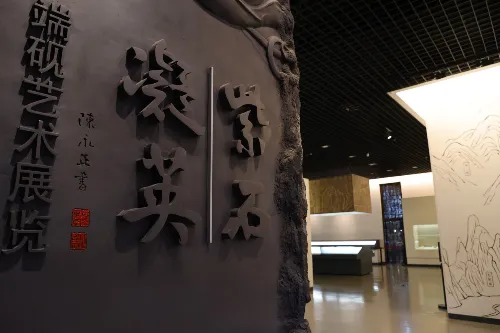
Purple Stone Elegance – Exhibition of Duan Ink Slab Art
Adjacent to the Chaozhou Wood Carving Hall on the third floor, this zone gathers fine Duan ink slabs from successive dynasties crafted from raw stone of major ink slab mines including Laokeng, Kengzaiyan and Maziyan. It houses representative ancient slabs such as the Golden Monkey King Ink Slab, alongside slab-making tools and raw Duan stone specimens. Divided by historical periods, mine origins and carving techniques, the exhibition explains Duan stone mining, carving procedures and Lingnan scholarly culture, systematically tracing the history of Duan ink slabs from the Tang Dynasty to the present and showcasing the unique scholarly craft culture of Zhaoqing, Guangdong.
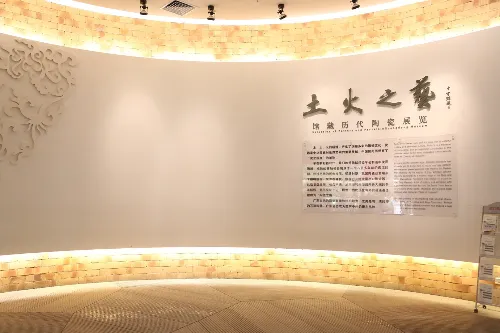
Art of Earth and Fire – Exhibition of Porcelain Collections Through Dynasties
Located on the mezzanine of the third floor, this hall displays nearly 300 ceramic artifacts spanning from the Neolithic Age to the Qing Dynasty, split into four sections: origins of pottery, national ceramic development, ceramic golden age, and Guangdong kilns and export porcelain. Exhibits include Shiwan kiln sculptures, Chaozhou kiln wares, Yuan blue-and-white porcelain vases with figure motifs, and Ming and Qing Guangcai export porcelain. The displays fully restore the development of ancient maritime porcelain trade, contrast craftsmanship between local Guangdong kilns and major national porcelain kilns, and intuitively present the history of Lingnan ceramic exports.
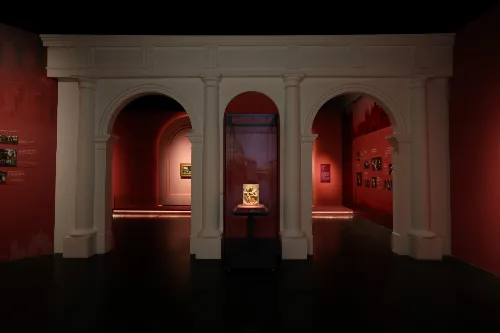
Temporary Special Exhibition Hall
Independent large-scale temporary exhibition spaces are set up on the third floor with regularly rotated themed displays. Exhibition content covers cultural relic loan shows from national cultural institutions, painting and calligraphy art exhibitions, special maritime archaeology displays, intangible cultural heritage exchange shows and more. The duration of temporary exhibitions varies, visitors should refer to official museum announcements for updates, which supplement diverse cultural content outside permanent halls.
Museum Atrium & Treasure Box Building Facade
The museum’s exterior adopts a hollow ivory treasure box design with grey stone hollow facades, a popular photography landmark. The central interior features a multi-story open atrium connected by circular corridors and large floor-to-ceiling observation windows offering panoramic views of the Pearl River, Guangzhou Tower and Huacheng Square. Visitors may visit and take photos without entering exhibition halls, making this the venue’s signature architectural sight.
Tour Routes
Efficient Streamlined Route (3-hour Essential Visit): Security Check-in at West Gate → 4F Permanent Exhibition of Guangdong History and Culture → 4F Permanent Exhibition of Guangdong Natural Resources → 3F Chaozhou Wood Carving Art Exhibition Hall → 3F Duan Ink Slab Art Exhibition Hall → Mezzanine 3F Porcelain Exhibition Hall → 1F Cultural and Creative Service Lobby → Exit via West Gate
Comprehensive Full Visit Route (4–5 Hour Complete Tour): Security Check-in at West Gate → 4F Permanent Exhibition of Guangdong History and Culture → 4F Permanent Exhibition of Guangdong Natural Resources → 3F Chaozhou Wood Carving Hall → 3F Duan Ink Slab Hall → 3F Temporary Special Exhibition Hall → Mezzanine 3F Porcelain Exhibition Hall → 2F Rest and Cultural & Creative Service Zone → External Visit of 1F Youth Activity Center & Academic Lecture Hall → Exit via West Gate
Travel Suggestions
- Recommended visiting duration: 3 hours for the streamlined tour, 4–5 hours for a full in-depth visit; families with children are advised to reserve over 4 hours.
- Visit time selection: Weekdays see fewer crowds for better photography and viewing experience. Every Friday offers extended opening hours until 20:30, with soft evening lighting ideal for artifact photography. Tickets are in high demand on weekends and statutory holidays; advance reservation is mandatory.
- Viewing order: Tour from the fourth floor down to the first floor to avoid backtracking and save energy.
- Collect paper guide maps upon entry marking the locations of museum treasures to boost visiting efficiency; audio guide rental is available for detailed background information on exhibits.
- The museum maintains low indoor air conditioning temperatures year-round; visitors are recommended to bring a light outerwear to avoid catching cold.
- Visitors fond of cultural and creative stamp collection may carry blank notebooks; free stamp punching services are available at the 1F cultural and creative store.
- Families with young children are recommended to prioritize the 4F Natural Resources Exhibition Hall, where dinosaur and marine specimens offer strong interactivity suitable for early-age science education.
- After visiting the museum, walk to Huacheng Square, Guangzhou Opera House and the Pearl River waterfront for a continuous cultural travel itinerary.
Notes
- The museum implements real-name time-slot reservation for all visitors, including infants and toddlers; entry is denied without a reservation. New reservation slots for the next 7 days are released at 22:00 every night. One account may only place one reservation order within 14 days, with a maximum of 5 visitors per booking.
- Visitors who miss their booked slots twice consecutively or three times in total will have their reservation privileges for museum tickets and research activities suspended for 90 days. Visitors unable to attend must cancel reservations online in advance.
- All visitors under the same reservation must bring original ID cards; digital ID cards serve as supplementary credentials. Scan ID cards at the individual visitor channel of the West Gate for security check. Each reservation is valid only once on the booked day, with no re-entry allowed after exiting.
- Eating and drinking are prohibited inside exhibition halls; snacks and beverages may be stored in free lockers at the West Gate. An independent lounge and catering zone are located on the second floor, where food and drinks may only be consumed within the lounge area.
- Flash photography, tripods and selfie sticks are banned inside exhibition halls. Do not touch display cabinets, cultural relics, scene restoration installations or cross protective barriers.
- Visitors must keep quiet throughout the venue; running and loud noise are forbidden, and minors must be accompanied and supervised by guardians at all times.
- Large luggage and rolling suitcases may not enter exhibition halls and require storage. Flammable, explosive, sharp and other contraband items are prohibited from the museum premises.
- The museum closes regularly every Monday but opens normally if Monday falls on a statutory holiday; the weekly closure shifts to the first working day following the holiday. Fridays feature extended opening hours, with last entry delayed to 19:30; last entry is at 16:00 on all other days. No further admission is permitted approaching the closing cutoff time, so avoid arriving at the last minute.
- Special visitor concessions: Seniors aged 65 and above and persons with disabilities may bring one accompanying person for on-site registration and entry. Active-duty and retired military personnel enjoy priority passage with valid identification documents.
Transportation
- Metro: Take the APM Line to Grand Theatre Station Exit B, a 3–5 minute walk to the museum West Gate. Metro Line 3 & Line 5 to Zhujiang New Town Station Exit B1 (10-minute walk). Metro Line 5 to Liede Station Exit D (15-minute walk).
- Bus: Alight at Xiancun South Stop or Guangzhou Opera House West Gate Stop, a 5-minute walk to the West Gate.
- Driving: Navigate to the East Gate parking lot of the Guangdong Museum, which opens at 08:50. Parking spaces are limited; visitors on holidays are advised to park at the underground Huacheng Hui parking lot nearby.
- Cycling: Shared bicycle parking zones are available at both the West Gate and East Gate, suitable for short cycling trips to the venue.
Opening Hours
Standard opening hours are Tuesday to Sunday, 09:00–17:00, with last visitor admission at 16:00 every day. The museum closes every Monday routinely; if Monday is a statutory holiday, the museum opens as normal and the weekly closure is rescheduled to the first working day after the holiday. Every Friday features extended opening hours from 09:00 to 20:30, with last entry at 19:30. Temporary adjustments to opening hours may occur for equipment maintenance, large events and other special circumstances, which will be announced in advance via the official service account. Service hours for exhibition halls, cultural and creative shops and luggage lockers follow the overall museum opening schedule.
Tickets
The museum offers free general admission; fees apply for certain special temporary exhibitions. Search the official WeChat service account "广东省博物馆" to access the latest updates and information.
Online Booking
Click here to jump to the Trip.com ticketing platform for ticket purchase.