
Shanghai Chenshan Botanical Garden is located at No. 3888 Chenhua Highway, Songjiang District, Shanghai. It is a comprehensive botanical garden jointly built by the Shanghai Municipal Government, the Chinese Academy of Sciences, and the National Forestry and Grassland Administration, and a national 4A-level tourist attraction. The garden covers a total area of 207 hectares, including 189 hectares of green space and 38 hectares of water area, making it one of the largest botanical gardens in East China. With the theme of "Plants and Health", it integrates scientific research, popular science, sightseeing, and recreation. The garden houses key buildings such as exhibition greenhouses, a research center, and a science museum, with a total construction area of approximately 43,000 square meters. Its core features include the largest exhibition greenhouse complex in East China, as well as the unique Mine Pit Garden and Chenshan Hill landscape. More than 12,000 plant species are collected and displayed here, covering ornamental plants, economic plants, medicinal plants, rare and endangered plants, etc. It is a national-level botanical garden dedicated to plant conservation, scientific research, science education, and ecological leisure.
History and Culture
Chenshan Hill itself has a long historical heritage. It was anciently known as "Divine Hill" and got its name because it lies in the "Chen" direction (southeast). As one of the "Nine Peaks and Twelve Hills" in Songjiang District, it is composed of volcanic rocks with an altitude of about 71.4 meters, and has long been a famous cultural hill in the Jiangnan region. There were many historical sites around Chenshan Hill, such as Chenshan Pagoda and Chenshan Shrine. Although some sites have been lost over time, rich cultural legends and historical records remain.
The construction of Shanghai Chenshan Botanical Garden began in 2006 and it officially opened to the public in April 2010. Its original goal was to fill the gap of a large comprehensive botanical garden in East China. Relying on the natural hill of Chenshan and surrounding water systems, combined with modern botanical garden planning concepts, it was built into a plant-themed park with both ecological value and cultural connotation. During construction, the garden focused on preserving the historical features of Chenshan Hill. The mine pit relics around the hill were ecologically restored and landscaped, integrating industrial heritage with natural ecology to form the unique Mine Pit Garden. This not only retains the industrial memory of Chenshan but also endows it with new ecological and cultural value.
As a national botanical garden, Chenshan Botanical Garden not only undertakes the scientific mission of protecting plant diversity but also inherits the gardening concept of Jiangnan gardens. It combines traditional landscape culture with modern botanical research, becoming an important ecological and cultural landmark in Shanghai and even the Yangtze River Delta region.
Main Attractions
Exhibition Greenhouses
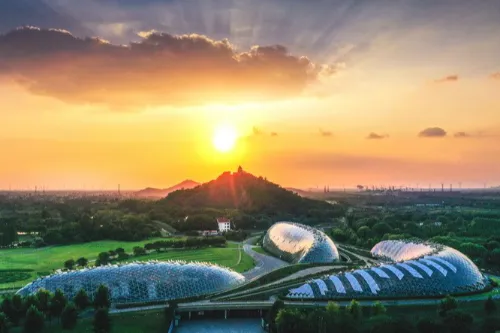
The Exhibition Greenhouses are the core attraction of Chenshan Botanical Garden, with a total construction area of 12,608 square meters. Composed of three independent greenhouses—the Tropical Fruit and Flower House, the Arid Land Plant House, and the Rare and Precious Plant House—it is the largest and most advanced plant exhibition greenhouse in East China. The Tropical Fruit and Flower House simulates a tropical rainforest climate, displaying tropical fruit trees such as bananas, jackfruits, and cocoas, as well as distinctive flowers like traveler's trees and birds of paradise. It also features an artificial waterfall reaching 8 meters high. The Arid Land Plant House collects various xerophytes from Africa, the Americas, and Australia, including over 1,000 species from Cactaceae, Agavaceae, and Crassulaceae families, among which there are many giant cacti and agaves decades old. The Rare and Precious Plant House exhibits rare and endangered plants such as carnivorous plants, epiphytes, and orchids, including pitcher plants, Venus flytraps, and dendrobiums. The hanging garden design inside is unique, showing the diverse growth forms of plants.
Mine Pit Garden
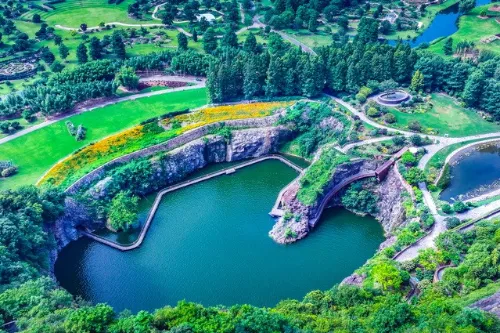
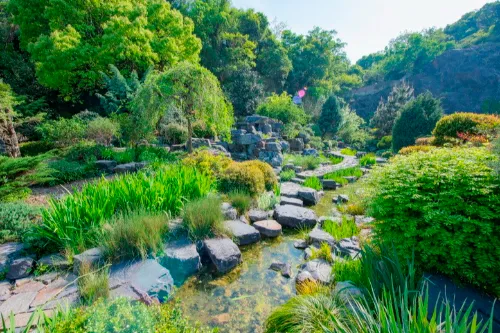
The Mine Pit Garden is located on the south side of Chenshan Hill, renovated from a century-old mining site. It covers an area of about 4.3 hectares. The garden retains industrial relics left by mining, such as deep pools, rock cliffs, and mine tunnels. Through ecological restoration and landscape design, it has become a featured garden integrating ecology, landscape, and popular science. The Mine Pit Garden is divided into four areas: Mirror Lake, Terrace Area, Deep Pool Area, and Waterfall Area. The deep pool is about 50 meters deep, and the highest cliff is about 30 meters high. An artificial waterfall cascades down the cliff into the deep pool, forming a spectacular waterscape. A suspended viewing plank road about 150 meters long runs along the pool, allowing visitors to closely appreciate the geological features and ecological landscape of the mine pit, making it one of the most iconic and distinctive landscapes in Chenshan Botanical Garden.
Chenshan Hill
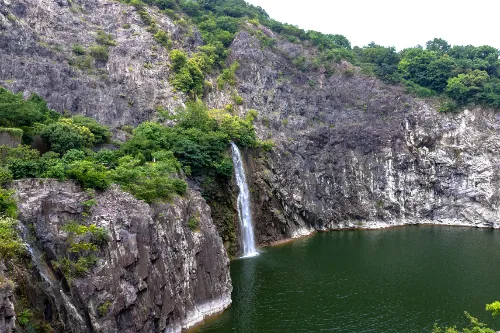
Chenshan Hill is the natural hill within the garden, with an altitude of 71.4 meters and an area of about 17 hectares. It is rich in vegetation, retaining native evergreen and deciduous broad-leaved forests, as well as various native tree species and ornamental plants. There are three hiking trails on the hill, with a total length of about 2,000 meters, leading to the summit from the east, south, and north directions. A viewing platform on the top offers a panoramic view of the entire botanical garden and the surrounding Songjiang New Town. Chenshan Hill is not only a great place for leisure hiking but also retains many historical sites, such as cliff carvings and ancient quarry relics, combining natural and cultural value.
Aquatic Plant Garden
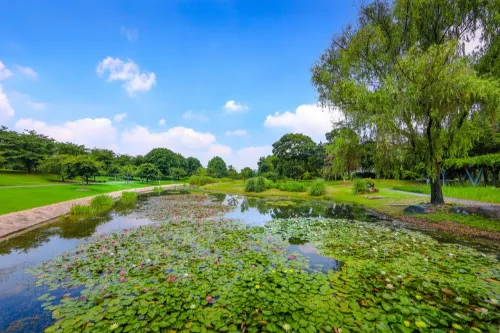
The Aquatic Plant Garden covers about 3.5 hectares, divided into an ornamental aquatic plant area, a purification function display area, and a rare aquatic plant area. It collects and displays more than 200 aquatic plant species, including lotus, water lily, calamus, reed, and lythrum salicaria. Wooden plank roads and viewing platforms are built in the garden, allowing visitors to observe aquatic plants up close. The water lily area collects various varieties of tropical and hardy water lilies. During summer flowering season, it presents a picturesque scene of "endless lotus leaves stretching to the sky", making it the core area for viewing lotus flowers in summer.
Medicinal Plant Garden
The Medicinal Plant Garden covers about 2 hectares, themed on traditional Chinese medicine culture. It is divided into 12 functional zones by medicinal effects, such as diaphoretic herbs, heat-clearing herbs, and tonic herbs. More than 600 medicinal plant species are planted here, including ginseng, angelica, astragalus, wolfberry, and honeysuckle. Science interpretation boards are set up in the garden, detailing the effects and usage of various medicinal plants. It is a featured garden integrating science education and cultural display, as well as an important traditional Chinese medicine popular science base in the Yangtze River Delta region.
Visiting Routes
Recommended classic one-day route: Enter the garden through Gate 1, first visit the Exhibition Greenhouses (suggested stay: 1.5 hours), touring the Tropical Fruit and Flower House, Arid Land Plant House, and Rare and Precious Plant House in order to experience plants from different climate zones. After leaving the greenhouses, walk south along the main road to the Mine Pit Garden (suggested stay: 1 hour), strolling along the viewing plank road to enjoy the mine pit scenery. Then go to the foot of Chenshan Hill and climb via the southern hiking trail (suggested stay: 1.5 hours) to overlook the whole garden from the top. After descending, visit the Aquatic Plant Garden (suggested stay: 0.5 hours) to view aquatic plants, then walk to the Medicinal Plant Garden (suggested stay: 0.5 hours) to learn about medicinal plants. Finally, walk along the garden’s water system to Gate 2 for exit. The whole trip takes about 5–6 hours, and you can adjust the stay time at each attraction according to your own situation.
Family leisure route: Enter through Gate 1 → Children’s Botanical Garden (interactive area) → Exhibition Greenhouses (Rare and Precious Plant House) → Aquatic Plant Garden (fish feeding experience) → Mine Pit Garden (gentle paths) → Science Museum (plant interactive exhibitions). The whole trip focuses on leisure experience with a relaxed pace, suitable for family outings, with a total duration of about 4 hours.
Tips for Visiting
- The best visiting seasons are spring (March–May) and autumn (September–November). In spring, cherry blossoms, tulips, poppies and other flowers bloom; in autumn, osmanthus, chrysanthemums and colorful foliage plants create rich scenery. Lotus and water lilies can be enjoyed in summer, while tropical plants in the greenhouses are available in winter.
- The garden is quite large. It is recommended to wear comfortable sports shoes. Walking the whole way takes about 20,000 steps. You can also rent a sightseeing bus inside the garden.
- It is recommended to enter at 9:00 a.m., when there are fewer visitors. You can visit the Exhibition Greenhouses first to avoid crowds. There are several catering spots in the garden, such as the Greenhouse Restaurant and Chenshan Post House, offering light meals and drinks. You may also bring your own food and water.
- Visitors with children can make reservations for free guided science popularization tours in advance. Guided tours are available at fixed times daily (10:00, 14:00) at the entrance of the Exhibition Greenhouses. Customized tours can be booked via the official WeChat public account 3 days in advance.
- Photography enthusiasts are recommended to bring telephoto lenses for close-up plant shots. The best shooting time for the Mine Pit Garden is before 10:00 a.m. or after 3:00 p.m., when the light is soft and suitable for waterscape and cliff photography.
Notes
- Picking plants, climbing trees, feeding wild animals, swimming and fishing in the water areas are prohibited in the garden. Violators will be dealt with according to garden regulations.
- The temperature inside the Exhibition Greenhouses is relatively high (about 25–30°C) with high humidity. Visitors with heart disease or high blood pressure should take breaks. Smoking and eating are not allowed in the greenhouses.
- Some sections of the Chenshan Hill hiking trails are steep. The elderly and children must climb accompanied by adults. The trails are slippery on rainy days; hiking is not recommended then.
- Most areas of the garden are outdoors. Sun protection is needed in summer, and rain gear is recommended on rainy days. There are many shelters and rest areas in the garden.
- Pets are not allowed in the garden (except guide dogs). A temporary pet storage area is available at the gate, free of charge with valid ID.
- Last admission is at 16:30, and the garden begins to clear at 17:00. Please arrange your visit time to avoid missing the exit.
Transportation
- Public transport: Take Shanghai Metro Line 9 to Dongjing Station, then transfer to Songjiang No.19 Branch Bus directly to Gate 1 of Chenshan Botanical Garden. You can also take Songjiang No.95 or Songjiang No.33 Bus to Chenshan Botanical Garden Station.
- Self-driving: Navigate to the parking lot of Gate 1, Shanghai Chenshan Botanical Garden. There are 3 parking lots with unlimited parking duration.
- Tourist shuttle: On weekends and holidays, the Shanghai Tourist Distribution Center (Xuhui Station) operates a special line to Chenshan Botanical Garden. Departure at 8:30 a.m., return at 3:30 p.m.
- Cycling: Shared bicycle parking areas are available around the garden. It takes about 15 minutes to cycle from Songjiang New Town to Chenshan Botanical Garden. Shared bicycles are not allowed inside the garden.
Opening Hours
Regular opening hours are daily from 8:00 to 17:30 (last admission at 16:30, garden clearing at 17:00). Opening hours remain unchanged on legal holidays. During major holidays such as Spring Festival and National Day, opening time may be adjusted to 7:30 a.m. according to visitor flow. Specific adjustments will be announced in advance via the official WeChat public account. The Exhibition Greenhouses follow the same opening hours as the garden, with last entry at 17:00. Chenshan Hill hiking trails close to entry at 16:00 and fully close at 16:30.
Admission
Ticket price: 60 yuan per person. You can search for the official WeChat public account "上海辰山植物园" to get the latest updates or purchase tickets online.
Online Booking
Click here to jump to the Trip.com ticketing platform for ticket purchase.