
Shawan Ancient Town is situated in Shawan Subdistrict, Panyu District, Guangzhou City, Guangdong Province. It lies in the southern part of Shiqiao River and the northwest of the Shawan Waterway of the Pearl River. It is the only ancient town in Guangzhou honored as a Chinese Historic and Cultural Town, rated as a national 4A-level tourist attraction. It has also obtained numerous provincial and national cultural tourism honors including Guangdong’s first Intangible Cultural Heritage Town, Hometown of Chinese Folk Culture and Art, Hometown of Guangdong Music and Hometown of Chinese Dragon and Lion Dance. The total planned land area of the ancient town is 1,475 mu (equivalent to 98.35 hectares), among which the core tourist development zone covers 265 mu (equivalent to 17.63 hectares), and the overall tourist management area spans more than 2,300 mu. The ancient town preserves around 400 ancient buildings built in the Ming, Qing and the Republic of China periods, with 1 Major Historical and Cultural Site Protected at the National Level and 17 Municipal-level Protected Cultural Relics Sites in Guangzhou. There are 109 officially recorded cultural relic spots and over 70 ancestral halls of various grades. The streets and alleys fully retain the traditional comb-shaped layout and the original texture of ancient villages with stone steps and flagstone lanes. A huge number of Lingnan traditional architectural decorations such as brick carvings, wood carvings, stone carvings and stucco sculptures are preserved here, forming a physical carrier for the concentrated display of tangible and intangible Guangfu culture in the Pearl River Delta. The region has 17 registered intangible cultural heritage items, including 1 national-level item and 5 provincial-level items. Centered on ancient building clusters, folk performances and traditional cuisines, it serves as an integrated Lingnan cultural tourism complex featuring ancient architecture appreciation, intangible cultural heritage experience, food and leisure, as well as research and popular science education.
History and Culture
The administrative construction of Shawan Ancient Town dates back to the Jiading reign of the Southern Song Dynasty. It was originally named Benshan Township. Named Shawan in later generations for its settlement built on the Zhuyaogang plot beside a crescent-shaped beach of an ancient bay, the town boasts a history of more than 800 years. During the Song Dynasty, the northern part of Shawan had turned into land while the southern area remained shallow sea waters. Ancestors of successive dynasties carried out continuous land reclamation projects to expand land areas, gradually forming residential villages relying on the shipping advantages of waterways. The He clan moved into this area during the Yuan Dynasty and thrived for generations through the tradition of farming and studying, growing into the core clan force in Shawan and laying a solid foundation for the cultural inheritance of the ancient town.
The Ming and Qing dynasties marked the golden age of Shawan Ancient Town. Benefiting from maritime trade, local handicrafts, shipping trade and market businesses flourished rapidly, forming a complete market layout known as "Three Streets and Six Markets" with well-matched streets, shops, ancestral halls and temples. Over hundreds of years, the He clan cultivated 8 jinshi (successful candidates in the imperial palace examination) and more than 50 civil and military juren (successful candidates in the provincial imperial examination). The profound imperial examination culture boosted the large-scale construction of academies and ancestral halls, and most existing ancient ancestral halls and residential buildings were erected in this period. Meanwhile, local folk art took initial shape, construction crafts such as brick carving and stucco sculpture became mature, and folk parades, dragon and lion dances as well as local ditties became daily recreational activities for local residents.
In modern times, Shawan became the birthplace of Guangdong Music. He Liutang, He Yunnian and He Shaoxia, collectively known as the Three Masters of the He Family, composed timeless Guangdong Music pieces including Racing for the Dragon Boat Trophy, Plantain Leaves Drenched by Rain and Neighing Horse Shaking Bells at Sanren Hall, making Shawan a core hub for Lingnan folk music. Two folk customs, namely Shawan Floating Color Parade and Shakeng Lion Dance, have been inscribed on the National Intangible Cultural Heritage List successively. The floating color parade held on the Beidi Festival every year has become a landmark regional folk activity. The overall architectural layout of the ancient town survived large-scale damage in modern history, completely preserving the street texture and living style from the late Qing Dynasty to the early Republic of China. In contemporary times, the local government launched systematic renovation and conservation works. Taking the revitalization of intangible cultural heritage as the development guideline, a cultural tourism model integrating heritage display, folk experience and traditional food has been developed. Shawan Ancient Town officially opened to tourists in 2012, completing the transformation from a traditional ancient town to a standardized scenic area.
Main Attractions
Liugeng Hall (Grand Ancestral Hall of the He Clan)
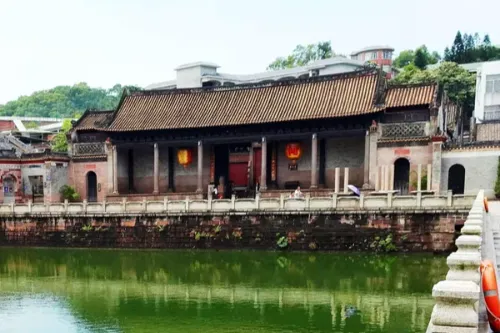
Listed as a Major Historical and Cultural Site Protected at the National Level, Liugeng Hall is the grand ancestral hall of the He clan in Shawan. First built in 1275 during the Southern Song Dynasty, it underwent large-scale expansion and renovation spanning seventeen years in the Qing Dynasty, covering a total area of 3,334 square meters. Constructed in accordance with the ritual standards for fourth-rank official ancestral temples, it adopts a five-bay and five-entry layout typical of large Lingnan ancestral halls, reputed by professionals as the Palace of Comprehensive Art among Lingnan ancient buildings. The hall’s name derives from the family precept "Leave a kind heart for descendants to inherit". The architecture incorporates the essence of four major Lingnan traditional crafts: brick carving, wood carving, stone carving and stucco sculpture. The beam wood carvings are engraved with patterns depicting the full story of Romance of the Three Kingdoms, while the stone carvings on the gate and platform feature exquisite craftsmanship. The painted figures, flowers and birds on the roof ridges remain well-preserved after hundreds of years. A crescent pond sits in front of the hall with ancient imperial examination flag holders on both sides, serving as the most tangible evidence of Shawan’s farming-and-studying culture and the core landmark building of the whole ancient town.
Sanren Hall
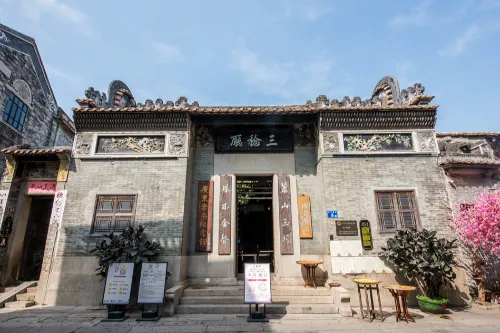
Nestled in the core streets of the ancient town, Sanren Hall gets its name from a century-old Indian jujube tree growing in its courtyard and is widely recognized as the birthplace of Guangdong Music. The building is a brick-and-wood structure in the style of Lingnan ancestral halls from the Qing Dynasty. From the late Qing Dynasty to the Republic of China era, the Three Masters of the He Family created and performed Guangdong Music here for a long time, and numerous Lingnan folk musicians gathered regularly for performances. The folk custom of spontaneous private music clubs has been passed down to this day, with local musicians performing traditional Cantonese music live every day. The hall displays traditional musical instruments used in the old days such as gaohu, yangqin and pipa, together with an exhibition area presenting historical materials of Guangdong Music, fully recording the origin and dissemination of Guangdong Music in Shawan. It is a key venue for visitors to experience Lingnan folk music culture.
Wenfeng Pagoda
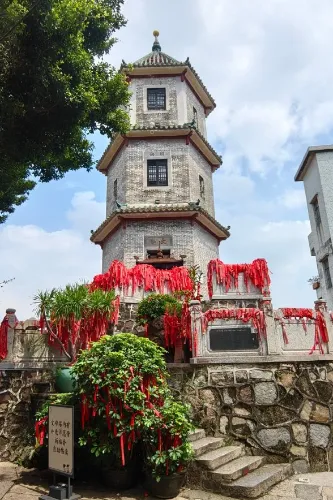
As the landmark structure standing at the highest point of the ancient town, Wenfeng Pagoda is a three-story attic-style Wenchang Pagoda built with blue bricks. The whole pagoda is laid with local ancient blue bricks featuring a stable structure, originally built to pray for prosperous scholarly fortune. Visitors can climb up to the second and third floors to overlook the dense clusters of wok-ear roof houses across the ancient town, making it the optimal spot for shooting panoramic views of the town. Ancient trees and green plants surround the pagoda, and the blue-brick tower forms a highly recognizable ancient town landscape together with surrounding Lingnan dwellings. The pagoda is open to visitors for free all day long.
Oyster Shell Wall Ancient Lane
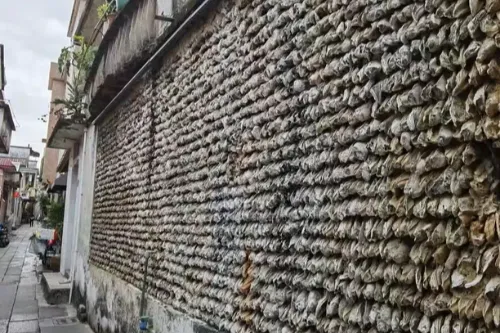
Oyster shell walls are mainly distributed along Chebei Street and Jinwei Lane, representing a special wall construction technique of Lingnan folk houses in the Ming Dynasty. Ancient locals built walls by mixing oyster shells from the sea with glutinous rice mortar, which endows the walls with natural heat insulation and moisture-proof effects, keeping interiors cool in summer and warm in winter. Flagstone paths run through multiple original oyster shell walls across the ancient lane, retaining the natural uneven texture of oyster shells. Paired with old wok-ear houses and vertical-bar doors on both sides, the lane boasts rich light and shadow effects, becoming a popular free spot for Hanfu and neo-Chinese style photography. It fully reflects the architectural wisdom of ordinary residents during the Ming Dynasty.
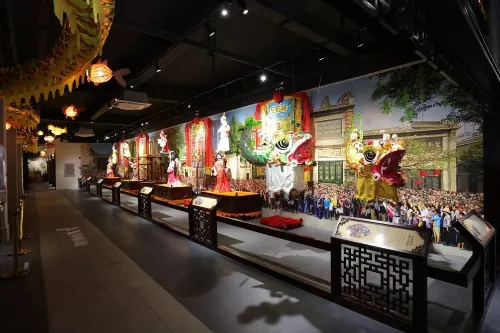
Shawan Folk Culture Exhibition Hall
Located along Anning West Street, Shawan Folk Culture Exhibition Hall is renovated from traditional Lingnan arcade buildings. It displays physical exhibits including full sets of parade props for Shawan Floating Color, finished traditional fish lanterns, ancient farming tools, Guangfu wedding utensils and local folk handicrafts in different zones. Illustrated boards explain the production techniques and festival application scenarios of various intangible cultural heritage folk customs, systematically demonstrating the evolution of residents’ living customs, festival traditions and folk crafts over hundreds of years in Shawan. This exhibition hall is covered by the combined ticket of the scenic area.
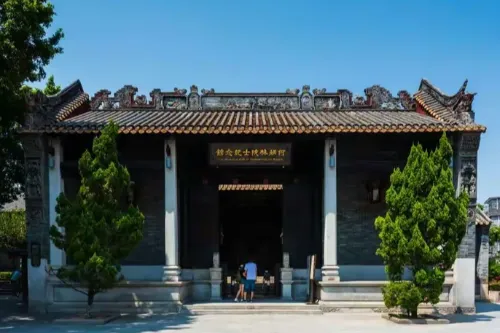
Academician He Binglin Memorial Hall
Academician He Binglin Memorial Hall centers on the life story of He Binglin, a scientist native to Shawan. Known as the Father of China’s Ion Exchange Resin, He Binglin was an important founder of polymer chemistry in China. The memorial hall exhibits his personal belongings used during his lifetime, research manuscripts, certificates of honor and working video materials, divided into exhibition sections covering academic pursuit, scientific research breakthroughs and dedication to the country. It bears both popular science education value and local humanistic memorial value, and access to this venue is included in the paid combined ticket.
Anning West Street Food Lane
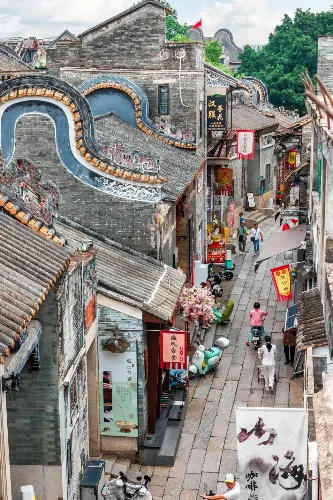
Anning West Street is an original traditional commercial street of the ancient town that completely preserves the commercial layout of the late Qing Dynasty. It is lined with time-honored stores serving local signature snacks with decades of heritage such as Shawan ginger milk custard, fish dumplings, deep-fried milk, dog congee and pancakes, alongside shops selling traditional pastries and souvenirs. Flagstone roads are shaded by old banyan trees and flanked by old arcade shops, filling the area with authentic marketplace charm and classic Lingnan streetscape. The whole block is open for free, serving as the primary area for dining and purchasing souvenirs during the tour.
Tour Routes
One-day classic route (backtrack-free): South Gate Entrance of Shawan Ancient Town → Daxiangyong Road → Liugeng Hall → Sanren Hall → Fish Lantern Lane on Chebei Street → Oyster Shell Wall Ancient Lane → Wenfeng Pagoda → Anning West Street (Dining & Souvenir Shopping) → Academician He Binglin Memorial Hall → Exit via West Gate of Ancient Town
Half-day streamlined route: South Gate of Ancient Town → Liugeng Hall → Wenfeng Pagoda → Oyster Shell Wall → Taste local delicacies on Anning West Street → Return along the original route to leave the scenic area
Travel Tips
- The recommended total visiting duration is 3 to 4 hours; around 5 hours is suggested for in-depth visits including exhibition halls. Soft natural light from 9:00 to 11:00 and 15:00 to 17:00 is ideal for photographing ancient architectures.
- The scenic area lanes are mainly paved with flagstones with partial uneven surfaces. Flat anti-slip shoes are recommended for touring instead of high heels.
- The ancient town boasts extensive free-access street areas. Visitors may purchase the combined ticket for paid exhibition halls according to personal interests. No ticket is required for strolling ancient alleys and tasting local food.
- Dense plants in ancient lanes breed numerous mosquitoes in summer, so mosquito repellent is recommended. Flagstone roads tend to be slippery during humid back-to-sky weather in rainy seasons; bring umbrellas and watch your step.
- Dine at time-honored stores on Anning West Street. Ginger milk custard, fish dumplings and deep-fried milk are representative local snacks. Hand-made egg rolls, milk cakes and chicken cakes are good choices for souvenirs.
- The scenic area sees heavy visitor flows on weekends and statutory holidays. Visit on workdays for a quieter ancient town experience.
- Fish lanterns in Fish Lantern Lane are lit after dusk with enhanced night scene atmosphere; schedule the visit to this lane for the evening hours.
Precautions
- Paid exhibition halls are normally open from 09:00 to 17:00 with ticket checking terminated at 17:00. Some halls close every Monday for maintenance; confirm opening status before your trip.
- It is forbidden to touch carved components, wall paintings and displayed cultural relics inside all ancient buildings and cultural exhibition zones. Graffiti, climbing ancient building walls and the pagoda structure are strictly prohibited.
- Residential areas and tourist zones are interwoven inside the ancient town. Keep quiet during the visit, avoid loud noises, refrain from entering private residential premises arbitrarily and respect local residents’ daily lives.
- Park private vehicles at the official South Gate and West Gate parking lots of the scenic area. Parking spaces are tight during holidays; public transport is preferred.
- Certain intangible cultural heritage and handicraft experience programs charge fees separately. Confirm prices and service contents before participation for rational consumption.
- Elderly visitors and children must be accompanied throughout the tour. Staircases inside Wenfeng Pagoda are narrow and steep; move in order when climbing and avoid crowding or chasing.
- Open flames and flammable, explosive articles are banned across the entire ancient town. Green plants and ancient buildings within the scenic zone are key fire prevention areas; strictly abide by the scenic area’s fire control regulations.
Transportation
- Metro plus bus: Take Guangzhou Metro Line 3 to Shiqiao Station, exit from Exit B and transfer to Bus No. Fan 67 or Fan 12 to the bus stop at Shawan Ancient Town South Gate. A 3-minute walk leads to the scenic entrance with an overall travel time of roughly 40 minutes.
- Metro plus taxi: Take a taxi directly from Shiqiao Metro Station to the South Gate of Shawan Ancient Town for a 15-minute ride, offering higher cost-effectiveness for groups.
- Self-driving: Navigate to the South Gate Parking Lot or West Gate Parking Lot of Shawan Ancient Town. The ancient town is adjacent to Shawan Avenue and Fulong Road with smooth urban driving conditions, and official paid parking lots are available within the scenic area.
- Long-distance passenger transport: Arrive at Panyu Shiqiao Coach Station and transfer to city buses Fan 6 or Fan 68 to reach the entrances of the ancient town directly.
Opening Hours
Outdoor lanes, public passages and open-air scenic spots of Shawan Ancient Town are open 24 hours all year round, allowing tourists to wander freely in the town blocks anytime. Paid cultural and museum exhibition halls follow fixed opening hours: 09:00 to 17:30 daily. Ticket checking stops at 17:00 every day before visitors enter the exhibition areas. The halls close regularly every Monday for rest and equipment maintenance, while they remain open normally on Mondays falling on statutory holidays and operate under regular hours during other holidays. Open-air scenic spots including Wenfeng Pagoda, Oyster Shell Wall, Fish Lantern Lane and Anning West Street have no time restrictions and are accessible for visits all day long.
Ticket Information
Public areas are free of charge. The combined ticket for exhibition halls costs 30 RMB per person, granting access to Liugeng Hall, Academician He Binglin Memorial Hall, Sanren Hall, Shawan Guangdong Music Hall and Cliff Cypress Art Museum. Scan the official WeChat service account "沙湾古镇" to get the latest updates and information.
Online Booking
Click here to jump to the Trip.com ticketing platform for ticket purchase.