
The Bund is located on the bank of the Huangpu River in Huangpu District, Shanghai. As a landmark scenic area of Shanghai and a core cultural and tourism card of the city, its cultural and tourism value and influence rank among the top in China. Stretching 1.5 kilometers in length, the Bund starts from Yan'an East Road in the south and extends to the Waibaidu Bridge over the Suzhou River in the north. To its east is the Huangpu River, and to its west stands the Bund Building Complex, known as the "Gallery of International Architecture". The core area of the scenic spot covers approximately 0.4 square kilometers, distributed in a north-south belt along the Huangpu River. The core feature of the Bund lies in the integration of Shanghai's century-long urban development history and the architectural cultures of the East and West. On one side, there are 52 classical revival buildings of diverse styles that have witnessed Shanghai's modern financial and commercial history, including Gothic, Romanesque, Baroque and Sino-Western fusion styles, with a total construction area of about 240,000 square meters. On the other side is the modern skyscraper complex in Lujiazui, forming a unique urban landscape of "two banks along one river, ancient and modern facing each other", which is a direct embodiment of the integration of Shanghai's modernization and contemporary development.
History and Culture
The development of the Bund began in the mid-19th century. After Shanghai was opened as a trading port in 1843, the Bund area was designated as the British Concession and quickly became a concentration of foreign banks, commercial firms, clubs and newspapers, emerging as the financial center of the Far East. In 1846, the first Western-style building was constructed at the current site of No. 3 Bund. In the following decades, architects from various countries designed and built a large number of Western-style buildings here. By the 1930s, the Bund Building Complex had basically taken shape. At that time, it concentrated more than 90% of the foreign-funded banks in China and was hailed as the "Wall Street of the Far East".
Since the mid-20th century, the function of the Bund has gradually transformed from a foreign-funded financial district to a local financial, office and cultural-tourism integrated area in Shanghai. In 1996, the Bund Building Complex was listed as a Major Historical and Cultural Site Protected at the National Level. During the 2010 Shanghai World Expo, the Bund underwent large-scale comprehensive renovation, optimizing the riverside walkway, transportation system and landscape lighting, further enhancing the cultural and tourism experience. Today, the Bund is not only an architectural cultural heritage, but also a vivid carrier of Shanghai's century-long history of opening up, financial development and urban changes. Behind every building is a connection to important historical events and figures of modern Shanghai. For example, the HSBC Building was once the largest bank building in the Far East, and the clock tower of the Jianghai Customs Building shares the same design origin as Big Ben in the UK, becoming a symbol of Shanghai's modern time order.
Main Attractions
The Bund Gallery of International Architecture
The Bund Gallery of International Architecture is the core landscape of the Bund, covering 52 independent buildings from Waibaidu Bridge in the north to Jinling East Road in the south, with a construction time span from the late 19th century to the 1930s. The representative buildings include: No. 1 Bund Asia Building, completed in 1916, is a Baroque-style structure and the first reinforced concrete building on the Bund; No. 3 Bund Shanghai Club Building, inaugurated in 1910, houses the longest bar counter in the Far East (34 meters); No. 12 Bund HSBC Building, built in 1923, was once hailed as "the most luxurious building from the Suez Canal to the Bering Strait in the Far East"; No. 13 Bund Jianghai Customs Building, completed in 1927, has a clock tower as high as 79 meters with a large bell weighing 4 tons inside, and the tune of "The East is Red" played on the hour has become a city memory of Shanghai; No. 24 Bund Nissin Building, built in 1921, is a model of the combination of modern Western architecture and classical architecture in Japan; No. 27 Bund Jardine Matheson Building, completed in 1922, is of Renaissance style. Although these buildings are of different styles, they form a unified visual rhythm in terms of volume, floor height and facade materials, making them the essence of modern Shanghai architecture.

Waibaidu Bridge
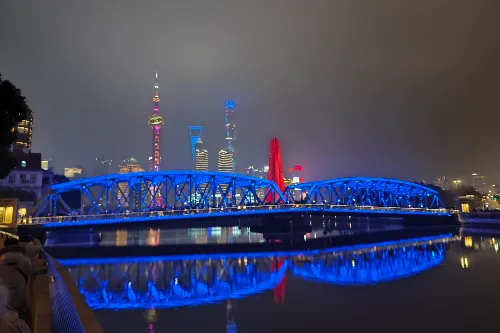
Located at the northern end of the Bund, Waibaidu Bridge connects Huangpu District and Hongkou District. It is China's first all-steel riveted bridge and the oldest existing steel structure bridge in Shanghai. First built as a wooden bridge in 1856, it was reconstructed into a steel truss bridge in 1907, with a total length of 104.2 meters and a width of 18.3 meters. The bridge deck was designed and constructed by a British engineering company. Waibaidu Bridge got its name from the historical fact of "free crossing" (no toll required to cross the bridge). It is not only an important transportation node in Shanghai, but also a filming location for many film and television dramas. Its steel structure outline forms a classic picture with the Huangpu River and the skyline of Lujiazui, and becomes a visual focus in the northern part of the Bund when the lights are turned on at night.
The Bund Riverside Walkway
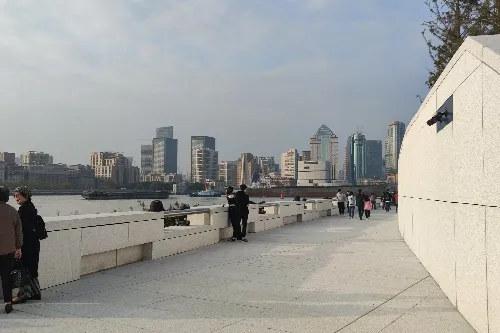
The Bund Riverside Walkway is built along the Huangpu River, with a total length of 1.5 kilometers and a width of about 10-20 meters. It is the core area for tourists to enjoy the scenery of the Huangpu River and the Lujiazui Building Complex. Renovated in 2010, the walkway is divided into three levels: water-friendly platform, viewing platform and leisure green space, with seats, signboards, viewing platforms and other facilities along the way, enabling barrier-free access throughout the whole journey. Starting from Yan'an East Road Ferry Terminal in the south and ending at Waibaidu Bridge in the north, the walkway offers a clear view of super high-rise buildings in Lujiazui such as the Shanghai Tower (632 meters), the Shanghai World Financial Center (492 meters) and the Jinmao Tower (420.5 meters), making it one of the best spots to take photos of Shanghai's urban skyline.
The Bund Origin
The Bund Origin is located at the northern end of the Bund, at the confluence of the Suzhou River and the Huangpu River, covering an area of about 164,000 square meters. It is the birthplace of the Bund's history and culture. There are 14 preserved modern historical buildings here, including the former British Consulate General in Shanghai (built in 1873), the Union Church (built in 1886) and the Broadway Mansions (built in 1928), with architectural styles covering Neoclassicism, Gothic and Art Deco. Through protective development, the Bund Origin area has not only preserved the style and features of historical buildings, but also introduced high-end commerce, cultural exhibitions and other business formats, making it a characteristic section in the Bund area that combines historical heritage with modern leisure functions.
Tour Routes
Classic Full-view Route: Start from the Bund entrance on Yan'an East Road, walk northward along the riverside walkway, and enjoy the buildings from No. 1 to No. 33 Bund one by one, with a focus on stopping at iconic buildings such as the HSBC Building, the Jianghai Customs Building and the Peace Hotel. The whole journey is about 1.2 kilometers, taking about 1 hour. After walking to Waibaidu Bridge, cross the bridge to the North Bund Riverside, look back at the panoramic view of the Bund and Lujiazui, then return to the Bund Origin area to visit the former British Consulate General in Shanghai and the Union Church. The whole journey including stops for sightseeing takes about 2.5 hours.
Night View Essence Route: Start from the east entrance of Nanjing East Road Pedestrian Street at 18:30, walk to Chen Yi Square on the Bund to watch the Bund building light show that starts at 19:00 (the light show lasts until 22:30), then walk northward along the riverside walkway to Waibaidu Bridge to enjoy the combined lighting landscape of the bridge and Lujiazui. The whole journey is about 1 kilometer, taking about 1 hour. If you want to experience the ferry view, you can take the East Jin Line ferry from Jinling East Road Ferry Terminal on the Bund to Dongchang Road Ferry Terminal in Lujiazui (the voyage takes about 15 minutes), and enjoy the night view of the Bund on the ferry during the return trip. The whole journey including the ferry ride takes about 1.5 hours.
In-depth Historical Route: Start from the Bund Origin, first visit the Historical Exhibition Hall of the former British Consulate General in Shanghai to learn about the early history of the Bund after its opening as a trading port, then walk westward along Zhongshan East 1st Road, visit the historical nameplates and characteristic details of the Bund buildings one by one, with a focus on checking in at No. 12 Bund HSBC Building (the hall inside is open to visitors) and No. 20 Bund Peace Hotel, and finally go to the Bund History Museum to systematically understand the century-long changes of the Bund. The whole journey takes about 3 hours.
Travel Tips
- It is recommended to watch the night view of the Bund between 19:00 and 21:00, when the building lights of the Bund and the Lujiazui light show are turned on simultaneously, presenting the best lighting effect. In summer (June-August), it is advisable to go after 19:30 to avoid the high daytime temperature. In winter (December-February), it is recommended to go around 18:00 when it gets dark earlier, making the lighting effect more prominent.
- The best spots to take panoramic photos of the Bund: during the day, you can choose the middle section of the Bund Riverside Walkway (near Chen Yi Square); at night, you can choose the south side of Waibaidu Bridge or the opposite bank of Dongchang Road Ferry Terminal in Lujiazui. It is recommended to carry a wide-angle lens for shooting architectural details, and the morning hours from 7:00 to 8:00 are ideal as there are fewer tourists, facilitating photography.
- If you want to have an in-depth understanding of the architectural history, you can rent the official audio guide of the Bund, which covers detailed explanations of 52 buildings. The audio guide can be rented at the Bund Tourist Service Center (entrance on Yan'an East Road).
- It is recommended to wear comfortable walking shoes during the tour, as the total walking distance is about 1.5-3 kilometers. In summer, you need to carry sun protection products and drinking water. The riverside area has strong winds, so it is advisable to bring a thin coat in spring and autumn.
- For family trips with children, you can combine the tour with an experience of the Bund Sightseeing Tunnel, which connects the Bund and Lujiazui, with a total length of 647 meters and a travel time of about 5 minutes, combining fun and transportation functions.
Notes
- Cycling (shared bikes, electric bikes) is prohibited on the Bund Riverside Walkway, and only walking is allowed. Drone aerial photography is prohibited; if aerial photography is needed, you must report to the Shanghai Civil Aviation Administration in advance.
- The number of tourists on the Bund surges during holidays (such as the Spring Festival, National Day and New Year's Day), and crowd control measures will be implemented in the core area. It is recommended to travel during off-peak hours and avoid the peak periods from 10:00 to 12:00 and from 19:00 to 21:00.
- There is no free luggage storage service in the Bund area. If you need to store luggage, you can go to the luggage storage lockers at Nanjing East Road Metro Station or the storage points in surrounding shopping malls.
- Do not trust unlicensed services on the street such as "low-price cruises" and "guide explanations".
- Pay attention to safety in the unguarded areas on the edge of the water-friendly platform of the riverside walkway, especially when the light is dim at night. Do not climb over the protective facilities; children must be accompanied by adults throughout the whole process.
Transportation
- Metro: Take Metro Line 2 to Nanjing East Road Station (Exit 1 or Exit 7), then walk for about 5 minutes to the northern section of the Bund. Take Metro Line 10 to Yuyuan Garden Station (Exit 1), then walk for about 10 minutes to the southern section of the Bund. Take Metro Line 12 to Tiantong Road Station (Exit 6), then walk for about 8 minutes to the Waibaidu Bridge area.
- Bus: Take Bus No. 20, 37, 42, 55, 65, 123, 135, 145, 576, 929, etc., get off at stops such as Zhongshan East 1st Road Nanjing East Road Station and Zhongshan East 1st Road Yan'an East Road Station, then walk to reach the destination.
- Ferry: Take the East Jin Line (Jinling East Road Ferry Terminal - Dongchang Road Ferry Terminal) or the East Fu Line (Fuxing East Road Ferry Terminal - Dongchang Road Ferry Terminal). The operating hours are from 07:00 to 22:00, and you can enjoy the scenery of the Bund from the water.
- Self-driving: There is no public parking lot in the core area of the Bund. You can park at commercial parking lots around Nanjing East Road and the Bund Origin. Parking spaces are tight during holidays, so it is recommended to give priority to public transportation.
Opening Hours
Open 24 hours a day all year round. The exterior of the Bund Gallery of International Architecture is open for viewing all day long, while the opening hours of the interior of the buildings (such as some banks and hotels) are subject to the regulations of each unit. Among them, the Bund History Museum is open from 09:00 to 17:00 (admission stops at 16:30, closed every Monday). The Bund Origin area is open 24 hours a day, and the opening hours of the internal exhibition halls are mostly from 10:00 to 22:00. The opening hours of the Bund landscape lighting: on weekdays from 19:00 to 22:00; on weekends and legal holidays from 19:00 to 23:00. The Lujiazui light show is staged three times a day at 19:00, 20:00 and 21:00 during major holidays (such as National Day and New Year's Day), with each show lasting 5 minutes.
Tickets
Open to the public free of charge. Separate tickets are required for cruises.
Online Booking
Click here to jump to the Trip.com ticketing platform for ticket purchase.