
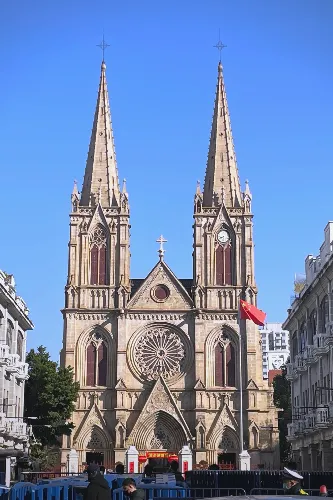
The Sacred Heart Cathedral of Guangzhou, commonly known as the Stone House Cathedral, is located at No. 56 Jiubuqian, Yide Road, Yuexiu District, Guangzhou City, Guangdong Province. It serves as the cathedral of the Catholic Diocese of Guangzhou and was listed as a Major Historical and Cultural Site Protected at the National Level in 1996. It is one of the four fully stone-built Gothic churches worldwide and the largest granite Gothic church in Southeast Asia, reputed as the "Notre-Dame of the Far East". Facing south with its back to the north, the building adopts a Latin cross layout. It covers a total construction area of 2,754 square meters, measuring 78.69 meters from north to south and 35 meters from east to west. The highest point of the twin spires reaches 58.5 meters. All walls and columns of the building are constructed with granite. Designed by French architects and built by Chinese craftsmen, the cathedral was laid in 1863 and completed in 1888 after a 25-year construction period. Blending typical Gothic features with localized Lingnan details, it adopts Chinese-style stone lions for drainage outlets, standing as an important heritage witnessing the integration of Chinese and Western architectural cultures in modern times.
History and Culture
The cathedral was built on the former site of the Viceroy’s Yamen of Liangguang from the Qing Dynasty. After the Second Opium War, French missionaries claimed the land from the Qing government under relevant clauses of unequal treaties to construct a church. The foundation-laying ceremony was held on June 18, 1863, the Feast of the Sacred Heart, hence the cathedral was named the Sacred Heart Cathedral. During the foundation ceremony, builders specially transported soil from Jerusalem and Rome to place under the foundation, carrying relevant religious implications.
The construction project faced enormous difficulties. Stones were mainly quarried from Ngau Tau Kok in Kowloon, Hong Kong, shipped to Guangzhou by waterways, and manually chiseled and laid by hundreds of Chinese craftsmen. Since its completion, the cathedral has suffered multiple damages. Architectural components were destroyed during the War of Resistance against Japanese Aggression, while numerous interior sculptures and stained glass were damaged in the Cultural Revolution. A large-scale restoration project was launched in 2004 and finished two years and four months later, restoring the building to its original appearance to the greatest extent possible.
For over a hundred years, this site has not only functioned as a venue for Catholic religious activities, but also serves as physical evidence of modern foreign exchanges in Guangzhou. It bears witness to the urban transformation of Guangzhou since the late Qing Dynasty and boasts extremely high architectural artistic, cultural relic and historical research values.
Major Attractions
Twin Spired Stone Bell Towers
A pair of octagonal hollow conical stone towers stand prominently on the front facade of the cathedral, rising 58.5 meters, marking the most striking landmark of the entire building. Bell chambers are built inside the towers. Originally fitted with multiple bronze bells imported from France, some bells were destroyed amid historical turmoil. The stone towers are decorated with classic Gothic elements including flying buttresses, pointed arches and pinnacles. The upward tapering lines create a soaring and solemn visual effect. Inscriptions reading "Jerusalem 1863" and "Roma 1863" are carved on the east and west sides of the walls.
Stained Glass Windows
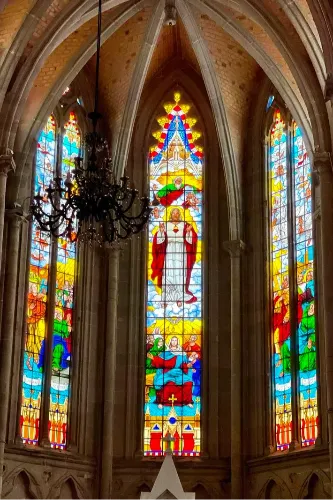
A circular rose window with a diameter of 7 meters is installed respectively on the front, east and west facades. The interior features over 600 square meters of colored glass. The glass panels were shipped from France in early years, painted with biblical stories and images of saints. When sunlight penetrates the glass, colorful shadows are cast on the ground, softening harsh indoor light and building a solemn and tranquil atmosphere, forming an iconic Gothic church landscape. The window tracery adopts a palm-shaped design symbolizing devout prayer.
Main Nave
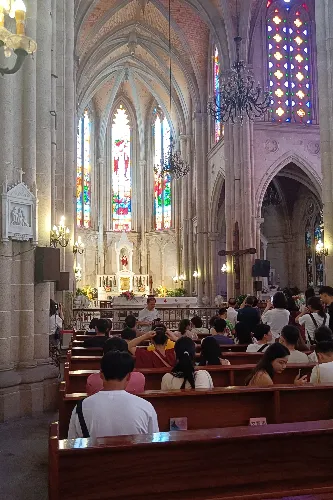
The nave adopts a pointed ribbed vault structure without horizontal beam supports, with the highest vault reaching approximately 28 meters. Ten huge granite clustered columns line both sides of the interior, guiding visitors’ sight toward the high altar. A large portrait of the Sacred Heart of Jesus hangs in the entrance vestibule, and a choir loft is located on the second floor, capable of accommodating over one hundred people for choir activities. Wooden pews are arranged inside, and the high altar at the far end of the nave constitutes the core area for religious ceremonies.
Plaza in Front of the Cathedral
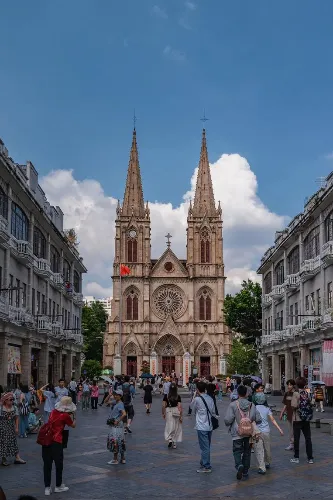
The plaza sits in front of the main entrance of the cathedral with an open view, making it the optimal spot to capture full-view photos of the building. Enclosed by railings and planted with trees, it serves as a short rest area for tourists. A stone stele marking the Major Historical and Cultural Site Protected at the National Level stands on the plaza.
Suggested Tour Route
Scenic Entrance Security Check → Plaza in Front of the Cathedral (Exterior Shooting) → Front Vestibule of Cathedral Main Gate → Visit Main Nave → Appreciate Stained Glass Along Side Aisles → Check Out Rose Windows on Side Facades → Exit after Tour
Tour Tips
- Visit between 15:00 and 16:00 on sunny days for proper sunlight and optimal light effects through stained glass.
- Avoid Mondays and the third Sunday of every month when the cathedral is closed all day to prevent unnecessary trips.
- Weekdays are less crowded than weekends. Tuesday to Friday is recommended for quiet sightseeing and photography.
- Reserve 1 to 1.5 hours for the whole tour to cover exterior photography and interior visiting.
- After visiting, walk to the arcade blocks on Yide Road to experience the local charm of old Guangzhou.
- Learn basic knowledge of Gothic architecture in advance to better appreciate architectural details and carvings.
Notes
- The cathedral is a place of religious worship. Visitors must dress appropriately. Strapless tops, vests, miniskirts, ripped shorts and slippers are prohibited. Shoulders and knees should be covered; improperly dressed visitors will be denied entry.
- Keep quiet indoors and set mobile phones to silent mode. Loud talking and running are forbidden.
- Photography is permitted indoors, but flashlights and tripods are strictly banned. Please refrain from walking around or taking photos during Mass.
- Do not touch or climb architectural pillars, doors, windows, stained glass and other cultural relic components.
- No eating inside; do not litter.
- Respect believers during Mass and do not interrupt religious ceremonies.
- Parking spaces around Yide Road are limited. Self-driving is not recommended.
Transportation
- Metro: Take Line 6 to Yide Road Station Exit B, a 3–5 minute walk; take Line 2 or Line 6 to Haizhu Square Station Exit B2, around a 10-minute walk.
- Bus: Take Bus No. 8, 61, 86, 823 and alight at Yide Middle Road Stop, followed by a 2-minute walk.
- Driving: Most surrounding roads are one-way streets with scarce parking resources. Self-driving is not advised.
Opening Hours
The cathedral is closed all day every Monday and on the third Sunday of each month. Opening hours: Tuesday–Friday 09:00–11:00, 15:00–17:00; Saturday 09:00–14:30; Sunday 13:00–14:30. Hours are subject to temporary adjustment for major religious events. Please follow official announcements before your trip.
Ticket Information
Admission is free. Search the WeChat official account "广州石室耶稣圣心大教堂" to obtain the latest updates.
Online Booking
Click here to jump to the Trip.com ticketing platform for ticket purchase.