
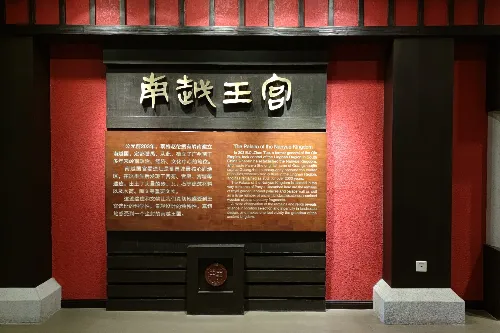
The Nanyue King Museum (Palace Exhibition Area) is located at No. 316 Zhongshan 4th Road, Yuexiu District, Guangzhou City, Guangdong Province, with its west gate connected to No. 374 Beijing Road. Situated in the core commercial zone of Beijing Road, it is an archaeological site museum built on the Site of the Nanyue Kingdom Palace, a Major Historical and Cultural Site Protected at the National Level. Affiliated to the Nanyue King Museum, it is also a First-Class National Museum. Covering a total land area of 3.7 hectares, the supporting buildings have a total construction area of nearly 10,000 square meters. All external walls are clad with hand-chiseled red sandstone panels installed by dry hanging, presenting a solemn and minimalist style that integrates modern exhibition halls with the thousand-year archaeological ruins for integrated protection and display. Its core feature lies in the in-situ presentation of multi-layered superimposed relics of an ancient capital city. The strata preserve relics spanning 12 historical periods from the Qin Dynasty, Nanyue Kingdom, Han Dynasty, Jin Dynasty, Tang Dynasty, Southern Han Dynasty, Song Dynasty, Yuan Dynasty, Ming Dynasty, Qing Dynasty to the Republic of China, making it a rare thousand-year palace ruin in the city center of China. The exhibition area consists of four main buildings: the Nanyue Palace Garden Hall, Southern Han Palace Hall, Exhibition Building and Ancient Well Hall. Centered on the permanent core exhibition "The Heart of Lingnan for Two Thousand Years", it fully demonstrates the development context of Guangzhou as the political center of Lingnan over more than two millennia. Among them, the Ruins of the Winding Stone Canal of the Nanyue Kingdom is the earliest well-preserved stone imperial garden water feature relic of the Qin and Han Dynasties extant in China. The excavation results of 1995 and 1997 were both selected as one of China’s Top Ten Archaeological Discoveries of the year.
History and Culture
In 203 BC, Zhao Tuo founded the Nanyue Kingdom with Panyu as its capital. The current scope of the Palace Exhibition Area was the core zone of the Nanyue King’s palace and imperial garden, which remained in use until the fall of the Nanyue Kingdom in 111 BC. Archaeological excavations confirm that this site housed a complete set of imperial facilities including the No.1 and No.2 palaces of the Nanyue Kingdom, a large stone-structured pool, winding stone canal, palace corridors and royal wells. The platform foundation of No.1 Palace stretches 30.2 meters from east to west and 14.4 meters from north to south, covering an area of 434.88 square meters. The connecting corridor of No.1 Palace is 5.94 meters wide and 44.05 meters long. The large stone pool covers a total area of about 4,000 square meters, and the exposed length of the winding stone canal is approximately 150 meters, completely restoring the imperial garden landscaping techniques of Lingnan two thousand years ago. Fragments of pottery lids inscribed with "Huayin Palace" unearthed from No.2 Palace directly verify the exclusive name of the palace. Stone slabs on the pool walls bear the earliest stone carvings in Lingnan including characters "Fan" and "Zi". A large number of imperial architectural components such as "Long Live" tile ends, large printed floor tiles, stone railings and stone columns were unearthed, witnessing the integrated civilization characteristics of Central Plains rituals and native Lingnan craftsmanship in the Nanyue Kingdom.
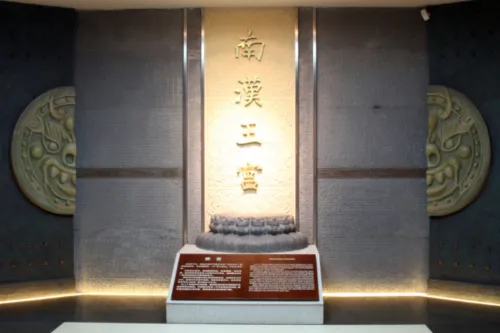
After the collapse of the Nanyue Kingdom, this site served as the administrative office of prefectures, counties and governments of Panyu and Guangzhou through successive dynasties starting from the Han Dynasty, with superimposed layers of buildings, wells and living relics of different eras. During the Five Dynasties and Ten Kingdoms period, the Southern Han regime made Guangzhou its capital and converted this site into the Southern Han Imperial Palace. The complete foundation of Southern Han No.2 Palace was excavated, equipped with courtyards, corridors and water supply and drainage systems. A total of 83 wells dating back to the Southern Han period were unearthed from the corresponding strata, proving that this place remained the supreme political center of Lingnan. Up to now, archaeologists have excavated and cleaned 113 ancient wells of successive dynasties, ranging from the Nanyue Kingdom to the Republic of China, completely recording the urban water supply history of Guangzhou over more than two thousand years. The superimposed cultural strata resemble a three-dimensional chronological history book, intuitively showing the uninterrupted urban development of Guangzhou. In September 2021, the former Nanyue Palace Museum and the Western Han Nanyue King Museum were integrated to establish the Nanyue King Museum, and the former Nanyue Palace Museum was officially renamed the Palace Exhibition Area of the Nanyue King Museum and opened to the public.
In 1995, the stone-structured pool relics of the Nanyue Kingdom were discovered during urban infrastructure construction, which was named one of China’s Top Ten Archaeological Discoveries that year. In 1997, the complete winding stone canal garden ruins were uncovered and again listed among China’s Top Ten Archaeological Discoveries. In 1996, the Site of the Nanyue Kingdom Palace was designated a Major Historical and Cultural Site Protected at the National Level by the State Council. Systematic archaeological excavations were carried out after 2000, fully revealing core relics including the Nanyue Kingdom palaces and Southern Han palaces. Partial opening of the Nanyue Palace Museum started in 2010. It was incorporated into the Nanyue King Museum in 2021 with comprehensive venue upgrades, forming a three-in-one display system featuring in-situ protection, original site exhibition and cultural relic display. In the same year, the Site of the Nanyue Kingdom Palace was selected into the List of Top 100 Archaeological Discoveries of the Past Century.
Main Attractions
Nanyue Palace Garden Hall
The Nanyue Palace Garden Hall is the core venue of the exhibition area, covering the complete relics of the Nanyue imperial garden on its original site. The first floor fully displays the 4,000-square-meter stone pool and the 150-meter-long winding stone canal. The stone pool is paved with sloped sandstone slabs with tight crack joints in ice crack patterns. The stone canal retains garden landscape components including stacked stones, stepping stones, flat bridges and wooden concealed water conduits. Stone colonnettes, stone lintels, wooden oars and other artifacts unearthed from the pool reconstruct the scene of royal boating and sightseeing in the Nanyue Kingdom. The second floor features supplementary thematic displays exhibiting tile ends, stone inscriptions and architectural components excavated from the garden, supported by multimedia projections recreating the full view of the thousand-year-old imperial water garden. It is the only venue in China where visitors can closely view the original site of a Qin and Han imperial stone garden.
Southern Han Palace Hall
The Southern Han Palace Hall fully protects and displays the foundation of Southern Han No.2 Palace of the Five Dynasties. Inside the venue, the rammed earth platforms of the first hall, central courtyard and bilateral corridors are completely preserved, alongside visible architectural structures of the Southern Han period including brick drainage aprons, drainage ditches and column base pits. Eighty-three ancient Southern Han wells are displayed in situ with intact brick and stone well rings and walls, intuitively presenting the water supply system of the Southern Han Imperial Palace. A layered archaeological profile display wall is set up inside the hall to clearly distinguish multi-layer cultural accumulations of the Nanyue Kingdom, Tang Dynasty, Southern Han Dynasty and Song Dynasty, demonstrating the characteristics of thousand-year superimposed strata.
Exhibition Building
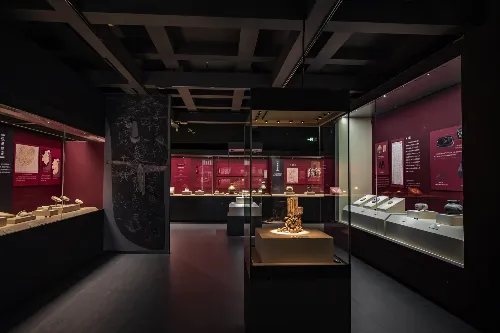
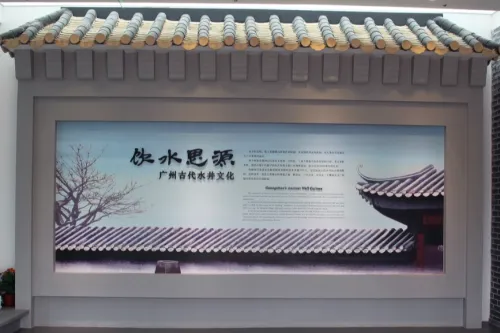
The three-story Exhibition Building hosts four permanent thematic exhibitions. The south area of the first floor houses the "Nanyue Imperial Palace" gallery, displaying architectural components, pottery, stone inscriptions and daily utensils unearthed from the Nanyue palaces. The south area of the third floor holds the "Southern Han Imperial Palace" gallery exhibiting imperial artifacts, bricks, tiles and relics from palace wells of the Southern Han Dynasty. The north zones of the second and third floors feature the "Two Thousand Years of Guangzhou, a Famous City" gallery sorting out the urban evolution of Guangzhou from the Qin and Han Dynasties to modern times. Attached to the north side is the special exhibition area "Drinking from the Source — Ancient Well Culture in Guangzhou", collecting cultural relics excavated from wells of all dynasties. Digital interactive devices are installed on the third floor for online simulation reconstruction of the Nanyue imperial palace layout, alongside cultural and creative retail zones selling replicas of Nanyue and Southern Han cultural relics.
Ancient Well Hall
The Ancient Well Hall is an open semi-outdoor venue showcasing well relics of various shapes from the Nanyue Kingdom to the Republic of China, with dozens of ancient wells on display. Among them stands a giant brick-stone well of the Tang Dynasty with a diameter of 1.2 meters, its walls bearing clear water level traces accumulated over a thousand years. Multiple well types including earthen wells, brick wells, tile wells and stone wells are categorized, supported by graphic panels illustrating the evolution of water fetching, purification and storage technologies in ancient Guangzhou. It only opens to visitors on Saturdays and Sundays and remains closed on workdays.
Tour Route
East Gate (No.316 Zhongshan 4th Road) → Ruins of Winding Stone Canal on the 1st Floor of Nanyue Palace Garden Hall → Auxiliary Exhibition Hall on the 2nd Floor of Nanyue Palace Garden Hall → Outdoor Garden Trail → Southern Han Palace Hall → Nanyue Imperial Palace Gallery on the 1st Floor of Exhibition Building → Comprehensive Galleries on the 2nd and 3rd Floors of Exhibition Building → Ancient Well Hall (Open on Weekends Only) → West Gate (No.374 Beijing Road)
Travel Suggestions
- Allocate 2 to 3 hours for a full tour; visiting only core venues can be shortened to 1.5 hours. If combining with the King’s Tomb Exhibition Area, reserve 4 to 5 hours in total, with the two venues about 2 kilometers apart.
- Free fixed-point guided tours start at 9:30 every day, limited to 20 visitors per session with no advance reservation required. Visitors may arrive at the service desk of the Nanyue Palace Garden Hall 10 minutes early. Free audio guides are also available via the official WeChat Official Account of the museum.
- Weekends and statutory holidays see heavy visitor flow. It is recommended to enter right after opening at 9 a.m. to avoid the peak hours from 2 p.m. to 4 p.m.
- The exhibition area features numerous stone slabs and rammed earth ruin paths with long walking distances. Flat anti-slip sports shoes are advised. Wheelchairs are provided free of charge for elderly and mobility-impaired visitors.
- After visiting, walk 3 minutes from the West Gate to Beijing Road Pedestrian Street for a combined tour of the old downtown commercial block.
- Visitors with minors may head to the digital interactive zone on the third floor of the Exhibition Building to learn about the layout of the Nanyue imperial palace via interactive installations.
Notes
- Admission is free with real-name reservation. Visitors need to book tickets 1 to 3 days in advance through the official WeChat Official Account "Nanyue King Museum". Daily visitor limits are set by time slots; ticket checking stops at 17:00 and entry is denied without a reservation.
- Flash photography and video recording are prohibited inside exhibition halls and ruin zones. Do not step on rammed earth ruins or touch unearthed cultural relics and original architectural components.
- Eating and drinking are forbidden inside exhibition buildings and ruin display zones; brief drinking breaks are only allowed on outdoor public lawns.
- The exhibition area closes regularly every Monday, but opens normally on national statutory holidays. During summer and winter vacations as well as statutory holidays, closing time is extended to 18:00 with ticket checking ending at 17:30. Temporary schedule adjustments will be announced in advance via the official WeChat Official Account.
- Large luggage and backpacks can be stored free of charge at the service desk by the East Gate. Strollers, reading glasses and walking sticks are available for free loan. Sign language guided tours require a phone reservation 7 days ahead.
- Flammable, explosive and sharp objects, skateboards and balance scooters are banned from entering the exhibition area; pets are not permitted.
- Commercial photography and live streaming are prohibited inside the museum. Organized study tours and group activities are not allowed without official permission.
Transportation
- Metro: Take Guangzhou Metro Line 1 or Line 2 to Gongyuanqian Station Exit F, then walk 3 minutes to the East Gate; take Line 1 to Nongjiangsuo Station Exit D, then walk 5 minutes to the East Gate.
- Bus: Alight at Cai Ting Station or Zhongshan Wulu Station, then walk 2 to 4 minutes to the East Gate.
- Self-driving: No dedicated parking lot on site. Visitors may park at Sun Yat-sen Memorial Hall Public Parking Lot and walk 10 minutes to the exhibition area.
Opening Hours
The regular opening hours of the Palace Exhibition Area of the Nanyue King Museum are Tuesday to Sunday from 9:00 to 17:30, with ticket checking ending at 17:00 daily. The venue closes every Monday for maintenance. It opens normally on national statutory holidays such as Spring Festival and National Day with no Monday closure. During summer and winter vacations and statutory holidays, opening hours are extended to 18:00, with ticket checking stopping at 17:30. Any temporary schedule changes will be posted in advance via the museum’s official WeChat Official Account. The Ancient Well Hall only opens on Saturdays and Sundays and remains closed on workdays.
Ticket Information
Admission is free of charge; paid guided tours are available. Search the WeChat Official Account "南越王博物院" to get the latest updates and make online reservations for visits.
Online Booking
Click here to jump to the Trip.com ticketing platform for ticket purchase.