
Jing'an Temple is located at No. 1686 West Nanjing Road, Jing'an District, Shanghai. It is one of the oldest Buddhist temples in Shanghai. Founded in 247 AD during the Chiwu period of the Eastern Wu Kingdom of the Three Kingdoms, it was originally named Hudu Chongxuan Temple. In 1008 AD, during the Dazhong Xiangfu period of Emperor Zhenzong of the Song Dynasty, it was renamed Jing'an Temple, with a history of nearly 1,800 years. The architectural style combines features of the Tang and Song dynasties, integrating the delicacy of Jiangnan temples and the grandeur of imperial temples. It serves as an important Chan Buddhist center in Shanghai. The temple covers a total area of about 22,000 square meters, with major buildings including the Mahavira Hall, Heavenly Kings Hall, Three Saints Hall, and Jing'an Pagoda. The Mahavira Hall has a construction area of about 1,870 square meters and houses a 6.2-meter-tall statue of Sakyamuni Buddha carved from a single piece of Burmese white jade, a rare large-scale jade Buddha statue in China. As a sacred religious site and an important urban cultural landmark in central Shanghai, Jing'an Temple is a scenic spot of great religious, cultural and tourist value.
History and Culture
The history of Jing'an Temple dates back to the Three Kingdoms period. It was first built as Hudu Chongxuan Temple by order of Sun Quan of Eastern Wu on the north bank of the Wusong River (now Suzhou Creek), making it one of the earliest Buddhist temples in the Jiangnan region. During the Eastern Jin Dynasty, the temple was renovated repeatedly and gradually became an important center for Buddhist activities. It was destroyed during the anti-Buddhist movement in the Huichang period of the Tang Dynasty and was rebuilt during the Wuyue Kingdom period, renamed Yongtai Chan Temple.
In the Northern Song Dynasty, the temple was moved to its present location and bestowed the name "Jing'an Temple" by Emperor Zhenzong, which has been used ever since. In the Southern Song Dynasty, the temple expanded further with the construction of the Gate, Mahavira Hall and Dharma Hall, and its incense flourished. It was restored many times during the Yuan and Ming dynasties, with its main structures preserved through wars. In the Qing Dynasty, Jing'an Temple entered its prime, with large-scale expansions during the reigns of Emperors Kangxi and Qianlong. The famous "Eight Scenes of Jing'an" were formed, making it the Buddhist center of Shanghai.
In modern times, Jing'an Temple underwent many changes. Part of it was demolished for urban construction in the Republican period and later restored through donations from Buddhists. After the founding of the People's Republic of China, it was designated a Shanghai Protected Cultural Site. In 1983, it was approved by the State Council as a key national Han Chinese Buddhist temple. Since the 1990s, large-scale restoration and expansion have restored its traditional layout, and the landmark Jing'an Pagoda was added, reviving the millennium-old temple.
As an important temple of the Linji Sect of Chan Buddhism in Shanghai, Jing'an Temple inherits profound Chan culture. Annual Buddhist ceremonies such as the Bathing Buddha Festival and Laba Festival are not only religious rituals but also important parts of Shanghai's folk culture, carrying the historical memory and cultural heritage of the region.
Main Attractions
Mahavira Hall
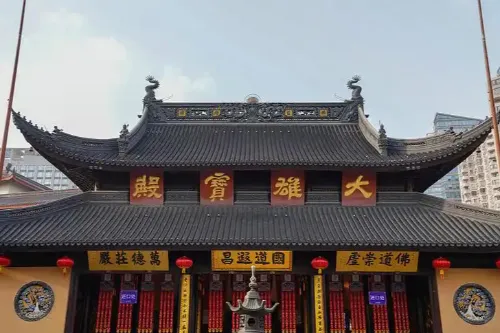
The Mahavira Hall is the core building of Jing'an Temple, a Tang-style double-eave hip-and-gable structure about 26 meters high with an area of 1,870 square meters. In the center sits a 6.2-meter-tall, 15-ton statue of Sakyamuni Buddha carved from a single piece of natural Burmese white jade, solemn and exquisite, the treasure of the temple. On both sides stand 18 Arhat statues carved of nanmu with vivid expressions. The beams and columns are made of precious nanmu and camphor wood; the roof is covered with golden glazed tiles, and the ridge is decorated with traditional mythical animals, showing magnificent traditional Chinese Buddhist architecture.
Heavenly Kings Hall
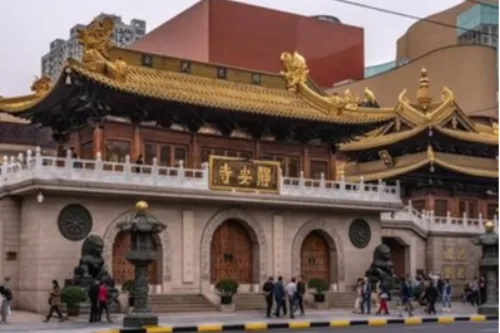
The Heavenly Kings Hall is the first main hall inside the temple gate, covering about 800 square meters. Inside are four 4.5-meter-tall Heavenly Kings statues made of cast bronze with gold finish, representing favorable wind, mild rain, good harvest and peace. In the center sits the Maitreya Buddha, with the Skanda Bodhisattva behind, both fine wood carvings from the Qing Dynasty. The hall features a Song-style hip-and-gable roof with upturned eaves and delicate wooden carved doors and windows, reflecting the architectural characteristics of Jiangnan temples.
Jing'an Pagoda
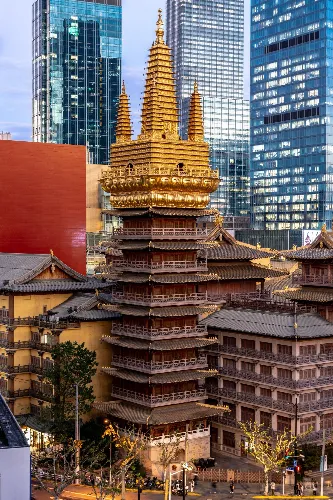
Built in 2000, Jing'an Pagoda is a seven-story octagonal Tang-style pagoda 53.6 meters tall, with a base area of about 600 square meters. Inside are numerous Buddhist scriptures and statues, and each floor has an observation deck overlooking the temple and the surrounding city. The pagoda has a reinforced concrete structure with granite exterior and copper bells hanging from the eaves, which ring gently in the wind. It is not only the landmark of Jing'an Temple but also a rare high Buddhist pagoda in downtown Shanghai.
Three Saints Hall
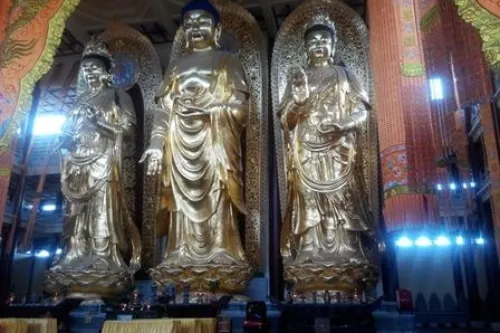
Located to the west of the Mahavira Hall, the Three Saints Hall covers about 600 square meters. It houses 5-meter-tall gilded bronze statues of Amitabha Buddha, Guanyin Bodhisattva and Mahasthamaprapta Bodhisattva. The hall also displays many ancient stone tablets, including the Song Dynasty "Record of Jing'an Temple", an important cultural relic for studying the temple's history. The hall has a symmetrical layout with painted beams and carved pillars, showing the features of Jiangnan Buddhist architecture in the Ming and Qing dynasties.
Guanyin Hall
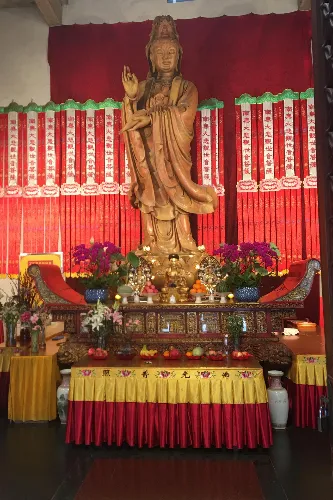
Located on the east side of the temple, the Guanyin Hall enshrines an 8-meter-tall Guanyin Bodhisattva statue carved of camphor wood, inlaid with agate, jadeite and other gems with exquisite craftsmanship. The hall also has a Guanyin culture exhibition area displaying statues and cultural relics from different dynasties, making it an important place to understand Guanyin culture.
Visiting Route
A recommended clockwise visiting route takes about 1.5 to 2 hours: Enter through the South Gate, first visit the Heavenly Kings Hall to appreciate the statues and architectural features. Pass through to the Mahavira Hall to view the precious jade Buddha. Walk west to the Three Saints Hall to see the ancient tablets and statues. Then go east to the Guanyin Hall. Finally, visit Jing'an Pagoda and climb up for a panoramic view. If time permits, you may taste vegetarian food at the temple's restaurant or visit the cultural relics exhibition room to learn more about the temple's history.
Visiting Tips
- Best time to visit: spring and autumn (March–May, September–November) with pleasant weather. 9:00–10:00 AM on weekdays is quieter with fewer Buddhist ceremonies.
- Recommended duration: 1.5–2 hours; 2.5–3 hours if including the exhibition and vegetarian meal.
- Buddhist events: Grand ceremonies are held on the 8th day of the 4th lunar month (Bathing Buddha Festival) and the 8th day of the 12th lunar month (Laba Festival).
- Guided service: Guided tours are available and recommended for a deeper understanding of history and culture.
- Photography: Non-commercial photography is allowed. Flash is forbidden inside the Mahavira Hall. The best spot to photograph Jing'an Pagoda is the square on the east side.
Notes
- Dress modestly: no vests, shorts or slippers. Keep quiet and avoid loud talking.
- No smoking, drinking or pets. Do not touch Buddha statues, stone tablets or cultural relics.
- Incense is only offered in designated areas. Free incense is provided (3 sticks per person); outside incense is not allowed.
- Follow staff instructions during Buddhist ceremonies and do not disturb rituals.
- The temple is in a busy downtown area; take care of personal belongings.
- Vegetarian restaurant reservations are recommended during holidays; please respect dining etiquette and avoid waste.
Transportation
- Metro: Take Metro Lines 2 or 7 to Jing'an Temple Station. Exit from Gate 1 or 7; walk about 50 meters to the South Gate.
- Bus: Take buses 20, 37, 45, 57, 76, 921, 113 to Jing'an Temple Stop; walk within 100 meters.
- Self-driving: Limited parking is available at the lot north of West Nanjing Road. Public transport is highly recommended.
- Taxi: Direct to "Jing'an Temple (South Gate)" at No. 1686 West Nanjing Road.
Opening Hours
Daily 7:30–17:00 (last entry 16:30). On legal holidays: 7:30–17:30 (last entry 17:00). Extended hours apply from Chinese New Year’s Eve to the first day of the Lunar New Year: 22:00 on New Year’s Eve to 01:00 the next morning for the first incense ritual, then regular hours resume. The temple is open all year; some areas may be temporarily adjusted during major ceremonies, subject to on-site notices.
Admission
Ticket: 50 yuan per person. For the latest updates, you may search the official service account "上海静安寺" on WeChat.
Online Booking
Click here to jump to the Trip.com ticketing platform for ticket purchase.