
Shanghai Natural History Museum is located at No. 510 West Beijing Road, Jing'an District, Shanghai, and situated in Jing'an Sculpture Park. It is one of the natural history museums in China with a large scale, rich collection resources and a high level of exhibition. With the core exhibition theme of "Nature · Human · Harmony", the museum integrates multiple functions such as specimen collection, scientific research, science popularization and cultural communication. Different from the static displays of traditional museums, it focuses more on interactive experience and immersive exhibition, allowing visitors to understand the evolution of nature and the mysteries of life in an all-round and multi-angle way. The core building of the museum is jointly designed by HPP International Architects from Germany and Tongji University Architectural Design and Research Institute. Shaped like a "green snail", the building has a highly recognizable and modern appearance, with a total construction area of about 45,257 square meters, including an above-ground construction area of about 12,857 square meters and an underground construction area of about 32,400 square meters. The entire museum is built on a part of Jing'an Sculpture Park, with a total area of about 15,000 square meters for the venue itself and the surrounding supporting exhibition areas, and a permanent exhibition area of about 9,800 square meters inside the museum, providing a broad and comfortable space for visitors to visit and study. The museum houses nearly 370,000 specimens, covering paleontology, animals, plants, minerals, humans and other fields, including a large number of rare and endangered species specimens and precious paleontological fossils, which have extremely high scientific research and exhibition value.
History and Culture
The history of Shanghai Natural History Museum can be traced back to 1868, whose predecessor was the "Xujiahui Museum" founded by French missionary Pierre Heude. It was one of the earliest natural history museums in modern Chinese history. The initial collection was mainly animal and plant specimens, especially rare species in the middle and lower reaches of the Yangtze River, laying a solid foundation for the development of the subsequent museum. At that time, the Xujiahui Museum was mainly open to church personnel and a small number of scholars, not popularized to the general public, but its work in specimen collection and classification research promoted the development of modern natural science in China.
In 1930, Xujiahui Museum merged with Aurora University Museum and was renamed "Aurora Museum". The scale of the collection was further expanded with the addition of paleontological fossils, mineral specimens and other categories, and it began to be gradually open to the public, becoming an important platform for disseminating natural science knowledge in Shanghai at that time. During the War of Resistance against Japanese Aggression, the collection of Aurora Museum suffered a certain degree of damage and loss, and some precious specimens were transferred for protection and thus preserved.
After the founding of the People's Republic of China, in 1956, on the basis of Aurora Museum, Shanghai Natural History Museum was officially established by integrating the natural specimen resources of many institutions in Shanghai at that time, with its location at No. 260 East Yan'an Road. It became a public welfare cultural venue affiliated to the Shanghai Science and Technology Commission. At this time, the museum was fully open to the public, and increased investment in specimen collection, scientific research and science popularization, gradually forming a complete collection, research and exhibition system.
With the development of the times, the space and facilities of the original site could no longer meet the needs of exhibition and research. In 2012, the new building of Shanghai Natural History Museum officially started construction, and on April 19, 2015, the new building was officially opened to the public, which is the current venue located on West Beijing Road, Jing'an District. On the basis of retaining the essence of the original collection and historical heritage, the new building integrates modern scientific and technological means and exhibition concepts, becoming a natural science popularization landmark with both a strong historical sense and a modern fashion sense. It undertakes the important mission of inheriting natural science culture, popularizing natural knowledge and advocating the harmonious coexistence of humans and nature.
Main Attractions
Mysteries of Origin
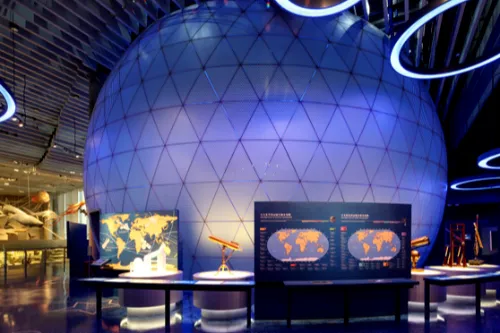
Located on the underground first floor of Shanghai Natural History Museum, Mysteries of Origin is the opening exhibition area of the entire venue, with an area of about 1,000 square meters, focusing on the two core themes of "the origin of the universe" and "the formation of the Earth". Through large-scale immersive projections, precious celestial specimens, simulated geological evolution models and other means, the exhibition area vividly reproduces the whole process from the Big Bang 13.8 billion years ago, the birth of the Earth 4.6 billion years ago, to the evolution of the early Earth's geological structure and the germination of life. The most eye-catching part is the "Big Bang" immersive theater in the exhibition area, which makes visitors feel as if they are in the moment of the birth of the universe through 360-degree circular screen images and shocking sound effects, intuitively experiencing the vastness and magic of the universe. In addition, the exhibition area displays precious collections such as meteorites and lunar rock specimens, some of which come from Mars and the asteroid belt with extremely high scientific value. Visitors can observe the shape and texture of celestial materials at close range and understand the connection between the Earth and other celestial bodies in the universe.
River of Life
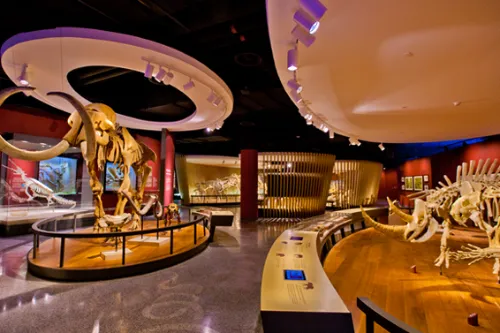
Connected to Mysteries of Origin, River of Life is located on the underground first floor, with an area of about 1,500 square meters, and is one of the core exhibition areas in the museum. Taking time as the axis, the exhibition area fully shows the long course of life evolution from the germination of the earliest life on Earth 3.8 billion years ago to the colorful biological world today. The exhibition area adopts various forms such as large-scale ecological scene restoration, rare fossil displays and dynamic model exhibitions. The most representative one is the 50-meter-long "Life Evolution Wall", on which various fossils and specimens from single-celled organisms to higher vertebrates are displayed, clearly presenting the evolutionary context of life from simple to complex, from aquatic to terrestrial, and from low to high. In addition, the exhibition area restores the Cretaceous scene where dinosaurs lived and the Ice Age scene where mammoths survived, and displays large paleontological fossils and skeleton models such as Mamenchisaurus, Tyrannosaurus rex and mammoth. Among them, the Mamenchisaurus skeleton model is 22 meters long and about 7 meters high, one of the largest paleontological skeleton models in the museum, allowing visitors to intuitively experience the hugeness and magic of prehistoric creatures.
Way of Evolution
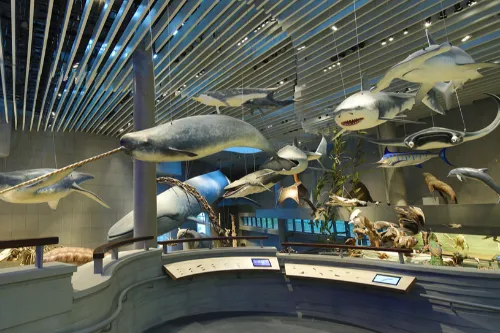
Located on the underground first floor, Way of Evolution covers an area of about 1,200 square meters, focusing on the core scientific issue of "the driving forces and mechanisms of biological evolution", revealing the core laws of biological evolution driven by natural selection, genetic variation and other factors. Through a large number of biological specimens, experimental simulation devices and interactive experience projects, the exhibition area enables visitors to deeply understand how organisms adapt to environmental changes and realize survival and reproduction through evolution. The highlight exhibits include the "Darwin's Theory of Evolution" exhibition area, which displays early editions of Darwin's work On the Origin of Species and related biological specimens, telling the birth and development process of the theory of evolution; there is also the "Animal Behavior and Adaptation" interactive area, where visitors can understand the evolutionary logic behind animal behaviors such as mimicry, protective coloration and migration by operating simulation devices. In addition, the exhibition area displays a large number of specimens of rare and endangered species, reminding visitors to pay attention to the protection of biodiversity and understand the close relationship between evolution and survival.
Treasures of the Earth
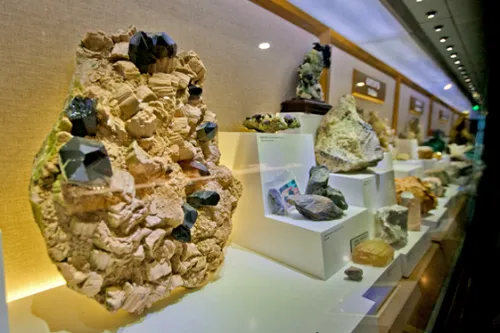
Covering an area of about 800 square meters on the underground first floor, Treasures of the Earth mainly displays the Earth's geological resources, mineral rocks and the evolution process of geological landforms. The exhibition area displays more than 2,000 various mineral, rock and gemstone specimens from all over the world, including precious gemstone specimens such as diamonds, rubies, sapphires and jadeite, as well as rare collections such as natural gold nuggets, crystal clusters and meteorites. Through model restoration and multimedia displays, the exhibition area also introduces the Earth's internal structure, plate movement, volcanic eruptions, earthquakes and other geological phenomena, as well as the formation, mining and utilization of mineral resources. The "Aesthetics of Mineral Crystals" exhibition area is a major highlight here, where various mineral crystals with beautiful shapes and bright colors are displayed, showing the extraordinary craftsmanship of nature. While understanding geological science knowledge, visitors can also appreciate the unique beauty of natural minerals. In addition, the exhibition area has a "Geological Disaster Prevention" science popularization area, which popularizes geological disaster prevention knowledge to visitors through interactive experience and improves the public's awareness of disaster prevention and mitigation.
Colorful Life
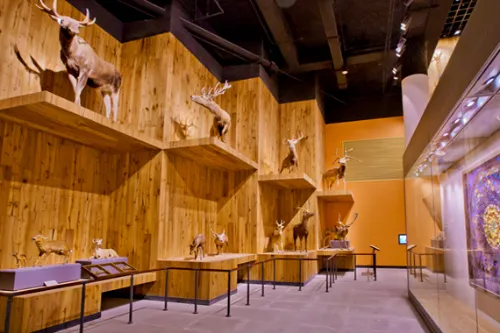
Located on the ground first floor, Colorful Life covers an area of about 2,000 square meters, and is one of the exhibition areas with the largest number of exhibits and the richest exhibition content in the museum, focusing on the rich and colorful biodiversity on the Earth today. According to the ecological environment and classification system of organisms, the exhibition area is divided into multiple ecological scenes such as forests, grasslands, deserts, wetlands and oceans, restoring biological communities in different ecological environments, and displaying more than 10,000 animal and plant specimens from all over the world. Among them, the "tropical rainforest" scene restoration is the most realistic. Through artificial landscaping, constant temperature and humidity control, sound effect simulation and other means, it reproduces the dense vegetation and diverse animals of the tropical rainforest. Visitors can see animal specimens such as macaws, sloths and pythons here and feel the vitality of the tropical rainforest. In addition, the exhibition area has a "Rare and Endangered Species" display area, which displays specimens of rare and endangered species unique to China such as giant pandas, golden snub-nosed monkeys, crested ibises and Chinese alligators, introduces the living status and protection measures of these species, and calls on visitors to pay attention to biodiversity protection and practice the concept of harmonious coexistence of humans and nature.
Human and the Earth
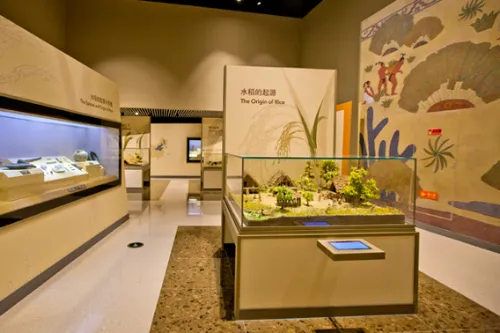
Covers an area of about 1,000 square meters on the ground first floor, Human and the Earth focuses on the theme of "the mutual relationship between humans and the natural environment", showing the whole process of humans from birth and development to gradually understanding, utilizing and transforming nature, and now advocating protecting nature and living in harmony with it. Through a large number of cultural relics, specimens, models and multimedia displays, the exhibition area introduces the origin and evolution of humans, the production and living methods of ancient humans, the development and utilization of natural resources by humans, the relationship between population growth and environmental changes and other contents. The highlight exhibits include the Peking Man skull fossil model, ancient agricultural production tools, traditional handicrafts and so on, showing the close connection between the development of human civilization and the natural environment. In addition, the exhibition area has a "Sustainable Development" display area, which introduces the environmental problems facing the world today and the measures taken by humans to achieve sustainable development through interactive experience and case displays, guiding visitors to establish the concept of green and environmental protection and contribute their own strength to protecting the global home.
Discovery Center
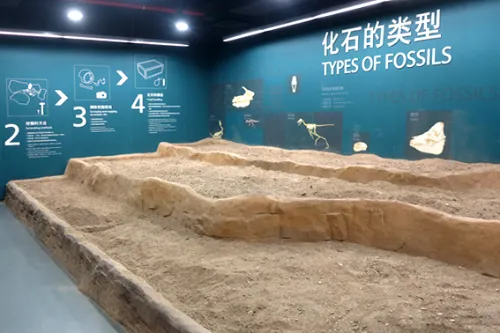
Located on the ground second floor, Discovery Center covers an area of about 600 square meters. It is an exhibition area focusing on interactive experience and hands-on practice, mainly for teenagers, providing visitors with a platform for independent exploration, hands-on experiments and learning natural science knowledge. The Discovery Center is divided into multiple functional areas such as an experimental area, a production area and a display area, with a large number of interactive experience projects and hands-on experimental courses, including "plant rubbing", "fossil excavation", "microscope observation", "ecological bottle making" and so on. Under the guidance of professional staff, visitors can personally complete various experimental and production projects, deeply understand the mysteries of natural science, and cultivate the spirit of scientific exploration and hands-on practical ability. In addition, the Discovery Center regularly holds various science popularization lectures, theme activities and scientific experimental courses to meet the learning needs of visitors of different ages, and it is an important position for Shanghai Natural History Museum to carry out science popularization education.
Tour Route
We recommend an efficient tour route of about 3-4 hours that covers the core attractions of the museum and balances viewing experience with knowledge learning: Enter from the main gate on the 1st floor of the venue, first go to the Mysteries of Origin exhibition area on the underground 1st floor as the opening of the tour to experience the birth of the universe and the Earth, which takes about 40 minutes; after that, go directly to the adjacent River of Life exhibition area to explore the course of life evolution along the time axis and watch large paleontological skeleton models, which takes about 1 hour; then move to the Way of Evolution exhibition area on the same floor to deeply understand the core laws of biological evolution and participate in interactive experience projects, which takes about 40 minutes; next, go to the Treasures of the Earth exhibition area to appreciate various precious mineral and gemstone specimens, which takes about 30 minutes; after that, return to the ground 1st floor to visit the Colorful Life exhibition area to experience the biodiversity of today's biological world, which takes about 1 hour; finally, go to the Discovery Center on the ground 2nd floor to participate in hands-on practice projects to end the whole tour perfectly, which takes about 30 minutes. This route requires no backtracking and the exhibition areas are connected smoothly, allowing visitors to understand natural science knowledge step by step and avoid getting lost due to the large size of the venue. It is suitable for family trips, parent-child tours and first-time visitors.
Travel Tips
- The recommended visiting time is 3-4 hours. If you want to have an in-depth understanding of the content of each exhibition area and participate in all interactive projects, you can reserve the whole day to avoid a hasty visit.
- The best visiting time is 9:30 a.m. to 11:30 a.m. from Tuesday to Friday every week, when the passenger flow is relatively small and you can get a better viewing experience and interactive effect. The passenger flow is large on weekends and holidays, so it is recommended to arrive at the venue in advance.
- It is suitable to take children and teenagers to visit. The interactive experience projects and science popularization content in the museum can effectively cultivate children's interest in scientific exploration. It is recommended that parents make some relevant knowledge reserves in advance to explain better to their children.
- The museum provides a free rental service of audio guide devices, and the deposit can be refunded when the device is returned after the visit. It is recommended to rent one to get more detailed exhibit introductions and enhance the visiting experience.
- There is a restaurant and a rest area on the ground 1st floor of the museum, providing light meals, drinks and snacks at a relatively reasonable price. If the visiting time is long, you can replenish energy in the rest area to avoid affecting the visit due to physical exhaustion.
- It is recommended to wear comfortable and easy-to-walk shoes. There are many exhibition areas in the venue and you need to walk for a long time, so avoid wearing high heels or uncomfortable shoes.
- You can follow the official WeChat account of Shanghai Natural History Museum to learn about the temporary exhibitions, science popularization activities and special opening information of the venue in advance, and arrange the tour itinerary reasonably so as not to miss the wonderful content.
Notes
- The venue implements a real-name reservation system for visits. Visitors need to make reservations in advance through the official WeChat account, official website of Shanghai Natural History Museum or third-party reservation platforms. Those who do not make reservations cannot enter the venue. The reservation quota is tight on holidays, so it is recommended to make reservations 3-7 days in advance.
- When entering the venue, you need to take the initiative to show the reservation voucher and your valid ID card, and cooperate with the staff for security check. It is forbidden to bring flammable, explosive, controlled knives, pets (excluding guide dogs) and other items into the venue.
- The specimens, exhibits and interactive devices in the museum are all precious resources and public property. It is forbidden to touch, climb or damage them, and the violators shall bear the corresponding compensation liability. At the same time, it is forbidden to make loud noises and chase in the museum to maintain a quiet order inside the venue.
- Taking photos for memory is allowed in the museum, but the use of flash, tripods and selfie sticks is prohibited to avoid damage to the exhibits. At the same time, shooting for commercial purposes is prohibited. If commercial shooting is needed, you need to apply to the venue management department in advance and obtain approval.
- Public facilities such as audio guide devices and interactive devices in the venue shall be operated correctly in accordance with the instructions. In case of equipment failure, do not disassemble and repair it by yourself, and contact the venue staff in a timely manner.
- Special groups such as minors, the elderly and the disabled need to enter the venue accompanied by adults. The venue is equipped with convenient facilities such as barrier-free access and mother-and-baby rooms. If necessary, you can contact the staff for help.
- Before leaving the venue, please check your personal belongings to avoid missing them, and consciously put the garbage into the trash can to keep the environmental hygiene inside the venue.
Transportation
- Subway: Take Shanghai Metro Line 13 to Natural History Museum Station, exit from Exit 1 or Exit 2, and walk about 50 meters to reach the main gate of the venue. This is the most convenient and efficient means of transportation.
- Bus: You can take buses heading for West Beijing Road, including Route 15, 21, 41, 104, 109, etc., get off at West Beijing Road and North Chengdu Road Station, and walk about 100 meters to the venue; you can also take buses such as Route 95, 64, 301, get off at North Chengdu Road and West Nanjing Road Station, and walk about 200 meters to the venue.
- Self-driving: There are a small number of parking spaces around the venue, located in the underground parking lot of Jing'an Sculpture Park and surrounding commercial parking lots at No. 128 Shimen 2nd Road, Jing'an District, Shanghai. Parking spaces are tight on holidays, so it is recommended to choose public transportation first.
- Shared Bikes: There are multiple shared bike parking spots around the venue along West Beijing Road and North Chengdu Road, suitable for visitors traveling short distances. After riding to the venue, you need to park the shared bikes in the designated parking areas to avoid illegal parking.
Opening Hours
Open from Tuesday to Sunday every week, closed on Mondays (except legal holidays, the opening hours of legal holidays will be announced separately). The specific daily opening hours are from 9:00 a.m. to 5:00 p.m., among which admission stops at 4:00 p.m., clearance starts at 4:30 p.m., and the venue officially closes at 5:00 p.m.
Tickets
The ticket price is 30 RMB per person. You can search the WeChat Official Account "上海自然博物馆" on WeChat to get the latest news or buy tickets online.
Online Booking
Click here to jump to the Trip.com ticketing platform for ticket purchase.