
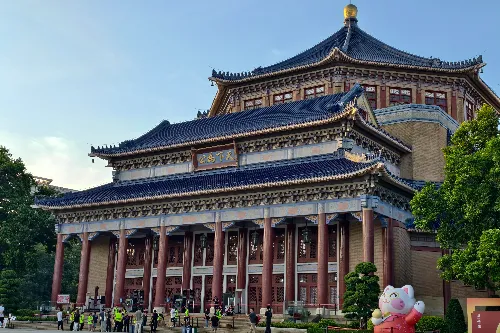
Sun Yat-sen Memorial Hall in Guangzhou is located at No. 299 Dongfeng Middle Road, Yuexiu District, Guangzhou City, Guangdong Province, on the southern foothills of Yuexiu Mountain. The site was originally the Presidential Palace where Sun Yat-sen took office as the Extraordinary President of the Republic of China. Rated as a national 4A-level tourist attraction, it is also designated as a Major Historical and Cultural Site Protected at the National Level, a patriotic education base of Guangdong Province, as well as a famous historical garden and ancient tree park of Guangzhou. It stands as a landmark modern memorial building on the central urban axis of Guangzhou. The total land area of the scenic area is 61,000 square meters, while the main building together with its surrounding platforms covers 12,000 square meters. The main building is 48.63 meters tall, with a north-south depth of 72.65 meters and an east-west width of 63.32 meters. Designed by the renowned modern architect Lü Yanzhi, the structure adopts the architectural style of Song Dynasty palaces combined with Western steel truss and reinforced concrete frameworks. The hall features an octagonal pyramidal roof decorated with sapphire blue glazed tiles and vermilion pillars and doors and windows. Its interior boasts a column-free hall with a large span of 71 meters, equipped with a fixed seating capacity of 3,238 seats. Serving multiple purposes including historical commemoration, cultural tourism, artistic performances and assemblies & exhibitions, it is the largest Sun Yat-sen-themed memorial hall in China.
History and Culture
The land plot of Sun Yat-sen Memorial Hall was used as the yamen of the Guangdong Military Governor in the Qing Dynasty. In May 1921, Sun Yat-sen set up the Extraordinary Presidential Palace of the Republic of China here to handle state affairs. In 1922, Chen Jiongming staged a mutiny, causing severe artillery damage to the Presidential Palace buildings. After Dr. Sun Yat-sen passed away in 1925, overseas Chinese and local residents of Guangzhou proposed constructing a memorial building to honor his achievements. In January 1926, the Second National Congress of the Kuomintang of China formally resolved to build Sun Yat-sen Memorial Hall on the former Presidential Palace site. In the same year, the preparation committee launched a global solicitation for architectural design proposals, among which Lü Yanzhi’s design was finally selected for implementation.
The memorial hall broke ground officially in January 1929 and was fully constructed and completed in October 1931. Since its inauguration, it has witnessed numerous pivotal modern historical events. On September 16, 1945, Tanaka Kyuichi, Commander of the 23rd Army of the Japanese invading forces, signed the instrument of surrender on this site, marking a landmark moment of victory in the War of Resistance against Japanese Aggression in South China. After the founding of the People's Republic of China, the memorial hall has long hosted large-scale municipal assemblies, government events and artistic performances. Seven routine renovations and maintenance projects were carried out successively from the 1950s to 1988. A comprehensive overhaul with an investment of 60 million yuan was conducted in 1998, replacing the entire internal audio-visual system, seats, fire control and monitoring facilities, alongside renovations to the bronze statue pedestal and garden landscapes. The building was included in the fifth batch of Major Historical and Cultural Sites Protected at the National Level in 2001. It was officially unveiled as an education base for members of the Revolutionary Committee of the Chinese Kuomintang in 2021. A roof anti-seepage renovation project, the largest in nearly 30 years, was implemented from July 2023 to July 2024 to conduct systematic conservation of the cultural relic structure.
Main Attractions
Main Building of Sun Yat-sen Memorial Hall
The main building forms the core landscape of the scenic area with a regular octagonal planar layout. Four multi-layered gabled porch structures are arranged on its four sides, topped with a gilded octagonal pyramidal roof fully covered with sapphire blue glazed tiles. The exterior walls are paved with cream-colored face bricks, the base is built of granite and bluestone, and the eaves are fitted with cement painted bracket components. A steel truss framework supports the domed interior structure, creating an unobstructed and spacious hall without any supporting columns. A horizontal plaque inscribed with "Universal Love" in Sun Yat-sen’s own handwriting hangs above the main entrance. The will of the Premier and matching couplets are displayed on the stage area. Permanent exhibitions featuring historical materials about Sun Yat-sen and archives recording the construction of the memorial hall are displayed inside the hall year-round, while concerts, dramas and various artistic performances are regularly held here.
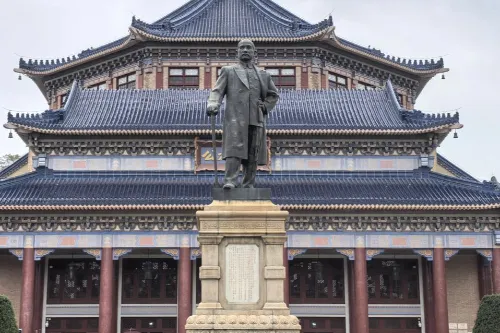
Bronze Statue of Sun Yat-sen
The bronze statue stands at the center of the central axis square directly in front of the main building. Standing 5.5 meters tall itself, the statue paired with its stone pedestal presents a solemn and dignified image, replicating Dr. Sun Yat-sen’s classic posture while delivering speeches. The original bronze statue was erected shortly after the completion of the memorial hall and was replaced with a pure bronze casting during the overall renovation in 1998. It is a key spot for visitors to pay respects and take photos. The central lawn where the statue is situated serves as the visual focal point of the scenic area, forming a complete symmetrical landscape layout together with the hall behind it.
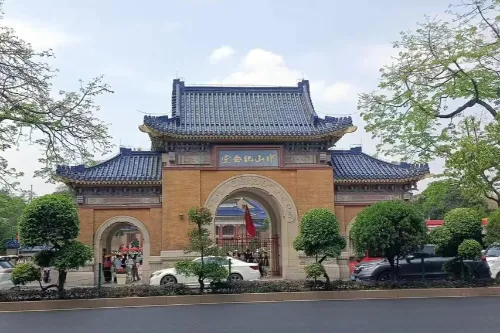
Gatehouse Building
Located at the south entrance of the scenic area, the gatehouse is an integral supporting structure of the memorial hall complex constructed with reinforced concrete. Three arched gateways are set on the facade, with the central gateway larger in scale than the two side entrances. Its roof combines the hip-and-gable roof and imperial hip roof styles and is also laid with blue glazed tiles. A horizontal board bearing the name "Sun Yat-sen Memorial Hall" is mounted right in the middle of the gatehouse, whose exterior walls are fitted with a granite base. It acts as the first iconic architectural landscape upon entering the garden.
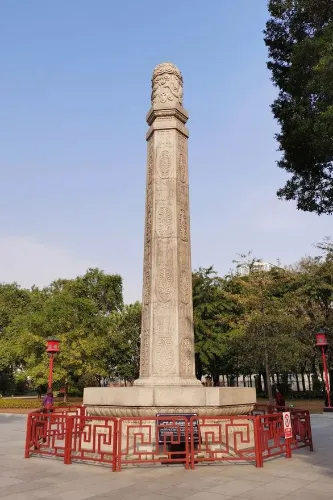
Cloud-and-Crane Ornamental Pillars
A pair of cloud-and-crane ornamental pillars stand on both sides of the lawn at the south gate square. The pillars are carved with patterns of cloud scrolls and cranes, inheriting the traditional ritual architectural style. They not only divide the spatial zones but also embody people’s remembrance and respect for Dr. Sun Yat-sen. Aligned on the same central axis with the bronze statue and the main building, the pillars strengthen the symmetrical Chinese-style layout aesthetic of the entire garden.
King Kapok Ancient Tree
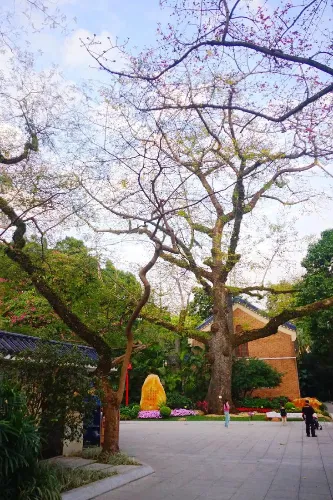
The King Kapok Ancient Tree grows in the northern section of the scenic area with an age of over 300 years, classified as a first-class protected ancient tree registered by Guangzhou City. Its trunk features a natural tree-within-a-tree growth form. Every March to April during its blooming period, the tree is covered with bright red blossoms, forming a highly representative local Guangzhou landscape against the backdrop of the hall building. Surrounded by white michelia ancient trees that exude delicate fragrance all year round, this area constitutes the core ancient tree landscape zone of the garden.
Tour Route
South Gate Entrance of Scenic Area → Gatehouse Building → Cloud-and-Crane Ornamental Pillars → Sun Yat-sen Bronze Statue Square → Interior Visit of Sun Yat-sen Memorial Hall Main Building → Garden Walkways on the East and West Sides of the Garden → King Kapok Ancient Tree Scenic Zone → West Gate Exit of Scenic Area
Travel Suggestions
- It is recommended to reserve 1.5 to 2 hours for a full tour of the whole scenic area. If you intend to browse the indoor historical exhibitions in detail, extend your visiting time to 2.5 hours.
- Two free guided tours are provided at the main building every day. Gather at the service counter of the building entrance at 09:30 and 16:00 without advance reservation. The guided content covers architectural craftsmanship, construction history and relevant modern historical events.
- For shooting exterior views of the buildings, choose time slots before 10:00 in the morning or after 16:00 in the afternoon when natural light is soft for optimal shooting effects of blue tiles and red pillars. Light-colored or neo-Chinese style outfits match well for photography.
- The blooming season of kapok flowers in spring and the hours after sunset when the building night lights are switched on are the best periods for sightseeing and photographing the scenic area.
- After the tour, you may walk westward to the adjacent Yuexiu Park to visit attractions such as the Five Rams Sculpture and Zhenhai Tower for a cohesive urban cultural travel itinerary.
Precautions
- The main building is closed every Monday for maintenance except on legal holidays. Only the outdoor garden areas remain open to the public during closures. Check the opening status before your trip to avoid a wasted journey.
- Eating, smoking and loud noises are prohibited inside the main building. Flash photography is banned when shooting exhibits and architectural paintings to prevent high-intensity light from damaging cultural relics.
- Stepping on lawns, breaking tree branches and feeding wild animals in the garden are forbidden. Visitors shall consciously protect the garden ecological environment.
- Mosquitoes are prevalent in the garden during summer; bring mosquito repellent supplies as needed. There are limited large-scale rain shelters in the square, so carry umbrellas on rainy days. The bronze statue pedestal gets slippery when damp, so watch your steps while walking and taking photos.
- Barrier-free access is available for indoor visits in the main building for visitors with mobility impairments. Public drinking water stations are distributed across the garden; visitors may bring their own water cups for refills.
- Parking spaces for private vehicles are scarce and usually fully occupied on workdays and weekends. Public transport is strongly recommended for a smoother trip.
- A solemn atmosphere must be maintained within the memorial premises. Horseplay and frolicking are not allowed around the bronze statue and hall premises.
Transportation
- Metro: Take Guangzhou Metro Line 2 and alight at Exit C of Memorial Hall Station, then walk for 2 to 3 minutes to reach the south gate of the scenic area.
- Bus: Take bus routes 2, 27, 42, 56, 74, 133, 185, 204, 224, 297 and 518 to the Sun Yat-sen Memorial Hall (Guangzhou Federation of Trade Unions) bus stop and walk into the scenic area.
- Self-driving: Navigate to No. 299 Dongfeng Middle Road, Yuexiu District, Guangzhou. Vehicles can be parked at the parking lots beside the east gate and west side of the scenic area, which operate from 09:00 to 17:00 daily. Self-driving is not recommended due to tight parking capacity.
Opening Hours
All outdoor areas including squares, gardens and ancient tree zones are open to the public free of charge from 06:00 to 22:00 every day all year round. The indoor visiting hours of the main building are 09:00 to 17:30 daily, with ticket checking terminated at 16:45. The main building is closed every Monday for maintenance, with normal opening on Mondays that fall on legal holidays such as the Spring Festival and National Day. Public restrooms and rest areas follow the overall opening hours of the garden, while exhibition spaces and performance venues inside the main building comply with the opening and closing schedule of the hall.
Ticket Information
Access to outdoor garden areas is free of charge. The admission ticket for visiting the interior of the main building costs 10 RMB per person, with separate fees for manual guided tours. Follow the official WeChat public account "广州中山纪念堂" for the latest updates and notices.
Online Booking
Click here to jump to the Trip.com ticketing platform for ticket purchase.