
Yuexiu Park is located at No. 988 Jiefang North Road, Yuexiu District, Guangzhou City, Guangdong Province. It is a national 4A-level tourist attraction, a national key park, one of China’s top 100 famous gardens and one of the Eight Sights of Yangcheng. It was rated a 4A-level scenic area in 2006. Covering a total area of about 690,000 square meters, the park consists of seven hills including Yuejinggang, Moke Hill and Guihuagang, as well as three artificial lakes: North Xiu Lake, South Xiu Lake and East Xiu Lake. The main mountain, Yuexiu Mountain, is a branch range of Baiyun Mountain. The highest peak of the mountain stands over 70 meters above sea level, and the green coverage rate of the whole park exceeds 90%. It is the largest comprehensive urban park in the central urban area of Guangzhou. The core feature of the scenic area lies in the integration of natural mountain forests, lake views and thousands of years of Lingnan historical relics. The park preserves diverse cultural buildings including Ming-dynasty pavilions, ancient city walls, modern memorial architectures and urban cultural landmarks. It is also equipped with leisure amusement zones, exotic gardens and ecological rest areas. It serves as a daily leisure venue for local citizens as well as a core check-in spot for out-of-town tourists to learn about the origin of Guangzhou and Lingnan history and culture. Representative buildings inside the park include Zhenhai Tower, Sun Yat-sen Monument, Five Rams Sculpture, Ming Ancient City Wall, Korea Donggyeong Gyeonggi Garden, Idiom Fable Garden, Jinyin Amusement Park and Yuexiu Mountain Stadium, covering multiple architectural types such as ancient military structures, modern memorial buildings, urban sculptures, theme gardens and recreational facilities.
History and Culture
The cultural history of Yuexiu Mountain dates back to the Qin and Han Dynasties. Zhao Tuo, King of Southern Yue, once built Chaohan Platform here as an important venue for exchanges with the central plains regime, making this place the core of Guangzhou’s cultural context ever since. Starting from the Yuan Dynasty, the scenery of Yuexiu Mountain has been continuously listed among the Eight Sights of Yangcheng through successive dynasties, remaining a carrier of Guangzhou’s urban cultural symbol for thousands of years.
In the 13th year of the Hongwu reign of the Ming Dynasty, Zhu Liangzu, Marquis of Yongjia, constructed Zhenhai Tower and simultaneously built the northern section of Guangzhou’s ancient city wall, which stretches approximately 1,100 meters long. It is the oldest surviving ancient city wall in Guangzhou, with bullet marks left from the War of Resistance against Japanese Aggression on its surface, bearing both ancient military value and modern historical imprints. During the Ming and Qing dynasties, Yuexiu Mountain served as the core defense zone in northern Guangzhou. As the city’s commanding height, Zhenhai Tower long functioned for observation and garrison duty, and literati of the Qing Dynasty hailed it as the foremost scenic wonder of Lingnan.
In the Republic of China era, Yuexiu Mountain underwent public garden transformation and was officially opened to the public as Yuexiu Park in 1927. To commemorate Dr. Sun Yat-sen, the Sun Yat-sen Monument was erected inside the park. Standing 37 meters tall, the monument is carved from a single piece of granite with Dr. Sun Yat-sen’s Testament inscribed on its front. Together with the Sun Yat-sen Memorial Hall at the foot of the mountain, they form an axis layout of hall in front and monument at the back, constituting an important red cultural memorial landscape suitable for historical study tours.
The Five Rams Sculpture, the symbol of Guangzhou’s alias "City of Rams", was completed in 1959. Derived from the ancient legend of five immortals riding five rams bringing grains to bless the people, it has become the official city emblem of Guangzhou. Zhenhai Tower was renovated into the Guangzhou Museum in 1956, housing more than 2,000 Lingnan historical cultural relics that systematically display the complete development of Guangzhou from the Pre-Qin period to modern times. Later, the park successively added the Five Rams Immortal Court, Idiom Fable Garden, Korea Donggyeong Gyeonggi Garden, supporting rest facilities and children’s play areas beside the three artificial lakes, forming a compound urban park cultural system blending ancient and modern elements as well as Chinese and foreign garden styles.
Main Attractions
Five Rams Sculpture
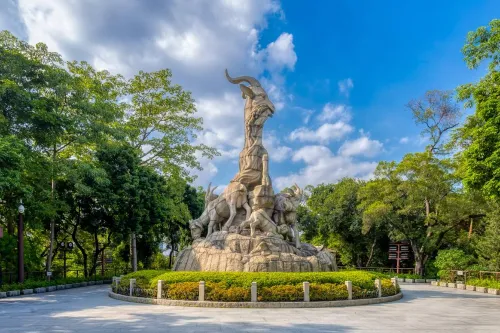
Situated on Moke Hill inside the park, the Five Rams Sculpture is the city symbol of Guangzhou. Standing 11 meters high in total, it is assembled and carved from 130 pieces of granite and was officially finished in 1959. The sculpture features a leading ram holding grain ears high, surrounded by four smaller rams of distinct postures, recreating the folk legend that five immortals rode five rams carrying grains down to Guangzhou to bring harvest to local residents. Adjacent to the sculpture lies the rest area of Five Rams Immortal Court, planted with native Lingnan trees such as kapok and banyan. When kapok blossoms in spring, they set off the stone sculpture, making this the most popular check-in spot in the whole park.
Zhenhai Tower (Guangzhou Museum)
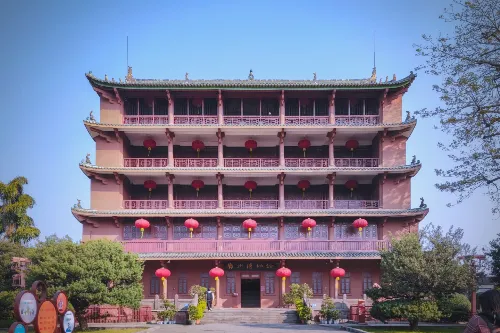
Commonly known as the Five-Story Tower, Zhenhai Tower was first built in the 13th year of the Hongwu reign of the Ming Dynasty, standing 28 meters high with five floors in total. The first and second floors are built with red sandstone slabs, while the upper three floors feature blue brick walls. With red walls, green tiles and a gradually narrowing structure, it combines the characteristics of a multi-story pavilion and an ancient pagoda. A pair of two-meter-tall Ming-dynasty red sandstone stone lions stand in front of the tower. Rebuilt into the Guangzhou Museum in 1956, the tower houses over 2,000 cultural relics including bronze wares, Cantonese embroidery, ivory carvings and porcelain representing Lingnan intangible cultural heritage and historical remains. Visitors can overlook Guangzhou’s traditional urban central axis, the Pearl River and the entire urban area from the fifth floor. The venue opens in separate time slots and closes every Monday for maintenance.
Ming Ancient City Wall
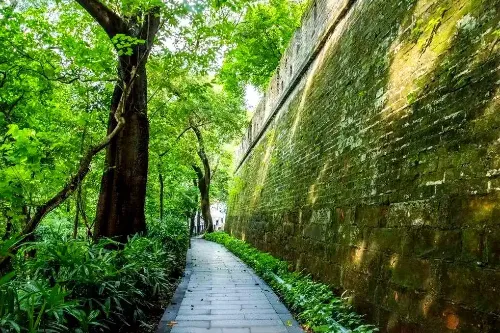
Located right to the west of Zhenhai Tower, the Ming Ancient City Wall stretches around 1,100 meters long. It is the preserved northern defensive wall of Ming-dynasty Guangzhou and the most intact and oldest surviving ancient city wall in the city. Constructed with Ming blue bricks, gaps between the bricks are filled with banyan trees, forming a natural coexistence landscape of trees twining around the wall. Bullet scars left from the War of Resistance against Japanese Aggression remain on the wall surface, endowing it with both ancient military architectural value and modern historical memory. The wall area is fully open to visitors free of charge with no extra admission fees.
Sun Yat-sen Monument
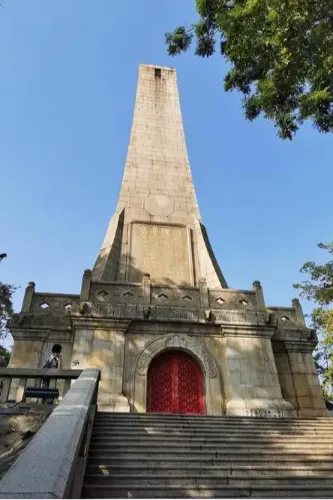
The Sun Yat-sen Monument stands at the top of Hundred-Step Stairs on Yuexiu Mountain, with a total height of 37 meters and carved entirely from a single granite block. Dr. Sun Yat-sen’s full Testament is inscribed on its front face. A spiral staircase inside the monument leads to the top for panoramic views, and the monument connects to 498 stone steps of Hundred-Step Stairs downhill. It shares the same urban central axis with the Sun Yat-sen Memorial Hall to the south, serving as an important modern memorial cultural landscape ideal for historical research visits.
Korea Donggyeong Gyeonggi Garden (Korean Garden)
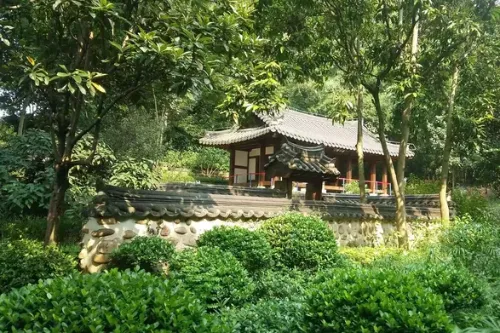
A theme garden for China-South Korea cultural exchange, Korean Garden is constructed referencing the architectural style of traditional Korean buildings from six hundred years ago. Inside the garden are grey wooden pavilions, hibiscus flower landscapes, Korean-style water features and stone ornaments. Boasting an elegant and minimalist overall style, it is perfect for portrait photography. The garden opens free of charge all year round, allowing visitors to stroll and experience the differences between classical East Asian gardens.
Artificial Lakes
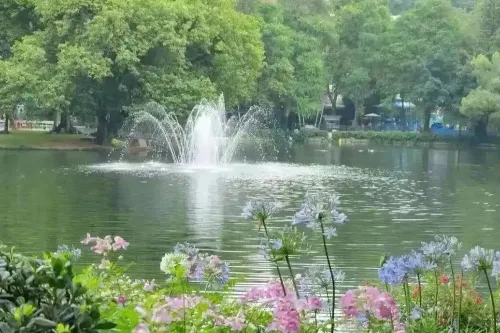
The park contains three artificial lakes: North Xiu Lake, South Xiu Lake and East Xiu Lake, each with distinct functions. North Xiu Lake features a Nine-Bend Bridge and a flower exhibition hall, with numerous koi fish raised on the lake surface; visitors may buy feed to feed the fish. South Xiu Lake is equipped with vast flat lawns suitable for picnics and casual walks. East Xiu Lake provides bumper boat rides for children next to the East Xiu Children’s Playground, ideal for family trips. Boats are available for rent on the lakes with separate rental fees applicable.
Jinyin Amusement Park
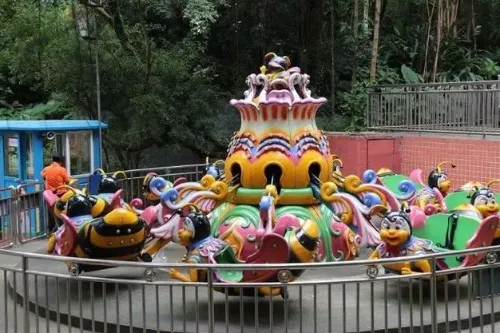
Situated on the eastern side of the park, Jinyin Amusement Park is fitted with family-friendly facilities including merry-go-rounds, mini trains and small roller coasters. All rides require separate tickets for entry. As the core family leisure zone of the park, it lies adjacent to East Xiu Lake and the children’s playground, drawing large numbers of family visitors.
Tour Routes
Classic History & Culture Route: Main Park Gate → Five Rams Sculpture → Five Rams Immortal Court → Ming Ancient City Wall → Zhenhai Tower (Guangzhou Museum) → Hundred-Step Stairs → Sun Yat-sen Monument
Family Leisure Route: South Gate Hundred-Step Stairs → Sun Yat-sen Monument → East Xiu Lake → Jinyin Amusement Park → Koi Feeding at North Xiu Lake → Korean Garden
Light Hiking Lakeside Route: Main Gate → South Xiu Lake Lawn → Bamboo Grove Scenic Area → Nine-Bend Bridge of North Xiu Lake → Idiom Fable Garden → Main Gate
Travel Tips
- The park covers a large area; a full tour is recommended to take 3 to 4 hours, while only visiting core landmarks requires roughly 2 hours.
- There are many stone steps on the hills throughout the park. Comfortable anti-slip sneakers are advised for the whole trip; high heels and slippers are not suitable for mountain climbing.
- The best visiting hours are 6:00–9:00 in the early morning and 16:00–18:00 in the late afternoon, when there are fewer tourists and soft light ideal for photography. Visitors may rest under lakeside shade at noon.
- Bring sunscreen and mosquito repellent in summer. Wind is stronger on the hilltops, so carry a light jacket in spring and autumn.
- Elderly visitors and children with limited stamina may take the sightseeing shuttle carts inside the park for a one-way fare of 10 yuan to reduce uphill walking.
- Plan visits to Zhenhai Tower Guangzhou Museum to avoid Mondays when it is closed; online pre-booking in advance can cut queuing time on site.
- Different flowers bloom across four seasons: kapok in spring, flame trees in summer, bougainvillea in autumn and bauhinia in winter. Shooting spots can be planned according to seasonal blossoms.
- There are a small number of convenience stores inside the park. Visitors are advised to bring drinking water and light snacks in advance; picnic mats can be laid beside the lakes for rest.
Precautions
- Smoking is prohibited throughout the entire park. Climbing the ancient city wall, walls of Zhenhai Tower, the Five Rams Sculpture and other cultural relic sculptures is forbidden; do not touch or carve historical remains.
- Pets entering the park must be kept on a leash at all times, and pet waste must be cleaned up timely. Fierce and large dogs are banned from the park.
- Stone steps on the hills become slippery on rainy days. Walk slowly on mountain trails and avoid running or chasing to prevent slips and falls.
- Flash photography is forbidden inside Zhenhai Tower. Food and drinks cannot be brought into exhibition halls, and touching exhibits is prohibited.
- Swimming and angling are banned on all lake surfaces. Rental boats can only travel within designated waters; do not approach dangerous lakeshore areas without permission.
- The park sees heavy crowds on weekends and holidays, and the Five Rams Sculpture check-in area often gets congested; travel off-peak if possible. Parking spaces are limited, so public transport is recommended as the priority travel option.
- Erecting tents, open-flame barbecues and flying drones are forbidden inside the park. Do not pick flowers or break tree branches arbitrarily.
- Take heatstroke prevention measures during high-temperature summer hours. Seek rest in shaded pavilions or covered corridors inside the park if dizziness, fatigue or other discomfort occurs.
Transportation
- Metro: Take Line 2 to Yuexiu Park Station, exit B1 and walk 3 minutes to reach the main park gate; take Line 2 to Sun Yat-sen Memorial Hall Station, exit C and walk 5 minutes to reach the south park gate.
- Bus: Take routes 109, 110, 211, 225, Sightseeing Bus Line 1, Night Bus 12 and others, alight at Yuexiu Park Bus Stop directly outside the park entrance.
- Self-driving: Navigate to the North Gate Parking Lot of Yuexiu Park. Parking spaces are tight on holidays; off-peak parking or switching to public transport is recommended.
Opening Hours
The whole Yuexiu Park opens daily from 6:00 to 22:00, with last entry at 21:30. There is no fixed weekly closing day, and the park operates normally all year round. The independent venue Zhenhai Tower Guangzhou Museum opens from 9:00 to 17:30 every Tuesday to Sunday and closes all Mondays for cultural relic maintenance. Opening hours on public holidays falling on Mondays will be adjusted separately. Operating hours of boat rentals, amusement park and other recreational facilities are adjusted according to daily sunlight, with shorter business hours in winter.
Ticket Information
Admission to the park is free, but tickets are required for lantern festivals. Search the official WeChat public account "广州市越秀公园" to get the latest updates.
Online Booking
Click here to jump to the Trip.com ticketing platform for ticket purchase.