
Sanbai Mountain Scenic Area is located in the southeast of Anyuan County, Ganzhou City, Jiangxi Province, at the junction of Jiangxi, Guangdong and Fujian Provinces. It is the general name of the peaks on the southeast border of Anyuan County and also the source of the Dongjiang River, the birthplace of drinking water for residents in Guangdong and Hong Kong. It is a National Scenic Area, National Forest Park and National 5A Tourist Attraction. It has also been awarded titles including one of China’s first Ecological Education Demonstration Bases for Mother River Protection, Water Source · Hong Kong Youth National Education Base and China Natural Oxygen Bar. Covering a total area of 197 square kilometers, the core sightseeing zone spans 58 square kilometers and the 5A creation zone covers 36 square kilometers. It includes five sightseeing areas: Fu’ao Pond, Butterfly Grand Canyon (Jiuqu Stream), Dongfeng Lake, Yangtian Lake and Jianfengbi, with more than 100 natural and cultural landscapes. Sanbai Mountain features volcanic landforms and boasts a forest coverage rate of 98%. It has 1,702 higher plant species from 271 families, over 300 rare plant species, 1,361 wild animal species and 38 nationally protected higher animal species, serving as an important biological gene bank in South China. The annual average temperature of the scenic area is 15.1℃, and the average temperature in summer is 23.3℃. The instantaneous maximum concentration of negative oxygen ions in the air can reach 100,000 per cubic centimeter. The source waterfalls, numerous peaks, canyon rapids, peaceful lake among green hills, primeval forests and volcanic landforms are known as the Six Wonders of Sanbai Mountain.
History and Culture
A widely known story about the origin of the name Sanbai Mountain says that during the Qing Dynasty, 330 households of villagers reclaimed land here and built 330 mountain huts. The place was commonly called Sanbasan, and the name Sanbai Mountain gradually came into use. This area has long been a natural boundary between Jiangxi and Guangdong. A local folk saying goes, “Among the ninety-nine rivers in Jiangxi, only one flows to Boluo.” This river, which runs south to Boluo in Guangdong and joins the Dongjiang River, is the Zhenjiang River originating from Sanbai Mountain, known as Anyuan Water in ancient times.
The core cultural value of Sanbai Mountain lies in the history of water supply from the Dongjiang source. In 1963, Hong Kong suffered a severe drought and faced a serious shortage of domestic water. With the instruction of Premier Zhou Enlai, the state allocated funds to build the Dongshen Water Supply Project, transporting water from the Dongjiang River at Sanbai Mountain to Hong Kong. The project was officially put into operation in 1965. Since then, fresh water from the source of the Dongjiang River has continuously supplied Hong Kong. Sanbai Mountain has become the only tourist site in China with the special significance of “remembering the water source” for Hong Kong compatriots. The Siyuan Baoding was erected in 2007 to mark the 10th anniversary of Hong Kong’s return. The Source Protection Stone was set up in 2017 for the 20th anniversary of Hong Kong’s return, engraved with the inscription “We must protect the water source of the Dongjiang River”. It embodies the bond between Jiangxi, Guangdong and Hong Kong people who share the same river water.
Anyuan County is home to the Hakka community and the birthplace of Gannan Tea-Picking Opera, with profound Hakka cultural heritage. The Sanbai Mountain area has preserved traditional customs of revering water sources and protecting forests for generations. Local residents consciously protect the ecology of the Dongjiang source. Combined with ecological education and water source protection themes, it forms a unique source culture.
Main Attractions
Fu’ao Pond (Volcanic Jade Pond)
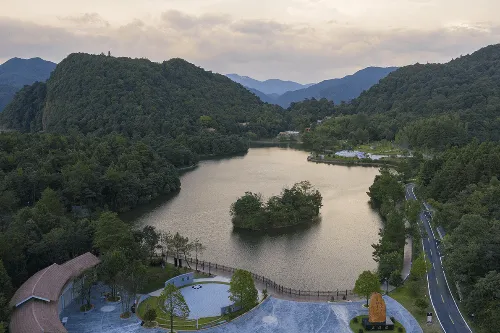
Fu’ao Pond sits at an altitude of 850 meters. It is a lake formed by water accumulation in an ancient volcanic crater, also called Volcanic Jade Pond. Its shape resembles an ao fish, and it is the core landscape of the Fu’ao Pond zone. Legend has it that an ao fish suppressed the volcano in ancient times to protect local residents, and a folk tale tells that a carp fairy transformed into an ao fish. The Fu’ao Pond zone covers 14.83 square kilometers. Along the lakeside are supporting landscapes including the Source Protection Stone, Water-Dripping Guanyin and Siyuan Pavilion. The lake water is clear, surrounded by primeval forests. It is a key spot for enjoying lake and mountain scenery and learning about the protection history of the Dongjiang source.
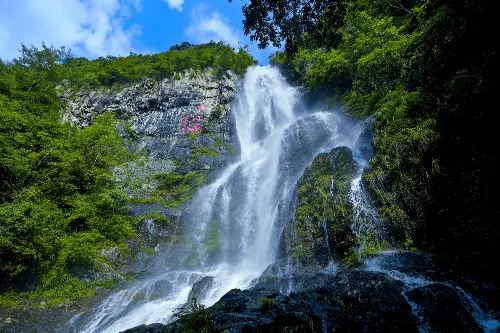
First Waterfall of Dongjiang River
The First Waterfall of Dongjiang River is the landmark waterfall of Sanbai Mountain, with a single drop of 120 meters. In rainy seasons, the water surges powerfully and fills the air with mist. It is the main collection point of water at the source of the Dongjiang River. The waterfall plunges down from steep cliffs, with multiple viewing platforms below for visitors to admire the full view up close. It is also a core check-in spot for tracing the source of the Dongjiang River.
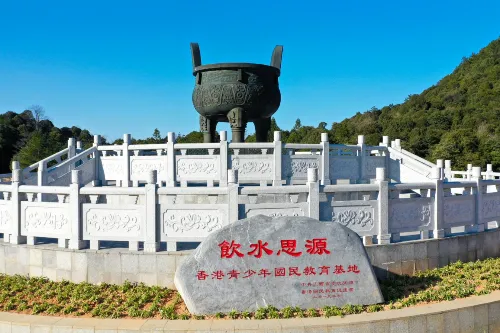
Siyuan Baoding
Completed in 2007, Siyuan Baoding was built to commemorate the 10th anniversary of Hong Kong’s return. The heavy and simple cauldron symbolizes that people from Jiangxi, Guangdong and Hong Kong jointly protect the Dongjiang water source and remember the source of water. It is placed on an open platform in the Fu’ao Pond zone, accompanied by landscape stones engraved with the theme of remembering the water source. It is a cultural site for water source protection education and learning about the Dongshen Water Supply Project.
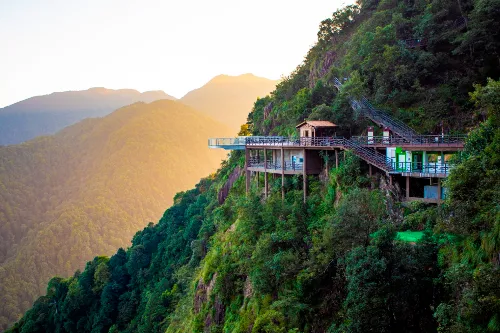
Manyun Boardwalk
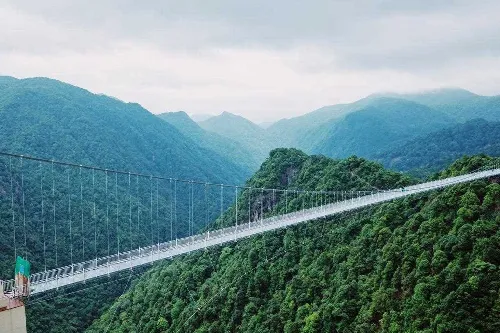
The Manyun Boardwalk stretches 3,166 meters in total, including an 80-meter glass boardwalk. Starting from Fu’ao Pond, it runs along cliff mountains and connects viewing platforms, Heavenly Seal Pine, Jianfengbi and other attractions, ending at Zhulin Parking Lot. Built along cliffs and through forests and clouds, the boardwalk offers wide views and gentle paths. It is the core hiking sightseeing corridor of Sanbai Mountain, from which visitors can overlook rolling peaks and mountain valleys.
Sanbai Mountain Glass Sky Bridge
The glass sky bridge spans two mountain peaks, with a total length of 330 meters, a width of 2.5 meters and a maximum vertical drop of 198 meters. It is one of the longer glass suspension bridges in Jiangxi. The transparent bridge seems floating above the sea of clouds when mountain mist rises, ideal for mountain viewing. It is an experiential attraction, and visitors with acrophobia should take caution.
Dongfeng Lake
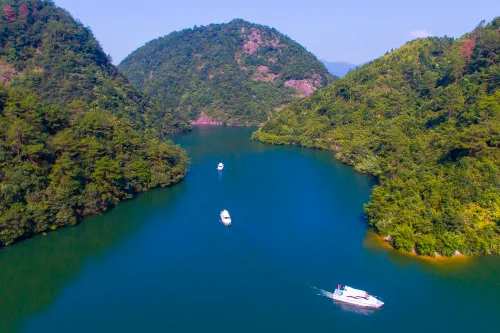
Dongfeng Lake is a medium-sized reservoir at the source of the Dongjiang River, completed in 1965. Its dam is 47.4 meters high with an arc crest length of 113.8 meters and a storage capacity of 11 million cubic meters. The lake stretches roughly 4 kilometers from east to west, with a width between 50 and 120 meters. The lake is serene, flanked by green mountains. Boat tours are available for visitors to admire the scenery of lake nestled among high mountains. It is the starting attraction of the north entrance route.
Butterfly Grand Canyon (Jiuqu Stream)
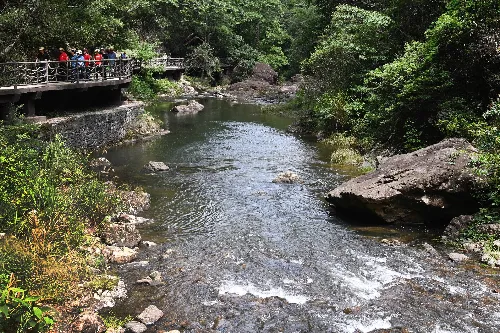
Butterfly Grand Canyon, also known as Jiuqu Stream, features winding streams and connected pools, suitable for many butterfly species to inhabit and breed. It contains scenic spots including Zhiyin Spring and Jiuqu Eighteen Shoals. Zhiyin Spring is famous for twin waterfalls falling side by side. Water plunges down on both sides of a huge stone screen and converges into a deep pool ahead, making it the most distinctive landscape inside the canyon. Jiuqu Eighteen Shoals is dotted with pools, with changing views and flowing streams, a popular hiking spot close to water.
Sky Mirror
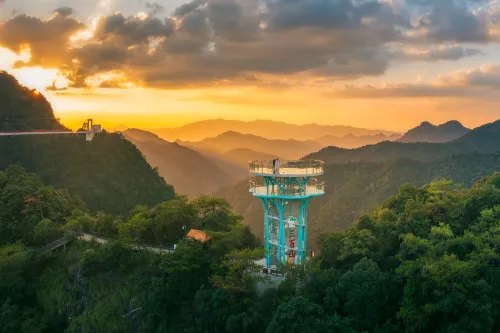
The Sky Mirror viewing platform is designed in the shape of a bauhinia flower. Located at a high altitude with broad views, the mirror platform reflects the sky and mountains, perfect for taking photos of mountain scenery. Adjacent to the glass sky bridge zone, it is a leisure viewing spot on the mountain top.
Tour Routes
Visitor Center → Upper Cableway Station → Fu’ao Pond → Siyuan Baoding → Source Protection Stone → First Waterfall of Dongjiang River → Manyun Boardwalk → Glass Sky Bridge → Sky Mirror → Cableway Downhill (Route A, Round-trip Cableway, Easy Loop)
North Gate Visitor Center → Scenic Shuttle → Dongfeng Lake Dock → Cruise Boat → Butterfly Grand Canyon → Zhiyin Spring → First Waterfall of Dongjiang River → Fu’ao Pond → Manyun Boardwalk → Glass Sky Bridge → Cableway Downhill (Route C, Enter by Cruise, Exit by Cableway)
Travel Tips
- The ticket allows re-entry within 48 hours. If time permits, you can visit over two days instead of rushing through all attractions in one day.
- It is recommended to enter the scenic area in the morning for better mountain light and stable waterfall flow. Mist often rises in the afternoon and may block the view.
- Many sections of the Manyun Boardwalk and canyon trails are beside water with damp surfaces. Non-slip sports shoes are recommended; slippers and high heels are not allowed.
- There are few supply points on the mountain. You may bring drinking water and light snacks, together with sun protection gear.
- Elderly visitors, children and those with acrophobia can skip the glass sky bridge and glass boardwalk and use alternative paths for viewing.
- Take heat-prevention measures in summer. The mountain temperature is relatively low with a big temperature gap between morning and evening; bring a thin jacket.
- To learn about the history of the Dongjiang source, you can drop by the Source Culture Museum to study water source protection knowledge.
Notes
- Sanbai Mountain belongs to the Dongjiang Water Source Protection Zone. Do not litter in streams or lakes, and swimming or aquatic fishing is prohibited.
- Jumping or hitting the glass on the sky bridge and glass boardwalk is forbidden. Please follow the guidance of on-site staff.
- Forests in the scenic area are key fire-prevention zones. Smoking, picnics with open flames and all open fires are banned across the whole area.
- Some hiking trails have steep steps. Do not leave official paths and avoid entering undeveloped wild trails without permission.
- The glass sky bridge and high-altitude boardwalk will be temporarily closed during thunderstorms. Adjust your itinerary according to notices from the scenic area.
- Bring valid documents. Students, seniors, military personnel and other eligible visitors can enjoy preferential policies with document verification at entry.
- Do not feed wild animals. Keep a safe distance and avoid disturbing wildlife in the mountains.
Transportation
- Self-driving: Navigate to Sanbai Mountain Scenic Area Visitor Center. Large parking lots are available. It takes about 40 minutes from Anyuan County downtown to the scenic spot.
- Passenger Bus: Take direct rural shuttle buses from Anyuan Bus Station to Sanbai Mountain Scenic Area with fixed schedules.
- High-speed Rail Transfer: Arrive at Ganzhou West Railway Station, transfer to a coach to Anyuan County, then take the scenic shuttle bus.
- Charter Buses: Seasonal tourist direct buses run from Ganzhou and Heyuan in Guangdong to the scenic area.
Opening Hours
The scenic area opens from 8:00 to 17:30 in summer time and from 8:00 to 17:00 in winter time. The ticket selling and entry closing time varies for different routes. Route A (cableway round trip) stops entry at 15:30. Route B (cableway in, cruise out) stops ticket sales at 13:30. North Gate Route C (cruise in, cableway out) stops ticket sales at 14:00. Hiking Route D stops entry at 13:00. The last departures of scenic shuttle, cruise boats and cableways are subject to on-site notices on the day.
Tickets
Package ticket: 150 yuan per person (including admission ticket and cable car).
You can search for the official WeChat public account "安远三百山景区" to get the latest news or buy tickets online.
Online Booking
Click here to jump to the Trip.com ticketing platform for ticket purchase.