
Nanyue King Museum (Tomb Exhibition Area) is located at No. 867 North Jiefang Road, Yuexiu District, Guangzhou City, Guangdong Province. It is a national first-class museum, a national 4A-level tourist attraction, and has been listed as a Major Historical and Cultural Site Protected at the National Level as well as a National Archaeological Site Park. Built on the tomb ruins of King Zhao Mo of Southern Yue of the Western Han Dynasty, the exhibition area covers a total land area of approximately 14,000 square meters with a construction area of around 33,000 square meters. Adopting a hillside-covered modern exhibition hall design, the complex fully preserves and displays the intact ancient royal tomb in its original location, making it one of the rare special museums in China that retains the complete physical remains of a Western Han vassal king’s mausoleum. Its core highlights include an intact, unlooted Western Han royal tomb of the Nanyue Kingdom and over ten thousand precious cultural relics unearthed from Lingnan dating back to the Pre-Qin to Western Han periods. The venue systematically presents the context of cultural exchanges between Lingnan, the Central Plains and overseas regions during the Qin and Han dynasties, serving as a core physical site for researching the early development of Lingnan and the embryonic Maritime Silk Road.
History and Culture
After unifying Lingnan, the Qin Dynasty established three commanderies: Guilin, Xiang and Nanhai. Amid the chaos at the end of the Qin Dynasty, Zhao Tuo, Prefect of Nanhai, seized control of Lingnan and founded the Nanyue Kingdom in 203 BC, with Panyu as its capital. Its territory covered present-day Guangdong, Guangxi and northern Vietnam. In 196 BC, Zhao Tuo submitted to the Han Dynasty and was enfeoffed as King of Nanyue, ushering in an era when Central Plains institutions, culture and craftsmanship spread to Lingnan. The Nanyue Kingdom had five successive monarchs and lasted for 93 years before being conquered by Emperor Wu of the Han Dynasty in 111 BC, bringing Lingnan under the direct administration of the Central Plains imperial court.
The central tomb within the exhibition area belongs to Zhao Mo, the second king of the Nanyue Kingdom, known posthumously as King Wen of Nanyue and grandson of Zhao Tuo. He reigned for roughly 16 years, and the tomb was buried around 122 BC. Discovered accidentally during infrastructure construction in 1983, the tomb lies deep beneath a hill and remained undisturbed for more than two thousand years. It is the largest and best-preserved Western Han royal tomb in Lingnan. Its burial layout follows the funeral system of Central Plains vassal kings while integrating local Lingnan burial customs, embodying the cultural fusion between Han and Nanyue peoples.
More than ten thousand cultural relics were excavated from the tomb, covering ritual vessels, daily utensils, chariot and horse fittings, weapons and imported overseas goods. Unearthed treasures include a jade suit sewn with silk threads, the golden imperial seal "Emperor Wen’s Seal", African ivory, a Persian silver box and red sea frankincense. These artifacts prove that Panyu was a vital departure port of the Maritime Silk Road in the early Western Han Dynasty, witnessing the southward spread of Central Plains rituals and handicraft technologies and the import of exotic overseas goods via sea routes, filling the gap of physical evidence for early overseas exchanges in Lingnan. The Western Han Nanyue King Museum was built on the tomb ruins in 1993. In 2021, it merged with the Nanyue Palace Museum and was officially renamed Nanyue King Museum, divided into two exhibition zones: the Tomb Area and the Palace Area.
Major Attractions
Original Tomb Site Exhibition Hall
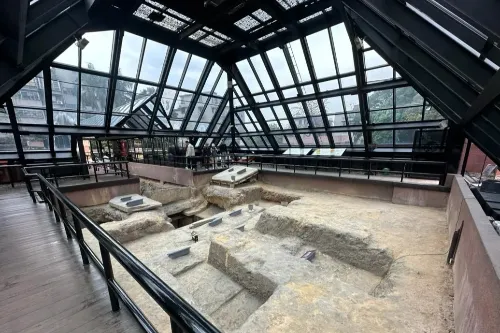
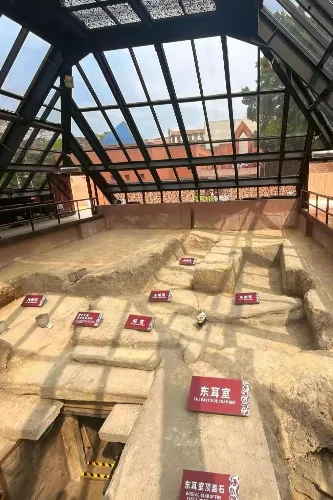
This hall is the core of the museum, fully preserving the original hill and tomb structure of Zhao Mo’s mausoleum. It is a vertical earthen pit stone chamber tomb consisting of seven spaces: an antechamber, main chamber, east and west side chambers, east storage chamber and west storage chamber. Suspended viewing walkways are built along the tomb pit, allowing visitors to closely observe the stone masonry, tomb passage, and remains of human and animal sacrifices, restoring the complete burial layout of a Western Han vassal king. Carved into red sandstone hillock, the tomb pit reaches around 10 meters deep. All stone slabs were hand-polished and tightly fitted without adhesives, demonstrating the exquisite stone craftsmanship of Lingnan during the Han Dynasty.
Treasures of Nanyue – Exhibition of Cultural Relics Unearthed from the Western Han Nanyue King Tomb
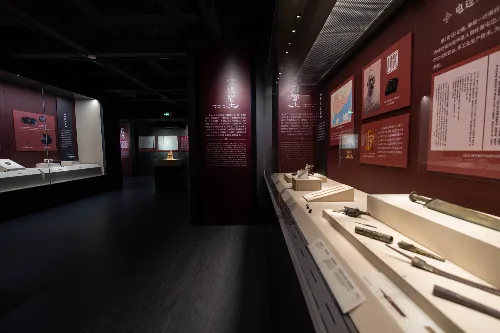
Located in the main exhibition building, this hall covers over 4,000 square meters and serves as the permanent core exhibition hall for cultural relics. It displays all key artifacts unearthed from the tomb divided into multiple themed sections. Iconic exhibits include the only complete surviving Western Han jade suit sewn with silk threads, assembled from more than 2,200 pieces of green jade; the golden imperial seal "Emperor Wen’s Seal", the only surviving practical golden seal of a Han Dynasty emperor; complete sets of bronze chime bells, chime stones, jade pendant sets, bronze ding cauldrons, bronze roasting ovens and other ritual and daily wares. The hall also showcases imported overseas relics such as the Persian silver box, African ivory, frankincense and dragonfly-eye glass beads, accompanied by archaeological illustrations. It compares artifacts from contemporary Central Plains royal tombs to explain the craftsmanship differences between Han and Nanyue wares and the history of overseas trade.
Southern Borderlands of Qin and Han – Special Exhibition on the History of the Nanyue Kingdom
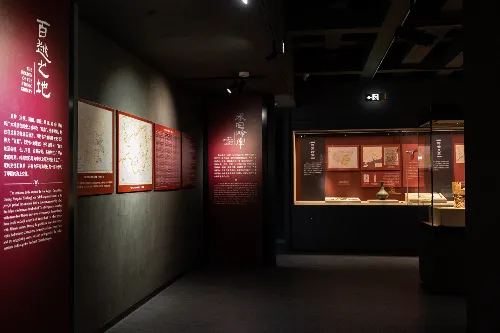
Situated on the second floor of the comprehensive exhibition building, this hall sorts out the complete development timeline of the Nanyue Kingdom. It displays archaeological artifacts, historical illustrations and restored topographic maps related to the kingdom. The content covers key historical events including the Qin conquest of Lingnan, Zhao Tuo’s founding of Nanyue, diplomatic exchanges between Han and Nanyue, and Emperor Wu’s annexation of Nanyue. It systematically introduces the administrative system, population, handicrafts and trade development of Lingnan in the Qin and Han dynasties, helping visitors form a complete historical framework of the Nanyue Kingdom.
Exhibition Hall of Porcelain Pillows Donated by Mr. and Mrs. Yongde Yang
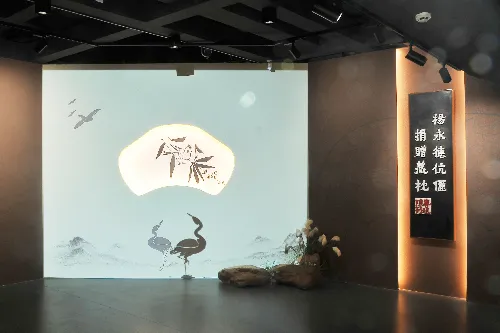
This hall houses over 200 ancient porcelain pillows donated by Mr. and Mrs. Yongde Yang, spanning the Tang, Song, Jin, Yuan and Ming dynasties from kilns including Cizhou, Jingdezhen and Ding. The pillows feature diverse shapes such as human figures, animal forms and geometric outlines, decorated with landscapes, flowers, birds and opera story patterns. They enrich the museum’s collection by showcasing folk ceramic culture from the Tang and Song dynasties as an auxiliary exhibition area.
Outdoor Archaeological Ruins and Square
The outdoor area retains the hill section exposed during tomb excavation, fitted with stone explanatory carvings and reconstructed archaeological sculptures. A relief wall themed on King Zhao Tuo of Nanyue stands on the square, illustrating the full development of the Nanyue Kingdom. Equipped with resting walkways and green landscapes connecting all exhibition hall entrances and exits, the area offers spaces for visitors to rest and take photos, restoring the original landform of Xianggang Hill where the ancient tomb is located.
Tour Route
Scenic Entrance → Outdoor Archaeological Ruins Square → Original Tomb Site Exhibition Hall → Treasures of Nanyue – Exhibition of Cultural Relics Unearthed from the Western Han Nanyue King Tomb → Southern Borderlands of Qin and Han – Special Exhibition on the History of the Nanyue Kingdom → Exhibition Hall of Porcelain Pillows Donated by Mr. and Mrs. Yongde Yang → Cultural & Creative Store → Scenic Exit
Travel Tips
- Set aside 2 to 3 hours for a full tour of all exhibition areas; the tomb and relic halls contain abundant details, and a hasty visit will cause visitors to miss core national treasure-level artifacts.
- Rent an official audio guide device or join the free scheduled guided tours offered at 10:00 and 14:00 daily to learn detailed historical background of relics and the tomb.
- It is recommended to visit the original tomb site first before viewing excavated relics; following the tomb excavation logic helps visitors better understand the context of each artifact.
- The on-site cultural and creative store sells replica Nanyue-themed artifacts and books, ideal as historical souvenirs.
- The exhibition halls maintain constant indoor temperature in summer, while the outdoor hilly area has strong sunlight; sun protection gear is advised. The hall lighting is soft, and camera flash is unnecessary for artifact photography.
- Plan a one-day combined itinerary with the Nanyue King Museum Palace Exhibition Area, approximately 3 kilometers away, to fully explore the history of the Nanyue Kingdom.
- Separate advance reservation tickets are required for in-depth visits to the lower tomb chamber ruins, which are not included in the general admission ticket.
Notes
- Touching glass display cabinets, stone tomb chamber walls and artifact replicas inside exhibition halls is prohibited; violators will be dissuaded per museum regulations.
- Camera flashes and fill lights are forbidden when photographing exhibits, as strong light causes irreversible damage to jade and silk relics.
- Eating and drinking are not permitted inside exhibition halls; snacks and beverages may only be consumed at rest zones on the outdoor square.
- Large luggage and rolling suitcases cannot be brought into exhibition halls. Free self-service lockers are available at the entrance; visitors should keep valuables with them at all times.
- Selfie sticks and tripods are banned inside the museum to avoid collisions with cultural relics and other visitors.
- Minors must be accompanied by adults at all times; climbing walkway railings, stone carvings and sculptures is prohibited.
- Certain exhibition areas may be temporarily closed for relic restoration or hall maintenance; check official museum announcements before visiting.
- The entire museum premises, including the outdoor square, are smoke-free zones; smoking is strictly forbidden.
- Temporary special exhibitions require separate tickets and cannot be accessed with general admission; check information on current special exhibitions prior to arrival.
Transportation
- Metro: Take Guangzhou Metro Line 2 to Yuexiu Park Station Exit E, then walk roughly 500 meters to the main entrance of the scenic area.
- Bus: Take buses No.5, 7, 24, 42, 101, 103, 109, 110, 113, 180, 203, 211, 256, 265, 284, 529, 543 or 886 to Yuexiu Park Stop, followed by a 300–600 meter walk to the venue.
- Self-driving: A small number of underground parking spaces are available on-site; street parking along North Jiefang Road is limited, and self-driving is not recommended during holidays. Navigate to "Nanyue King Museum (Tomb Exhibition Area)".
- Taxi: Directly set the destination as Nanyue King Museum (Tomb Exhibition Area) Main Entrance; the drop-off point is right at the entrance.
Opening Hours
The regular opening hours of Nanyue King Museum (Tomb Exhibition Area) are 9:00 to 17:30 daily, with last entry at 17:00. The museum closes every Monday for maintenance. If Monday falls on a statutory public holiday, it remains open, and the weekly closure is rescheduled to the first working day after the holiday. Extended last entry times will be implemented during major statutory holidays such as Spring Festival and National Day, with adjustments announced in advance via the official WeChat official account. On New Year’s Eve, opening hours are shortened to 9:00–16:00, with last ticket check at 15:30. There is no midday break all year round, and visitors may enter freely within opening hours.
Ticket Information
The admission ticket for the Tomb Exhibition Area costs 10 RMB per person, while the Palace Exhibition Area offers free entry. Search the WeChat official account "南越王博物院" to obtain the latest updates.
Online Booking
Click here to jump to the Trip.com ticketing platform for ticket purchase.