
Officially named the Chen Clan Academy, the Chen Clan Ancestral Hall is located at No. 34 Enlongli, Zhongshan 7th Road, Liwan District, Guangzhou City, Guangdong Province. It is a national 4A-level tourist attraction, a Major Historical and Cultural Site Protected at the National Level, and a national first-class museum operating under the name Guangdong Folk Art Museum. Selected as one of the New Eight Sights of Guangzhou in 2002 and known by the elegant alias "Ancestral Hall's Timeless Charm", it is hailed as a pearl of Lingnan architectural art. Covering a total land area of approximately 15,000 square meters with a main building area of 6,400 square meters, the complex consists of nineteen standalone buildings arranged in a north-facing-south symmetrical layout featuring three rows, three corridors, nine halls and six courtyards. Enclosed by blue brick walls, the compound includes four courtyards (front, rear, east and west) with an 80-meter length and width respectively. Qingyun lanes, long corridors and patios connect all halls together. It stands as the largest surviving and best-preserved joint ancestral hall complex of the Guangfu style from the Qing Dynasty in Guangdong Province. Its core highlight lies in the complete preservation of seven traditional Lingnan architectural decorative crafts: wood carving, stone carving, brick carving, stucco molding, Shiwan ceramic ridge sculpture, copper and iron casting, and painted murals. The ceramic ridge decoration on the main roof ridge stretches 27 meters, while the total length of stucco moldings across the museum exceeds 2,500 meters — both records among surviving Lingnan relics of the same era. Serving multiple integrated functions including clan worship, accommodation for clansmen sitting imperial examinations, and folk art exhibition, it is a comprehensive cultural attraction that embodies ancestral hall rituals, Lingnan construction techniques and Guangfu folk crafts.
History and Culture
During the Qianlong reign of the Qing Dynasty, the imperial government issued a ban restricting the construction of cross-county joint ancestral halls by common people. Clansmen of the Chen surname across Guangdong thus raised funds to build an ancestral hall under the guise of an academy. In the 14th year of the Guangxu reign (1888), Chen Lanbin, former Minister to the United States, together with 48 gentry of the Chen clan, took the lead in establishing a hall construction committee. They raised donations from Chen clansmen across seventy-two counties in Guangdong, offering donors the right to enshrine memorial tablets as compensation. Construction of the main structure finished six years later in the 19th year of the Guangxu reign (1893), and the entire complex was fully completed in the 20th year of the Guangxu reign (1894), with a total construction cycle of seven years. The academy was built for two primary purposes: first, to host collective ancestor worship ceremonies for the Chen clan every spring and autumn; second, to provide temporary lodging and study space for Chen clansmen traveling to Guangzhou to sit the imperial examinations or handle tax and litigation affairs, hence the formal name Chen Clan Academy, commonly known as the Chen Clan Ancestral Hall among locals.
After the abolition of the imperial examination system in the 31st year of the Guangxu reign (1905), the academy no longer accommodated examination candidates. It was successively repurposed as the Chen Clan Industrial School, Wenfan School, Guangdong Physical Education College and Juxian Middle School. The venue was assigned to the Guangzhou Municipal Administrative Cadre School in 1950. It was listed as a Guangzhou Municipal Cultural Relic Protection Unit in 1957, launching special restoration works. The Guangdong Folk Art Museum officially opened to the public within the ancient buildings of the Chen Clan Ancestral Hall on October 1, 1959. It was upgraded to a Guangdong Provincial Cultural Relic Protection Unit in 1960, and designated one of the Third Batch of Major Historical and Cultural Sites Protected at the National Level by the State Council in 1988.
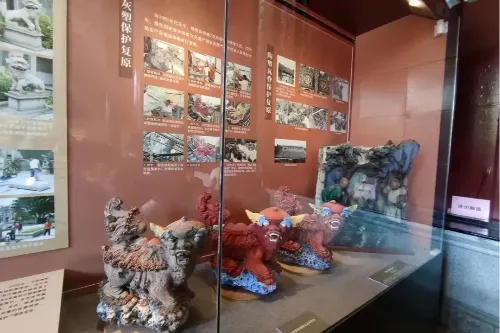
The venue has undergone two large-scale comprehensive restorations in history. The first phase took place from 1958 to 1959, repairing architectural damage caused by wars and school usage. The second phase ran from 1980 to 1983, restoring tens of thousands of ancestral memorial tablets and carved components damaged during a special historical period, with only two original Qing Dynasty tablets preserved to this day. Entering the 21st century, the museum has adopted technical monitoring tools including termite surveillance and Beidou structural monitoring systems for routine preventive conservation. It holds permanent exhibitions of traditional Lingnan craft collections such as Guang embroidery, ivory carving, Shiwan ceramics and paper-cutting year-round. As a public cultural venue showcasing Guangfu clan culture, traditional construction craftsmanship and folk arts and crafts, it receives over one million visitors from home and abroad each year and serves as one of Guangzhou’s iconic cultural landmarks.
Main Attractions
Front Square and Main Gate
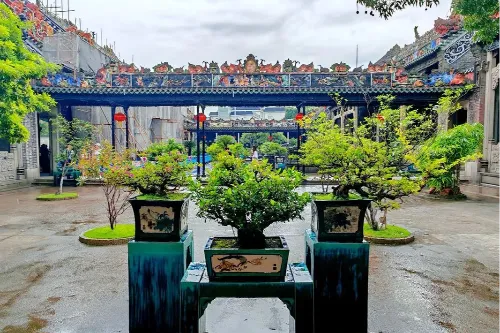
The front square sits at the southernmost end of the building complex with an open layout, flanked by preserved stone flagpole holders from the Qing Dynasty — facilities used by clans to display scholarly honors in ancient times. The main gate spans five bays with a total width of 27.56 meters. A wooden plaque inscribed "Chen Clan Academy" hangs above the lintel, while 4-meter-tall painted door gods from the Qing Dynasty adorn the inner gate panels. Six giant brick carvings are embedded on the outer walls beside the gate, featuring themes including Liangshan Heroes Gather and Phoenixes Among Paulownia and Apricot Trees. Intricate layers and vivid character depictions make them representative masterpieces of Lingnan brick carving from the Qing era. The roof is fitted with a 27-meter-long Shiwan ceramic ridge sculpture carved with opera tales, immortals and auspicious beasts, whose colors remain vivid after over a century, ranking among the core visual decorations of the entire museum.
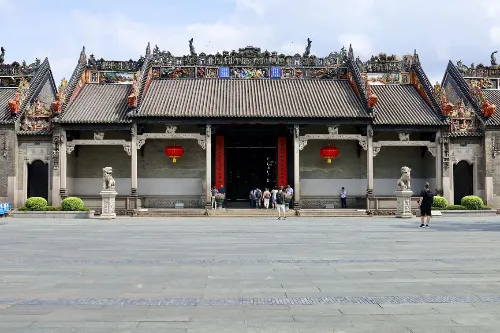
East and West Side Halls
The symmetrical side halls flank the main gate. Originally office and rest spaces for clan stewards and guests, they now function as permanent craft exhibition halls displaying categorized collections of Guangfu wood carving, paper-cutting, lacquer art and embroidery. All window and door frames retain original hollowed wood carvings from the Qing Dynasty patterned with auspicious motifs including peonies, red-crowned cranes and pomegranates. Granite stone railings line the patios, while small stucco molded eaves decorate the roof surfaces, balancing practicality and ornamental aesthetics.
Juxian Hall (Central Main Hall)
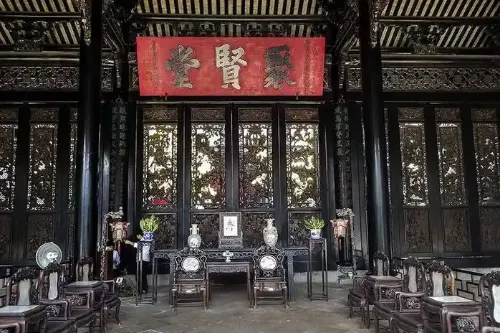
Juxian Hall is the grandest and largest core hall within the entire Chen Clan Ancestral Hall complex, reserved for annual spring and autumn ancestor worship, clan meetings and large assemblies of Chen clansmen. The character "Ju" on the plaque "Juxian Hall" is written in reverse, a traditional ritual custom meant to avoid sharp brush strokes offending ancestral spirits. The hall spans 27 meters in width and 16.4 meters in depth with a building height of roughly 14.5 meters, fronted by an independent stone-built moon terrace. Baluster posts on the terrace are carved with stone lions, peaches, pineapples, bergamots and other Lingnan fruits and flora. A rare double-sided openwork iron cast balustrade from the Qing Dynasty stands at the center of the terrace, a precious iron art relic uncommon in Lingnan regions. Twelve panels of double-sided hollowed wood carved folding screens depicting the Twenty-Four Filial Piety stories and historical legends are installed between the rear golden pillars, ranking as top-tier wood carving collections of the museum. Exquisite wood carvings adorn all beam frames and bracket sets, creating a spacious, solemn interior that serves as a key highlight along the central axis route.
Qingyun Lanes
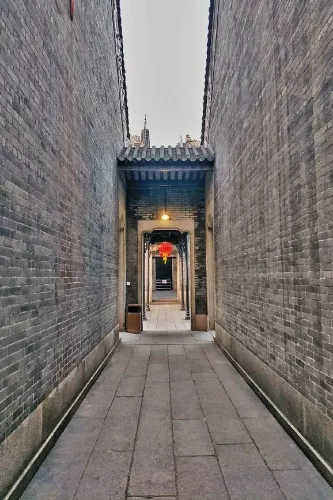
Four Qingyun Lanes separate the three rows of halls, stretching a combined total length of 150 meters. The ground slopes gently upward from south to north, embodying the auspicious metaphor of steady progress and rising social status ("advancing step by step toward the clouds"). Gate lintels at lane entrances feature stucco moldings of upside-down bats and treasure vases, homophonic symbols for fortune and peace. Blue brick gable walls line both sides, capped by continuous stucco molded eaves with over 2,500 meters of decorative components covering the entire eave line. Decorations cover landscapes, flowers, birds and opera characters, allowing visitors to appreciate continuous Qing Dynasty plaster art while the lanes serve practical purposes of courtyard division, ventilation and natural lighting.
Ancestral Hall
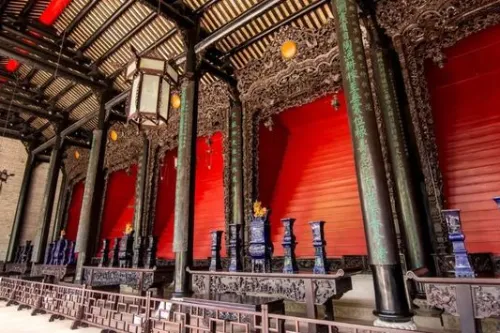
The Ancestral Hall stands at the northernmost end of the central axis, dedicated solely to enshrining ancestral memorial tablets. Its raised foundation sits higher than Juxian Hall to show juniors’ reverence for ancestors, with no attached moon terrace. Five large Qing Dynasty wooden carved shrines occupy the hall interior, the tallest reaching 8 meters in height, fully hollow-carved with auspicious patterns across canopies and shrine bodies. Tens of thousands of original Chen clan memorial tablets were once stored here; replica tablets are displayed today to recreate ancient worship scenes. Large ceramic and stone craft exhibits fill the side rooms flanking the hall, creating a solemn, tranquil atmosphere.
East & West Auxiliary Courtyards and Back Garden
The east and west auxiliary courtyards flank the main building complex, connected to all halls by long covered corridors, furnished with small patios and greenery. Miniature brick and stucco carvings decorate courtyard walls and corridor beams. The back garden lies at the northern end of the complex, planted with distinctive Lingnan flowering trees and shrubs and fitted with stone benches for rest. Complete ceramic and stucco decorations remain intact on roofs and surrounding walls, ideal for observing carved details on the building side elevations and offering a quiet resting spot to conclude the tour.
Tour Route
Front Square → Main Gate Brick Carving Viewing Area → East Front Side Hall Craft Exhibition Hall → West Front Side Hall Craft Exhibition Hall → Central Front Courtyard → Juxian Hall Moon Terrace → Juxian Hall Main Chamber → East Qingyun Lane → East Auxiliary Courtyard Corridor → Rear Ancestral Hall → West Qingyun Lane → West Auxiliary Courtyard Exhibition Hall → Back Garden → Scenic Area Exit
Travel Suggestions
- Allow 1.5 to 2 hours for sightseeing to fully appreciate intricate brick, wood and stucco carvings without superficial rushed visits.
- Visit on weekdays either from 9:00 to 10:30 or after 15:00 for fewer crowds and soft indoor natural light, ideal for examining carving details and photography.
- Free volunteer guided tours are available beside the stone lions at the main gate at 10:00 and 15:00 daily, explaining hidden stories behind architectural motifs and clan history.
- Follow the south-to-north central axis route combined with the east and west Qingyun Lanes to avoid backtracking and cover all core attractions completely.
- Light-toned, neo-Chinese or Hanfu outfits match well with the ancient blue brick buildings and colorful sculptures; flat comfortable shoes are recommended due to extensive stone pavement throughout the grounds.
- Bring sunscreen and insect repellent in summer. Though shaded by dense foliage, mosquitoes are abundant. Stone floors turn slippery during humid rainy seasons, so walk with caution.
Notes for Visitors
- The scenic area closes every Tuesday except legal holidays; confirm the opening schedule before travel to avoid missed visits.
- All visitors must complete real-name reservation in advance via the official WeChat public account "Guangdong Folk Art Museum" and scan valid ID cards for entry. No on-site physical ticket windows are available.
- Touching ancient architectural carvings, railings and craft exhibits is strictly prohibited. Flash photography is banned. Commercial photography and tripod use require prior filing with museum administration staff.
- Pets, balloons and drones are forbidden inside the scenic zone. Eating, loud noise and running are not permitted; comply with all cultural relic protection visiting regulations.
- No on-site parking spaces are provided. Private vehicles must be parked at the nearby Liwan Stadium parking lot at a rate of 8 RMB per hour. Parking spaces are extremely limited on holidays; self-driving is not recommended.
- Tickets are only valid on the reserved date. E-tickets purchased through unofficial third-party platforms cannot be verified for admission. The third Wednesday of each month is a free open day, which still requires advance reservation with limited quota.
- Large luggage cannot be brought into exhibition halls; storage service is available near Exit F of Chen Clan Ancestral Hall Metro Station, operating from 7:30 to 24:00.
- Elderly visitors and minors must be accompanied by adult guardians. The complex features numerous steps; visitors with limited mobility may consult staff in advance for accessible passage locations.
Transportation
- Metro: Take Guangzhou Metro Line 1 or Line 8 to Chen Clan Ancestral Hall Station, Exit D. Walk approximately 110 meters (3 minutes) directly to the scenic main gate — the most recommended travel option.
- Bus: Take bus routes 17, 88, 104, 107, 109, 128, 193 or 204 and alight at Chen Clan Ancestral Hall Bus Stop, followed by a 2-minute walk to the main gate.
- Self-driving: No on-site parking; park at Liwan Stadium public parking lot with an 8-minute walk to the venue. Severe traffic congestion occurs during holidays, so this method is not advised.
- Taxi: Navigate to "Guangdong Folk Art Museum (Chen Clan Ancestral Hall)". Taxis may stop temporarily at the drop-off zone on Zhongshan 7th Road near the main gate for passenger pick-up and drop-off only, with no long-term parking allowed.
Opening Hours
The scenic area operates two seasonal opening schedules. From April 15 to October 15 each year, opening hours are 9:00 to 18:00 with last entry at 17:30. From October 16 to April 14 of the following year, opening hours are 9:00 to 17:30 with last entry at 17:00. Regular full-day closure takes place every Tuesday for cultural relic maintenance work. Normal opening applies during legal holidays including Spring Festival, National Day and Mid-Autumn Festival, with the weekly closure postponed to the first working day after the holiday period. Ticket checking stops 30 minutes prior to daily closing time, and staff will guide visitors to exit orderly with no extended visiting hours permitted.
Ticket Information
A combined package ticket priced at 50 RMB per person includes admission and guided tour service. Standalone entry tickets can be reserved and purchased through the official WeChat public account "广东民间工艺博物馆" at a price of 10 RMB per person.
Online Booking
Click here to jump to the Trip.com ticketing platform for ticket purchase.