
The Shanghai City God Temple Tourist Area is located at No. 249 Middle Fangbang Road, Huangpu District, Shanghai. Centered on the City God Temple, the scenic area integrates Jiangnan classical architecture, Taoist culture, Shanghai folk customs and characteristic commerce, and is an important representative of Shanghai's historical and cultural features. The total area of the scenic area is about 35,000 square meters, and the core building, the City God Temple Taoist Temple, covers an area of more than 1,000 square meters. The existing main buildings consist of the pre-temple square, the main hall, the Yuanchen Hall, the God of Wealth Hall, the Cihang Hall, etc. The architectural complex is large in scale and rigorous in layout, all of which are typical of the Ming and Qing styles in Jiangnan, with overhanging eaves and angled corners, carved beams and painted pillars, having both religious sacrifice and architectural art value. The City God Temple Tourist Area includes the City God Temple Taoist Temple, Yu Garden (adjacent to the core area), the City God Temple Snack Street and other sections, receiving tens of thousands of tourists per day on average. It is a highly recognizable cultural and tourist landmark in the downtown area of Shanghai, which not only retains the traditional religious and cultural core, but also integrates modern commerce and folk experience, becoming an important window to show Shanghai's local culture.
History and Culture
The history of Shanghai City God Temple can be traced back to the Yongle period of the Ming Dynasty (1403-1424). Initially built to commemorate Huo Guang, a famous general of the Qin Dynasty, it was then called "Huo Guang Shrine". In the 21st year of Yongle in the Ming Dynasty (1423), Zhang Shouyue, the then magistrate of Shanghai, moved the shrine to its current location. After several expansions and renovations, it gradually became the core place for worshipping the City God. As a deity guarding the city in Chinese folk belief, the City Gods worshipped in Shanghai City God Temple include Huo Guang, Qin Yubo, Chen Huacheng and others in succession. Among them, Qin Yubo was honored as the "City God of Shanghai" by later generations for his important contributions to the development of Shanghai, and became the core worshipping object of the City God Temple.
During the Ming and Qing dynasties, Shanghai City God Temple ushered in a period of prosperity. Large-scale renovations were carried out in the 22nd year of Kangxi in the Qing Dynasty (1683) and the Qianlong period, and the scale of the building continued to expand, making it one of the most important Taoist temples in Shanghai. From the late Qing Dynasty to the Republic of China period, a market block integrating sacrifice, commerce and entertainment gradually formed around the City God Temple, becoming the commercial and cultural center of the old town of Shanghai. Buildings such as Yu Garden and Huxin Pavilion were connected with the City God Temple, forming the prototype of today's tourist area.
After the founding of the People's Republic of China, Shanghai City God Temple has undergone several renovations and protections. It was listed as a municipal-level cultural relic protection unit of Shanghai in 1994. Since the 1990s, through systematic restoration and transformation, it has not only retained the traditional architectural style and religious and cultural functions, but also integrated the surrounding commercial resources, becoming a comprehensive tourist area integrating cultural inheritance, religious activities, tourism and sightseeing, and folk experience. Its folk activities such as temple fairs and Lantern Festival lantern shows have continued to this day, becoming an important carrier for the inheritance of Shanghai's intangible cultural heritage.
Major Attractions
City God Temple Taoist Temple
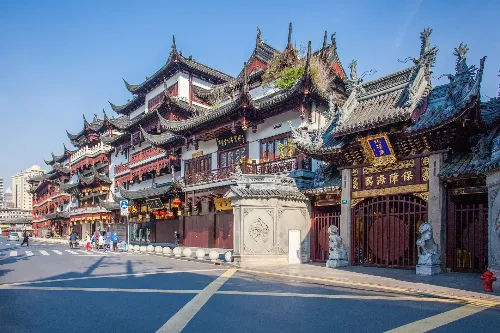
The City God Temple Taoist Temple is the core of the entire tourist area, covering an area of about 1,000 square meters. The main building faces south with its back to the north, and along the central axis are the screen wall, the temple gate, the ceremonial gate, the main hall, the rear hall and so on in sequence. The main hall is the core building of the Taoist temple, about 15 meters high, with three bays in width and two bays in depth. Inside the hall stands a statue of Qin Yubo, the City God of Shanghai. The roof of the hall adopts a gable and hip roof design, covered with yellow glazed tiles, and the beams and brackets are painted with traditional colorful paintings such as "Eight Immortals Crossing the Sea" and "Twenty-Four Filial Piety", with exquisite craftsmanship. The Yuanchen Hall is located on the east side of the main hall, where the sixty Jiazi Tai Sui Gods are worshipped, being an important place for Taoist believers to pray for blessings and good fortune; the God of Wealth Hall worshipped the God of Literature Wealth and the God of Martial Wealth, etc., with incense burning vigorously all year round; the Cihang Hall worshipped Guanyin Bodhisattva, reflecting the integration of Taoist and Buddhist cultures.
Yu Garden
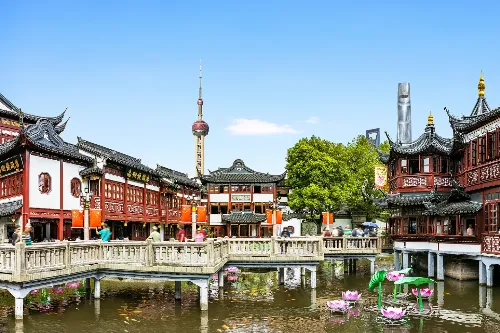
Adjacent to the City God Temple Taoist Temple, Yu Garden is located at No. 100 Yuyuan Road, Huangpu District, and is an important part of the City God Temple Tourist Area. First built in the 38th year of Jiajing in the Ming Dynasty (1559), it was constructed by Pan Yunduan for his father Pan En, and named "Yu Garden", implying "pleasing parents and enjoying a comfortable old age". Covering an area of about 20,000 square meters, Yu Garden is a model of Jiangnan classical gardens, with iconic landscapes such as Sansui Hall, Yangshan Hall, Nine-Zigzag Bridge, Huxin Pavilion and Jade Exquisite. Among them, Jade Exquisite is one of the three famous stones in Jiangnan, about 3.3 meters high and weighing about 5 tons. The stone has many holes, with the characteristics of "wrinkled, leaking, thin and transparent"; the Nine-Zigzag Bridge is about 18 meters long and 2 meters wide, with a tortuous nine-bend bridge body connecting Huxin Pavilion, being one of the most representative landscapes of Yu Garden.
City God Temple Snack Street
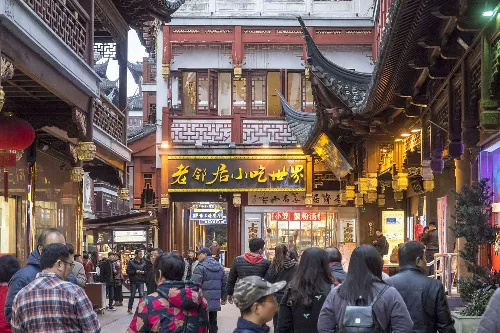
Located on the south side of the City God Temple Tourist Area, the City God Temple Snack Street is about 200 meters long, gathering Shanghai's characteristic snacks such as Nanxiang Steamed Buns, Ningbo Glutinous Rice Balls, Spiced Beans and Pear Syrup Candy, being a concentrated display area of Shanghai's folk food culture. Relying on the historical heritage of the City God Temple, most of the shops are buildings in the Ming and Qing styles, with more than 50 snack shops of various types. Among them, Nanxiang Mantou Shop was founded in the 11th year of Tongzhi in the Qing Dynasty (1872). Its Nanxiang Steamed Buns are famous for their thin skin, abundant filling and rich soup, with a daily sales volume of tens of thousands of cages, being the iconic food of the snack street.
Huxin Pavilion
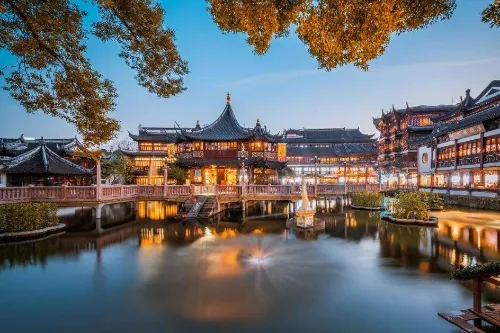
Located in the center of the lotus pond in Yu Garden, Huxin Pavilion was first built during the Jiajing period of the Ming Dynasty, being one of the oldest existing garden pavilions in Shanghai. Covering an area of about 20 square meters, it is an octagonal double-eaved pavilion with a roof covered with blue tiles and copper bells hanging from the eaves corners. There are teahouses inside the pavilion where you can taste tea and enjoy the scenery. Connected with the Nine-Zigzag Bridge, Huxin Pavilion is surrounded by pool water, with lotus flowers in full bloom in summer, being an excellent spot for viewing scenery in Yu Garden. Its architectural style integrates the delicacy and grandeur of Jiangnan gardens, and it is now a cultural relic protection unit of Shanghai.
Recommended Tour Route
Recommended one-day tour route for Shanghai City God Temple: Arrive at the City God Temple Tourist Area at 9:00 a.m., first visit the City God Temple Taoist Temple (about 1 hour), and visit the main hall, Yuanchen Hall, God of Wealth Hall and other core buildings in turn to learn about Taoist culture and Shanghai's City God belief; then walk to Yu Garden (about 2 hours), enter from the main gate of Yu Garden, and visit Sansui Hall, Yangshan Hall, Jade Exquisite, Nine-Zigzag Bridge, Huxin Pavilion and other scenic spots to enjoy the scenery of Jiangnan classical gardens; go to the City God Temple Snack Street at noon to taste characteristic snacks (about 1 hour), it is recommended to try classic snacks such as Nanxiang Steamed Buns and Spiced Beans; visit the old Shanghai commercial street around the City God Temple in the afternoon (about 1.5 hours) to purchase Shanghai specialties such as pear syrup candy and silk; in the evening, you can enjoy the night view of the City God Temple around Yu Garden and feel the market customs of old Shanghai. The total duration of the tour is about 5.5 hours. If you are short on time, you can choose the core route: City God Temple Taoist Temple (40 minutes) → Nine-Zigzag Bridge + Huxin Pavilion (30 minutes) → Snack Street (40 minutes), with a total duration of about 2 hours.
Travel Tips
- The best time to visit is spring and autumn (March-May, September-November), when the temperature is pleasant, the flowers and trees in Yu Garden are lush, and temple fair activities are rich; avoid the high-temperature period in summer (June-August), when the average daily temperature is about 30℃ and there are a large number of tourists.
- It is recommended to hire a tour guide when visiting Yu Garden (cost about 50 yuan per time), which can help you deeply understand the history and architectural characteristics of the garden and enhance the travel experience.
- It is recommended to visit the snack street during off-peak hours. The peak hours of the snack street are from 11:30 a.m. to 1:30 p.m., when the queuing time can be more than 30 minutes, so you can choose to go before 10:00 a.m. or after 2:00 p.m.
- If you want to take a panoramic photo of the City God Temple, you can go to the observation deck of Yu Garden Mall, where the view is wide and you can fully capture the architectural style of the Taoist temple and the surrounding block style.
- Every year on the 15th day of the first lunar month, the Lantern Festival, a lantern show will be held at the City God Temple. It is recommended to arrive 1-2 hours in advance. The number of tourists is large during the lantern show, so you need to pay attention to safety.
- You can visit Shanghai Old Street (Middle Fangbang Road) together when traveling. The old street is adjacent to the City God Temple, about 1 kilometer long, where you can experience the market culture of old Shanghai.
Notes
- Loud talking and making noise are prohibited in the City God Temple Taoist Temple, and touching the gods and offerings at will is not allowed. You need to be neatly dressed when entering the main hall, and wearing slippers or vests is prohibited.
- Climbing rockeries and picking flowers and trees are prohibited in Yu Garden. The deck of the Nine-Zigzag Bridge is narrow, running and pushing are prohibited, especially taking good care of the elderly and children.
- Some shops on the snack street have inflated prices. It is recommended to understand the market price in advance and give priority to choosing time-honored shops with clearly marked prices.
- The number of people in the scenic area is large, so you need to take good care of your personal belongings, especially in crowded areas such as the snack street and the Nine-Zigzag Bridge, to guard against theft.
- Parking spaces around the City God Temple are tight, and there is no public parking lot in the core area. It is recommended to choose public transportation first.
- During religious activities (such as the first and 15th day of the lunar month), the incense in the Taoist temple is strong. Carrying flammable and explosive items into the temple is prohibited, and you should follow the guidance of the on-site staff.
- There are many steps in some areas of the scenic area. For people with limited mobility, it is recommended to bring wheelchairs or walking sticks, and wheelchairs can be rented at the entrance of the scenic area.
Transportation
- Metro: Take Shanghai Metro Line 10 to Yuyuan Station, exit from Exit 1, and walk about 500 meters to reach the main gate of the City God Temple; or take Metro Line 8 to Laoximen Station, exit from Exit 5, and walk about 800 meters to arrive.
- Bus: Take bus lines such as No.11, No.26, No.64, No.715, No.929, No.969 to City God Temple Station and walk about 100 meters to arrive; take bus lines such as No.55, No.65, No.305 to East Zhongshan 2nd Road Xinkahe Road Station and walk about 600 meters to arrive.
- Taxi: For taxis from downtown Shanghai to the City God Temple, it is recommended to choose the entrance of the City God Temple on Middle Fangbang Road as the drop-off point to avoid traffic restrictions in the core area.
- Shared Bike: There are shared bike parking spots around the scenic area. You can ride to the vicinity of Middle Fangbang Road to park, and then walk into the core area (shared bikes are prohibited in the core area).
Opening Hours
Open all day. The opening hours of the City God Temple Taoist Temple are 8:00 a.m. to 4:30 p.m. every day, and admission stops at 4:00 p.m.; the opening hours of Yu Garden are 8:30 a.m. to 5:00 p.m. every day (April 1 to June 30, September 1 to November 30), 8:30 a.m. to 5:30 p.m. (July 1 to August 31), 8:30 a.m. to 4:30 p.m. (December 1 to March 31 of the next year), and admission stops 30 minutes before closing time; the opening hours of the City God Temple Snack Street are 8:00 a.m. to 10:00 p.m. every day, and the business hours of each shop are slightly different. Most shops start business at 9:00 a.m. and stop business at 9:00 p.m. During the Lantern Festival lantern show, Yu Garden and the City God Temple Taoist Temple will extend their opening hours to 9:00 p.m., subject to the announcement of the scenic area.
Tickets
Free and open to the public. Separate tickets are required for the City God Temple Taoist Temple and Yu Garden.
Online Booking
Click here to jump to the Trip.com ticketing platform for ticket purchase.