
Kaiyuan Temple is situated at No.176 West Street, Licheng District, Quanzhou City, Fujian Province. It is a national 4A-level tourist attraction, the largest Buddhist temple in Fujian and a Major Historical and Cultural Site Protected at the National Level. Covering a core area of about 78,000 square meters, the temple faces south with a neat architectural layout. Marked by twin pagodas, it integrates Minnan traditional architecture, Buddhist culture and maritime trade history. As a vital cultural relic of Quanzhou's status as a global maritime commercial hub in the Song and Yuan dynasties, it serves as a core place for spreading Minnan Buddhist culture. There are nearly 30 major halls remaining inside. Boasting the tallest pair of stone pagodas in China, the temple features architectural styles from the Tang and Song dynasties as well as exquisite Minnan craftsmanship, owning tremendous cultural and artistic value.
History and Culture
Constructed in 686 during the Tang Dynasty, Kaiyuan Temple was originally named Lianhua Dojo. Founded on donated land by Huang Shougong, it ranks among the earliest Buddhist temples in Quanzhou. It got its current name in 738. After constant renovation and expansion across dynasties, it remained the religious center of Minnan region.
The temple reached its heyday amid prosperous overseas trade of Quanzhou in the Song and Yuan periods. Its scale expanded steadily and it became an important venue for Buddhist exchanges at home and abroad. Closely linked with Quanzhou Port's maritime history, it witnessed cultural integration of diverse civilizations. The twin pagodas were initially built in the Five Dynasties and Song Dynasty, evolving into superb stone structures representing peak ancient masonry architecture.
Multiple renovations were carried out in the Ming and Qing dynasties, preserving the original layout and cultural heritage. Systematic protection and restoration have been implemented in modern times. It was designated as a national key cultural relic in 1982. In 2021, it was inscribed on the World Heritage List as part of Quanzhou: Emporium of the World in Song-Yuan China, becoming a landmark cultural resort of Quanzhou.
Major Scenic Spots
Twin Pagodas
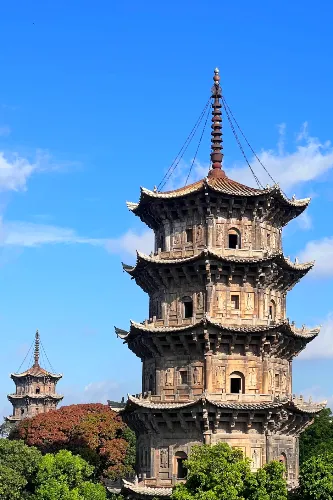
The twin pagodas are iconic landmarks of Kaiyuan Temple and nationally protected cultural relics. The east pagoda is named Zhenguo Pagoda while the west one is Renshou Pagoda. First built as a wooden pagoda in 865 and later rebuilt with stone, Zhenguo Pagoda stands 48.27 meters high with five octagonal floors, adorned with delicate Buddhist carvings. Constructed in 916, Renshou Pagoda reaches 44.06 meters in height with identical structure and fine sculptural details. Built entirely of stones without any wood components, they are the tallest and oldest multi-storey stone pagodas surviving in China.
Mahavira Hall
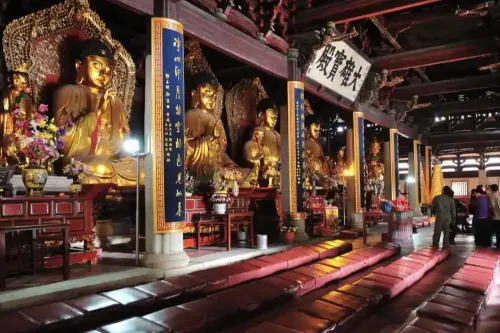
Serving as the core building of the temple, Mahavira Hall dates back to the Tang Dynasty and was reconstructed in the Ming Dynasty. It is 20 meters tall, nine bays wide and six bays deep, covering an area of around 1387 square meters. Statues of three Buddhas are enshrined inside. Twenty-four wooden flying apsara sculptures on the roof perfectly combine Minnan carving art and Buddhist aesthetics, making it the architectural highlight of the temple.
Dew Ordination Altar
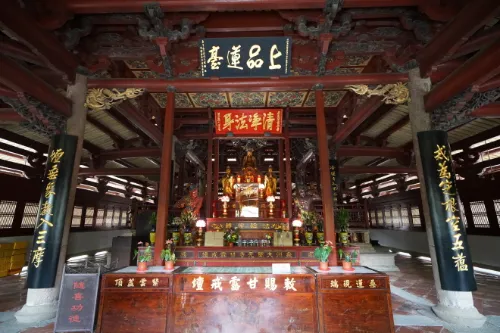
As one of the three existing famous ordination altars in China, it was founded in 1024 of the Northern Song Dynasty and renovated in the Qing Dynasty. The five-tier altar houses Buddha statues and guardian deities. It is a sacred site for Buddhist initiation rituals with rigorous architectural norms, possessing great religious and architectural value.
Ancient Mulberry and Lotus Site
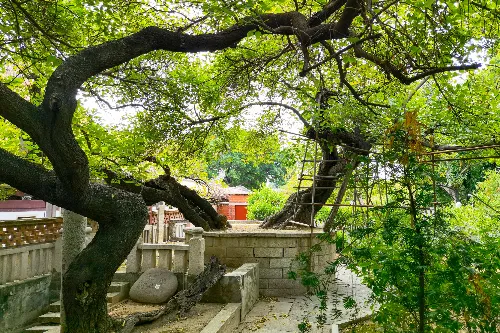
This scenic spot marks the origin of the temple. An ancient mulberry tree aged over 1300 years still grows here, witnessing the founding history of the temple. Legend has it that the tree bloomed white lotus flowers, which led to the construction of the temple. It is the oldest natural and cultural heritage in the scenic area.
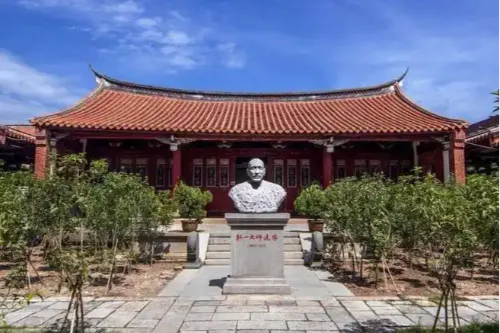
Master Hongyi Memorial Hall
The memorial hall inside the temple is built in memory of eminent modern monk Master Hongyi. It collects his manuscripts, personal belongings, paintings and calligraphy works, displaying his spiritual practice and cultural contributions in Minnan region. It is a notable cultural memorial attraction.
Tour Route
Mountain Gate → Heavenly King Hall → Worship Courtyard → Mahavira Hall → Ancient Mulberry and Lotus Site → Dew Ordination Altar → Zhenguo Pagoda (East Pagoda) → Renshou Pagoda (West Pagoda) → Master Hongyi Memorial Hall → Scripture Repository
Travel Tips
- Spend 1.5 to 2 hours touring to fully visit core spots and experience Buddhist culture
- Prioritize visiting twin pagodas, where visitors can overlook the ancient city with separate tickets required
- Combine the trip with West Street and Zhongshan Road to form an ancient city cultural travel route
- Arrive before 9 a.m. or after 3 p.m. for fewer crowds and better sightseeing experience
- Hire professional guides to learn in-depth historical and architectural knowledge
Precautions
- Keep quiet in the religious area; no loud noise or running around
- No photography or videography inside halls; do not touch relics or climb buildings and pagodas
- Flammable, explosive goods and pets are prohibited from entering
- Observe religious etiquette; avoid random kneeling and stepping on courtyard stone slabs
- Passenger capacity is limited for pagoda climbing, please queue up orderly
- No smoking and littering; protect cultural relics and scenic environment
Transportation
- Bus: Take bus No.2, K502 or K612 and get off at Kaiyuan Temple Stop
- Ancient City Tour Bus: Take the special tour bus and alight at Kaiyuan Temple Station
- Self-driving: Navigate to Kaiyuan Temple parking lot, public parking spaces are available nearby
- Walking: Enter from West Street entrance and walk straight to the mountain gate
Opening Hours
The scenic area opens daily from 08:00 to 17:30, with entry closed at 17:00. The opening time advances to 07:30 on the first and fifteenth day of each lunar month while closing time remains unchanged. Opening hours stay normal on legal holidays, and adjustments will be announced in advance under special circumstances.
Ticket Information
Admission is free of charge. Paid manual explanation service is available. Visitors can follow the official WeChat account “泉州开元寺” to obtain latest updates.
Online Booking
Click here to jump to the Trip.com ticketing platform for ticket purchase.