
Nansha Tianhou Palace is situated at the southeast foot of Dajiao Mountain in Nansha District, Guangzhou City, Guangdong Province. It is a national 4A-level tourist attraction. Covering an area of about 180,000 square meters, it houses one of the larger Mazu temple complexes in South China. Built against mountains and facing the sea, the site integrates Mazu culture, ancient architectural landscapes and coastal scenery. The architectural complex draws on the layout style of the Palace Museum in Beijing and Sun Yat-sen Mausoleum in Nanjing. Halls rise tier upon tier along the mountain, stretching from the square at the foot of the mountain to the Mazu Statue on the mountain top. The core feature of the scenic area is inheriting the belief culture of Mazu. It also serves as a venue for coastal sightseeing and folk worship. As a well-known landmark of Mazu culture in the Guangdong-Hong Kong-Macao Greater Bay Area, it hosts folk sacrificial activities related to Mazu every year, attracting believers and tourists from home and abroad.
History and Culture
Nansha has been an important maritime thoroughfare since ancient times, and folk belief in Mazu has a long history. Small-scale Tianhou palaces were built in Nansha in history but were destroyed over the passage of time. The existing Nansha Tianhou Palace started construction in 1994 and officially opened to the public in 1996. Its construction absorbed architectural concepts of Mazu temples at home and overseas, aiming to build an important venue for Mazu cultural exchanges among Guangdong, Hong Kong and Macao.
Mazu culture originated in Putian, Fujian Province, and spread along the Pearl River Estuary with maritime trade. Merchants and fishermen navigating the Lingding Ocean in ancient times often prayed to Mazu for safe voyages. Located at the strategic throat of the Lingding Ocean, Nansha became a vital node in the spread of Mazu faith along the Pearl River Estuary. Since its completion, Nansha Tianhou Palace has continuously promoted the inheritance of Mazu culture. It regularly holds Mazu sacrificial ceremonies, folk exhibitions and cultural seminars, acting as a key platform connecting exchanges of Mazu folk beliefs across Guangdong, Hong Kong and Macao.
Every year on the 23rd day of the third lunar month, the birthday of Mazu, the scenic area holds grand sacrificial rituals following traditional ceremony procedures. It carries forward the folk tradition of worshipping Mazu along the Lingnan coast and fully showcases the marine folk culture of Lingnan region.
Major Attractions
Giant Mazu Statue
The Giant Mazu Statue stands atop Dajiao Mountain and serves as the landmark of Nansha Tianhou Palace. Carved from granite, the statue is 14.5 meters high, facing the Lingding Ocean and overlooking the Pearl River Estuary. The viewing platform on the summit offers broad vistas covering waters of the Pearl River Estuary and Humen Bridge. The platform is suitable for sightseeing and worship, and also the best spot for tourists to take panoramic coastal photos.
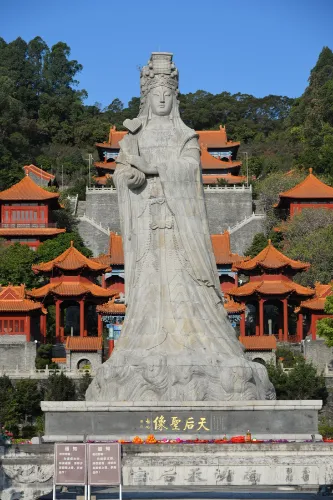
Entrance Square
The Entrance Square lies at the scenic area gateway with flat and open ground. The main gate of Tianhou Palace stands in the center, decorated with stone lions and landscape greenery. The square functions as a tourist distribution zone. Cultural display zones on both sides briefly introduce the life of Mazu and the construction history of Tianhou Palace. It marks the starting point to enter the temple complex.
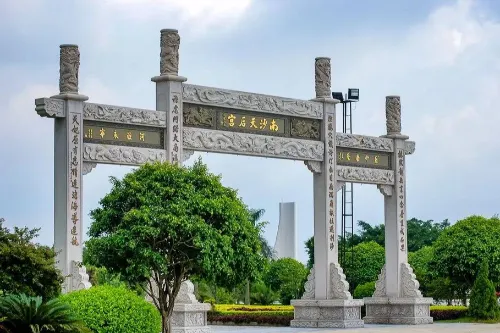
Main Hall
The Main Hall is the core building of the temple, erected on the terrace in the middle of the complex. Inside enshrines the primary statue of Mazu alongside attendant guardian deities. The hall adopts the double-eaved hip-and-gable roof, a traditional Lingnan palace architectural style, with exquisite carved beams and painted rafters and sacrificial ritual furnishings. It is the primary worship venue for believers. A courtyard in front of the hall allows tourists and worshippers to conduct prayer ceremonies.
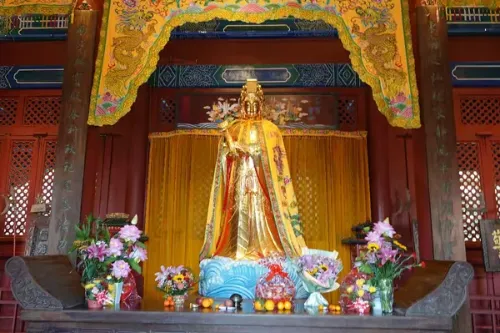
Nanling Pagoda
Nanling Pagoda sits on the hillside to the west of Tianhou Palace. It is an octagonal seven-storey pavilion-style ancient pagoda with a height of 45 meters. Constructed based on traditional feng shui principles, visitors climbing the pagoda can overlook the entire Tianhou Palace complex and coastal mudflats. Stairs run upwards inside the pagoda. Serving as both a scenic landmark and a sightseeing tower, it is one of the important ancient architectures within the scenic spot.
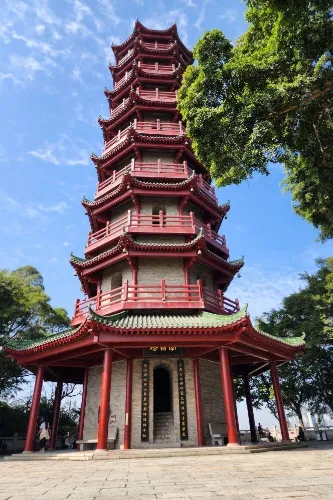
Bell and Drum Towers
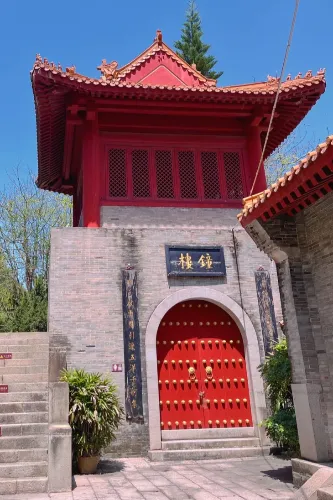
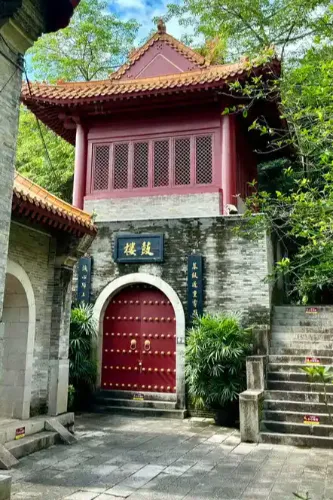
The Bell Tower and Drum Tower stand symmetrically on two sides in front of the Main Hall. The Bell Tower houses a large bell while the Drum Tower contains a huge drum. Bells and drums are struck during grand traditional sacrificial ceremonies to create a solemn ritual atmosphere. With simple and elegant appearance, they are typical components following ancient temple architectural regulations.
Back Hall
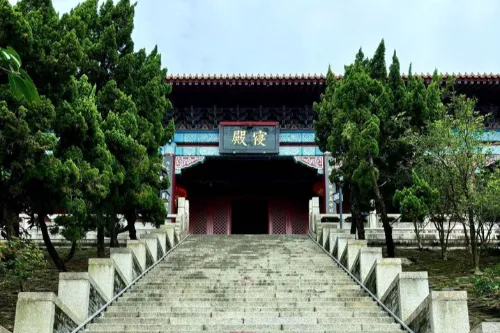
The Back Hall is located beside the main architectural complex. It mainly enshrines statues of Mazu’s ancestors. As a supporting ritual building of the temple, it features a simple layout and completely preserves the traditional architectural specifications of Tianhou Palace. Visitors can learn folk legends related to Mazu’s family here.
Suggested Tour Route
Scenic Area Entrance → Entrance Square → Bell and Drum Towers → Courtyard and Main Hall → Back Hall → Mountain Hiking Trail → Nanling Pagoda → Summit Viewing Platform of Giant Mazu Statue → Coastal Footpath
Travel Tips
- It is recommended to visit in the morning or late afternoon to avoid midday heat. The lighting on the mountain top is also ideal for photography.
- The route includes mountain climbing sections. Wear comfortable non-slip flat shoes; high heels are not advised.
- There are many steps leading up to the Giant Mazu Statue platform. Visitors with limited physical strength may slow down and take breaks on the way.
- Please abide by temple regulations for worship. Purchase prayer supplies officially sold inside the scenic area preferentially.
- After sightseeing, you may walk to the coastal zone outside the scenic area to enjoy river views and get a close view of Humen Bridge.
- A large number of tourists come during Mazu’s birthday celebration in the third lunar month. Choose weekdays if you want to avoid crowds.
Notes
- Keep quiet inside temple halls. Do not shout or chase others.
- Do not touch statues and sacrificial utensils randomly inside halls. Climbing railings and walls of ancient buildings is prohibited.
- Open flame is banned in mountainous zones of the scenic spot. Bringing fire sources and burning unapproved sacrificial offerings are strictly forbidden.
- Steps on hiking trails are steep and slippery on rainy days. Walk cautiously for safety.
- Protect plants, stone carvings and ancient buildings in the scenic area. No graffiti or picking plants.
- Pets are not allowed in core worship zones of the temple. Follow relevant management rules of the scenic spot.
- Strong winds blow on the mountain top. Take good care of light belongings to prevent them from being blown away.
Transportation
- Public Transport: Take Guangzhou Metro Line 4 to Nanheng Station, then transfer to Nansha Bus Route N4 or N54 to reach Nansha Tianhou Palace Bus Stop.
- Self-driving Navigation: Set destination as "Nansha Tianhou Palace". Parking lots are available inside the scenic area for private vehicles.
- Water Transport: Water routes are available during certain periods to Nansha Port Area. Transfer to buses to the scenic spot afterwards. Verify ferry schedules before departure.
Opening Hours
Nansha Tianhou Palace normally opens from 08:30 to 17:30 every day. The visiting hours for the inner worship zones of temple halls are consistent with the overall opening time of the scenic area. Any adjustment to opening hours during statutory holidays and Mazu birthday folk activities will be subject to on-site announcements. Under extreme weather conditions, the scenic area may temporarily close hiking trails or suspend operation entirely.
Ticket Information
The admission ticket costs 20 RMB per person. Search the official WeChat service account "广州南沙天后宫旅游景区" to obtain the latest updates.
Online Booking
Click here to jump to the Trip.com ticketing platform for ticket purchase.