
Qinghui Garden Museum is located at No.23 Qinghui Road, Daliang Subdistrict, Shunde District, Foshan City, Guangdong Province. It is a Major Historical and Cultural Site Protected at the National Level, a national 4A-level tourist attraction, and one of China’s Top Ten Classical Gardens. Together with Liang Garden in Foshan, Yuyin Mountain House in Panyu and Keyuan Garden in Dongguan, it is known as one of the Four Great Qing-dynasty Gardens of Guangdong. It is also the site of "Qinghui Elegance", one of the New Eight Scenic Spots of Foshan. Covering an area of 22,000 square meters, the garden integrates the art of Lingnan classical gardens, Jiangnan garden techniques and the water-town features of the Pearl River Delta. It adopts the design philosophy of creating grand scenes within limited space with flexible and varied architectural forms. Most existing heritage buildings in the garden were built in the Qing Dynasty, including pavilions, waterside halls, main halls, studios, galleries, towers, terraces, covered corridors and boat-style buildings. Lingnan craftsmanship such as wood carving, grey sculpture and etched coloured glass are widely used for decoration. Lush flowers and trees offer changing views at every step. Now open to the public as a museum, it undertakes the functions of cultural relic preservation, exhibition and study tours.
History and Culture
The origin of Qinghui Garden can be traced back to the Ming Dynasty. In the Dingwei year of the Wanli reign of the Ming Dynasty (1607), Huang Shijun, a top scholar, built the Huang Ancestral Hall, Tianzhang Pavilion and Ling’e Pavilion here in the first year of the Tianqi reign of the Ming Dynasty (1621). This place was originally the mansion of the top scholar. During the Qianlong reign of the Qing Dynasty, Long Yingshi, a jinshi from Daliang, purchased the former site, renovated it gradually and planted flowers and trees, and the garden took initial shape. Later, Long Tinghuai built Xiaofang Garden, and his son Long Yuanren continued the expansion and named the garden "Qinghui Garden". The name derives from the poem "Who says the heart of a tiny grass can repay the radiance of the spring sun". The Long family spent generations carefully developing the garden, and added Long Taichang Garden, Chuxiang Garden and other courtyards one after another, until the layout of the garden was finalized.
During the War of Resistance against Japanese Aggression, the garden was poorly maintained and gradually fell into disrepair. In 1959, local authorities launched the restoration project of Qinghui Garden. Chuxiang Garden, Guangda Garden, Jiemei Hall and Jingqin Hall were incorporated into the compound and collectively named Qinghui Garden. At the end of the 1990s, the Shunde local government allocated funds for large-scale reconstruction and expansion to restore the original look of the ancient garden, forming the current layout of three zones: the front garden, the old garden and the new garden.
Qinghui Garden embodies the aesthetic taste and the tradition of valuing education of Lingnan scholar-officials in the Ming and Qing dynasties. A large number of couplets, wood carvings, coloured glass windows, stone carvings and brick carvings are preserved inside. Some of the coloured windows adopt modern etched coloured glass, which reflects the traces of foreign exchanges in modern Lingnan. It is an important physical relic for the study of Lingnan garden history and local humanities in Shunde. It was designated as a Major Historical and Cultural Site Protected at the National Level in 2006, and Qinghui Garden Museum was later established for public opening.
Major Attractions
Boat Hall (Young Lady’s Tower)
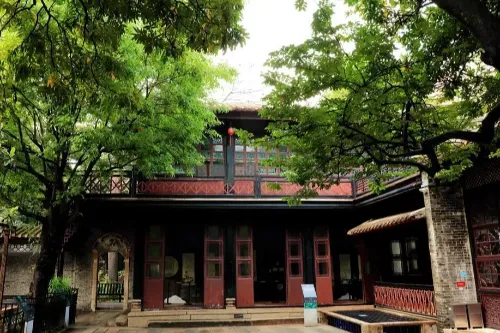
Situated at the northeast corner of the Square Pond, the Boat Hall is one of the architectural highlights of the whole garden. It was built in the Jiaqing reign of the Qing Dynasty, a two-storey brick-and-timber boat-style building modelled on the "Zidong Boat", a type of barge from the Pearl River Delta. The overhead corridor on the second floor is decorated with wavy railings to echo the shape of a boat. It is said to be the boudoir for the female residents of the garden, hence the alternative name "Young Lady’s Tower". It is a classic example of boat-style architecture in Lingnan gardens.
Bixi Thatched Hall
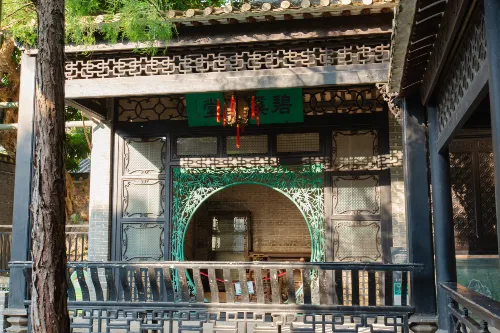
Bixi Thatched Hall was built in the Bingwu year of the Daoguang reign of the Qing Dynasty (1846). It is a waterside bungalow made of polished blue bricks and one of the oldest surviving buildings in the garden. The front of the hall features an exquisite hollow wood carving of green bamboo, forming a round doorway with a square outer frame, known as a "round light screen" in ancient architecture. The waist of the outer wall is embedded with an intaglio brick carving inscribed with "Light Wisp of Mist, Dew upon Petals". The hall has black beams and white tiles, with dark red brick paving on the floor. It is a quiet place, once used by the garden owner for reading and receiving guests.
Chengyi Pavilion
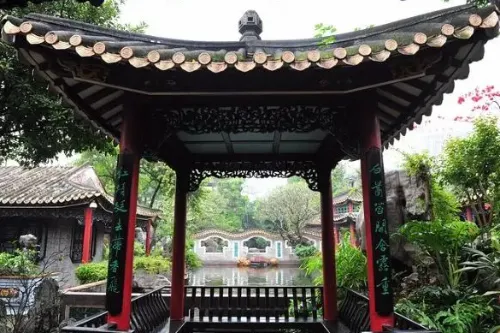
Chengyi Pavilion stands by the water next to the Octagonal Cracked Pond. The pavilion is open on all sides with a broad view. Visitors can watch fish, rockery reflections and trees in the pond. It is a core spot for enjoying waterside scenery and rest. With a light and elegant shape, it sets off beautifully against the water surface.
Fenglai Peak
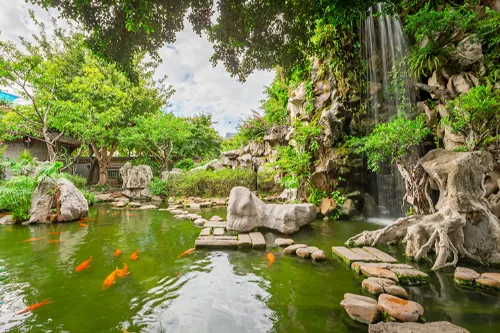
Fenglai Peak is a large rockery in the garden stacked with Ying stones. Stone steps are built inside the rockery, together with a small cascading waterfall. Standing on the top, visitors can overlook the surrounding buildings and trees of the garden. It is a representative work of Lingnan rockery landscaping, creating a mountain forest atmosphere within a limited space.
Xiyin Study
Xiyin Study was a place for reading in ancient times. Its name means cherishing time. It is a small and quiet courtyard enclosed by bamboo trees. It comes with Zhenyan Studio. It was the place for the Long family’s children to study, filled with scholarly charm.
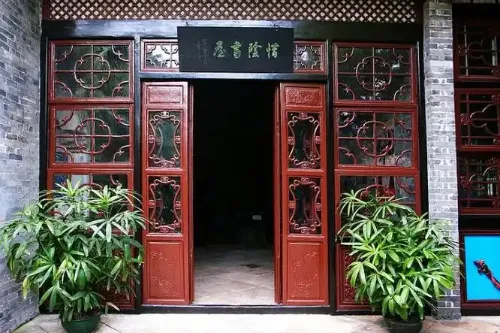
Bishenghua Studio
Bishenghua Studio is adjacent to the Xiyin Study area. It is also a study building. Its name carries the wish of writing brilliant works. The architecture is simple and elegant for reading and writing. Many couplets are preserved inside, reflecting the garden owner’s respect for education.
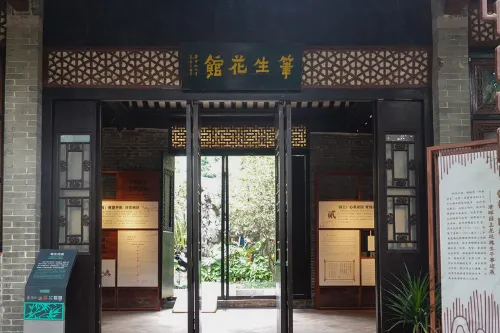
Guiji Lodge
Guiji Lodge lies in the rear part of the garden with a serene environment. Its horizontal board was inscribed by Li Wentian, a third-rank scholar from Shunde in the Xianfeng reign. The name means "returning home from officialdom and dwelling in the courtyard", echoing Long Tinghuai’s original intention of building the garden for seclusion. The courtyard has a restrained layout and served as a quiet retreat for the garden owner.
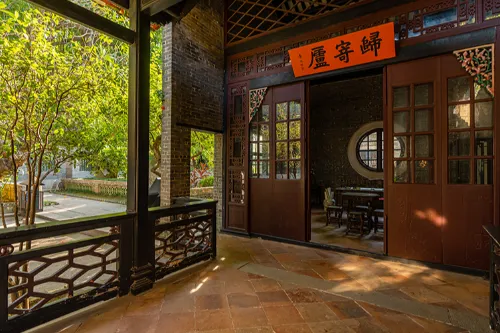
Muying Stream
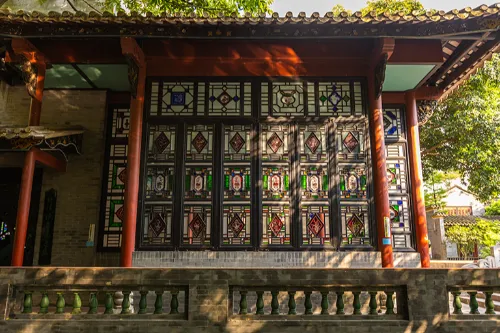
Muying Stream is a waterside courtyard including Linglong Pavilion and Linbie Pool Hall. Around the stream are rocks symbolizing spring, summer, autumn and winter, with fine trees planted among them. Water flows under the bridge. Its highlight is etched coloured glass windows. Sunlight casts colourful light and shadows through the glass, making it a showcase of the garden’s integrated Chinese and Western decorative arts.
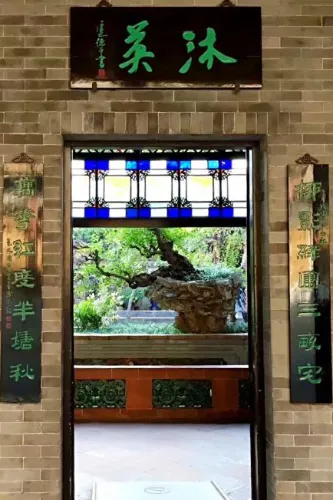
Xiaopengying
The horizontal board of Xiaopengying Hall was written by Song Xiang, a poet and calligrapher from Zhaoqing in the Qianlong reign of the Qing Dynasty. "Pengying" refers to the fairy islands Penglai and Yingzhou, expressing the owner’s noble and detached aspiration. A large painted wood carving "Peach of Longevity" is displayed in the hall, depicting a peach tree with luxuriant branches and ripe peaches. It is a fine piece of wood carving art in the garden.
Liufen Pavilion
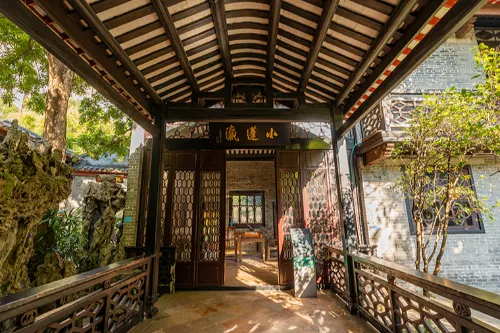
Liufen Pavilion is located in the northeast corner of the garden. It is the tallest building in the whole garden with three storeys. This pavilion-style building adapts to the humid climate of Guangdong. Precious etched coloured glass is embedded in the windows on the ground floor. It is related to the legend that Huang Shijun, the top scholar of the Ming Dynasty, lived in seclusion upstairs and refused to step on the land ruled by the Qing court. Visitors can overlook the whole garden from the top.
Tour Route
Enter from South Gate → Octagonal Cracked Pond → Chengyi Pavilion → Bixi Thatched Hall → Hexagonal Pavilion → Boat Hall (Young Lady’s Tower) → Muying Stream → Fenglai Peak → Xiyin Study → Zhenyan Studio → Bishenghua Studio → Guiji Lodge → Xiaopengying → Liufen Pavilion → Zhuangyuan Hall → Exit from North Gate
Tour Suggestions
- The recommended visiting time is 1.5 to 2 hours. The garden is rich in details and suitable for slow sightseeing rather than a quick glance.
- You may book tickets in advance via the WeChat official account "Shunde Qinghui Garden Museum" to visit off-peak and reduce queuing time.
- Visit right after opening or after 15:00 for soft light, better photography effects and fewer crowds.
- Take part in the scheduled free guided tours inside the garden to learn about the history, wood carvings and coloured glass windows.
- After the tour, you may walk to the nearby Huagai Road Pedestrian Street to taste local Shunde delicacies.
- Mosquitoes are common in summer. Bring mosquito repellent and wear comfortable non-slip shoes.
Notes
- Qinghui Garden is a Major Historical and Cultural Site Protected at the National Level. Smoking is banned throughout the garden. Picking flowers and fruits, trampling lawns, scribbling and damaging heritage buildings and garden facilities are prohibited.
- Pets and flammable, explosive dangerous goods are not allowed. Except for baby strollers and wheelchairs for the disabled, other mobility devices cannot enter the garden.
- Drone flight is forbidden inside the garden. Commercial photography, filming, assemblies and group team-building activities are not permitted without prior approval.
- Study tour groups need to call the scenic spot in advance for registration. The garden generally does not receive study tour groups on weekends and statutory holidays due to heavy visitor flow.
- Please keep quiet and avoid disturbing other visitors.
- Some buildings may be temporarily enclosed for heritage restoration. Check the official WeChat account for updates before your trip.
Transportation
- Metro: Take Foshan Metro Line 3 to Daliang Zhonglou Station, then walk a few hundred metres along Qinghui Road after exiting the station.
- Bus: Take various bus routes to the "Qinghui Garden" stop and walk to the entrance.
- Self-driving: Navigate to "Qinghui Garden Museum". The garden is in the old town of Daliang with parking spaces nearby. Parking is tight on holidays, so public transport is recommended.
Opening Hours
Qinghui Garden Museum opens from 09:00 to 17:30, and ticket checking stops at 17:00. Visitors must enter the garden before the stop time. The opening arrangement may be adjusted dynamically according to holidays and heritage maintenance work. Please check the official WeChat account for the latest information before visiting.
Ticket
Tickets start from 26 RMB per person. Search for the WeChat official account "佛山市顺德区清晖园博物馆" for the latest updates.
Online Booking
Click here to jump to the Trip.com ticketing platform for ticket purchase.