
Located in Lintan County, Gannan Tibetan Autonomous Prefecture, Gansu Province, the Yeliguan Tourist Area is situated at the northeastern edge of the Qinghai-Tibet Plateau and the western section of the Qinling Fold Belt, serving as a transitional zone between the Qinghai-Tibet Plateau and the Loess Plateau. Centered on Yeliguan Town in Lintan County, the tourist area consists of two connected zones: Chibi Valley (Red Cliff Valley) and Tianchi Yehai (Ye Sea Tianchi). It covers a total area of 20.2 square kilometers.
The scenic area integrates alpine lakes, Danxia landforms, subalpine meadows, and forest canyons, featuring original forests, subalpine meadows, and other pristine natural landscapes interwoven with highland terrace cultural landscapes, offering extremely high ornamental and recreational value. In December 2024, it was rated as a national 5A-level tourist attraction. Additionally, it has successively won titles such as National Geopark, National Forest Park, National Water Conservancy Scenic Area, and National Sports Tourism Demonstration Base, as well as honors like China's Top Ten Cultural and Ecological Tourism Destinations and China's Forest Oxygen Bar.
The unique geographical environment has nurtured rich animal and plant resources. The area is home to over 1,300 species of higher plants belonging to 433 genera in 122 families, including more than 30 rare plant species and 40 precious tree species, over 30 species of national rare animals, 37 species of endangered butterflies, and more than 120 species of precious wild medicinal herbs, making it an important treasure trove of Chinese herbal medicine resources in Northwest China.
History and Culture
Yeliguan has a long history. According to records, Shuichi County was established in 443 AD (the 4th year of Taiping Zhenjun in the Northern Wei Dynasty); in 518 AD (the 1st year of Shengui in the reign of Emperor Xiaoming), Qie Tiehu, a Qiang tribesman from Fuhan, declared himself king here; Shuichi County was maintained during the Sui Dynasty; in the late Tang Dynasty, it fell under the rule of Tubo, and Gongling City was built for garrison; during the Ming and Qing Dynasties, it was under the jurisdiction of Taozhou.
Historically, Yeliguan was an important post station and gateway to Tibet on the "Tang-Tubo Ancient Road" and "Tea-Horse Ancient Road," serving as a key channel for tea-horse trade between the Tibetan area and Gansu region, and witnessing the cultural exchange and integration of Tibetan, Hui, Han, and other ethnic groups.
It is the birthplace of the renowned Taozhou Hua'er, an annual Hua'er grand gathering famous at home and abroad. The area also preserves historical relics such as the Quantan Peasant Uprising Site, as well as multiple ancient castle ruins including Shuichi County Ancient City, Gongling City, Shiguan Fort, and Xincheng Fort. Remnants of ancient castles like Dashun City from the Song Dynasty and Shimiao Fort from the Ming Dynasty can still be found, with the ancient Qin Zhidao (Straight Road) winding through the mountains like a long dragon.
Main Attractions
Chibi Valley (Red Cliff Valley)
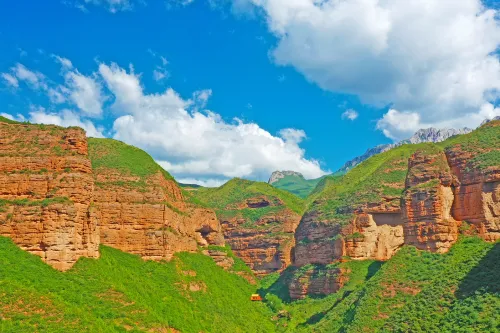
Located 5 kilometers west of Yeliguan Town, it is a typical Danxia landform. Amidst a sea of green, ochre-colored rock formations abruptly emerge. Fronting the Yemu River, the valley extends northward into the Baishi Mountains, stretching as deep as 20 kilometers. A small stream flows through the valley bottom, with both walls composed of red sandstone. Thousands of years of wind and rain erosion have shaped the walls into countless strange forms: some resemble red screens, others like lions and tigers leaping out, monks chanting sutras, or pythons twisting and turning. Walking through the valley inspires endless reverie.
Tianchi Yehai (Ye Sea Tianchi)
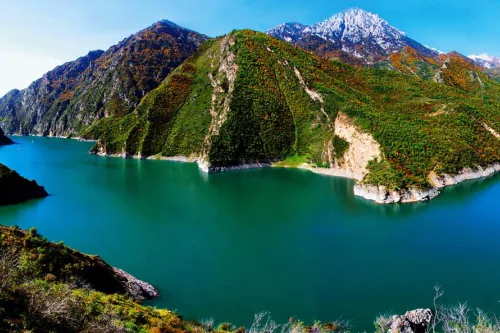
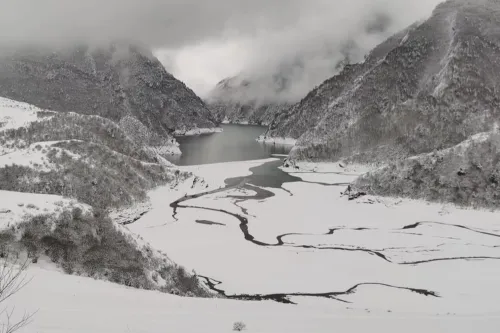
Located 5 kilometers north of Yeliguan between Baishi Mountain and Miaohua Mountain, it is an alpine barrier lake at an altitude of 2,610 meters. The lake is 5 kilometers long, with a width ranging from tens to hundreds of meters. The clear blue lake water ripples gently, surrounded by green mountains and blooming wildflowers. A Changye Temple stands on a hill by the lake, enshrining a statue of Chang Yuchun, a general from the early Ming Dynasty, hence the local name "Changye Pool." In midwinter, the lake freezes over, and the ice surface displays various mysterious ice patterns. Local residents traditionally gather on the 8th day of the 12th lunar month to observe these patterns and predict the next year's planting and harvest.
General's Horse Watering Spot
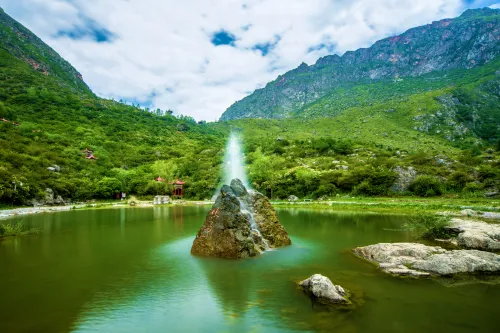
The Horse Watering Spring is located at the bottom of the valley below Shimenkan of Tianchi Ye Lake, and it is a canyon flat spring with water sourced from Tianchi Ye Lake. It covers an area of about 300 square meters and has a depth of approximately 1.7 meters. According to legend, General Chang Yuchun of the Ming Dynasty watered his horses here during his military campaigns, hence the ancient name "Horse Watering Spring". The spring water is abundant all year round with a constant water level, and it is also known as the "Eye of the Earth".
Xiangshui Grassland
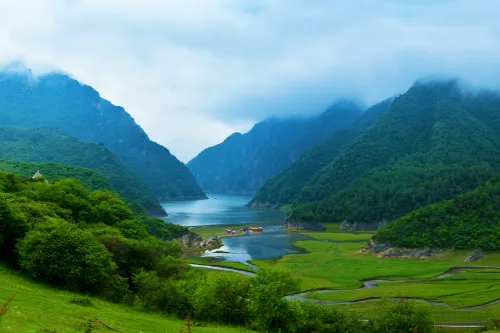
As one of the main water sources of Tianchi Ye Lake, Xiangshui River enjoys the reputation of "the Source of Ye Lake". The grassland surrounding Xiangshui River is called "Xiangshui Grassland". Due to the differences in channel gradient, lithology and other factors between the upper and lower reaches of Xiangshui River, a typical "meander" landscape is formed. In terms of shape, the meander looks just like a snake.
Ye Lake Ice Patterns
Ye Lake Ice Patterns is one of the famous Eight Scenes of Taozhou. Every year in the coldest days of winter, the mountain tops around Tianchi Ye Lake are covered in snow, and the lake surface freezes solid. The ice surface presents a variety of vivid and lifelike patterns, ranging from small items like pots and bowls to large structures such as pavilions and towers, with everything you can think of. Standing on the crystal-clear ice surface, you feel as if you are in a crystal maze.
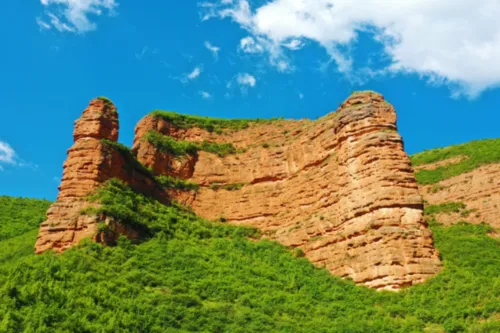
Imperial Edict Cliff
It is a typical Danxia stone gate landscape, formed by red clastic rocks cemented by unevenly mixed layered ferric and calcareous materials, which are cut by vertical or high-angle joints and shaped by comprehensive factors such as weathering, gravity and water erosion. It is named "Imperial Edict Cliff" because of its shape resembling an imperial edict.
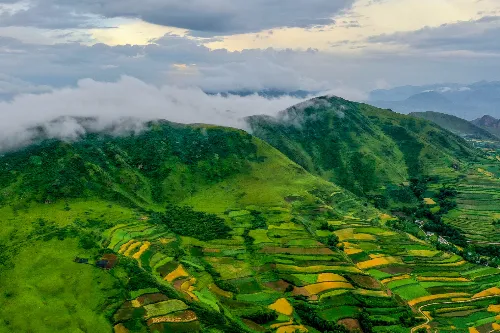
Terraced Field Flower Sea
The terraced field scenery has now become a beautiful landscape in the Yeliguan Scenic Area. Overlooking from a high place, the well-arranged terraced fields extend down from one mountain top and climb up another, with a unique geometric beauty in their layers.
Recommended Tour Route
Recommended one-day tour route: Chibi Valley to admire the Danxia landform → Tianchi Ye Lake to enjoy the alpine lake scenery.
Travel Tips
- Wear comfortable sports shoes, as some attractions require walking, such as Chibi Valley.
- The temperature difference between day and night in the plateau area is large. Bring a jacket for warmth, and prepare sunscreen products in summer.
- Respect the customs of local ethnic minorities and follow etiquette norms when entering religious sites.
- Pay attention to scenic area weather warnings in advance and avoid entering canyon areas during rainy days.
Notes
- Do not pick plants or feed wild animals in the scenic area to protect the ecological environment.
- The roads around Tianchi Yehai are narrow. Pay attention to safety during sightseeing and do not approach dangerous areas by the lake.
- Do not make loud noises or damage Danxia landform landscapes in Chibi Valley.
- Self-driving tourists must follow scenic area traffic guidelines and park vehicles properly.
- When purchasing local specialties, it is recommended to choose regular shops and confirm prices.
Transportation
- 【Self-driving】From Lanzhou, take the Lanlin Expressway and transfer to National Highway 213, passing through Lintao, Kangle, etc. The whole journey is about 180 kilometers, taking 3.5 hours. From Hezuo City, the prefectural capital of Gannan, drive along National Highway 316 for about 90 kilometers, taking 2 hours.
- 【Public transportation】Take a bus from Lanzhou South Bus Station to Lintan County, then transfer to a bus or tourist shuttle to Yeliguan Town at Lintan County Town. The whole journey takes about 4.5 hours.
Opening Hours
Peak season: 07:30 - 19:00
Off-season: 09:00 - 16:00
For reference only. Opening hours may be temporarily adjusted due to extreme weather or special events. It is recommended to check the latest information through official scenic area channels before traveling.
Admission Tickets
Full-price ticket: 60 yuan/person
You can search the official WeChat public account "冶力关旅游区" on WeChat to get the latest updates or purchase tickets online.
Online Booking
Click here to jump to the Trip.com ticketing platform for ticket purchase.