
Shanghai Astronomy Museum is located at No. 380 Lingang Avenue, Lingang New Area, Pudong New District, Shanghai. It is currently the largest astronomy museum in the world in terms of building area. With the core concept of "Connecting People and the Universe", the museum integrates architectural aesthetics with astronomical technology. Its overall design closely follows the "cosmos" theme, offering an immersive astronomical exploration experience from its exterior to the internal exhibitions. The total construction area of Shanghai Astronomy Museum is about 38,164 square meters, of which the exhibition area covers around 12,500 square meters. It includes three core exhibition areas: Home, Cosmos and Journey, as well as special functional zones such as the Star News Salon, Wangshu Observatory and Xihe Solar Tower. The museum houses approximately 70 pieces/sets of precious astronomical relics and is equipped with advanced facilities like a dome theater, optical observatory and digital observatory. Balancing the professionalism of science popularization and education with engaging interactive experiences, it has become a vital astronomical science popularization and education base and a cultural tourism landmark in the Yangtze River Delta region and even across the whole country.
History and Culture
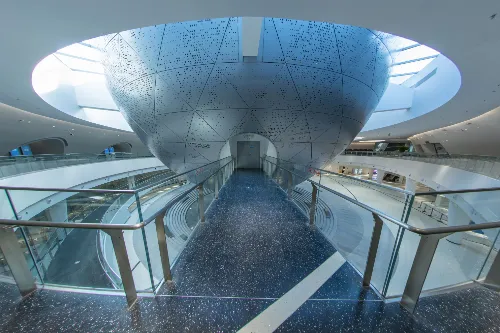
The planning and construction of Shanghai Astronomy Museum started in 2014. Its project approval and development are closely aligned with Shanghai's strategy of building a global science and technology innovation center, aiming to fill the gap of large-scale professional astronomy museums in East China and enhance the public's scientific literacy and understanding of cosmic exploration. Designed by East China Architectural Design & Research Institute Co., Ltd., the building features a "Three-Body" structure corresponding to the circular skylight, inverted dome and planetarium. These three elements form the visual symbol of "celestial movement", echoing the ancient Chinese astronomical observation concepts while integrating the scientific connotation of modern astrophysics.
In terms of cultural inheritance, Shanghai Astronomy Museum deeply integrates the essence of Chinese and Western astronomical cultures. It not only displays ancient Chinese astronomical observation instruments such as armillary spheres and simplified armillary spheres, telling the exploration stories of ancient astronomers like Zhang Heng and Zu Chongzhi, but also presents the major achievements of modern human cosmic exploration, such as lunar rock samples brought back by the Apollo moon landing mission and a 1:1 model of the Zhurong Mars rover. It thus constructs an astronomical cultural context spanning from tradition to modernity and from local to global perspectives. Officially opened on July 18, 2021, Shanghai Astronomy Museum marks China's entry into the international forefront in the construction of astronomical science popularization infrastructure, and serves as an important carrier for inheriting and promoting astronomical culture and inspiring the public's spirit of scientific exploration.
Main Attractions
Home Exhibition Area
Located on the first floor of Shanghai Astronomy Museum, the Home Exhibition Area covers an area of about 3,000 square meters and is the most down-to-earth section among the three core exhibition areas. With the core thread of "Earth-Moon-Sun", the area showcases the composition of the solar system, the evolution of the Earth and the movement relationships between the Sun, Earth and Moon through immersive theaters, interactive models and physical exhibits. Among them, the 18-meter-diameter Earth model is the iconic exhibit of the area, using dynamic projection technology to reproduce natural phenomena such as atmospheric movement and plate tectonics on Earth. Meanwhile, the area also displays lunar soil samples, various meteorite specimens and interactive devices simulating the formation of solar and lunar eclipses, allowing visitors to intuitively understand the impact of celestial movements on the Earth's environment.
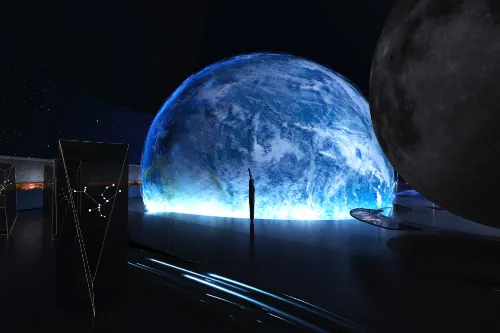
Cosmos Exhibition Area
Distributed on the second floor of the museum, the Cosmos Exhibition Area covers around 4,000 square meters and focuses on macro astronomical topics such as galaxies, black holes, dark matter and the origin of the universe. Taking "the scale of the universe" as the clue, the area presents the spatial hierarchy from the solar system to the Milky Way, from galaxy clusters to the edge of the universe through giant sky screens, VR experiences and data visualization technologies. Among them, the "Black Hole Theater" is the core experience project of the area, using 3D animation and acoustic effects to simulate the gravitational effects and spacetime distortion phenomena of black holes. In addition, the area also displays the observation achievements of the Hubble Space Telescope and the James Webb Space Telescope, as well as popular science content on cutting-edge astronomical theories such as the Big Bang and stellar evolution, systematically presenting the laws of the birth and evolution of the universe.
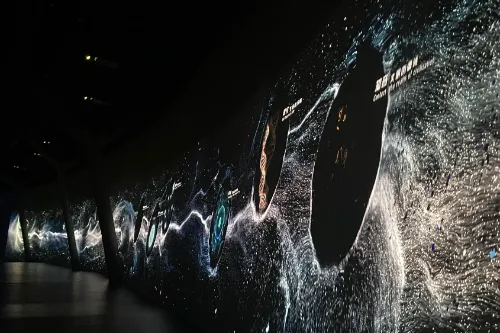
Journey Exhibition Area
Situated on the third floor of the museum, the Journey Exhibition Area covers an area of about 3,500 square meters and focuses on the history of human cosmic exploration, divided into three sub-sections: "Heading to Space", "Exploring the Solar System" and "Interstellar Voyage". The area exhibits physical objects and replicas of aerospace artifacts such as the return capsule of China's Shenzhou spaceship, models of the Long March series rockets and the model of the Chang'e-5 probe, fully demonstrating the development of China's aerospace industry from its inception to lunar and Martian exploration. At the same time, it also displays international aerospace exploration achievements, such as the model of the Apollo 11 lunar module and physical replicas of Mars rovers. In addition, the area sets up interactive experience projects simulating space station life and spacewalks, allowing visitors to immerse themselves in the hardships and achievements of human cosmic exploration.
Chinese Sky Observation Exhibition Area
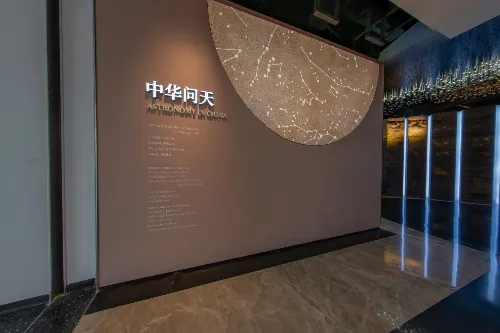
After thousands of years of diligent observation, a vast amount of astronomical records have been accumulated. The unique Eastern thinking has created a distinctive astronomical system that closely links celestial phenomena with the fate of empires, as well as a complex calendar system with orderly inheritance and continuous improvement. With the impact of the introduction of Western learning to the East, the constantly incoming scientific knowledge ultimately changed the form and function of traditional astronomy, and also made Shanghai the starting point of modern astronomy in China.
Mars Mission Exhibition Area
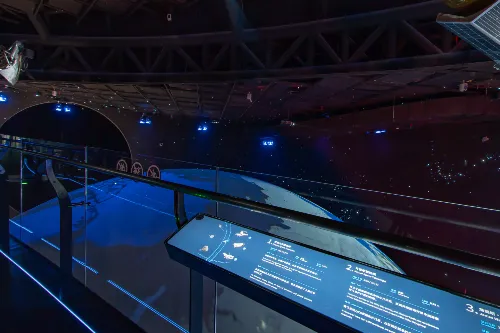
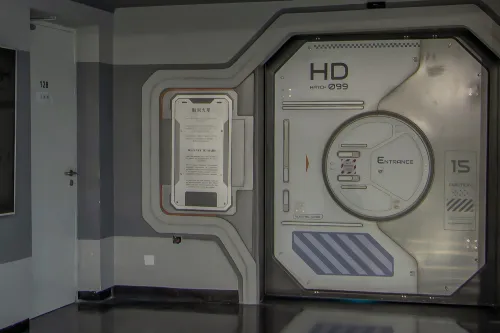
It is a fantasy about space travel and Mars development 50 years from now, where visitors will form a Mars rescue team and fly to the Mars base. Inside the exhibition hall, realistic scenes show the rendezvous and docking of space vehicles, the landing process of the lander on Mars is staged, and the Mars base presents a vivid and lifelike look.
Xihe Solar Tower
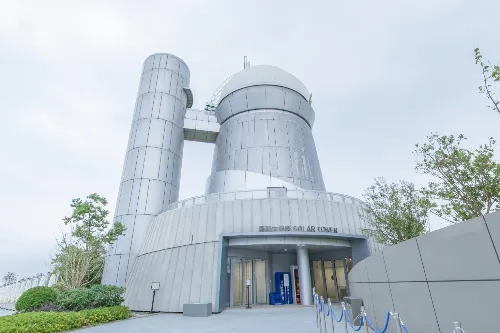
Named after Xihe, the sun goddess in Chinese mythology, the Xihe Solar Tower is one of the special facilities of Shanghai Astronomy Museum. Equipped with a solar telescope and relevant observation equipment, it can conduct real-time observation of the activities of the photosphere and chromosphere of the Sun, such as sunspots, solar flares and prominences. The observation data is transmitted to the exhibition area of the museum in real time, enabling visitors to directly observe the dynamic activities of the Sun and understand the impact of the Sun on the Earth's space environment.
Dome Theater
The Dome Theater of Shanghai Astronomy Museum has a spherical screen with a diameter of 20 meters and can accommodate 280 audiences. Adopting 4K laser projection technology and an immersive sound system, it screens dome films themed on cosmic exploration and astronomical phenomena. The film content covers topics such as solar system cruise, black hole exploration and cosmic evolution. Combined with the surround effect of the spherical screen, it creates an immersive cosmic viewing experience and is one of the most popular experience projects in the museum.
Recommended Tour Route
Recommended one-day tour route for Shanghai Astronomy Museum: After entering from the main gate, first go to the Home Exhibition Area on the first floor, which takes about 1.5 hours. Focus on visiting the Earth model, lunar soil sample exhibition area and the interactive experience area of solar and lunar eclipses. Then take the escalator to the Cosmos Exhibition Area on the second floor, which takes about 2 hours. Prioritize experiencing the Black Hole Theater and the Cosmic Scale Exhibition Area, then visit the galaxy evolution and dark matter science popularization sections. Next, go to the Journey Exhibition Area on the third floor, which takes about 1.5 hours. Focus on viewing China's aerospace exhibits and space interactive experience projects. Lunch can be enjoyed at the Starry Sky Café in the museum, taking about 30 minutes. In the afternoon, first book the observation experience at Wangshu Observatory or Xihe Solar Tower (reservation in advance through official channels is required, and the observation time is about 30 minutes), then go to the Dome Theater to watch the specified screening (the film duration is about 40 minutes). Finally, return to the first floor to visit the temporary special exhibitions and the cultural and creative store of the museum to end the whole-day tour. If time is limited (half-day tour), you can choose the streamlined route of Home Exhibition Area (1 hour) + core sections of Cosmos Exhibition Area (1 hour) + Dome Theater (40 minutes) to balance the core exhibits and characteristic experiences.
Travel Tips
- Reservation in advance is required for visiting Shanghai Astronomy Museum. The number of daily reservations is limited (about 5,000 people on weekdays and 8,000 people on weekends). It is recommended to book as early as possible, especially during holidays, summer and winter vacations.
- The recommended visiting duration is 4-6 hours. If you want to experience special projects such as the Dome Theater and observatory observation, it is recommended to reserve a full day.
- Separate reservation is required for Dome Theater screenings. The number of daily screenings is limited. After successful reservation, you can enter with the reservation code and ID card. It is recommended to book morning screenings first.
- It is suitable for visiting with children (recommended for children over 6 years old). The museum has a Children's Astronomy Paradise (suitable for children aged 3-6), and you can choose the corresponding exhibition area according to your child's age.
- The museum provides free guided tour services. The guided tour times are 10:00 a.m. (Home Exhibition Area) and 2:00 p.m. (Cosmos Exhibition Area). Self-service audio guides are also available for rent.
- It is recommended to wear comfortable shoes as the exhibition area of the museum is large with a long walking distance. You can bring a small amount of drinking water, and there are drinking fountains in the museum.
Notes
- To enter the museum, you need to verify your ID card (or electronic ID card) and reservation code. One person, one code, which cannot be transferred to others. Those without reservation are not allowed to enter.
- Pets, flammable and explosive materials, controlled knives and other prohibited items are not allowed to be brought into the museum. Food should be stored in sealed containers and can only be consumed in designated catering areas.
- Using flash photography, touching exhibits and non-operational areas of interactive devices in the exhibition area is prohibited to avoid damaging the equipment.
- The observatory observation experience is greatly affected by the weather. In case of rainy, cloudy or hazy weather, the observation may be canceled, and the museum will notify the reserved visitors in advance.
- The temperature in the museum is kept at around 24℃ all year round. It is recommended to bring a thin coat according to your own situation, especially for the elderly and children.
- The museum is crowded during holidays. It is recommended to visit during off-peak hours and avoid the peak passenger flow period from 10:00 a.m. to 12:00 p.m.
- If you need to leave the museum temporarily (such as for meals), you can apply for a re-entry certificate at the exit, which is valid on the same day and allows only one re-entry.
Transportation
- Subway: Take Shanghai Metro Line 16 to Dishui Lake Station (Exit 3), transfer to Lingang Bus Line 1043 or 1009 and get off at Lingang Avenue Huanhu North Third Road Station, then walk for about 5 minutes to reach the museum. Alternatively, take a taxi from Dishui Lake Station, which takes about 3 minutes and costs around 10 yuan.
- Bus: Take Lingang Bus Line 1043, 1009, Shengang Line 1 or Shengang Line 3 to Lingang Avenue Huanhu North Third Road Station, then walk to reach the museum.
- Self-driving: Navigate to "Shanghai Astronomy Museum Parking Lot", which is located on the west side of the museum area. The parking lot is likely to be full during holidays, so green travel is recommended.
- Tourist Special Line: There is a customized tourist special line between Shanghai Science and Technology Museum and Shanghai Astronomy Museum, running 4 round trips every day. The departure times are 8:00 a.m. and 9:00 a.m. (departing from Shanghai Science and Technology Museum), and 2:00 p.m. and 3:00 p.m. (returning from Shanghai Astronomy Museum).
Opening Hours
Open from Tuesday to Sunday, 9:30 a.m. - 4:30 p.m. (last entry at 3:30 p.m.). Closed on Mondays (except for legal holidays). On legal holidays, the opening hours are adjusted to 9:30 a.m. - 5:00 p.m. (last entry at 4:00 p.m.), subject to the official announcement. During the summer vacation (July 1 - August 31), the opening hours are extended to 9:00 a.m. - 5:00 p.m. (last entry at 4:00 p.m.), and the museum is not closed on Mondays (except for legal holiday adjusted rest days). The observation time of Wangshu Observatory is 7:00 p.m. - 9:00 p.m. every Friday and Saturday (reservation required). The observation time of Xihe Solar Tower is 10:00 a.m. - 3:00 p.m. every day (one session per hour, reservation required). The Dome Theater screenings are at 9:50 a.m., 10:50 a.m., 1:00 p.m., 2:00 p.m. and 3:00 p.m. every day, subject to the on-site announcement of the museum on the day.
Tickets
Ticket price: 30 yuan per person. You can search for the official WeChat account "上海天文馆" to get the latest updates or make reservations and purchase tickets online.
Online Booking
Click here to jump to the Trip.com ticketing platform for ticket purchase.