
Dongtan Wetland Park is located in Dongwang Road, Dongtan, Chongming District, Shanghai. It is a national 4A-level tourist attraction and also a large-scale original ecological wetland conservation and restoration base at the Yangtze River Estuary. With the core features of "wetland ecological protection, science education, and leisure sightseeing", the scenic area relies on the unique tidal flat wetland landform of the Yangtze River Estuary, creating a comprehensive wetland park integrating nature conservation, ecological experience, and scientific research. The total area of the scenic area is about 241 hectares, of which the water area accounts for about 60% and the terrestrial green area is about 90 hectares. The park is equipped with functional buildings such as a tourist service center, a science exhibition hall, and a bird-watching platform, with a total construction area of about 5,000 square meters. The total length of various plank roads and footpaths is about 18 kilometers, making it one of the core landmarks of ecotourism on Chongming Island. Based on the protection of the wetland ecosystem at the Yangtze River Estuary, the park balances ecological exhibition and leisure functions, boasting rich wetland vegetation and bird resources. It is an important wetland ecological science education base in the Yangtze River Delta region.
History and Culture
The Chongming Dongtan area where Dongtan Wetland is located is a Cenozoic tidal flat formed by sediment accumulation from the Yangtze River. Its formation history is closely related to the geological evolution of the Yangtze River Delta. Since the 1990s, Chongming Dongtan has attracted attention for its unique ecological value. In 1998, Chongming Dongtan Birds Nature Reserve was established, becoming China’s first coastal wetland nature reserve. Dongtan Wetland Park, an ecotourism supporting area planned around the reserve, was officially opened to the public in 2008.
Culturally, Dongtan Wetland carries the dual connotations of the "tidal flat culture" and "migratory bird culture" of the Yangtze River Estuary. As a key stop on the migratory route of Asia-Pacific migratory birds, more than one million birds stop, overwinter, or breed here every year, including national key protected birds such as the white-naped crane and tundra swan. This ecological phenomenon has spawned a distinctive bird-watching culture. Meanwhile, the local fishermen’s traditional "tidal flat gathering" lifestyle, passed down through generations, has also become an important part of the human history of Dongtan Wetland. The park preserves and inherits this regional cultural feature through science exhibitions and other forms.
Main Attractions
Wetland Bird-Watching Platform
The Wetland Bird-Watching Platform is the core attraction of Dongtan Wetland Park, located in the northeast of the park, with a total height of about 12 meters and a construction area of about 200 square meters. The platform adopts an all-glass curtain wall design and is equipped with high-power bird-watching telescopes, allowing clear observation of bird activities in the core wetland area. The best bird-watching period is from October to March of the following year. More than 290 species of birds such as geese, ducks, cranes, and sandpipers can be observed here. The observation rate of the white-naped crane during the wintering period can reach over 80%, making it one of the highest-quality bird-watching spots in the Yangtze River Delta.
Yangtze River Estuary Tidal Flat Plank Road
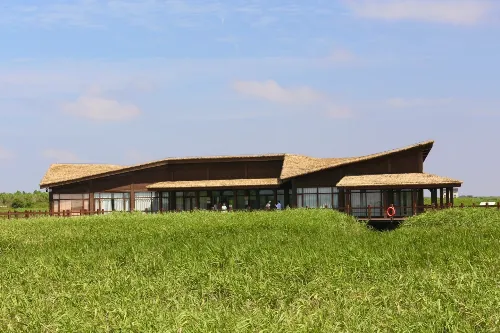
The Yangtze River Estuary Tidal Flat Plank Road is about 3.5 kilometers long, running through the core wetland area of the park. Made of anti-corrosion wood and built along the tidal flat terrain, the lowest part is only 0.5 meters above the tidal flat. Walking on the plank road, visitors can closely observe the wetland ecological process of rising and falling tides and appreciate characteristic wetland vegetation such as Spartina alterniflora, reeds, and Scirpus mariqueter. There are 12 science interpretation boards along the plank road, detailing the ecological functions of wetland plants, making it the best path to understand the wetland landform.

Science Education Hall
The Science Education Hall is located next to the park’s tourist service center, with a construction area of about 800 square meters. It is divided into three exhibition areas: wetland ecology, bird protection, and geological evolution of the Yangtze River Estuary. Through physical specimens, multimedia demonstrations, and interactive experiences, the hall displays the ecosystem structure of Dongtan Wetland. It houses more than 30 species of bird specimens and over 20 species of wetland plant specimens, receiving more than 50,000 science study teams annually. It is a science education base for primary and secondary schools in Shanghai.
Wetland Flower Sea Area
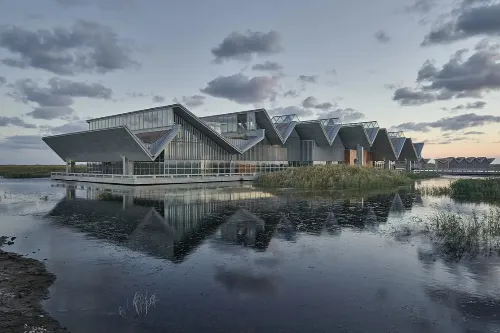
The Wetland Flower Sea Area covers about 15 hectares in the southwest of the park, dominated by seasonal herbaceous flowers. Poppies and violet orychophragmus are planted in spring, lotus and water lilies are featured in summer, sulfur cosmos and sunflowers in autumn, and reed landscapes are preserved in winter. Connected to the wetland water system, the flower sea forms a landscape feature of "flowers and water interdependent". The lotus pond covers about 3 hectares with 12 lotus varieties, making it the most representative landscape of the park in summer.

Tour Route
The recommended tour route of Dongtan Wetland Park is about 8 kilometers long and takes about 4–5 hours. The specific route is: Enter from the Tourist Service Center → Science Education Hall (visit about 30 minutes) → Wetland Flower Sea Area (visit about 1 hour) → Tidal Flat Plank Road (walk about 1.5 hours) → Wetland Bird-Watching Platform (bird-watching about 1 hour) → Leisure Station (rest about 20 minutes) → Riverside Footpath (walk about 30 minutes) → Exit. This route covers the core attractions of the park, balancing ecological viewing and science education experience. There are 3 rest areas and 2 catering spots along the route to meet basic tourist needs. If time is limited (2–3 hours), you can choose a shortened route: Tourist Service Center → Bird-Watching Platform → Northern Section of Tidal Flat Plank Road → Flower Sea Area → Exit, focusing on the core bird-watching and wetland landscapes.
Visiting Tips
- Best visiting time: April–May (northward migration of migratory birds, blooming flowers) and October–December (southward migration of migratory birds, pleasant autumn scenery). 9:00–15:00 daily is the best time for bird-watching and photography.
- Recommended duration: 4–5 hours for an in-depth tour, 2–3 hours for a casual visit.
- Equipment: Bring binoculars (bird-watching ones are better), sun protection, comfortable walking shoes. Prepare windproof coats in winter as the wind is strong in the wetland.
- Catering: Only 1 leisure station in the park provides simple meals (per capita consumption about 30 yuan). It is recommended to bring your own drinking water and snacks, or dine in Chongming Island’s urban area after the visit.
- Science experience: Free wetland science lectures are available at 10:00 and 14:00 every Saturday and Sunday (reservation required at the Tourist Center in advance), suitable for families with children.
Notes
- Feeding birds, picking plants, and capturing wild animals are prohibited in the park. Violators will be fined 200–2000 yuan in accordance with the Shanghai Wetland Protection Regulations.
- Some sections of the tidal flat plank road may be flooded during high tide. Follow the instructions of staff and do not enter unopened areas without permission.
- Keep quiet while bird-watching. Do not take photos with flash to avoid disturbing birds.
- There are no charging stations in the park. Self-driving tourists should confirm vehicle power in advance. Only 1 charging station is available within 3 kilometers nearby (Dongtan Tourist Center Parking Lot).
- The plank road is slippery on rainy days. It is recommended to bring non-slip shoe covers. The park may be temporarily closed in severe weather such as typhoons and rainstorms.
- Pets are not allowed to enter (except guide dogs). Bringing large equipment such as drones and tents is prohibited.
Transportation
- Self-driving: Depart from the urban area via Hushan Expressway (G40) to Chenjia Town Exit, Chongming. Drive along Dongtan Avenue for about 10 kilometers to Dongwang Road.
- Public transport: Take Metro Line 6 to Wuzhou Avenue Station, transfer to Shenchong Line 6 to Chenjia Town Hub Station, Chongming, then transfer to Chongming Dongtan Bus Line 1 to Dongtan Wetland Park Station. The whole journey takes about 2 hours. Chongming Dongtan Bus Line 1 departs every 30 minutes (first bus 7:00, last bus 16:00).
- Tourist shuttle: Every Saturday, Sunday, and legal holidays, there is a direct shuttle from Shanghai Tourist Distribution Center (Hongkou Football Stadium Station). Departure time 8:00, return time 15:00.
Opening Hours
Daily opening hours: 8:30–17:00 (last entry 16:00). Adjusted to 8:00–17:30 (last entry 16:30) during the migratory bird wintering period from November to February of the following year. Legal holidays (Spring Festival, National Day, etc.): 8:00–18:00 (last entry 17:00).
Tickets
Ticket price: 45 yuan per person. You can search for the official service account "东滩湿地公园" on WeChat for the latest updates.
Online Booking
Click here to jump to the Trip.com ticketing platform for ticket purchase.