
The Palace Museum is located at No. 4 Jingshan Front Street, Dongcheng District, Beijing. It is a World Cultural Heritage site and a national 5A-level tourist attraction. As the imperial palace of the Ming and Qing dynasties (formerly known as the Forbidden City), it is the largest and best-preserved complex of ancient wooden structures in the world, covering an area of approximately 720,000 square meters with a building area of about 150,000 square meters. It houses more than 70 palaces of various sizes and over 980 rooms. The buildings, featuring yellow glazed tile roofs, blue and white stone bases, and resplendent colored paintings, are symmetrically distributed along the central axis, strictly adhering to feudal rituals and displaying the layout characteristics of "Front Court for State Affairs and Rear Palace for Living, Ancestral Shrines on the Left and Altars of Land and Grain on the Right".
Historical and Cultural Significance
Construction of the Palace Museum began in the 4th year of the Yongle reign of the Ming Dynasty (1406) and was completed in the 18th year of the Yongle reign (1420). Having witnessed 24 emperors of the Ming and Qing dynasties, it stands as the pinnacle of ancient Chinese imperial architecture. The Palace Museum was officially established in 1925 and is now a comprehensive museum integrating cultural relic protection, exhibitions, and research. Its collection boasts over 1.86 million pieces (sets) of cultural relics, among which more than 90% are precious relics, covering 25 major categories such as bronzes, calligraphy and paintings, and ceramics.
Historically, due to the outbreak of the War of Resistance Against Japanese Aggression, the cultural relics of the Palace Museum began to be moved southward in 1933, passing through Shanghai, Nanjing, Sichuan and other places, and were gradually transported back north in 1947, creating a miracle in the protection of human cultural heritage. Today, the Palace Museum is not only a material carrier of ancient Chinese imperial court culture but also revitalizes over 600 years of historical and cultural heritage in modern times through special exhibitions such as "A Thousand Li of Rivers and Mountains" and "Palace Museum Cultural and Creative Products".
Major Attractions
Hall of Supreme Harmony (Taihe Dian)
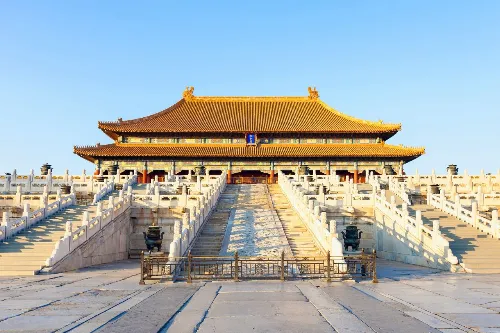
As the core building of the Outer Court, the Hall of Supreme Harmony is 35.05 meters high, 11 bays wide, with a building area of 2377 square meters, making it the largest and highest-ranked palace in the Palace Museum. Inside the hall, 72 gilded wooden pillars support the double-eaved hip-and-gable roof, and a 2-meter-high gilded throne carved with nine dragons is set in the center. A coiled dragon holding a pearl is embedded in the caisson ceiling. It was the venue where emperors of the Ming and Qing dynasties held grand ceremonies such as coronations and royal weddings. The three-layer white marble terrace outside the hall is carved with 1142 chi shou (mythical animal-shaped) drainage spouts, serving both practical and decorative purposes.
Hall of Mental Cultivation (Yangxin Dian)
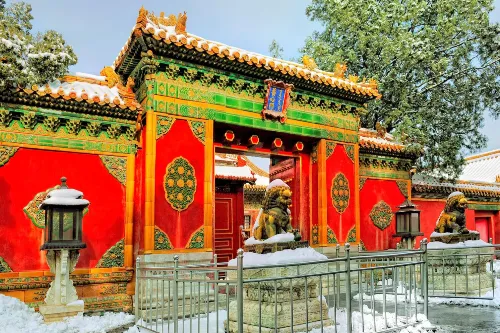
The Hall of Mental Cultivation was the living quarters and political center of emperors in the Qing Dynasty, covering an area of about 5000 square meters, consisting of the main hall, the rear sleeping hall, and wing rooms on the east and west sides. Eight emperors from Yongzheng to Xuantong lived here. The East Warmth Chamber was once the place where Empress Dowager Cixi held court behind a screen, and the West Warmth Chamber "Sanxi Tang (Hall of Three Rarities)" is famous for housing rare calligraphy scrolls such as Wang Xizhi's "Rapid Snow on a Sunny Day". The furnishings inside the hall preserve the original appearance of Qing court life.
Imperial Garden (Yu Hua Yuan)
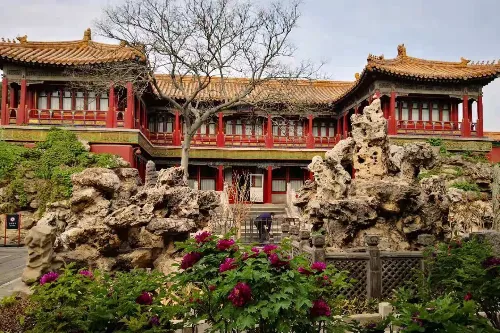
The Imperial Garden is a royal garden for emperors and empresses to relax, covering an area of about 12,000 square meters, with Qin'an Dian (Hall of Imperial Peace) as the center and more than 20 pavilions, terraces, towers and halls scattered around. There are over 160 ancient cypress trees in the garden with a tree age of more than 300 years, among which "Lianli Bai (Interlocking Cypress)" and "Jiulong Bai (Nine-Dragon Cypress)" are rare landscapes. The rockery "Duixiu Shan (Piled Elegance Mountain)" is about 10 meters high, and the Yujing Ting (Imperial View Pavilion) on the top is the place where emperors and empresses climbed to enjoy the scenery on the Double Ninth Festival. The garden paths are paved with colored pebbles forming auspicious patterns such as "Fu (blessing)" and "Lu (prosperity)", combining ornamental value with cultural implications.
Hall of Central Harmony (Zhonghe Dian)
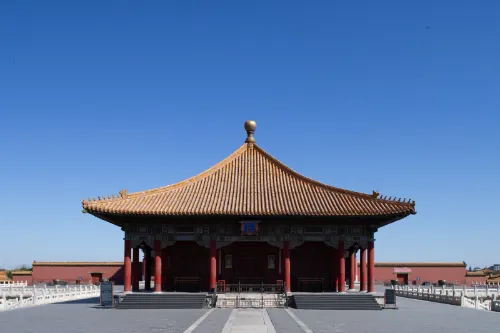
One of the three main halls of the Outer Court of the Palace Museum, it is located between the Hall of Supreme Harmony and the Hall of Preserving Harmony in the Forbidden City, with a building area of 580 square meters. First built in the 18th year of the Yongle reign of the Ming Dynasty (1420), it was initially named Huagai Dian (Hall of Canopy) in the early Ming Dynasty. It was destroyed by fire during the Jiajing reign and renamed Zhongji Dian (Hall of Central Extremity) after reconstruction. Traces of the Ming Dynasty inscription "Zhongji Dian" still remain on the components inside the ceiling. In the first year of the Shunzhi reign of the Qing Dynasty (1644), the Qing royal family moved into the Forbidden City and renamed Zhongji Dian to Hall of Central Harmony in the following year.
Hall of Preserving Harmony (Baohe Dian)
One of the three main halls of the Outer Court of the Palace Museum, it has a building area of 1240 square meters and a height of 29.50 meters. Located behind the Hall of Central Harmony, it was completed in the 18th year of the Yongle reign of the Ming Dynasty (1420), initially named Jinshen Dian (Hall of Diligent Governance). It was destroyed by fire during the Jiajing reign and renamed Jianji Dian (Hall of Establishing Extremity) after reconstruction. It was renamed Hall of Preserving Harmony in the second year of the Shunzhi reign of the Qing Dynasty.
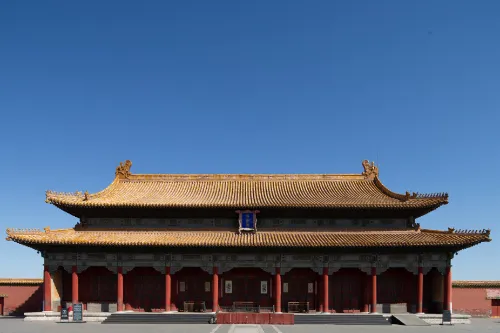
Palace of Heavenly Purity (Qianqing Gong)
One of the three rear palaces of the Inner Court, with a building area of 1400 square meters. First built in the 18th year of the Yongle reign of the Ming Dynasty (1420), it was rebuilt several times in the Ming and Qing dynasties after being destroyed by fire, and the existing building was constructed in the third year of the Jiaqing reign of the Qing Dynasty (1798).
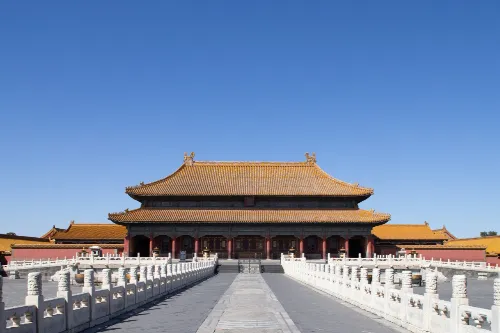
Hall of Union and Peace (Jiaotai Dian)
One of the three rear palaces of the Inner Court, it is located between the Palace of Heavenly Purity and the Palace of Earthly Tranquility. It was approximately built during the Jiajing reign of the Ming Dynasty, reconstructed in the 12th year of the Shunzhi reign (1655) and the 8th year of the Kangxi reign (1669) of the Qing Dynasty. In the second year of the Jiaqing reign (1797), the Palace of Heavenly Purity caught fire, which spread to this hall, and it was rebuilt in the same year.
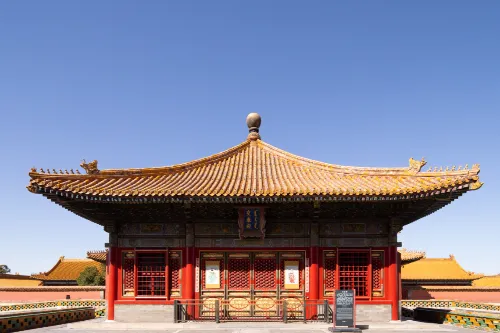
Palace of Earthly Tranquility (Kunning Gong)
One of the three rear palaces of the Inner Court, it was first built in the 18th year of the Yongle reign of the Ming Dynasty (1420). It was destroyed by fire twice in the 9th year of the Zhengde reign (1514) and the 24th year of the Wanli reign (1596), and reconstructed in the 33rd year of the Wanli reign (1605). The Qing Dynasty followed the Ming system and rebuilt it in the 2nd year of the Shunzhi reign (1645), and reconstructed it again in the 12th year (1655) imitating the Qingning Palace in Shengjing (Shenyang). In the 2nd year of the Jiaqing reign (1797), the Palace of Heavenly Purity caught fire, which spread to the front eave of this hall, and it was rebuilt in the 3rd year (1798).
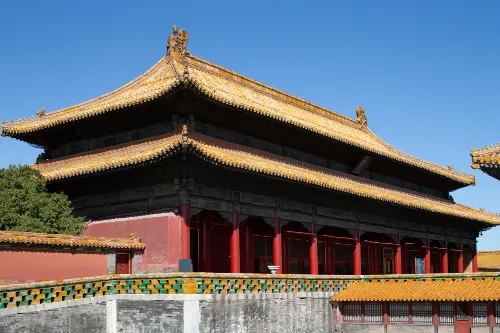
Xianruo Guan (Hall of Universal Peace)
Located in the center of the northern part of the Cining Palace Garden, it is the main building in the garden and a place for empress dowagers and imperial concubines of the Qing Dynasty to worship Buddha. Initially built as Xianruo Ting (Pavilion of Universal Peace) in the Ming Dynasty, it was renamed Xianruo Guan in the 11th year of the Wanli reign (1583). It underwent major repairs and reconstructions successively during the Qianlong reign of the Qing Dynasty, forming the existing structure we see today.
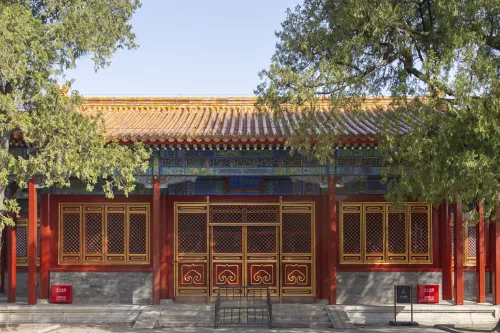
Hall of Imperial Supremacy (Huangji Dian)
As the main building of the Ningshou Palace area, it was first built in the 28th year of the Kangxi reign of the Qing Dynasty (1689), initially named Ningshou Palace. During the reconstruction of the Ningshou Palace area from the 37th year (1772) to the 41st year (1776) of the Qianlong reign, Ningshou Palace was renamed Hall of Imperial Supremacy, serving as the place where Emperor Qianlong held court and received congratulations after abdicating the throne.
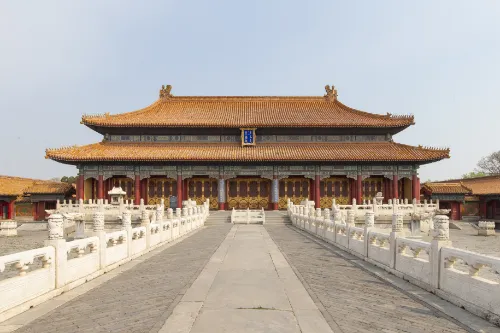
Treasure Gallery (Zhenbao Guan)
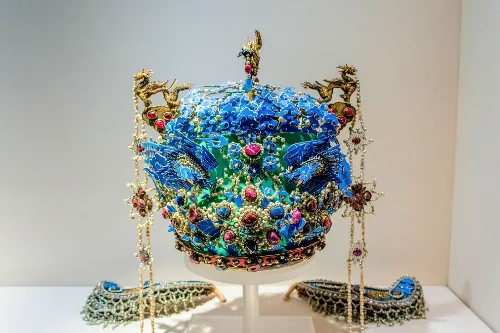
The Treasure Gallery (separate ticket required) is located in the northeastern part of the Palace Museum, originally the Ningshou Palace area built during the Qianlong reign. It now exhibits more than 400 pieces of various imperial treasures. The "Golden Eternal Stability Cup (Jin'ou Yonggu Bei)", the treasure of the gallery, is made of 80% gold, inlaid with pearls and gemstones, and was the special wine cup used by emperors of the Qing Dynasty for the New Year's Day writing ceremony. The "Empress Dowager Cixi's Phoenix Crown" is inlaid with 5 large east pearls and more than 100 gemstones, with a total weight of about 2300 grams, demonstrating the pinnacle level of Qing court craftsmanship.
Recommended Tour Routes
Recommended half-day tour route: Enter through the Meridian Gate → Visit the Hall of Supreme Harmony → Hall of Central Harmony → Hall of Preserving Harmony → Palace of Heavenly Purity → Hall of Union and Peace → Palace of Earthly Tranquility → Imperial Garden along the central axis → Exit through the Gate of Divine Prowess (about 3 hours). For an in-depth one-day tour, you can add the Six Western Palaces (Palace of Gathering Elegance, Palace of Feathered Felicity) → Six Eastern Palaces (Palace of Eternal Joy, Palace of Eternal Harmony) → Treasure Gallery (Ningshou Palace area) → Clock and Watch Gallery (Hall of Imperial Ancestors), with the whole journey taking about 6 hours. It is recommended to bring a portable chair to rest in the Imperial Garden. From late April to early May every year, the crabapple flowers in front of the Hall of Literary Glory are in full bloom, and you can add the visit route of the "Hall of Literary Glory - Hall of Martial Valor" calligraphy and painting exhibition (additional reservation required).
Travel Tips
- Recommended visiting time is 4-6 hours. Enjoy the crabapple flowers in the Hall of Literary Glory in spring (April-May), take photos of the golden ginkgo trees in autumn (October-November) (near Broken Rainbow Bridge and Eighteen Cypresses area), and avoid the high-temperature peak in summer (July-August) when the average daily number of tourists exceeds 50,000.
- There are no restaurants inside the Palace Museum, only convenience stores at the exit of the Gate of Divine Prowess. It is recommended to bring light lunches (such as sandwiches) and have lunch on the benches east of the Tianyi Gate in the Imperial Garden at noon (there are shade trees here and fewer people).
- Wear lightweight and non-slip shoes during the visit (the ground of the Palace Museum is paved with Ming Dynasty city bricks, and some areas are slippery due to wear). Bring a sun protection jacket in summer (no shelter from the Meridian Gate to the Hall of Supreme Harmony) and warm baby patches in winter (no heating in the halls, with a room temperature of about 5℃).
- Download the official "Palace Museum" APP in advance, which contains 8 themed explanation routes (such as "Calligraphy Tour" and "Ceramic Road"), supports AR real-scene navigation, and can accurately locate the cultural relic stories of the current position.
- If you want to take photos of the Palace Museum without crowds, it is recommended to choose the Wednesday night session in the off-season (17:00-20:00), when the number of tourists is only 1/3 of that during the day. You can take "empty shots" in the square in front of the Hall of Supreme Harmony, but note that only some areas are open at night.
Notes
- The Palace Museum implements a "one-way visiting" system. Visitors must enter through the Meridian Gate (South Gate) and exit through the Gate of Divine Prowess (North Gate) or the East Glory Gate (East Gate). Retrograde is strictly prohibited, and violators will be persuaded to leave.
- Carrying large luggage exceeding 30 cm × 40 cm is prohibited. There is a free luggage storage area at the entrance of the Gate of Divine Prowess (open daily from 8:30 to 18:00). Luggage must be retrieved before the museum closes on the same day; otherwise, a storage fee of 5 yuan per hour will be charged for overdue retrieval.
- Most of the steps in the Treasure Gallery and Clock and Watch Gallery are original stones from the Ming Dynasty, some of which are up to 18 cm high. It is recommended that the elderly and children be assisted by their families. Using flash photography when taking photos of cultural relics is strictly prohibited (it will accelerate the fading of silk fabrics).
- Smoking is prohibited in the Palace Museum. Intelligent smoke detectors are installed around the three main halls, and violators will face a fine of 200 yuan. Stepping on the lawn in the Imperial Garden is prohibited, and violators will receive on-site education.
- In case of extreme weather such as heavy rain and strong winds, the square in front of the Hall of Supreme Harmony may be temporarily closed, and staff will guide visitors to indoor exhibition halls such as the Hall of Literary Glory. On snowy days from December to February every year, the Palace Museum will close 1 hour in advance. It is recommended to follow the official Weibo account "Palace Museum" for real-time notifications.
Transportation
- Subway: Take Line 1 to "Tiananmen East" Station (Exit A) and walk about 900 meters to the Meridian Gate; or take Line 8 to "National Art Museum of China" Station (Exit D) and walk 1.2 kilometers to the Gate of Divine Prowess.
- Bus: Bus stops near the Meridian Gate include "Tiananmen East" (Routes 1, 2, 52, 120) and "Tiananmen West" (Routes 1, 52, 120); bus stops near the Gate of Divine Prowess include "Palace Museum" (Route 58) and "East Gate of Jingshan Park" (Routes 5, 60, 111).
- Self-driving: There is no dedicated parking lot around the Palace Museum. The nearest parking lot is the underground parking lot of "Beijing APM Shopping Center" outside the East Glory Gate, with about 800 parking spaces, charging 15 yuan per hour, and it takes about 10 minutes to walk to the Meridian Gate; alternatively, you can park at the "Capital Hotel" parking lot on East Qianmen Street (300 parking spaces, 12 yuan per hour).
Opening Hours
Open all year round (closed on Mondays, except for legal holidays). The peak season opening hours are 8:30-17:00 (admission stops at 16:30), and the off-season opening hours are 8:30-16:30 (admission stops at 16:00). The Treasure Gallery and Clock and Watch Gallery have the same opening hours as the main scenic area. The first 2000 reserved visitors every Wednesday can participate in the "free themed explanations" (9:00-11:00/13:00-15:00). During the off-season from December to February every year, the Palace Museum extends its opening hours to 20:00 every Wednesday (admission stops at 19:30), only opening the route from the Meridian Gate to the Hall of Supreme Harmony, Hall of Preserving Harmony, Six Eastern Palaces, and Treasure Gallery.
Tickets
The ticket price is 60 yuan per person.
You can search for the official WeChat public account "故宫博物院" to get the latest updates or purchase tickets online.
Online Booking
Click here to jump to the Trip.com ticketing platform for ticket purchase.