
Mangrove Coastal Ecological Park is located in Futian District, Shenzhen City, Guangdong Province, on the north bank of Shenzhen Bay. It is part of Shenzhen Bay Park and a free urban coastal ecological park open to the public. Covering an area of approximately 20.67 hectares, the park serves as an important coastal wetland ecological reserve in central Shenzhen. Centered on coastal mangrove wetland scenery, it also functions for coastal recreation, science popularization education and migratory bird observation. Supporting facilities constructed inside the park include coastal sightseeing trails, birdwatching platforms and ecological squares, with the coastal walkway stretching about 2 kilometers in total length. Adjacent to Binhai Avenue, the park faces Mai Po Wetland of Hong Kong across Shenzhen Bay. It is a rare ecological park in an urban downtown area of China that combines mangrove wetland and urban coastal landscapes, and is also a well-known venue for natural science popularization and coastal leisure in Shenzhen.
History and Culture
In the 1990s, Binhai Avenue in Shenzhen was planned for construction. The original road scheme would occupy a large stretch of mangrove tidal flat, arousing public concern over mangrove conservation. After discussions among multiple parties, the government revised the road plan by moving Binhai Avenue northwards to preserve the mangrove tidal flat on its southern side. An ecological park was then planned and built on this site to strike a balance between urban development and wetland protection. Mangrove Coastal Ecological Park was officially completed and opened to the public in December 2000, being one of China’s early urban ecological parks constructed for mangrove conservation.
Shenzhen Bay, where the park sits, is a vital stopover site for migratory birds along the East Asian-Australasian Flyway. Every autumn and winter, numerous migratory birds inhabit and forage here, and the mangrove wetland supplies food and shelter for them. This mangrove forest consists of native mangrove communities including Kandelia candel, Aegiceras corniculatum and Avicennia marina. It represents the native coastal wetland ecosystem of Shenzhen. For years, mangrove conservation, ecological restoration and natural science popularization activities have been continuously carried out here. The park undertakes publicity of wetland protection and ecological environmental education, and also records the course of coastal ecosystem protection amid Shenzhen’s urban development.
Major Attractions
Mangrove Wetland Scenic Area
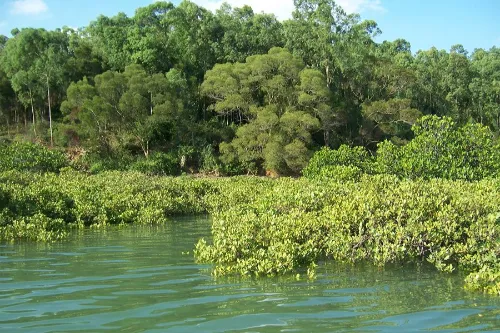
The Mangrove Wetland Scenic Area is the core zone of the park. It is a general term referring to the mangrove tidal flat area in the southern part of the park, where extensive native mangrove plants grow on the intertidal zone. With tidal changes, the tidal flats are submerged by seawater at times and exposed as mudflats at others, crisscrossed by tidal creeks. Visitors can closely observe distinctive botanical features of mangroves such as their unique root systems and viviparous seedlings. The mudflats are home to benthic organisms including fiddler crabs and mudskippers, forming a natural classroom for learning about coastal wetland ecosystems.
Coastal Birdwatching Platform
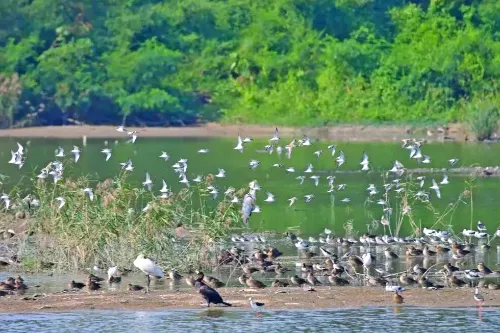
The Coastal Birdwatching Platform is a general name for the seaside viewing facilities of the park. Built alongside Shenzhen Bay and fitted with viewing railings, it commands a wide view facing the waters of Shenzhen Bay and acts as the primary spot for watching migratory birds. From October each year to March of the next year, visitors may spot migratory waterbirds such as black-faced spoonbills and plovers and sandpipers. Science signage boards are set up on the platform with information of common bird species to help visitors identify birds.
Coastal Sightseeing Trail
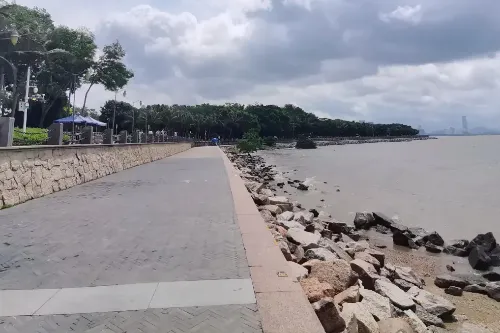
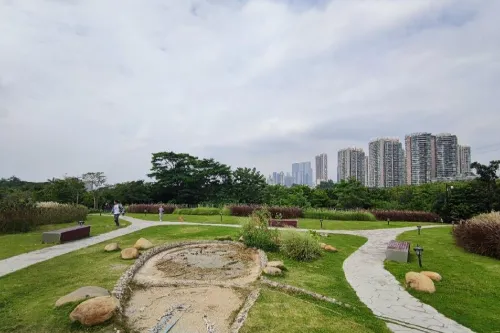
The Coastal Sightseeing Trail is the general term for the coastal pedestrian greenway of the park. Stretching along the coastline for roughly 2 kilometers, it features flat pavement suitable for walking and jogging. One side of the trail borders mangrove tidal flats while the other side is lined with lawns and garden vegetation, with rest seats placed along the route. While walking, visitors can enjoy seascape of Shenzhen Bay and overlook the mountain and sea outline of Hong Kong on the opposite bank. It is also a popular spot for sunset viewing.
Ecological Square
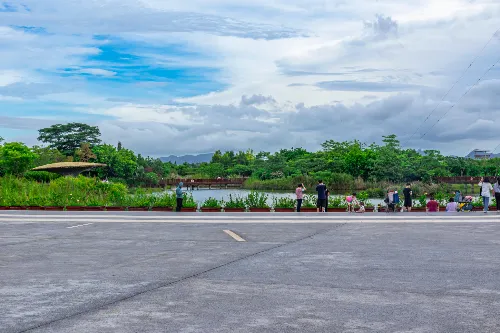
The Ecological Square is the common name for the square area at the main entrance of the park. Located near Binhai Avenue, it boasts an open space paved with hard ground and surrounded by arbor trees. The square can host wetland science popularization events and is equipped with ecological display boards introducing knowledge about mangroves, wetlands and migratory birds. It serves as the main gathering zone for science activities as well as a place for visitors to assemble and take short breaks.
Seaside Lawn Area
The Seaside Lawn Area is the general term for the green space on the inner side of the trail. Distributed inward of the trail, it features large gentle lawns planted with native trees such as royal poinciana and lychee, which create shaded areas. This area is ideal for picnics and relaxation. Walkways run along the edge of the lawn, allowing visitors to admire the scenery of the bay and mangroves under tree shade.
Tour Route
Main Park Entrance → Ecological Square → Seaside Lawn Area → Coastal Sightseeing Trail → Mangrove Wetland Scenic Area → Coastal Birdwatching Platform → Return along Coastal Sightseeing Trail → Secondary Park Exit
Travel Suggestions
- Birdwatching is recommended from October to March of the following year. You may bring binoculars for long-distance observation of migratory birds.
- To watch sunset, it is advised to enter the park in the late afternoon. The west section of the coastal trail offers good views.
- The park has lengthy trails. Wear comfortable non-slip flat shoes and get ready for long-distance walking.
- Sunlight is strong in summer. Prepare sun hats and sunscreen. The seaside can be windy, so bring a thin jacket.
- It is suitable for family trips. You may explain mangrove wetland knowledge to children with the help of science display boards inside the park.
- Tidal variations affect tidal flat scenery. You can check the Shenzhen Bay tide table before your trip and choose low tide periods to view benthic creatures on mudflats.
Notes
- Do not trample mangroves or enter tidal flats to protect mangrove plants and benthic organisms. The mud on tidal flats is deep and visitors may get trapped if entering without permission.
- Feeding birds is forbidden, for it will alter the habits of migratory birds and cause water pollution.
- Camping, barbecuing and tent pitching are prohibited. Open flames are not allowed.
- Mosquitoes are common at the seaside. Insect repellent is recommended.
- Ultraviolet radiation is strong at the seaside. Avoid prolonged unshaded exposure and watch out for heatstroke.
- Do not litter. Take all rubbish away with you to protect the wetland water environment.
- Keep quiet when photographing birds. Do not speak loudly so as not to disturb migratory birds.
Transportation
- Metro: Take Shenzhen Metro Line 9 to Shenzhen Bay Park Station, exit from Exit D and walk to Mangrove Coastal Ecological Park.
- Bus: Take bus routes 229, 337, 362, M106 and others to Mangrove Station, cross the road and enter the park.
- Self-driving: Navigate to Mangrove Coastal Ecological Park. Public parking lots are available along Binhai Avenue, but parking spaces are limited and tend to be full on holidays. Public transport is recommended.
Opening Hours
Mangrove Coastal Ecological Park is open to the public all day long. Visitors may enter the park for sightseeing at any time of day. The normal opening hours of supporting facilities such as restrooms and rest areas are consistent with the park’s service hours. Some science display boards and signs can be viewed around the clock. The park will be temporarily closed in severe weather such as typhoons and heavy rain. Please pay attention to official notices before your trip.
Ticket
Admission is free of charge. No tickets are required.