
Jiangwan Scenic Area is located in the northeast of Wuyuan County, Shangrao City, Jiangxi Province. It is a national 5A-level tourist attraction and one of the core scenic areas of Wuyuan Cultural and Ecological Tourism Zone. The scenic area is mainly characterized by Huizhou-style ancient architectural complexes, profound surname culture, and beautiful pastoral scenery. It covers an area of about 27.4 square kilometers, with the core tourist area being 3 square kilometers. Featuring Huizhou-style ancient architectural complexes and natural ecological landscapes, it is praised as a microcosm of "China's Most Beautiful Village". The core area of the scenic area is Jiangwan Ancient Village, where more than 120 ancient buildings from the Ming and Qing dynasties are preserved, including ancestral halls, official residences, shops, and folk houses. The architectural style integrates elements of Huizhou architecture such as horse-head walls, carved window lattices, and courtyard patios, embodying the architectural concept of "harmony between man and nature". Jiangwan is one of the few thousand-year-old towns in Wuyuan, named after the Jiang family who settled here. It has nurtured many literati and officials in history, with profound cultural heritage. Together with the surrounding farmland, streams, and ancient bridges, it forms a typical picture of a water town in the south of the Yangtze River.
History and Culture
The history of Jiangwan can be traced back to the Tang Dynasty. Initially, it was a settlement of the Feng family. Later, the Jiang family moved here from She County and gradually developed into a prominent local clan, hence the name "Jiangwan". Since the Song Dynasty, Jiangwan has had a flourishing literary atmosphere, producing a large number of talents in the imperial examinations. According to historical records, during the Ming and Qing dynasties, there were 24 jinshi (successful candidates in the highest imperial examination) and 36 juren (successful candidates in the provincial imperial examination) in Jiangwan. Among them, the most famous are Jiang Yilin, the Minister of the Ministry of Revenue in the Ming Dynasty, and Jiang Yong, a Confucian classics scholar in the Qing Dynasty.
The Jiang family attaches great importance to the inheritance of clan culture. The complete "Genealogy of the Jiang Family" is preserved in the village, recording the clan's migration, reproduction, and deeds of important figures. The layout of the ancient village follows the concept of "feng shui", backed by Houlong Mountain and facing Liyuan River, with streets and lanes built along the streams, forming a pattern of "mountains surrounding and waters embracing". In addition, traditional art forms such as Huizhou opera and Nuo dance have been passed down in Jiangwan. Among them, Nuo dance has a history of more than 800 years and is listed in the national intangible cultural heritage list, serving as important living materials for studying ancient folk culture.
Main Attractions
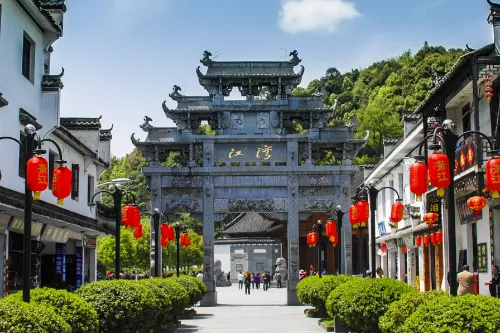
Jiangwan Memorial Arch
The Jiangwan Memorial Arch adopts relief and open‑work carving techniques. It is engraved with traditional patterns including "Kylins Frolicking", "Tigers and Leopards Bringing Blessings", "Deer and Cranes Celebrating Spring", and "Five Lions Playing with a Pearl", all symbolizing auspiciousness and abundant blessings. The carvings of "Civil and Military Ministers" and "The Eight Immortals Crossing the Sea" on both sides are said to express the wish that descendants of the Xiao‑Jiang clan would pursue scholarship and official careers to become great generals and high‑ranking ministers, or display their extraordinary talents just like the Eight Immortals.
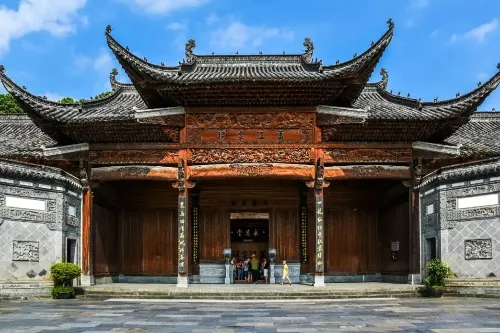
Xiaojiang Ancestral Hall
Xiaojiang Ancestral Hall was first built during the Wanli period of the Ming Dynasty to commemorate the ancestor of the Jiang family, Xiaojiang. It covers an area of about 2000 square meters and was once known as "the First Ancestral Hall in the South of the Yangtze River". It was destroyed in wars, and the existing building was rebuilt in 2003 according to its original appearance. The ancestral hall adopts an axisymmetric layout, including a screen wall, a memorial archway, a ceremonial gate, a courtyard, and a main hall. The memorial archway is 11.8 meters high, of the four-pillar, three-bay, and five-story style, with exquisite carvings and a magnificent momentum. The hall displays the historical origin of the Jiang family changing their surname from Xiao to Jiang, as well as the life stories of famous figures of past dynasties, having important historical research value.
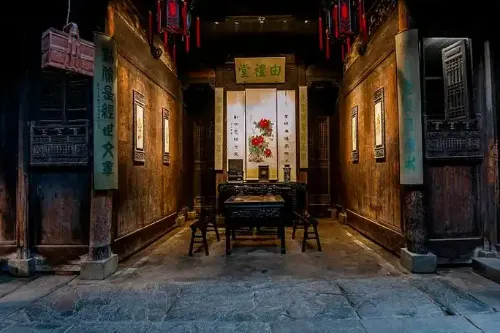
Teng Family Old House
Teng Family Old House was built in the early Qing Dynasty, being one of the oldest existing folk houses in Jiangwan. Covering an area of about 300 square meters, it is a two-story brick-and-wood building. The most distinctive feature of the building is the "upstairs hall" structure, that is, the hall is located on the second floor, and the first floor is a utility room. This layout is relatively rare in Huizhou architecture, reflecting the living customs of the owner at that time. The wood carvings and brick carvings in the house are well preserved, especially the "fishing, woodcutting, farming, and reading" patterns on the doors and windows, vividly reproducing the life scenes of ancient agricultural society.
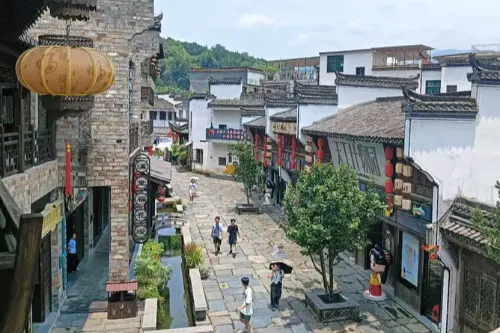
Jiangwan Ancient Street
Jiangwan Ancient Street is about 500 meters long, with dozens of shops from the Ming and Qing dynasties distributed along the street, retaining the traditional pattern of "shop in front and workshop at the back" and "residence upstairs and shop downstairs". The bluestone slabs of the ancient street have been trodden smooth and round after hundreds of years. The buildings on both sides are mostly two-story, with horse-head walls of varying heights, and the shop signs are antique. Some shops still sell Wuyuan specialties, such as wine-braised fish and Huizhou ink cakes, allowing tourists to experience the market atmosphere of the ancient town.
Jiang Yilin Memorial Hall
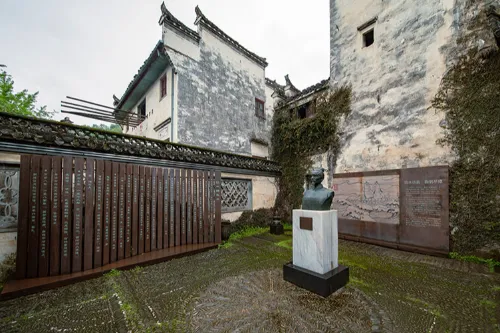
Jiang Yilin Memorial Hall is the former residence of Jiang Yilin. The main hall of the building is named "Dunlun Hall", which signifies fostering kinship, harmonizing the clan and advocating moral education. The hanging scroll in the central hall bears the portrait of Jiang Yilin. Buildings of the Ming Dynasty generally feature few figure carvings and boast a simple style, unlike the ornate and overly elaborate works after the Kang‑Qian period of the Qing Dynasty. Though this structure has evidently undergone maintenance and reconstruction by later generations, its overall layout remains largely intact. It still retains some original craftsmanship, with plain decorations, dignified rather than extravagant.
Tour Route
Recommended Half-Day Tour Route
Arrive at the entrance of Jiangwan Scenic Area at 9:00 a.m. First, visit Xiaojiang Grand Ancestral Hall (about 1 hour) to learn about the history of the Jiang family; at 10:40, go to Sansheng Hall (about 30 minutes) to visit the former residence of Jiang Yilin; at 11:10, stroll along Jiangwan Ancient Street (about 1 hour) to taste local snacks; at 12:10, visit Teng Family Old House (about 30 minutes) to appreciate the characteristics of Huizhou-style ancient folk houses; at 12:40, have lunch at a restaurant near the ancient street and end the trip. This route can efficiently visit the core attractions of the scenic area, suitable for tourists with limited time.
Travel Suggestions
- Jiangwan is mainly composed of cultural attractions. It is recommended to hire a scenic area guide (50 yuan per time) to gain an in-depth understanding of the historical stories and cultural connotations behind the ancient buildings.
- The best tourist seasons are spring (March-April) and autumn (October-November). In spring, you can enjoy the beautiful scenery of surrounding rapeseed fields reflecting with the ancient village; in autumn, there is the folk scene of drying autumn crops.
- Time-honored shops on the ancient street (such as "Jiangwan Winery" and "Huizhou Pastry Shop") offer authentic Wuyuan specialties. Wine-braised fish and Huizhou ink cakes have a long shelf life, suitable as souvenirs.
- It is recommended to have meals at farm restaurants near the ancient street, trying special dishes such as steamed powdered pork and hexagonal red carp, with an average consumption of about 50 yuan per person.
- If time permits, you can visit nearby ancient villages such as Xiaoqi and Likeng to experience the characteristics of different ancient villages in Wuyuan.
Matters Needing Attention
- Most ancient buildings in the scenic area are of brick-and-wood structure. Smoking and using open fires are strictly prohibited, and touching or carving cultural relics is not allowed.
- The bluestone slabs on the ancient street are slippery on rainy days. It is recommended to wear non-slip shoes and pay attention to safety when visiting.
- Respect local customs. When entering ancestral halls and folk houses, follow the guide's instructions and do not take photos of the elderly and children casually.
- When buying specialties, pay attention to checking the production date and shelf life, especially for food such as wine-braised fish. It is recommended to buy from regular shops.
- There are multiple restrooms and rest areas in the scenic area, distributed in the middle of the ancient street and near the ancestral halls. You can arrange rest time reasonably.
Transportation
- Public transportation: There are direct buses from Wuyuan County North Bus Station to Jiangwan Scenic Area, with a departure every 30 minutes from 7:00 to 17:00 every day, taking about 30 minutes, with a fare of 8 yuan per person; from Wuyuan High-Speed Railway Station, you can take a bus to Jiangwan, taking about 40 minutes, with a fare of 5 yuan per person.
- Self-driving: Starting from Wuyuan County, drive along Hangzhou-Ruijin Expressway to Jiangwan Exit, then turn to Jiangwan Avenue, with a total distance of about 28 kilometers, taking 40 minutes; starting from Jingdezhen, drive along Hangzhou-Ruijin Expressway to Jiangwan Exit, with a total distance of about 80 kilometers, taking 1.5 hours. The charging standard for the scenic area's parking lot is 10 yuan per car per day.
- Internal transportation in the scenic area: The scenic area is small, and major attractions are within walking distance, so no transportation is needed; if you have limited physical strength, you can rent a bicycle on the ancient street, with a rent of 20 yuan per hour.
Opening Hours
It is open all year round, with daily opening hours from 8:00 to 17:30 (admission stops at 17:00). Affected by the season, the closing time in winter (November to February of the next year) is advanced to 17:00 (admission stops at 16:30). For details, please refer to the scenic area's announcement on the day.
Tickets
The ticket price is 60 yuan per person.
You can search for the official WeChat public account "江湾景区" to get the latest news or buy tickets online.
Online Booking
Click here to jump to the Trip.com ticketing platform for ticket purchase.