
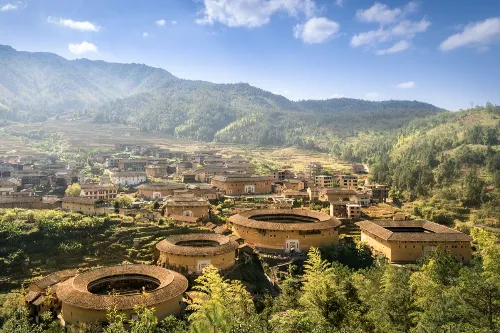
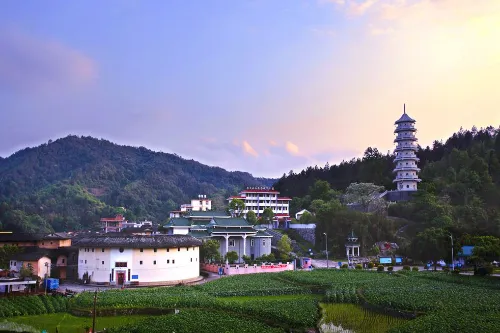
The Fujian Tulou (Yongding) Scenic Area is located in Yongding District, Longyan City, Fujian Province. It is a UNESCO World Cultural Heritage site and a national 5A-level tourist attraction. The total area of the scenic area is about 122.8 square kilometers, with a core tourist area of approximately 8.3 square kilometers. It consists of several sections including the Gaobei Tulou Cluster, Hongkeng Tulou Cluster, Chuxi Tulou Cluster, Nanxi Tulou Cluster, and Zhongchuan Ancient Village. The highlight of the scenic area lies in its large number of uniquely shaped tulou buildings. There are more than 23,000 existing tulou structures, including over 360 round tulou and more than 4,000 square tulou, making it the most concentrated tulou complex in the world. Tulous are mainly built with raw earth, integrated with wood and stone structures, and constructed against mountains and beside rivers, embodying the Hakka tradition of living together as a clan and the concept of harmony between humans and nature.
History and Culture
The construction history of Yongding Tulous can be traced back to the Tang Dynasty, formed a scale during the Song and Yuan dynasties, and reached its peak in the Ming and Qing dynasties. According to research, the earliest tulou was built in 769 AD, and the oldest existing tulou is Fuxin Building, constructed during the Dali period of the Tang Dynasty (766-779 AD). The rise of tulou is closely related to the southward migration of the Hakka people. To resist foreign enemies and wild beasts, the Hakka people built these unique buildings that combine defense and residence with families as units.
Yongding Tulous contain rich cultural connotations. The couplets, carvings, and paintings inside the buildings mostly reflect the ideas of loyalty, filial piety, etiquette, and emphasizing agriculture and education. For example, the couplet "Uphold principles and establish disciplines, cultivate virtue and develop talents" inside Zhencheng Building reflects the Hakka people's emphasis on ethics and talent cultivation. In 2008, Yongding Tulous, as an important part of "Fujian Tulou", were inscribed on the World Cultural Heritage List, becoming a model of traditional Chinese residential architecture.
Major Attractions
Gaobei Tulou Cluster
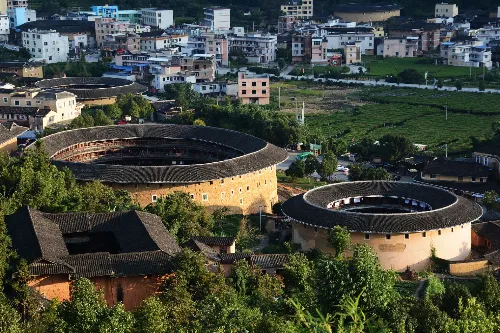
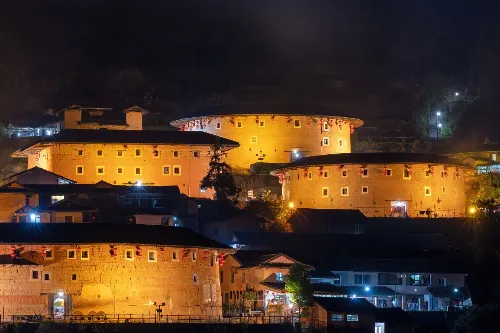
Located in Gaotou Township, Yongding District, it is one of the most representative clusters of Yongding Tulous, including Chengqi Building, Wuyun Building, Shize Building, etc. Chengqi Building was built in the 48th year of Kangxi reign in the Qing Dynasty (1709 AD), with a diameter of 73 meters and a four-ring concentric circle structure, covering an area of 5,376 square meters. It can accommodate more than 800 people at most and is known as the "King of Tulous" for its rare scale and structure among tulou buildings.
Hongkeng Tulou Cluster
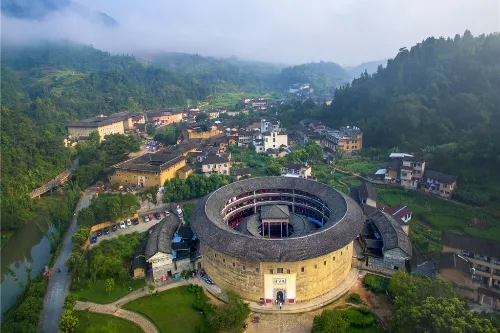
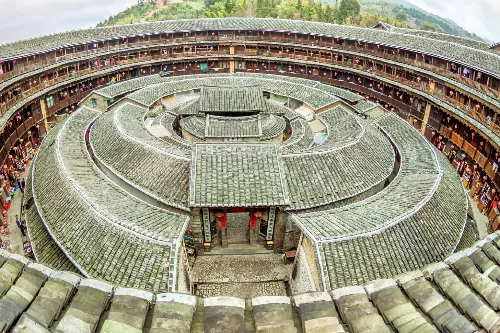
Located in Hukeng Town, it is a core scenic spot that visitors must visit, featuring famous tulous such as Zhencheng Building, Kuiju Building, and Fuyu Building. Zhencheng Building was built in 1912, laid out according to the Eight Trigrams diagram, divided into inner and outer rings. The outer ring has 4 floors and the inner ring has 2 floors, covering an area of about 5,000 square meters. It is known as the "Prince of Tulous" for its exquisite architecture. Kuiju Building was built in the 14th year of Daoguang reign in the Qing Dynasty (1834 AD), representing palace-style tulou with a majestic and solemn architectural style.
Chuxi Tulou Cluster
Located in Chuxi Village, Xiayang Town, it consists of 5 round tulou and 31 square tulou, built along the river in a scattered and well-arranged manner. Among them, Jiqing Building was built during the Yongle period of the Ming Dynasty (1403-1424 AD), being one of the oldest existing round tulou in Yongding. It has 72 staircases with a unique structure and was listed as a Major National Historical and Cultural Site in 2001.
Nanxi Tulou Cluster
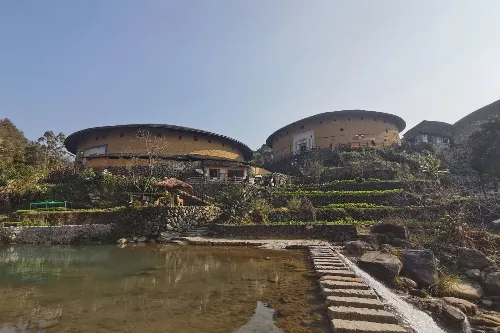
Located in the Nanxi River Basin of Hukeng Town, it is known as the "Great Wall of Tulous", stretching for more than 10 kilometers with over 130 tulou distributed along it. Yanxiang Building, built in the 22nd year of Daoguang reign in the Qing Dynasty (1842 AD), is a round tulou with 4 floors, covering an area of about 1,000 square meters. A large number of Qing Dynasty wood carvings, stone carvings and other artworks are preserved inside the building.
Zhongchuan Ancient Village
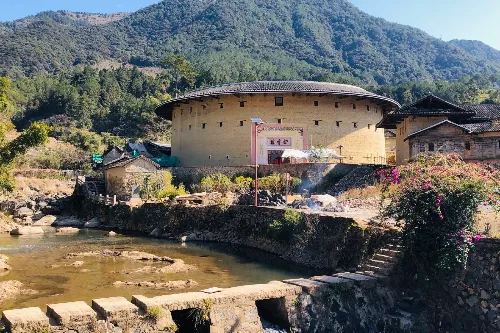
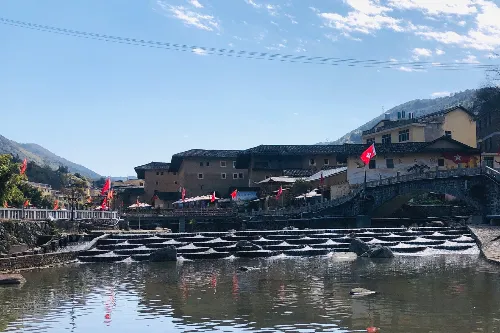
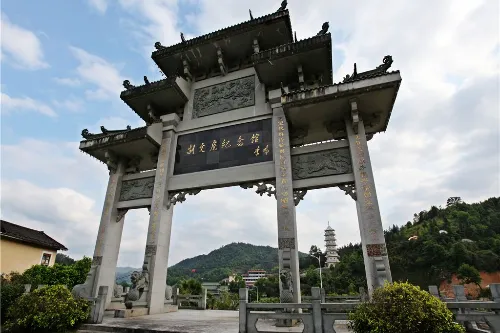
Located in Xiayang Town, it is a famous overseas Chinese hometown with buildings such as the Hubao Villa and the Hu Wenhu Memorial Hall. The Hubao Villa, built in 1946, is the former residence of the patriotic overseas Chinese Hu Wenhu, integrating Chinese and Western architectural styles, covering an area of about 3,000 square meters, and is now a provincial-level cultural relic protection unit.
Tour Routes
One-day Tour Route: Hongkeng Tulou Cluster (visit Zhencheng Building and Fuyu Building in the morning) → Gaobei Tulou Cluster (tour Chengqi Building and Wuyun Building in the afternoon). Suitable for tourists with limited time to experience the most representative tulous intensively.
Two-day Tour Route: Day 1: Hongkeng Tulou Cluster → Nanxi Tulou Cluster (enjoy the "Great Wall of Tulous" landscape); Day 2: Gaobei Tulou Cluster → Chuxi Tulou Cluster (visit ancient buildings such as Jiqing Building). Deeply experience the characteristics of different tulou clusters.
Three-day Tour Route: Day 1: Hongkeng Tulou Cluster → Zhongchuan Ancient Village (experience overseas Chinese hometown culture); Day 2: Gaobei Tulou Cluster → Nanxi Tulou Cluster; Day 3: Chuxi Tulou Cluster → Yongding Tulou Museum (learn about tulou history). Suitable for tourists who want to explore the scenic area comprehensively.
Travel Tips
- Spring (March-May) and autumn (October-November) have pleasant climates, making them the best seasons for travel. Sunscreen is needed in summer, and warm clothing should be prepared in winter.
- The interior of tulou is mostly wooden structure with steep staircases. It is recommended to wear non-slip shoes, and the elderly and children should be accompanied by their families.
- Some tulou allow visitors to climb up for a visit with an additional fee of 10-20 yuan. You can negotiate with local residents to experience the bird's-eye view of the tulou.
- Restaurants in the scenic area mainly serve Hakka cuisine. It is recommended to try special dishes such as beef balls and stuffed tofu, with an average consumption of about 50-80 yuan per person.
- When purchasing tulou specialties such as preserved mustard greens and rice wine, it is recommended to go to regular stores and avoid buying randomly from roadside stalls.
Notes
- Tulous are wooden buildings, and smoking is prohibited in the scenic area to avoid fire.
- Respect local customs, avoid loud noise when entering tulou, and do not touch cultural relics and residents' daily necessities at will.
- The weather in mountainous areas is changeable. It is recommended to carry rain gear with you, and prevent mosquito bites in summer.
- Self-driving tourists should pay attention to many curves on mountain roads, control the speed. Some sections have insufficient lighting at night, so it is recommended to avoid driving late at night.
- The joint ticket of the scenic area is valid for 2 days, and the single attraction ticket is valid on the day of purchase. Please keep the tickets properly after purchase.
Transportation
- External Transportation:
- Airplane: Take a flight to Longyan Guanzhishan Airport, transfer to an airport bus to Yongding urban area, then take a scenic area special line bus, with a total journey of about 2 hours.
- Train: There are high-speed trains directly from Longyan Station to Yongding, with a journey of about 40 minutes. After getting off the train, take a tulou special line bus at Yongding Bus Station, and it takes about 1.5 hours to reach Hongkeng Scenic Area.
- Bus: There are long-distance buses directly from Fuzhou, Xiamen, Guangzhou and other places to Yongding Bus Station, then transfer to scenic area buses. Buses from Yongding to Hongkeng depart every 30 minutes.
- Self-driving: Drive along the Xiamen-Chengdu Expressway from Longyan urban area, exit at the Yongding Tulou exit, with a journey of about 1.5 hours. Each section of the scenic area has parking lots, with a fee of 10-20 yuan per day.
- Internal Transportation:
- Scenic Area Sightseeing Bus: Sightseeing buses connect core sections such as Hongkeng, Gaobei and Chuxi, with a ticket price of 20-30 yuan per person. Discounted tickets can be purchased with admission tickets.
- Chartered Car: Local private vans provide chartered car services, with a full-day cost of about 200-300 yuan. Suitable for group travel, and the route can be arranged flexibly.
- Walking: The interior of some tulou clusters is suitable for walking tours. For example, the tulous in Hongkeng Scenic Area are close to each other, and it takes about 1-2 hours to walk around.
Opening Hours
Open all year round from 08:00 to 18:00. Extended to 18:30 in summer (June-August) and closed early at 17:30 in winter (December-February). Some tulou may be temporarily closed for maintenance, subject to the scenic area announcement.
Tickets
Tickets start from 50 yuan.
You can search the official WeChat public account "福建土楼永定景区" to get the latest news or buy tickets online. There are many types of tickets, please purchase according to your needs.
Online Booking
Click here to jump to the Trip.com ticketing platform for ticket purchase.