
Gutian Tourist Area is located in Gutian Town, Shanghang County, Longyan City, Fujian Province. It lies in the southwest of Fujian Province and at the southern foot of Meihua Mountain Nature Reserve, with a planned area of 7.6 square kilometers. It is a national 5A-level tourist attraction, as well as a Major Historical and Cultural Site Protected at the National Level, a National Patriotic Education Demonstration Base, a National "Red Tourism Area" and a "Classic Red Tourism Scenic Spot". The area boasts abundant and diverse tourism resources, where revolutionary cultural landscapes and natural scenery complement each other. A number of classic red scenic spots centered on the Site of the Gutian Conference shine brightly.
History and Culture
The predecessor of Gutian Tourist Area was the "Liao Clan Ancestral Hall" in the Qing Dynasty, also known as "Wanyuan Hall". First built in the 28th year of the Daoguang reign of the Qing Dynasty (1848), it was constructed by descendants of the Liao Clan to commemorate their ancestor Mr. Beiguo. In the early years of the Republic of China, descendants of the Liao Clan established Hesheng Primary School, the first local primary school, here. In May 1929, the Red Army entered the Gutian area in western Fujian and renamed the primary school "Shuguang Primary School".
From December 28 to 29, 1929, Mao Zedong, Zhu De, Chen Yi and other revolutionaries convened the 9th National Congress of the 4th Red Army of the Communist Party of China (i.e., the Gutian Conference) at Shuguang Primary School in Gutian District, with more than 120 delegates attending. This conference was of great significance and was hailed as a "milestone in the Chinese revolution". After the conference, the new-type people's army gradually developed and grew stronger. On October 30, 2014, President Xi Jinping convened the All-Army Political Work Conference in Gutian, drawing more attention to this place. Gutian Town has continuously explored and enriched its red culture and vigorously developed the tourism industry, transforming from a poverty-stricken old revolutionary base area into a national 5A-level red tourist attraction and a national forest health and wellness base. In addition, the scenic area is home to intangible cultural heritage such as Mutong Haozi (wooden bucket work songs), Minxi Han Opera and Liancheng Sibao woodblock printing, as well as the Chen Jinggu belief culture with a history of over 1,200 years. In March 1961, Gutian Tourist Area was rated as a Major Historical and Cultural Site Protected at the National Level; in 2004, it was listed as a National "Red Tourism Area" and a "Classic Red Tourism Scenic Spot"; in 2015, it was rated as a National 5A-level Tourist Attraction; and in 2016, it won the title of National Patriotic Education Demonstration Base.
Major Attractions
Gutian Conference Memorial Hall
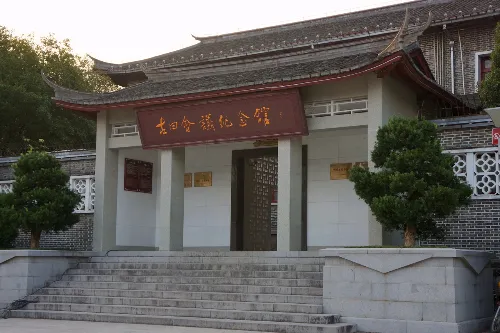
Located at No. 85 Gutian Road, Gutian Town, Shanghang County, Longyan City, Fujian Province, it is a national first-class museum. The hall is a traditional Chinese-style building with a "rectangular courtyard" layout, and the seven characters "Gutian Conference Memorial Hall" on the horizontal plaque above the main entrance were inscribed by General Xiao Ke. Founded in July 1971 and opened to the public in October 1974, the memorial hall has 10 exhibition halls and serves as a revolutionary memorial integrating cultural relic collection, research and educational publicity.
Chairman Mao Memorial Park
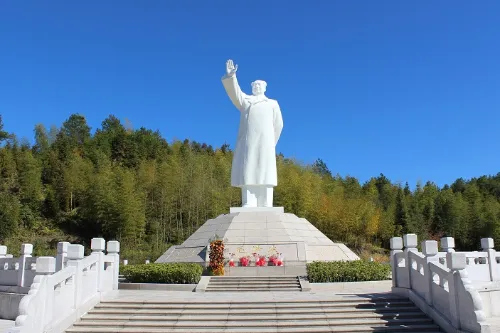
It is situated on the northeast side of the Site of the Gutian Conference. The first platform has a depth of 1.9 meters, which, combined with the subsequent 11 steps, symbolizes the outbreak of the 1911 Revolution. In the middle of the memorial park stands a white marble statue of Chairman Mao. The carving of the statue started in 1969 but was suspended due to historical reasons. It was proposed to be erected again in 2009 to mark the 80th anniversary of the Gutian Conference and was officially installed on June 6 of the same year. The dimensions of the statue are closely related to Chairman Mao's life and the important history of the Chinese revolution: the statue is 7.1 meters high, representing the founding date of the Communist Party of China on July 1; the total height of the statue is 10.1 meters, and the width of the first platform is 1.949 meters, symbolizing the founding of the People's Republic of China on October 1, 1949; the base is in the shape of a regular octagon, implying the octagonal cap of the Red Army; the base has 5 layers, symbolizing the five-pointed star and the Five-star Red Flag; from bottom to top, the 1st to 3rd layers are 0.18 meters, 0.93 meters and 1.929 meters respectively, and the combined inclined surface of the 4th and 5th layers is 1.228 meters, representing Chairman Mao's birth year of 1893 and the convening date of the Gutian Conference on December 28, 1929; each side of the octagonal base is 4.1 meters long, representing the 41 years from the Zunyi Conference in 1935 to 1976 when Chairman Mao was in charge; the distance of the base is 9.9 meters, and the width of the third platform is 19.76 meters, marking the date of Chairman Mao's passing on September 9, 1976.
Red Army Bridge
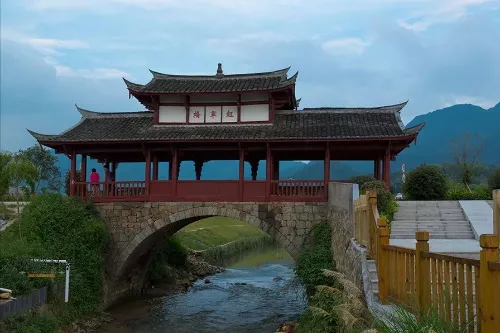
Also known as "Sanji Bridge", it spans the Wulong Stream on the left side of Wanyuan Hall (Liao Clan Ancestral Hall). In mid-December 1929, Comrade Mao Zedong led the 4th Red Army to move from Xinquan in Liancheng to Gutian for military training and to convene the Gutian Conference. The 4th Red Army stayed here for more than 20 days, and Sanji Bridge, as the main thoroughfare, became a place for Red Army soldiers to stand guard and rest. Since then, it has been called the Red Army Bridge and is one of the few remaining revolutionary sites in Gutian.
Shuhuai Hall
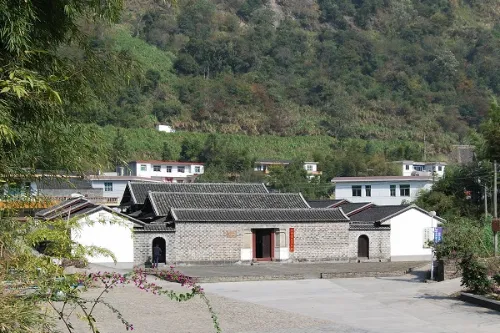
It is located in Sujiapo Village, Gutian Town. In October 1929, the Western Fujian Special Committee of the Communist Party of China moved its office from Shanghang City to Shuhuai Hall in Sujiapo. On the mountainside to the right of Shuhuai Hall, there is a natural cave — Zhenbei Cave, which was a place where Mao Zedong rested and read books in those years and is locally known as "Chairman's Cave".
Wenchang Pavilion
It stands in Jiaoyang Township, Shanghang County, and is a pagoda-style pavilion building. Built by the people of Jiaoyang in Shanghang to pray for cultural prosperity, its construction took 13 years to complete. It has six floors in appearance but actually four floors inside, with statues of Confucius, Emperor Wenchang and other figures enshrined within. After the 1911 Revolution, it was converted into Guangzhi Primary School, where revolutionary activities were carried out. From July 22 to 29, 1929, the First Western Fujian Congress of the Communist Party of China was held here. In May 1961, it became one of the first batch of Provincial Key Cultural Relic Protection Units.
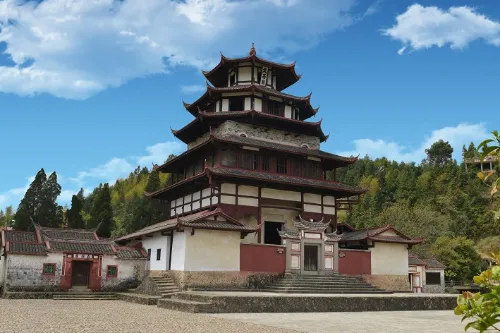
The Slogan "The Gutian Conference Shines Forever"
It is erected directly behind the Site of the Gutian Conference. These words were put forward by Chairman Mao at the All-Army Political Work Conference in 1960 and were written into the conference's Resolution. The slogan was written by Liao Chun from Yongding Cultural Center, made into stainless steel enamel characters of 3 meters square, and fixed on a reinforced concrete foundation.
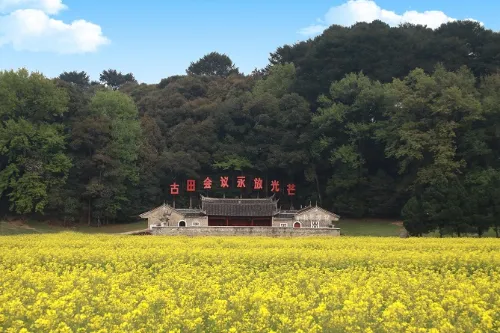
The "Monument • Army Soul" Theme Sculpture
It was built with assistance from the General Political Department of the Chinese People's Liberation Army. The main sculpture reflects the important position and role of the Gutian Conference and interprets the unwavering army soul of the Chinese military's loyalty to the Party. Designed and produced by the Chinese People's Revolutionary Military Museum, it is 7.5 meters long, 3.5 meters wide and 5.4 meters high, with a 1-meter-high base. The sculpture consists of bronze statues of 12 figures including Mao Zedong, Zhu De and Chen Yi, three Party flags of the Communist Party of China made of Chinese red marble, a base faced with mushroom stones, and an inscription.
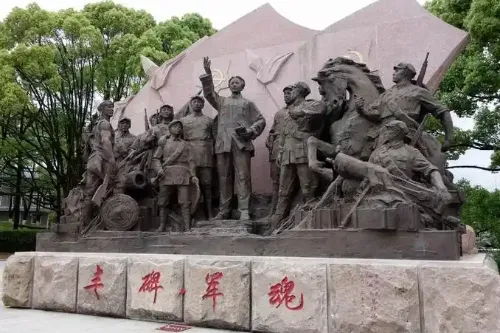
Zhongxing Hall (Former Headquarters of the 4th Red Army)
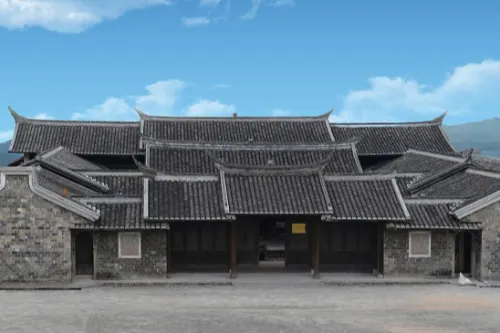
Originally the headquarters of the 4th Red Army, it was first built in the 10th year of the Jiaqing reign of the Qing Dynasty (1805) and took three years to complete. The entire building is a brick-and-wood single-story structure with a gable roof, belonging to the enclosed courtyard-style architecture, with a layout of one main house and three side wings. In December 1929, the 4th Red Army stationed in Gutian and designated Zhongxing Hall as its headquarters. In May 2005, it was listed as a Major Historical and Cultural Site Protected at the National Level.
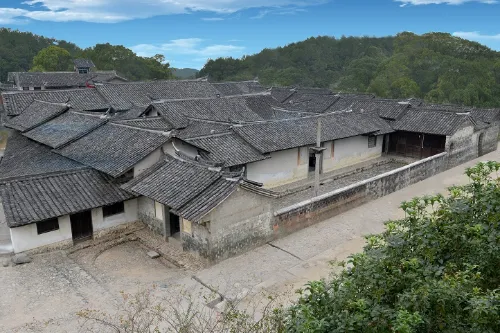
Songyin Hall (Former Political Department of the 4th Red Army)
The former site of the Political Department of the 4th Red Army of the Communist Party of China, also known as "Yongdong Building", is located in Bajia Village, Gutian Town, Shanghang County. Built in the 12th year of the Jiaqing reign of the Qing Dynasty (1807), it took 8 years to complete and has a history of 205 years. The overall construction integrates the characteristics of ancient southern Chinese architecture and Hakka architecture. In the 1920s, it was forcibly rented by foreign missionaries as a church, and the missionaries left after the land reform in May 1929. In December 1929, after the 4th Red Army stationed in Gutian, the Front Committee and the Political Department were set up here.
Tour Routes
One-day Tour Route: After entering the scenic area from the entrance, tourists can first visit the Site of the Gutian Conference to explore this building of great historical significance and learn about the background and historical significance of the Gutian Conference. Then proceed to the Gutian Conference Memorial Hall to gain an in-depth understanding of the Gutian Conference and the magnificent revolutionary history through the rich cultural relics and materials in the hall. Afterwards, head to the Chairman Mao Memorial Park to pay homage to the white marble statue of Chairman Mao. Later, visit the Red Army Bridge to feel the scenes of the Red Army's activities here in those years. Finally, you can choose to visit other attractions such as Zhongxing Hall (Former Headquarters) and Songyin Hall (Former Political Department).
Two-day Tour Route: On the first day, visit the Site of the Gutian Conference and the Memorial Hall in the morning, then explore the Chairman Mao Memorial Park and the Red Army Bridge in the afternoon. In the evening, you can stay near the scenic area to experience the local red culture atmosphere. On the second day, go to attractions such as Shuhuai Hall and Wenchang Pavilion to further understand Gutian's revolutionary history and culture. You can also visit the intangible cultural heritage exhibition areas in the scenic spot, such as the displays of Mutong Haozi, Minxi Han Opera and other intangible cultural heritage, to experience the profound cultural heritage of Gutian.
Travel Tips
- The recommended travel time is 1-2 days, and you can choose between the one-day tour and two-day tour routes according to your own schedule and interests. Spring and autumn are the best seasons to visit with pleasant weather; in summer, please take sun protection and heatstroke prevention measures; in winter, keep warm.
- Walking is the main way to visit the scenic area, so it is recommended to wear comfortable shoes for easy walking.
- You can hire a tour guide in the scenic area or rent an audio guide device to better understand the historical and cultural stories behind the attractions.
- When tasting local special food, choose regular and hygienic restaurants to ensure food safety.
- You can buy some cultural souvenirs with Gutian characteristics, such as handicrafts with red culture themes, as mementos.
Notes
- Respect the historical and cultural relics in the scenic area, and do not touch or damage cultural relics and ancient buildings at will.
- Maintain silence and abide by the venue regulations when visiting former residences of celebrities and memorial halls.
- The scenic area is usually crowded, especially during holidays, so please take good care of your personal belongings.
- Protect the environment of the scenic area and do not litter.
- Observe the on-site order when watching performances or participating in activities in the scenic area.
Transportation
- Self-driving: You can set the destination as Gutian Tourist Area on navigation software. Departing from downtown Longyan, drive along the expressway with good road conditions, and the journey takes about 1 hour. There are parking lots around the scenic area for the convenience of self-driving tourists.
- Public Transportation: First arrive in Longyan City, then take a bus from Longyan Bus Station to Gutian Town, with frequent bus services. After arriving in Gutian Town, you can take local buses or taxis to the scenic area, with convenient transportation.
Opening Hours
The scenic area is open all day, but the opening hours of individual attractions vary.
Tickets
It is open to the public free of charge, but some attractions may charge a fee.