
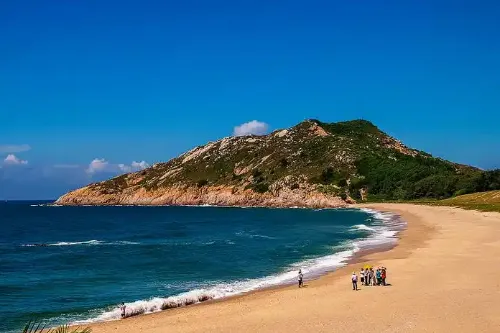
Sea Turtle Bay, full name Guangdong Huidong Port Sea Turtle National Nature Reserve, is located at the southern foot of Daxing Mountain, Port Coastal Tourism Resort, Huidong County, Huizhou City, Guangdong Province, at the junction of Daya Bay and Honghai Bay. It is also a national nature reserve, a wetland of international importance and a national popular science education base. The total area of land and sea under the reserve is about 18 square kilometers, including approximately 2 square kilometers of land and 16 square kilometers of sea area. Its core spawning beach is crescent-shaped, serving as the only stable natural spawning ground for sea turtles along China’s 18,000-kilometer coastline, known as the last sea turtle nesting beach on China’s mainland coast. Surrounded by mountains on three sides and facing the sea on one side, the bay features soft and even sand and clean seawater. It integrates sea turtle conservation, scientific research monitoring, natural science popularization and coastal sightseeing. Within the reserve lies the approximately 600-meter-long cliffside coastal plank road of Huixian Bridge, together with supporting facilities including the Sea Turtle Science Museum and the Sea Turtle Breeding Center. Five species of sea turtles inhabit this area: green sea turtles, loggerhead turtles, hawksbills, olive ridley turtles and leatherback turtles. More than 1,300 kinds of marine flora and fauna such as finless porpoises and bottlenose dolphins have also been recorded in adjacent waters.
History and Culture
Sea Turtle Bay has been a natural habitat where sea turtles migrate ashore to lay eggs since ancient times. Local fishermen have known for generations that sea turtles reproduce here, and a simple tradition of protecting the bay without harming sea turtles has taken shape over a long period. In the breeding season of early years, numerous mature sea turtles would migrate long distances back to this beach to lay eggs, forming a representative life scene in the local marine ecosystem.
In the 1980s, sea turtle populations suffered from fishing activities and habitat destruction, leading to a continuous decline in the number of sea turtles coming ashore to nest. In 1985, the fishery authority of Guangdong Province approved the establishment of the sea turtle nature reserve. It was promoted to a provincial-level nature reserve in 1986. With the approval of the State Council, it became a national nature reserve in 1992. It joined the Chinese Biosphere Reserve Network in 1993 and was inscribed on the Ramsar List of Wetlands of International Importance in 2002.
Since its establishment, the reserve has carried out continuous sea turtle rescue, artificial breeding, wild release and scientific monitoring work. It has made breakthroughs in artificial propagation technology for sea turtles and released tens of thousands of artificially bred juvenile sea turtles in total. Relying on reserve resources, natural science education and ecological research bases have been built to spread the concepts of sea turtle protection and marine ecological conservation to the public. It has successively been awarded the title of Guangdong Popular Science Education Base and Guangdong Natural Education Base, selected as one of China’s first batch of typical ecological tourism cases, and become a benchmark site for marine wildlife conservation in China.
Main Attractions
Sea Turtle Science Museum
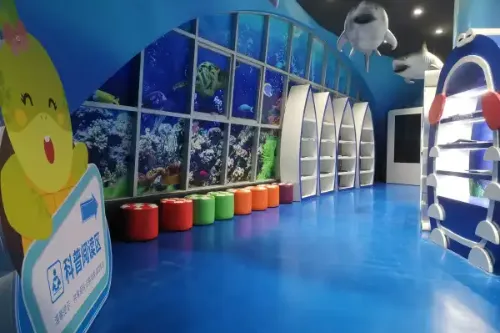
The Sea Turtle Science Museum is the core science venue of the scenic area. It is equipped with display boards, specimens, video exhibitions and interactive installations. It systematically introduces sea turtle classification, migratory habits, life cycles, breeding processes, as well as the conservation history, research achievements of the reserve and marine ecological knowledge. It is suitable for parent-child research visits, where visitors can systematically learn science knowledge about sea turtles.
Linggui Square
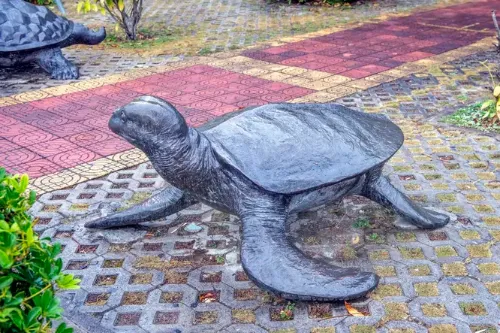
Linggui Square is near the Science Museum and serves as a rest and distribution hub of the scenic area. The square features sea turtle-themed landscape sculptures with an open space for visitors to take a break and take photos. It also acts as a transfer point on the sightseeing route within the park.
Huixian Bridge Sea View Plank Road
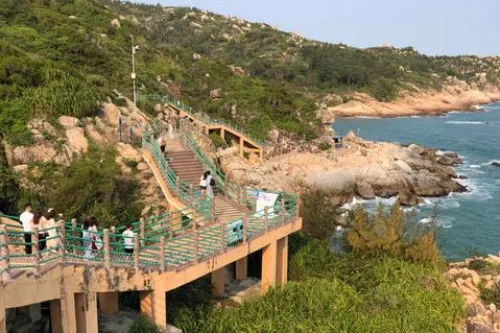
Huixian Bridge refers to the cliffside coastal plank road. It stretches about 600 meters along the coastal cliff of Daxing Mountain. One side of the plank road is steep cliff, and the other side faces offshore reefs and the sea. Sea-view pavilions and observation decks are arranged along the road for sightseeing and rest. It is a popular spot for enjoying sea views and watching sunsets. Waves crash against the reefs along the coastal section of the plank road with an open view.
Sea Turtle Breeding Center
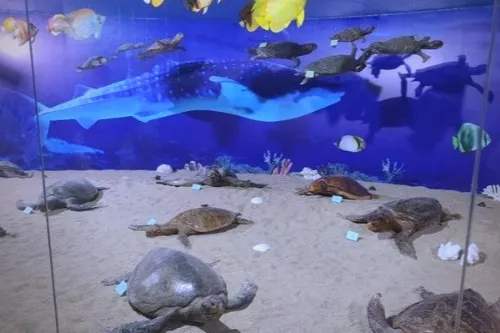
The Sea Turtle Breeding Center is the core area for sea turtle rescue, rearing and breeding. Multiple large breeding pools are built here, raising green sea turtles, loggerhead turtles, hawksbills and other sea turtles, including adults and subadults. Science feeding demonstrations are available at certain times. Visitors can watch sea turtles up close through the tank and learn about sea turtle rescue and breeding work.
Sea Turtle Nesting Beach
The Sea Turtle Nesting Beach is the core controlled zone of the reserve. The crescent-shaped beach is the traditional nesting site for wild green sea turtles, around 1,000 meters long with soft sand. This zone is strictly protected. Visitors are not allowed to enter the beach and can only watch from a designated viewing platform from a distance. The breeding season runs from May to October each year. Mature sea turtles come ashore to lay eggs at night, and reserve staff conduct 24-hour monitoring and protection.
Tour Route
Visitor Center Entrance → Sea Turtle Science Museum → Linggui Square → Sea View Pavilion → Observation Deck → Huixian Bridge Sea View Plank Road → Sea Turtle Breeding Center → Visitor Center Exit
Tour Tips
- It is recommended to visit in the morning or after 4 p.m. to avoid intense midday sunlight. The light is better for photos on the plank road and the temperature is more comfortable.
- The plank road has many steps and the coastal path is slippery. Non-slip sneakers are recommended. Slippers and high heels are not suitable for sightseeing.
- Shuttle electric carts are available inside the scenic area at a one-way fare of 5 RMB. Visitors with limited physical strength can take them uphill to save energy.
- The sea turtle breeding season lasts from May to October with rich science programs, suitable for research tours. If you watch sea turtles from afar at night during the breeding season, you must follow reserve regulations and staff instructions.
- Few goods are sold in the scenic area. Prepare drinking water and light snacks, sunscreen, sun hats and sunscreen lotion.
- Take your time to enjoy the scenery and science displays. Reserve 1.5 to 2 hours for the visit.
Notes
- The Sea Turtle Nesting Beach belongs to the core reserve zone. Visitors are forbidden to step on the beach or climb over fences to enter controlled areas.
- Do not touch or tap the glass of sea turtle tanks. Feeding sea turtles or marine organisms with your own food is prohibited.
- Waves can be strong around reefs beside the plank road. Do not climb over guardrails to approach reefs. Watch out for tide changes and wave hazards.
- Pets are not permitted inside the reserve. Do not shine bright flashlights on sea turtles or make loud noise to disturb them.
- There is heavy traffic on holidays. The winding mountain road to the scenic area has many curves. At times, visitors need to park vehicles at the outer distribution parking lot and transfer by shuttle buses. Pay attention to scenic traffic notices.
- Collecting shells and reef stones is forbidden. Do not litter to protect the marine ecosystem of the bay.
- Comply with reserve regulations and follow staff guidance. Violations will be handled in accordance with relevant reserve management rules.
Transportation
- High-speed rail: Take high-speed rail to Huidong Station. Transfer to the special shuttle bus from Huidong to Port Town, then take a taxi or scenic shuttle bus to Sea Turtle Bay.
- Bus: Take the direct shuttle bus from Huidong Coach Terminal to Port Coach Station, then transfer to a shuttle bus or taxi to the scenic area.
- Self-driving: Navigate to Sea Turtle Bay Visitor Center, located in Sea Turtle Bay, Port Coastal Tourism Resort, Huidong County. The mountain road near the scenic spot has many curves. Drive within the speed limit and check vehicle reservation notices during holidays.
- Scenic shuttle bus: Shuttle services are available at the Port Distribution Center for one-way 5 RMB, departing roughly every 15 minutes. Shuttle buses are preferred during traffic control in peak seasons.
Opening Hours
The scenic area adopts different opening hours for peak and off-peak seasons. The peak season runs from May 1 to October 15, opening from 8:30 to 17:30 with last admission at 17:30. The off-peak season runs from October 16 to April 30 of the next year, opening from 8:30 to 17:00 with last admission at 17:00. Temporary closure may be implemented under bad weather or typhoon conditions. Check official announcements before your trip.
Tickets
The ticket price is 30 RMB per person. Combo ticket (ticket + sea turtle conservation experience) is 199 RMB per person.
Search the WeChat service account “惠州海龟湾” for the latest updates.
Online Booking
Click here to jump to the Trip.com ticketing platform for ticket purchase.