
Hong Kong-Zhuhai-Macao Bridge Tour is located in Xiangzhou District, Zhuhai City, Guangdong Province. Tourists depart from the Hong Kong-Zhuhai-Macao Bridge Zhuhai Port, take special sightseeing buses onto the Hong Kong-Zhuhai-Macao Bridge, enjoy the sea views of Lingdingyang along the way, and arrive at Blue Dolphin Island (East Artificial Island) for visits. Spanning the Lingdingyang waters at the Pearl River Estuary, the Hong Kong-Zhuhai-Macao Bridge connects the Hong Kong Special Administrative Region in the east and links Zhuhai City of Guangdong Province and the Macao Special Administrative Region in the west. It is a mega cross-sea transport corridor integrating bridges, artificial islands and tunnels, hailed as one of the "Modern Seven Wonders of the World".
The total length of the Hong Kong-Zhuhai-Macao Bridge is 55 kilometres. The marine bridge-tunnel main project stretches approximately 29.6 kilometres, including about 22.8 kilometres of bridge works and a 6.7-kilometre immersed tube tunnel under the sea. Constructed to the standard of a dual six-lane expressway, the bridge has a design speed of 100 kilometres per hour and a design service life of 120 years. It can withstand typhoons of level 16 and magnitude-8 earthquakes. The total investment of the bridge exceeds RMB 120 billion. The steel plate used for the main girders of the main project alone reaches 420,000 tonnes, equivalent to the steel consumption of 60 Eiffel Towers.
On 15 December 2023, the trial operation of the Hong Kong-Zhuhai-Macao Bridge Tour officially launched. Tourists may board the bridge and visit Blue Dolphin Island without a Hong Kong and Macao Entry Permit. The whole sightseeing trip lasts roughly 140 minutes.
History and Culture
The concept of the Hong Kong-Zhuhai-Macao Bridge can be traced back to around 2003. In March 2004, the Office of the Coordination Group for the Preliminary Work of the Hong Kong-Zhuhai-Macao Bridge was established, formally kicking off preliminary demonstration work. After six years of preparation and planning, construction of the bridge officially commenced on 15 December 2009.
The construction lasted nine years. Tens of thousands of builders overcame many world-class technical challenges such as the offshore immersed tube tunnel and rapid artificial island formation. On 7 July 2017, the full line of the bridge’s main works was completed. Acceptance inspection of the main project was finished on 6 February 2018, and the bridge officially opened to traffic at 9 a.m. on 24 October 2018.
The Hong Kong-Zhuhai-Macao Bridge holds multiple world records. It is the world’s longest cross-sea bridge in overall span, home to the world’s longest highway immersed tube tunnel (6.7 kilometres in total length), and also the immersed tube tunnel with the deepest burial depth worldwide (roughly 48 metres below sea level at the deepest point). Each standard immersed tube segment measures 180 metres long, 38 metres wide and 11 metres high, weighing around 80,000 tonnes, making it the heaviest immersed tube component globally. The bridge also pioneered the deep-insert steel cylinder rapid island formation technology.
The pylons of the three navigation bridges each carry distinctive cultural implications: the "Sail Pylons" of Jiuzhou Navigation Bridge symbolize setting sail; the "Dolphin Pylons" of Jianghai Direct Ship Navigation Bridge embody harmonious coexistence between humanity and nature; the "Chinese Knot" pylon of Qingzhou Navigation Bridge represents the unity of the three regions, reflecting the cultural connotation of close connections within the Guangdong-Hong Kong-Macao Greater Bay Area.
Major Attractions
Jiuzhou Navigation Bridge (Sail Pylons)
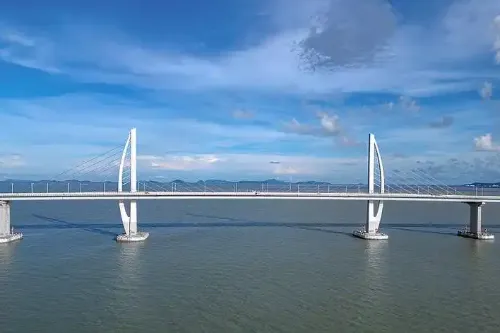
Jiuzhou Navigation Bridge is the navigation bridge closest to the Zhuhai side of the main bridge, with a main span of 268 metres. Two pylons about 120 metres high stand on the bridge, shaped like billowing sails in the wind, hence the name "Sail Pylons", symbolizing "setting sail for a distant voyage". As a steel box composite girder cable-stayed bridge, it is the first landmark bridge tourists pass by when boarding the bridge from Zhuhai Port by coach.
Jianghai Direct Ship Navigation Bridge (Dolphin Pylons)
The main span layout of Jianghai Direct Ship Navigation Bridge is 2×258 metres. Three bridge pylons shaped like dolphins along the bridge axis stand on the bridge, known as the "Dolphin Pylons", symbolizing "harmonious coexistence between humanity and nature". Lingdingyang serves as an important habitat for Chinese white dolphins. The dolphin-shaped pylons echo the surrounding ecological environment and embody the conservation philosophy for the white dolphin reserve adopted during bridge construction.
Qingzhou Navigation Bridge (Chinese Knot)
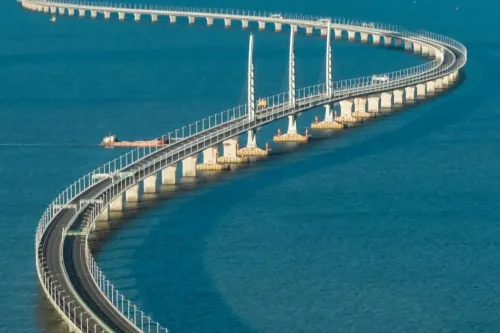
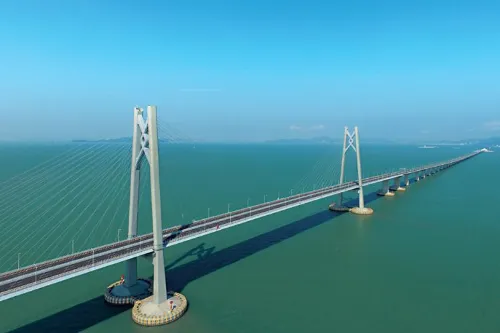
Qingzhou Navigation Bridge is the largest single bridge along the whole route, with a main span of 458 metres, the longest main span among all cable-stayed bridges of the project. Its pylons adopt a double-column portal frame structure with a central single-column concrete pylon reaching a total height of 163 metres. A total of 112 stay cables are installed on the bridge. The "Chinese Knot" landscape element atop the pylon stands nearly 50 metres above sea level, symbolizing the unity of Guangdong, Hong Kong and Macao. It is the most recognizable landmark of the Hong Kong-Zhuhai-Macao Bridge.
Subsea Immersed Tube Tunnel
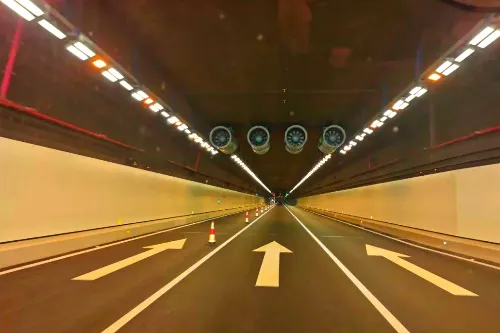
The subsea immersed tube tunnel has a total length of 6.7 kilometres, of which the undersea section is approximately 5,664 metres. It is assembled from 33 giant prefabricated immersed tube segments plus one final joint. It is the world’s longest highway immersed tube tunnel and the first offshore immersed tube tunnel in China. Each standard immersed tube segment is 180 metres long, 38 metres wide and 11 metres high, with a maximum displacement of roughly 80,000 tonnes. The maximum installation water depth exceeds 40 metres. Tourists ride sightseeing buses from the bridge section into the tunnel and experience the spatial transition from sea surface to seabed.
Blue Dolphin Island (East Artificial Island)
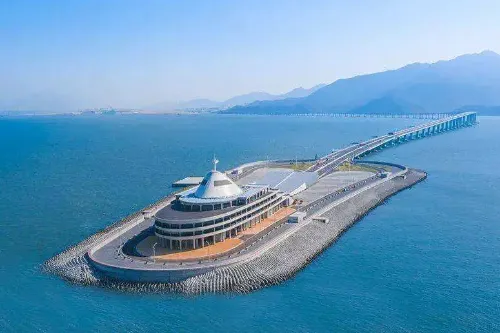
Blue Dolphin Island is the connecting artificial island between the bridge and tunnel of the Hong Kong-Zhuhai-Macao Bridge and the core stop for sightseeing. The island is 625 metres long and 215 metres at its widest point, shaped like a long scallop (oyster shell), covering an area of 105,000 square metres. Its architecture draws on the Lingnan "veranda building" style and hosts the world’s largest group of marine engineering fair-faced concrete buildings. The island is merely 366 metres away from the Guangdong-Hong Kong boundary. Standing on the island, visitors can get close views of Lantau Island and Hong Kong International Airport.
A 360-degree viewing platform is built on the island for panoramic views over Lingdingyang. On the fourth floor of the main building lies the Hong Kong-Zhuhai-Macao Bridge Exhibition Hall, introducing the bridge’s construction history, technological innovations and engineering equipment via multimedia presentations, audio-visual effects, photos and physical models. In front of the main building are 120 wide steps, symbolizing the bridge’s 120-year design service life. The square area features photo spots combining a model of Qingzhou Bridge pylon, Chinese white dolphin sculptures and bilingual welcome signs of the Hong Kong-Zhuhai-Macao Bridge. Visitors have about 80 minutes for free exploration on the island.
Tour Route
Assemble and verify identity at Tourism Inspection Hall, 2/F, Zone B, Zhuhai Highway Port → Security check and ticket verification → Sightseeing bus departs onto the bridge → Pass Jiuzhou Navigation Bridge (Sail Pylons) → Pass Jianghai Direct Ship Navigation Bridge (Dolphin Pylons) → Pass Qingzhou Navigation Bridge (Chinese Knot) → Cross the Subsea Immersed Tube Tunnel → Arrive at Blue Dolphin Island → Visit Bridge Exhibition Hall, viewing platform, 120 steps and square photo spots → Return by the same bus to Zhuhai Highway Port. The whole journey takes about 140 minutes (around 30 minutes outbound, 80 minutes on the island, 30 minutes return).
Tour Tips
- It is recommended to book tickets online at least 1 day in advance and up to 1 month ahead. Walk-in tickets are limited.
- When riding the sightseeing bus, choose the upper right seats (departing from Zhuhai) for better views of bridges and sea scenery.
- Strong winds blow on Blue Dolphin Island; bring a light jacket even on sunny days.
- You have roughly 80 minutes of free time on the island. It is advised to visit the fourth-floor exhibition hall first, then take photos at the viewing platform, and finish at the square photo spots to arrange your time reasonably.
- Sightseeing works best on clear days with good visibility for overlooking Lantau Island and Hong Kong International Airport. Rainy or windy weather may degrade the experience or even lead to schedule adjustments.
- This is a group tour with unified entry and exit. You must travel back and forth by the arranged bus and are not allowed to alight arbitrarily on the bridge.
Notes
- Visitors must carry original valid identity documents (Mainland visitors shall present Resident Identity Cards). No Hong Kong and Macao Entry Permit or endorsement is required. Document information must match reservation details.
- The sightseeing bus has a capacity of 47 passengers, one seat per person. Overloading is prohibited; children also need tickets and separate seats.
- Parking or alighting to take photos on the bridge deck is strictly forbidden after boarding the bridge. All sightseeing is conducted on moving buses and Blue Dolphin Island.
- Blue Dolphin Island sits close to the Guangdong-Hong Kong boundary. Do not cross the boundary. Drones and other unauthorized flying devices are prohibited.
- Mobile networks from Hong Kong and Macao may be received on the island. It is recommended to turn off mobile data roaming in advance or check tariff terms to avoid extra charges.
- In case of severe weather such as typhoons, heavy rain or dense fog, the bridge may be temporarily closed or trips cancelled. Check updates on the official WeChat account before travel.
- Real-name reservation is required. Refund and modification rules follow the official account’s statement. Arrive on time; late arrivals may miss the scheduled trip.
Transportation
- Public Bus: Take Zhuhai Bus No.3, 12, 23 or 25 and get off at "Bridge Port Hub" stop, or take L1 Sightseeing Bus to "Hong Kong-Zhuhai-Macao Bridge Highway Port" stop. Follow signs to Tourism Inspection Hall, 2/F, Zone B of Port World.
- Self-driving: Navigate to "Hong Kong-Zhuhai-Macao Bridge Zhuhai Highway Port". Park in P1 or P2 car park, take the elevator up to Port World and follow signs to Tourism Inspection Hall, 2/F, Zone B.
- High-speed / Intercity Rail: Take Guangzhu Intercity Railway to Zhuhai Station. Taxis from Zhuhai Station to Hong Kong-Zhuhai-Macao Bridge Zhuhai Highway Port take roughly 15–20 minutes and cost around RMB 20–30. Shuttle buses are also available.
- From Guangzhou: Take intercity trains from Guangzhou South Railway Station to Zhuhai Station (about 1 hour), then transfer by taxi or public bus to the port.
Opening Hours
The Hong Kong-Zhuhai-Macao Bridge Tour operates year-round (1 January to 31 December), with daily service hours from 09:00 to 17:00. Sightseeing buses depart according to pre-booked slots, and the whole tour lasts about 140 minutes.
Tickets
The ticket price for Hong Kong-Zhuhai-Macao Bridge Tour is RMB 188 per person. Search for the service account "港珠澳大桥游" on WeChat to get the latest updates.
Online Booking
Click here to jump to the Trip.com ticketing platform for ticket purchase.