
Yumenguan Scenic Area is located 90 kilometers northwest of Dunhuang City, Jiuquan City, Gansu Province. It is a component of the Dunhuang World Cultural Heritage, a national 4A-level tourist attraction, and also listed as a Major Historical and Cultural Site Protected at the National Level. The overall controlled area of the scenic spot is about 60,000 square meters. The core pass city ruins cover 16,000 square meters, and supporting facilities including sightseeing walkways, exhibition halls and viewing platforms occupy around 14,500 square meters. As a critical pass on the northern route of the ancient Silk Road, Yumenguan features desert borderland scenery and a cluster of military garrison ruins dating back to the Han Dynasty, including a pass city, beacon towers and Hecang City. The existing Yumenguan Pass City is a square rammed-earth structure. After more than 2,000 years of wind and sand erosion, it still retains its original urban layout, serving as a physical evidence for researching the northwest border defense system and Silk Road trade of the Han Dynasty.
History and Culture
Yumenguan was first built in the 6th year of the Yuanding reign of Emperor Wu of the Western Han Dynasty. After defeating the Xiongnu tribes, the imperial court developed the four commanderies along the Hexi Corridor. To secure passages to the Western Regions, regulate merchants on the Silk Road and fend off nomadic invasions, two major border passes were constructed: Yumenguan and Yangguan. It got its name because fine jade from Hotan in the Western Regions was transported into the Central Plains through this pass. In the Western Han Dynasty, garrison soldiers and land-reclamation troops were stationed here, supported by a complete military system with granaries, beacon warning stations and courier supply posts. All envoys, merchant caravans and monks traveling between regions had to present customs documents here, making it the primary gateway connecting the Central Plains to the Western Regions.
During the Wei and Jin dynasties, the Central Plains regime’s control weakened, and the northern Silk Road shifted slightly. Large-scale military garrisons at Yumenguan were gradually reduced, though it remained open for trade. The Sui and Tang dynasties brought a new boom to Yumenguan. Frequent border wars sent numerous soldiers to defend the frontier, and many literati who passed through composed timeless frontier poems. The line "Spring breeze never reaches Yumenguan" from Wang Zhihuan’s became a famous line passed down for millennia, endowing Yumenguan with profound literary frontier symbolism.
After the Song and Yuan dynasties, maritime trade flourished while overland Silk Road trade declined sharply. Yumenguan was completely abandoned, its city walls half-buried by desert wind and sand for centuries. Modern archaeological excavations gradually revealed the full picture of the ruins. In 2014, Yumenguan was inscribed on the World Heritage List as an important node of the "Silk Roads: the Routes Network of Chang'an-Tianshan Corridor". Today it opens to visitors as a protected cultural relic scenic area.
Major Attractions
Yumenguan Pass City Ruins
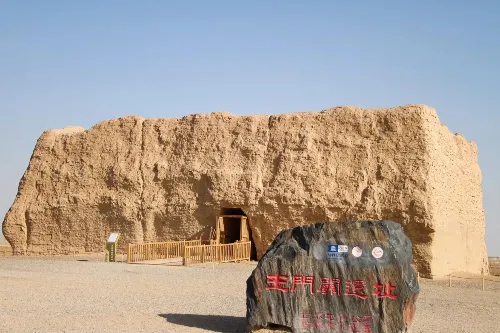
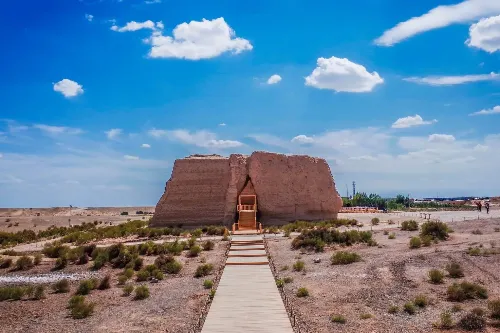
The pass city is the core landmark of the scenic area. It is square in plan with each side measuring 40 meters. The surviving rammed-earth walls stand roughly 9.7 meters high, with east and west city gates. Foundations of houses and horse paths remain inside the city. In ancient times, this core zone housed offices and living quarters for defending soldiers and customs inspection for merchants. A moat once surrounded the outer walls, and traces of it can still be seen today. The pass city intuitively demonstrates the construction style and military defense layout of Han Dynasty border fortresses.
Hecang City Ruins
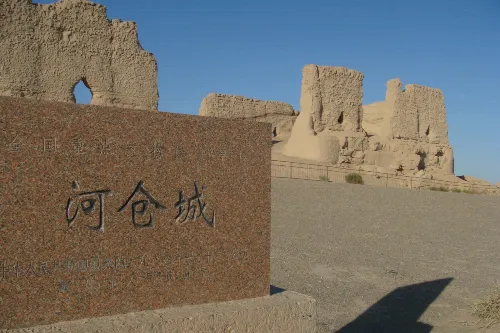
Hecang City lies about 11 kilometers northwest of Yumenguan Pass City. It was a large supporting grain storage warehouse for Yumenguan in the Han Dynasty, a rectangular rammed-earth complex split into north and south granary compounds. In ancient times, grain was delivered via water transport along the Shule River to supply soldiers stationed at Yumenguan and surrounding beacon towers. The ruins have severely damaged walls, yet foundations of partitioned grain storage compartments are clearly visible, representing vital remains of the Han Dynasty’s northwest garrison logistics system.
Dafangpan Beacon Tower
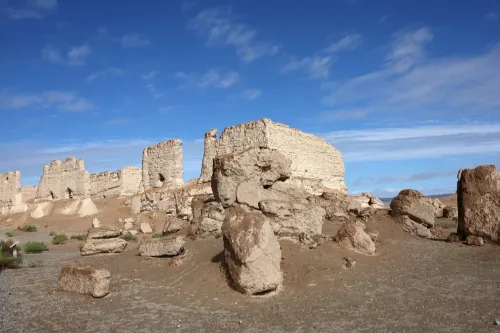
Dafangpan Beacon Tower stands adjacent to Hecang City, part of the Han Dynasty’s military warning beacon network. Built as a tall rammed-earth platform, it used smoke and fire signals to relay military intelligence during enemy incursions. The coordinated system of beacon towers, pass city and granary formed a complete frontier early warning defense line, serving as a typical physical specimen of Han beacon tower institutions.
Yumenguan Exhibition Hall
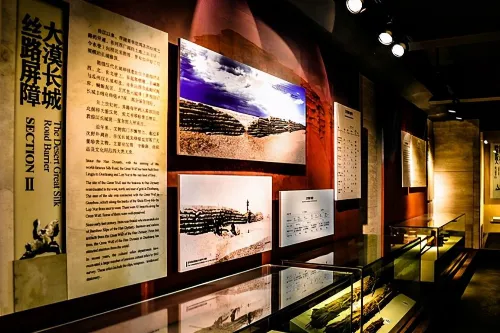
An indoor exhibition hall is located at the scenic area entrance. It displays cultural relics unearthed at Yumenguan including bamboo slips, pottery shards, ironware and silk fragments, alongside illustrated panels and scene reconstructions. Detailed displays explain Han border defense systems, Silk Road trade, daily life of garrison troops and archaeological excavation history, helping visitors fully grasp the historical context of the ruins.
Gobi Viewing Boardwalk
A wooden viewing boardwalk encircles the pass city and extends to a highland viewing platform on the Gobi Desert. From the platform visitors overlook boundless desert and distant Yardang landforms, experiencing the frontier scenery depicted in the phrase "lonely smoke rising over the vast desert". Protective isolation zones line the entire boardwalk to prevent visitors from stepping on undisturbed relic soil layers.
Tour Route
Scenic Visitor Center → Exhibition Hall → Viewing Boardwalk → Yumenguan Pass City Ruins → Sightseeing Bus Transfer Station → Hecang City Ruins → Dafangpan Beacon Tower → Return to Visitor Center
Travel Tips
- The best travel season is April to October each year; winter brings extremely low temperatures and heavy sandstorms that greatly reduce touring comfort
- The full itinerary covers two remote ruin sites; taking the scenic sightseeing bus is recommended as long-distance hiking drains excessive physical energy
- Reserve 2 to 3 hours for the full visit to thoroughly explore the exhibition hall and two ruin sites and absorb historical content
- Midday sunlight is intense on the Gobi; avoid touring between 12:00 and 15:00 during peak heat
- Bring binoculars to clearly observe fine details of beacon towers and distant desert landforms
- Book guided tours or rent audio guide devices to deeply understand historical stories behind the relics
Precautions
- The rammed-earth ruins are fragile cultural relics; climbing walls, stepping on ruin foundations, carving walls or picking up soil and stones are strictly prohibited
- The Gobi has almost no shaded areas; prepare sun hats, sunglasses, high-SPF sunscreen and windproof scarves
- Drinking water supply points are scarce in the desert; bring sufficient water per person plus small portions of high-calorie snacks for energy replenishment
- Temperature differences between morning and evening are extreme; pack a lightweight jacket even in summer, and thick windproof warm outerwear for spring, autumn and winter
- No on-site first-aid medical station deep in the desert; visitors with hypertension or cardiopulmonary conditions should consider carefully before traveling long distances
- Sandstorms occur frequently on the Gobi; follow staff instructions to suspend outdoor ruin visits during strong wind and dust conditions
- Unregistered drone flights are forbidden; apply for official approval from scenic management before using drones to photograph cultural relic ruins
- Never stray from designated boardwalks and sightseeing routes; the outer Gobi has no mobile signal or marked roads, posing high risks of getting lost
Transportation
- Self-driving: Travel 90 kilometers along Provincial Highway S303 from central Dunhuang, with a driving time of roughly 1.5 hours; free open-air parking is available at the scenic area
- Scenic shuttle buses: Fixed daily round-trip departures run from designated downtown Dunhuang hotels and tourist hubs, with fares included in basic bundled tickets
- Chartered vehicles: Local 5-seat and 7-seat private cars can be chartered for one-day itineraries combining Yumenguan, Yardang Ghost City and Hecang City
- Public coaches: No regular city bus routes reach the site; temporary tourist shuttle coaches operate only during peak travel seasons
Opening Hours
The scenic area adjusts opening hours for peak and off-peak seasons. Peak season runs from April 1 to October 31, open daily 8:00 to 18:00. Off-peak season spans November 1 to March 31 of the next year, open daily 9:00 to 17:00. Hours may be shortened temporarily or the site fully closed during extreme gales, rain or snow; check real-time official announcements before departure. The exhibition hall and outdoor ruins open simultaneously, with ticket entry halted 30 minutes prior to closing time.
Ticket Information
The entrance ticket for Yumenguan Ruins costs 40 RMB per person, and sightseeing bus fares are 50 RMB per person. Search the WeChat official account "敦煌玉门关" to access the latest updates and information.
Online Booking
Click here to jump to the Trip.com ticketing platform for ticket purchase.