
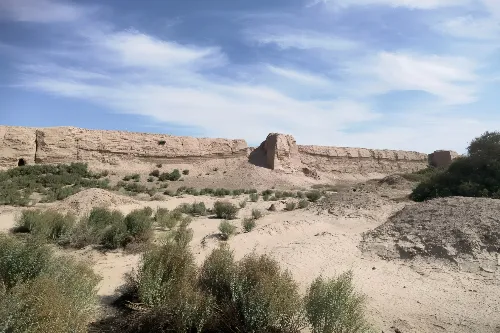
Suoyang City Ruins is situated in the Gobi desert southeast of Suoyang Town, Guazhou County, Jiuquan City, Gansu Province. It is a Major Historical and Cultural Site Protected at the National Level, a component of the World Cultural Heritage Silk Roads: the Routes Network of Chang'an-Tianshan Corridor, and also rated a national 4A-level tourist attraction. The total area of relics at the site covers approximately 1.06 million square meters. The city complex consists of an outer city and an inner city; the inner city spans 210,000 square meters while the outer city covers around 150,000 square meters. The total length of rammed earth walls remaining within the city exceeds 7,000 meters. The core highlight of the scenic area is China’s best-preserved Tang Dynasty military defense city system, complemented by reclamation irrigation relics, ancient tomb clusters and Gobi desert landforms, fully preserving a complete chain of relics reflecting military-civilian land cultivation and frontier defense in ancient Western Regions. All city walls adopt rammed earth casting construction techniques. The base width of inner city walls measures 7.5 meters, with the highest residual height reaching 18 meters. The outer city walls suffered more severe damage from weathering, with residual heights mostly ranging from 3 to 8 meters. A complete ancient irrigation canal network survives around the site, paired with large areas of reclaimed farmland relics, serving as physical specimens for researching the integrated military-administrative system and oasis agricultural development along Hexi frontier in the Tang Dynasty.
History and Culture
Suoyang City was first established in the Western Jin Dynasty as the administrative seat of Jinchang Commandery. It was renamed Changle County in the Sui Dynasty, and functioned as the prefectural seat of Guazhou in the Tang Dynasty, acting as a pivotal military stronghold guarding the northern route of the Silk Road at the western end of Hexi Corridor. During the Wude and Zhenguan reign periods of the Tang Dynasty, this place served as a strategic passage connecting the Central Plains with the Western Regions, stationing massive troops and implementing military land cultivation systems. Ditches and canals were dug to divert water from Shule River for irrigating Gobi farmland, enabling self-sufficiency for frontier garrisons. The folk legend of Xue Rengui being besieged in Suoyang City during his western expedition has been widely passed down, becoming an iconic cultural story of this area.
After the Anshi Rebellion, turmoil swept Hexi, and Tubo forces occupied Guazhou region, inflicting partial damage to the city. The city remained in continuous use as a local military-administrative stronghold through the Five Dynasties and Western Xia periods. In the Yuan Dynasty, shifts in Silk Road transportation patterns prompted the relocation of Guazhou’s military and administrative center, leading to the gradual abandonment of Suoyang City, which was thereafter buried beneath desert sandstorms for a long time.
In the Ming and Qing dynasties, abundant growth of Cynomorium songaricum (suoyang) medicinal herb across the land gave rise to the folk name Suoyang City. On November 20, 1996, Suoyang City Ruins was listed among the fourth batch of Major Historical and Cultural Sites Protected at the National Level. On June 22, 2014, it was inscribed on the World Cultural Heritage List as part of the overall Silk Roads site. Subsequent projects including wall reinforcement, security monitoring and display boardwalks were carried out for protection and renovation, opening the site officially for cultural tourism visits. A wealth of cultural relics such as Tang pottery shards, coins, weapons, farm tools and fragmentary documents have been unearthed here, corroborating its thousand-year history of frontier garrison and land cultivation.
Main Attractions
Inner City Complex
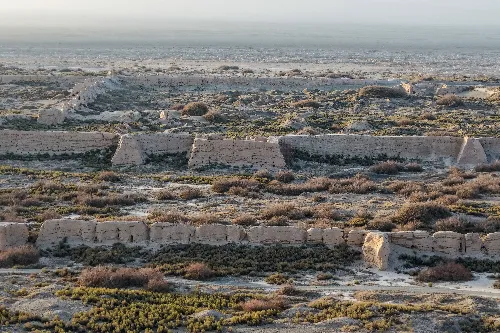
The inner city forms the core body of Suoyang City, shaped as an irregular square roughly 560 meters east to west and 480 meters north to south. Four city gates pierce the rammed earth walls, each equipped with a barbican defensive structure outside. Multiple rammed earth platforms remain inside the city, corresponding to foundation sites of ancient government offices, barracks and granaries, with faint traces of street layouts still discernible. Remnants of horse platforms and corner towers dot the walls; evenly spaced horse platforms follow standard Tang military city construction norms. Visible layered rammed patches from successive renovations on the walls clearly record reinforcement engineering marks from different dynasties.
Outer City Complex
The outer city encircles the perimeter of the inner city, with an irregular contour following terrain undulations yet covering a broader area. It mainly functioned as an outer defensive buffer zone, troop camp and market district. Severe weathering and collapse fragmented the outer city walls into intermittent ruins, with numerous brick, tile and pottery fragments scattered across the ground. Archaeological surveys identify these as remains of civilian residences, workshops and temporary reclamation housing; clear outlines of large flat ancient farmland foundations can be seen in the northern outer city.
Ta'er Temple Ruins
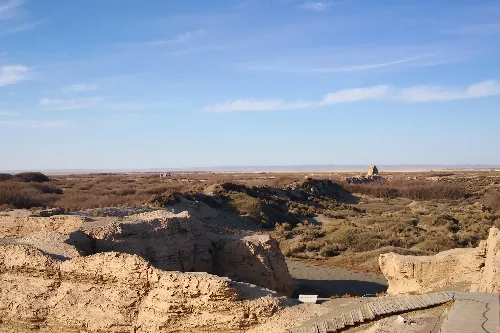
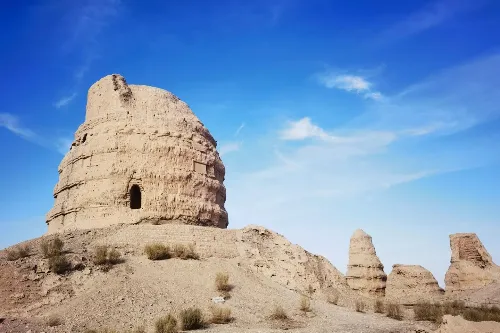
Ta'er Temple lies approximately 1,000 meters northwest of Suoyang City, a large Buddhist temple ruin dating from Western Xia to Yuan Dynasties. The temple occupies a rectangular plot covering around 27,500 square meters. At the site’s center stands a stupa with a residual height of 14.5 meters, surrounded by rammed earth foundations of small monk quarters and auxiliary halls. Unearthed artifacts include broken Western Xia painted sculptures, scripture fragments and brick-tile components. As a vital Buddhist propagation hub of ancient Guazhou, it bears witness to religious integration along the Silk Road.
Ancient Irrigation Canal System Relics
Canal relics stretch for dozens of li across the Gobi surrounding Suoyang City, structured hierarchically into main canals, branch canals and field ditches. Main canals reach widths of 8 to 12 meters, with total surviving canal length spanning dozens of kilometers. Water diverted from Shule River irrigated extensive farmland divided into orderly plots, perfectly recreating the Tang military land cultivation water conservancy system. As a typical relic of ancient Gobi oasis hydraulic engineering, farmland ruins spanning roughly 246,000 square meters remain distinctly visible.
Ancient Tomb Cluster
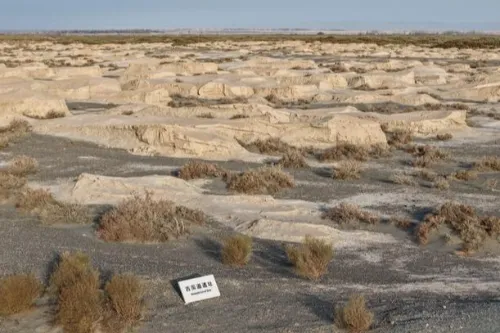
Vast clusters of Western Jin to Tang dynasty tombs spread across the Gobi outside the site, numbering over a thousand. Tomb structures fall into two categories: earthen cave tombs and brick-chamber tombs, some fitted with sloped passageways. Excavated grave goods include bronze mirrors, pottery, gold and silver ornaments, epitaphs and other artifacts. Spanning from Western Jin to Tang, these tombs serve as critical physical materials for researching funeral customs, social stratification and ethnic integration among Hexi residents during that era.
Tour Route
Scenic Area Entrance Visitor Service Center→Sightseeing Bus Stop→Ta'er Temple Ruins→Outer City Wall Viewing Platform→East Gate Barbican of Inner City→Core Rammed Earth Platforms of Inner City→Northwest Corner Tower Ruins of Inner City→Ancient Irrigation Canal Exhibition Zone→Outer Tomb Viewing Spots→Return to Visitor Service Center
Travel Tips
- The full sightseeing tour takes 3 to 4 hours. There are few shaded buildings across the relic zone; prioritize visits from 8:00 to 11:00 in the morning or after 16:00 in the afternoon to avoid intense midday heat
- Gobi winds carry heavy sand; always walk along laid wooden boardwalks, and do not step on unreinforced rammed earth walls or relic ground
- Bring binoculars for distant views of canal networks and tomb clusters; join official scenic guides to hear professional historical interpretations of weathered wall details up close
- No catering shops operate within the scenic area; bring drinking water and light meals before departure. Picking or digging wild Cynomorium songaricum is forbidden, regulated by cultural relic and ecological protection laws
- Drone photography is prohibited; formal approval from scenic management and cultural relic authorities must be submitted in advance if aerial filming is required
- Combine Suoyang City with other Guazhou County attractions for a one-day itinerary; pairing Suoyang City Ruins and Yulin Grottoes forms a complete heritage loop
Precautions
- Suoyang City is a protected zone for World Cultural Heritage and cultural relics. Climbing rammed earth walls, carving wall surfaces, or collecting pottery shards from the ground is strictly prohibited, with penalties enforced under Cultural Relics Protection Law
- Huge temperature fluctuations occur between day and night in the desert; bring a light jacket even in summer. High UV intensity requires sun hats, sunscreen, windproof sunglasses and gauze scarves
- No medical stations inside the scenic area. Visitors with heart, lung or hypertension conditions should assess their physical capacity. Mobile signal coverage is incomplete across the Gobi; always travel in groups and never stray far from designated boardwalks
- Open flames and ignition sources are banned throughout the relic zone. Sparse Gobi vegetation means strict fire control; smoking is only permitted in designated zones at the visitor center
- Private vehicles cannot enter the core relic protection zone; all outside cars must park in the external scenic parking lot, with transfers via official sightseeing vehicles to relic areas
- Protect Gobi ecology: do not chase or disturb desert wildlife, and avoid crushing native desert vegetation and wild Cynomorium songaricum plants
Transportation
- Self-driving: Depart from Guazhou County Town, drive south along Guasuo Highway for roughly 38 kilometers (40 minutes drive). A free open-air parking lot is available at the scenic area
- Public transport: No direct shuttle buses run from Guazhou County Bus Station to Suoyang City; local shared passenger vehicles can be booked at the bus station
- Long-distance transfers: Self-driving from Jiuquan Urban Area covers about 260 kilometers (3 hours 10 minutes drive); Dunhuang Urban Area sits 130 kilometers away (1 hour 40 minutes drive), ideal for looping Dunhuang and Guazhou Silk Road sites
- On-site transport: Sightseeing electric shuttles connect core relic sections. The long distance between Ta'er Temple and the city complex makes shuttles recommended for visitors with limited stamina
Opening Hours
Suoyang City Ruins adjusts opening hours seasonally year-round. Peak season runs April 1 to October 31, open daily 8:30–18:00 with ticket sales closing at 17:30. Off-season spans November 1 to March 31 of the following year, open daily 9:00–17:00 with ticket sales stopping at 16:30. Temporary closures may be implemented during extreme high winds, sandstorms, or cultural relic conservation renovation work; confirm daily opening status with scenic management before traveling. The site operates normally on legal holidays with no regular rest days.
Ticket Fees
Ticket price is 20 RMB per person. Follow the official WeChat public account “锁阳城遗址旅游景区” for the latest updates.
Online Booking
Click here to jump to the Trip.com ticketing platform for ticket purchase.