
Nanyue Hengshan Scenic Area is located in Hengshan District, Hengyang City, Hunan Province. It is one of China's "Five Great Mountains" and is a national-level scenic area, a national 5A-level tourist attraction, and a national dual heritage of nature and culture. The total area of the scenic area is 181.5 square kilometers, with the core scenic area covering 100.7 square kilometers. The main peak, Zhurong Peak, has an altitude of 1,300.2 meters. Known as "the most beautiful among the Five Great Mountains", Hengshan has a forest coverage rate of 74.75%, and is home to 2,019 plant species belonging to 762 genera and 174 families. Among these, 21 are rare and endangered tree species such as Gleditsia japonica var. velutina and Cathaya argyrophylla, making it an important gene bank for biological resources in southern China. The mountain is composed of granite and gneiss, with a terrain that is higher in the south and lower in the north, presenting a landform characterized by "a row of peaks with magnificent momentum". It has a subtropical monsoon humid climate, with an average annual temperature of 17.5℃, abundant rainfall, and distinct four seasons.
History and Culture
Hengshan has a long history. In ancient times, it was a place where emperors Yao and Shun of the pre-Qin period patrolled their territories, hunted, and offered sacrifices to the state. Yu the Great once climbed Hengshan to combat floods. After unifying China, Emperor Qin Shihuang sent Prime Minister Li Si to Hengshan in 219 BC to inscribe a stone tablet in commemoration of his achievements. Since the Han Dynasty, Hengshan has been regarded as a Taoist sacred place. During the Eastern Jin Dynasty, Buddhism was introduced here, forming a religious and cultural pattern where Taoism and Buddhism coexist.
Hengshan is one of the important birthplaces of Huxiang Culture. Great Confucian scholars of the Neo-Confucianism school such as Zhu Xi and Zhang Shi once gave lectures here, leaving behind the famous story of "Zhu-Zhang Joint Lectures". In history, many literati and poets such as Li Bai, Du Fu, and Han Yu also climbed Hengshan many times and left a large number of poems and essays, such as Han Yu's "Visiting the Hengyue Temple and Staying Overnight in the Mountain Temple to Inscribe the Gate Tower".
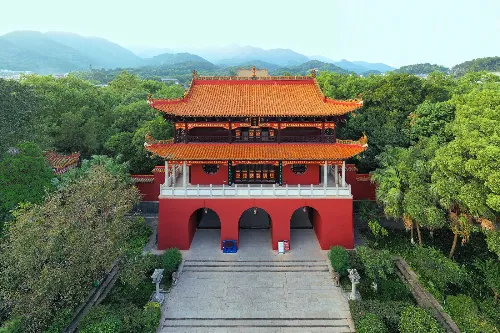
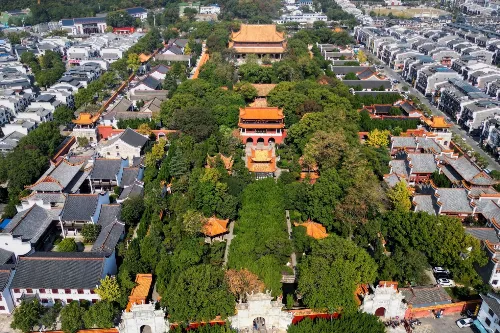
Nanyue Grand Temple is the most important historical building in Hengshan. First built in the Tang Dynasty, the existing buildings were reconstructed in the 8th year of the Guangxu reign of the Qing Dynasty (1882). It is the largest and best-preserved palace-style building complex in southern China, covering an area of 98,500 square meters. Modeled after the Forbidden City in Beijing, it is known as the "Little Forbidden City in the South".
Major Attractions
Zhurong Peak
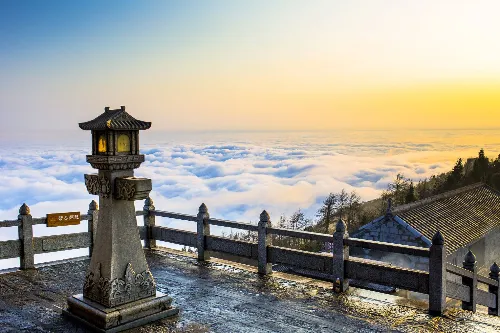
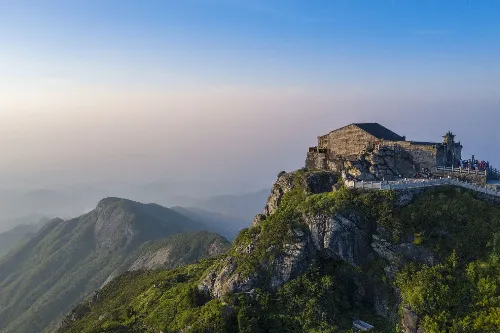
Zhurong Peak is the main peak of Hengshan, with an altitude of 1,300.2 meters. It gets its name because Zhurong, the god of fire in Chinese mythology, was buried here. At the top of the peak stands Zhurong Hall, which was first built in the Tang Dynasty and rebuilt during the Tongzhi reign of the Qing Dynasty. The hall houses a statue of Zhurong, the Fire God. From the peak, visitors can overlook the surrounding mountains and enjoy natural landscapes such as sunrises and sea of clouds. It is the best place to watch the sunrise in Hengshan and attracts a large number of tourists every year.

Nanyue Grand Temple
Nanyue Grand Temple is located at the northern end of Nanyue Ancient Town and is the largest ancient building complex in Hengshan. Covering an area of 98,500 square meters, the temple has nine courtyards and four layers of buildings arranged along the central axis, including Lingxing Gate, Kuixing Pavilion, South Main Gate, Imperial Stele Pavilion, Jiaying Gate, Imperial Book Building, Main Hall, Bedroom Hall, and North Back Gate. There are eight Taoist temples on the east side and eight Buddhist temples on the west side, presenting a unique pattern of "coexistence of Buddhism and Taoism, and integration of Confucianism, Buddhism and Taoism". The temple preserves a large number of cultural relics from the Ming and Qing dynasties, such as stone carvings and plaques, among which the stone carving "Longevity of Nanyue Hengshan" is particularly famous.
Water Curtain Cave
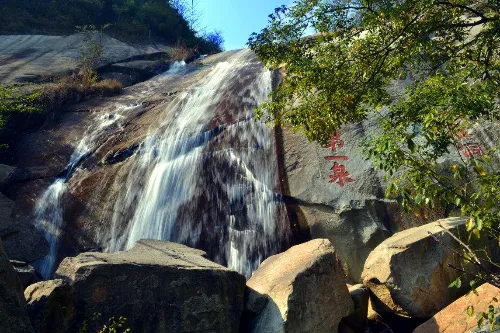
Water Curtain Cave is located in the northeastern part of Hengshan and is one of the famous natural landscapes of Hengshan. In front of the cave, water flows down from a cliff more than 70 meters high, forming a waterfall shaped like a beaded curtain, hence the name. There is a green pool under the waterfall, whose depth is immeasurable. Around the Water Curtain Cave, there are many cliff carvings. Among them, "Zhuling Taixu Cave Heaven" was written by Mi Fu, a calligrapher of the Song Dynasty. It is the location of Zhuling Cave Heaven, one of the "36 Cave Heavens" of Taoism in Nanyue.
Sutra Repository Hall
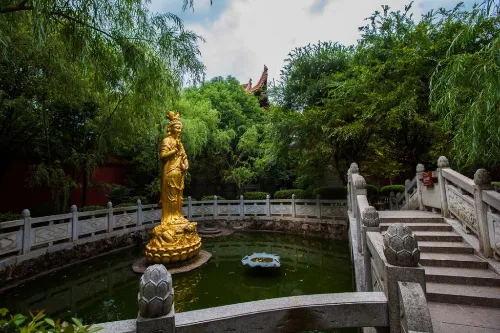
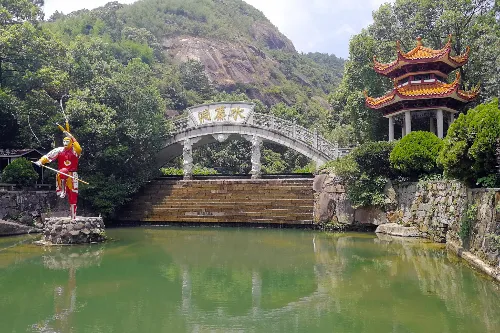
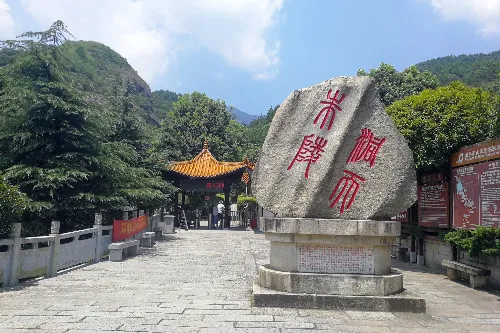
Sutra Repository Hall is located at the foot of Xiangguang Peak in Hengshan. It was built in the 2nd year of the Guangda reign of Emperor Fei of the Southern Chen Dynasty (568 AD) by Monk Huisi, and was originally named "Mahaprajna Temple". Later, it was renamed Sutra Repository Hall because Zhu Yuanzhang, the founding emperor of the Ming Dynasty, granted a large collection of Buddhist scriptures here. The existing building was reconstructed in 1933. The hall originally stored 10,000 volumes of Buddhist scriptures, but now only a part of them remains. Surrounded by towering ancient trees, the hall is in a quiet environment and is known as "the elegance of Sutra Repository Hall", making it one of the most beautiful places in Hengshan.
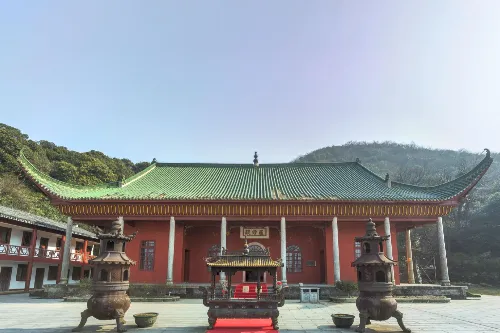
Fangguang Temple
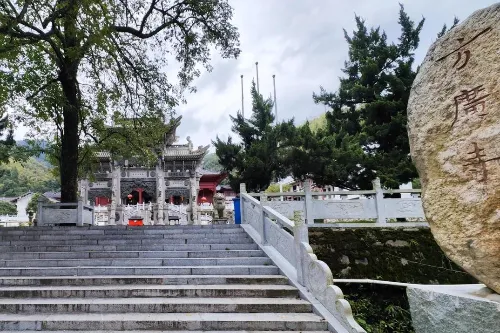
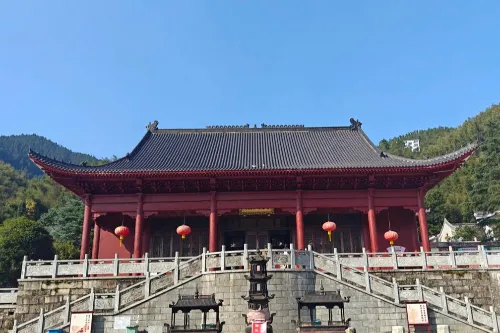
Fangguang Temple is located at the foot of Lianhua Peak in Hengshan. It was first built in the 2nd year of the Tianjian reign of the Liang Dynasty of the Southern Dynasties (503 AD). Later, it was destroyed by wars many times, and the existing building was reconstructed in 1983. The temple has buildings such as the Mahavira Hall and the Sutra Pavilion. In front of the temple, there is a stone arch bridge, under which there is a stream. Surrounded by peaks and lush ancient trees, it is known as "the seclusion of Fangguang Temple" and is one of the most secluded scenic spots in Hengshan.

Tour Routes
Recommended one-day tour route: In the morning, start from Nanyue Ancient Town and visit Nanyue Grand Temple to learn about the history and culture of Hengshan, which takes about 2 hours. Then take the scenic area's environmental protection bus to Zhurong Peak, climb the peak and enjoy the landscape at the top, which takes about 3 hours. In the afternoon, go to Water Curtain Cave to appreciate the waterfall, which takes about 1.5 hours. Finally, return to Nanyue Ancient Town to end the trip.
Recommended two-day tour route: On the first day, visit Nanyue Grand Temple in the morning, and in the afternoon, go to scenic spots such as Sutra Repository Hall and Mojing Platform to experience the natural and cultural landscapes of Hengshan. On the second day, take the environmental protection bus to Zhurong Peak in the morning, then go to Fangguang Temple to experience the seclusion of Hengshan, and return in the afternoon.
Travel Tips
- Spring (March-May): Azaleas bloom all over Hengshan, presenting a beautiful scenery. It is recommended to wear light clothes and carry rain gear, as there is much rain in spring.
- Summer (June-August): The climate is cool, making it a good place to escape the heat. However, the ultraviolet rays are strong, so it is necessary to take sun protection measures and carry sunscreen, sunglasses, etc.
- Autumn (September-November): The weather is clear with high visibility, which is suitable for mountain climbing and sightseeing. There is a large temperature difference between morning and evening at this time, so it is necessary to carry a coat.
- Winter (December-February): Hengshan may snow, and you can enjoy the rime landscape, which is very beautiful. However, the temperature is low, so it is necessary to keep warm and wear thick down jackets, snow boots, etc.
- It is recommended to wear comfortable sports shoes when climbing the mountain, and carry enough water and snacks to reduce the load.
- If you are not physically strong enough, you can choose to take the scenic area's environmental protection bus to save energy for better sightseeing.
Notes
- Fireworks are strictly prohibited in the scenic area, and smoking is not allowed in non-smoking areas to avoid causing mountain fires.
- Pay attention to safety when climbing the mountain, abide by the scenic area's regulations, and do not climb in unopened areas.
- In religious places such as Nanyue Grand Temple, respect religious beliefs and customs, and do not make loud noises or litter.
- Some scenic spots in the area are at a high altitude, such as Zhurong Peak, which may cause mild altitude sickness. Those who are unwell can prepare in advance.
- During the peak tourist season, there are many tourists in the scenic area, so it is necessary to keep personal belongings safe to avoid loss.
- When taking the scenic area's environmental protection bus, follow the staff's arrangements and do not jump the queue or crowd.
Transportation
- By plane: You can first arrive at Changsha Huanghua International Airport, then take an airport bus or high-speed rail to Hengyang City, and then transfer to a bus to Nanyue Hengshan. The distance from Changsha Huanghua International Airport to Nanyue Hengshan is about 150 kilometers, and the journey takes about 2.5 hours.
- By train/high-speed rail: Hengyang City has Hengyang Railway Station and Hengyang East Railway Station. It is about 50 kilometers from Hengyang Railway Station to Nanyue Hengshan by bus or taxi, and the journey takes about 1 hour. It is about 45 kilometers from Hengyang East Railway Station to Nanyue Hengshan by high-speed rail special line, and the journey takes about 50 minutes.
- By bus: Nanyue Hengshan has long-distance buses directly to surrounding cities such as Changsha, Zhuzhou, and Xiangtan. The distance from Changsha Nanyue Bus Station to Nanyue Hengshan is about 120 kilometers, and the journey takes about 2 hours.
- Scenic area transportation: There are environmental protection buses in the scenic area, with a one-way ticket price of 78 yuan per person (including round trip). You can take the bus to major scenic spots. You can also choose to climb the mountain on foot. The walking distance from Nanyue Ancient Town to Zhurong Peak is about 15 kilometers, and it takes 5-6 hours.
Opening Hours
The scenic area is open year-round. The opening hours are 08:00-18:00 (summer) and 08:30-17:30 (winter). Nanyue Grand Temple is open from 08:00 to 17:30, and Water Curtain Cave is open from 08:00 to 18:00.
Ticket Information
Separate tickets are available for different scenic spots.
The ticket price for the core scenic area is 110 yuan per person, 58 yuan per person for Nanyue Grand Temple, 29.5 yuan per person for Wanshou Tripod, and 30 yuan per person for Water Curtain Cave.
You can search for the official WeChat public account "南岳衡山风景名胜区" to get the latest updates or purchase tickets online.
Online Booking
Click here to jump to the Trip.com ticketing platform for ticket purchase.