
The Mogao Grottoes are located on the eastern cliff of Mingsha Mountain, 25 kilometers southeast of Dunhuang City, Jiuquan City, Gansu Province. A World Cultural Heritage site, it ranks among China’s Four Great Grottoes. Famous for exquisite murals and painted sculptures, the scenic spot is hailed as "Art Gallery in the Desert" and "Museum on the Wall". First built in the Former Qin Period of the Sixteen Kingdoms, the grottoes underwent successive construction during the Northern Dynasties, Sui, Tang, Five Dynasties, Western Xia and Yuan dynasties. Presently there exist 735 grottoes, 45,000 square meters of murals and 2,415 clay painted sculptures, making it the world’s largest and most content-rich sacred site of Buddhist art. The core protected area covers around 1324.54 hectares, with the construction control zone spanning approximately 1980 hectares. It is a world-class cultural scenic area integrating history, art, religion and culture.
History and Culture
Excavation of the Mogao Grottoes started in 366 AD, the second year of Jianyuan reign of Former Qin, initiated by monk Le Zun. Afterwards, Master Faliang and other monks continued digging, gradually turning the site into a sacred Buddhist retreat. During the Sixteen Kingdoms era, successive northern regimes promoted Buddhism, facilitating initial development of the grottoes with simple cave layouts and rustic mural styles. In the Northern Dynasties, namely Northern Wei, Western Wei and Northern Zhou, expansion proceeded steadily; more caves were carved, and murals plus sculptures blended Central Plains culture with Western Regions artistic features.
The Sui and Tang Dynasties marked the golden age of Mogao Grottoes. Thanks to national unification, prosperous economy and thriving Silk Road trade, Dunhuang evolved into a key hub for Sino-Western cultural exchange. Cave excavation boomed and artistic craftsmanship peaked. Tang-era caves feature grand scale, vivid colorful murals with diverse themes and plump lifelike painted sculptures embodying the prosperous temperament of the flourishing Tang. Construction persisted through the Five Dynasties, Song and Western Xia periods on a smaller scale yet retaining distinctive contemporary artistic traits. After the Yuan Dynasty, cave excavation ceased entirely, and remote geographic location helped preserve the complex intact.
In modern times, the grottoes regained global attention after the accidental discovery of the Library Cave in 1900, which yielded over 50,000 relics including scriptures, documents, silk paintings and embroideries dating from the Sixteen Kingdoms to Northern Song. The finding sparked worldwide academic research and gave birth to the specialized discipline of Dunhuang Studies. In 1987, the Mogao Grottoes was inscribed onto the UNESCO World Heritage List as common cultural treasure of all mankind. Today it serves as a vital carrier showcasing ancient Sino-Western communication, Buddhist art evolution and daily life of ancient societies.
Key Attractions
Nine-Story Building
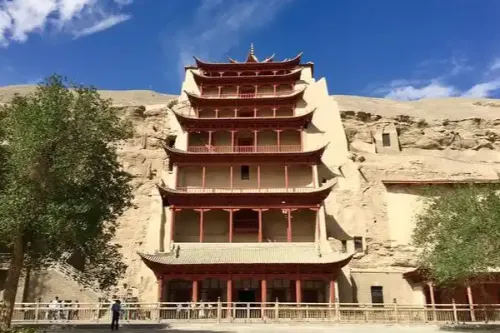
The iconic Nine-Story Building corresponds to Cave No.96, hewn in early Tang Dynasty and named after its nine-tier wooden exterior pavilion. Inside sits a 35.5-meter-tall Maitreya Buddha statue, the largest painted sculpture at Mogao and one of China’s grandest ancient clay Buddha figures. Built clinging to the cliff with upturned eaves, the pavilion has been renovated repeatedly and the existing structure was reconstructed in the Republic of China period. It is the first landmark visitors spot upon entering the scenic zone.
Library Cave
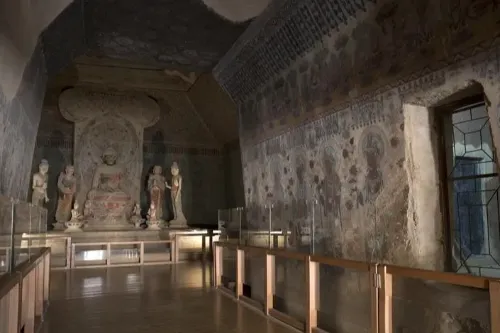
Numbered Cave No.17, the Library Cave was chiseled in late Tang as the memorial niche for monk Hong Bian of Hexi Region. In 1900, Taoist priest Wang Yuanlu accidentally uncovered the cave housing more than 50,000 relics including Buddhist scriptures, official documents, woven embroidery and portrait paintings spanning from Sixteen Kingdoms to Northern Song, covering religion, literature, history, art and science. Regarded as one of the most significant archaeological finds of the 20th century, the cave no longer keeps original collections and preserves only its primitive layout for visitors to learn the origin of Dunhuang Studies.
Central Pillar Caves
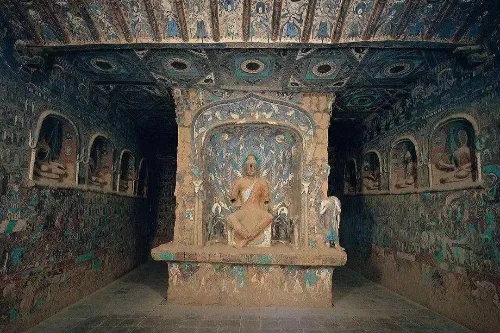
Represented by Cave No.254 and Cave No.257, Central Pillar Caves stand as typical Northern Dynasties cave layout. A square stone pillar rises at each cave’s center with Buddha shrines carved on four sides for enshrining statues. Cave murals mainly depict Buddhist jataka tales and karma stories in primitive bold strokes combining Gandhara art from Western Regions and traditional Central Plains aesthetics, precious physical evidence for studying Northern Dynasties Buddhist art and cave architecture.
Grand Tang Caves
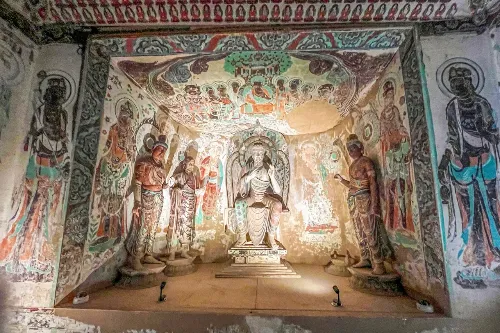
Grand Tang Caves represented by Cave No.130 and Cave No.148 embody the pinnacle of Mogao artistic achievement. Cave No.130 is a giant Buddha cave from High Tang housing a 26-meter Maitreya Buddha; Cave No.148 is a nirvana cave featuring a 15.8-meter-long reclining Sakyamuni surrounded by disciples, Bodhisattvas and celestial beings. Bright-hued, fluent-lined murals depict Western Pure Land transformation, flying apsaras and sutra transformation scenes, vividly reflecting Tang artistic attainment and social customs.
Exhibition Center of Dunhuang Academy
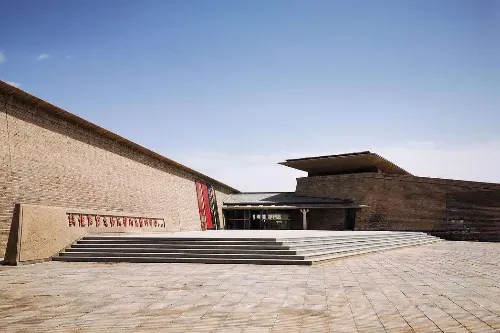
Situated near the entrance of Mogao Scenic Area, the Exhibition Center of Dunhuang Academy is a modern museum displaying Dunhuang relics and arts. Through replicated caves, artifact specimens, graphic panels and digital videos, the center systematically introduces the grottoes’ history, artwork, archaeological discoveries and conservation achievements. Visitors can preview background knowledge and view reproductions of normally inaccessible caves to complement in-site touring experience.
Tour Route
Mogao Digital Exhibition Center → Shuttle Bus Station → Mogao Cave Zone → Nine-Story Building → Library Cave → Central Pillar Caves → Grand Tang Caves → Exhibition Center of Dunhuang Academy → Shuttle Bus Station → Return to Digital Exhibition Center
Travel Tips
- Reserve admission tickets in advance via official booking platform; book 15 days ahead during peak travel season to avoid sold-out situations
- Watch two featured documentaries at Digital Exhibition Center before cave visits to enrich understanding of grotto history and art
- Visit caves only with official professional guides; solo wandering is prohibited, with 8 to 15 original caves arranged per guided group
- Reserve 3 to 4 hours for full sightseeing including movie screening, shuttle ride, cave tour and museum visit
- Combine with Mingsha Mountain & Crescent Spring and Dunhuang Ancient City to plan one-day or two-day Dunhuang travel itinerary
- Bring drinking water and light snacks as limited catering services are available inside cave area; replenish water regularly in hot summer
Precautions
- Photography, video recording and touching murals or sculptures inside caves are strictly forbidden; flashlights and extra lighting devices are banned
- Keep quiet inside caves; no loud talking or running; refrain from touching cave inner walls randomly
- Flammables, controlled cutting weapons and drones are prohibited from entering the scenic spot
- Follow tour regulations closely; never leave guided groups or step into restricted unopened cave areas
- No carving, graffiti or littering in core cultural preservation zone to protect historic relic environment
- Elderly visitors, children and pregnant women must be accompanied by family members and arrange schedules according to personal physical condition
- Real-name entry required; original ID card mandatory for adults; household registration book needed for kids without ID certificates
Transportation
- Public Bus: Take dedicated tourist shuttle departing near Dunhuang Hotel from downtown Dunhuang, around 30 minutes ride
- Taxi: Ride taxi from downtown to Mogao Digital Exhibition Center with roughly 20 minutes driving time
- Self-driving: Navigate to parking lot of Digital Exhibition Center with free parking; private vehicles cannot access cave core zone
- Online Car-hailing: Book ride via online platforms with fares comparable to regular taxis for flexible transfer
Opening Hours
Mogao Grottoes implements time-slot reservation visiting system. Peak season (April 1 – October 31): 8:00-18:00; documentaries start screening at 8:00 and last entry is permitted at 15:00. Off-season (November 1 – March 31 next year): 9:00-17:30; movie screening opens at 9:00 with final entry cutoff at 14:00. Opening schedules may adjust on public holidays or for cultural preservation needs, subject to official real-time announcements.
Ticket Information
Ticket fares start from 140 RMB per person. Search official WeChat service account "莫高窟参观预约网" for latest updates.
Online Booking
Click here to jump to the Trip.com ticketing platform for ticket purchase.