
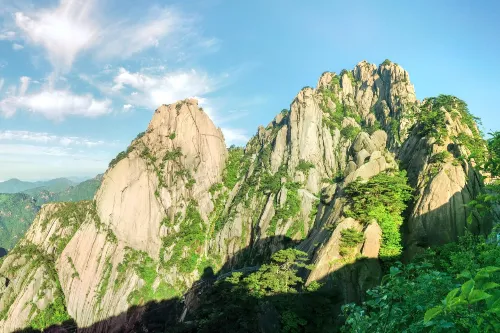
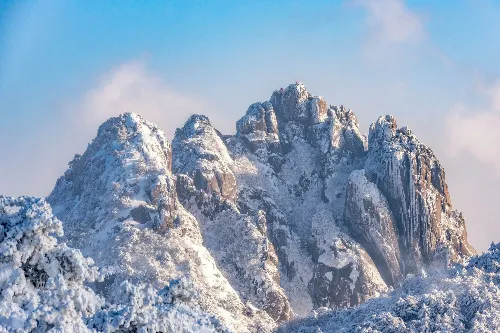
Huangshan Scenic Area is located in Huangshan District, Huangshan City, Anhui Province. It is a National Scenic Area, a 5A-level tourist attraction, and a UNESCO World Cultural and Natural Heritage Site. Covering a total area of approximately 160.6 square kilometers, with its core scenic area spanning about 1154 square kilometers, the area consists of 72 peaks. Among them, Lianhua Peak (Lotus Peak), Guangmingding (Bright Summit), and Tiandu Peak (Heavenly Capital Peak) are the three main peaks, all exceeding 1,800 meters in altitude. Lianhua Peak is the highest at 1,864.8 meters. Renowned worldwide for its "Five Wonders"—peculiar pines, grotesque rocks, sea of clouds, hot springs, and winter snow—Huangshan is hailed as the "Most Fantastic Mountain Under Heaven." With a vegetation coverage rate of 98.29%, the scenic area is home to 1,805 species of higher plants belonging to 827 genera and 222 families, as well as over 300 species of wild animals, making it a crucial region for biodiversity conservation in China.
History and Culture
Huangshan boasts a long history. Known as "Yishan Mountain" during the Qin Dynasty (221-207 BCE), it was officially renamed "Huangshan" (Yellow Mountain) by Emperor Xuanzong of the Tang Dynasty in 747 CE, a name that has endured to this day. As one of China's Taoist sacred sites, Huangshan is steeped in legend—Xuanyuan Huangdi (the Yellow Emperor), a mythical ancestor of the Chinese people, is said to have refined elixirs and cultivated immortality here, leaving behind relics such as the Danlian Platform (Elixir Refining Platform) and Xiyao Chi (Medicinal Herb Washing Pond). During the Ming and Qing dynasties, Huangshan became a magnet for literati and artists, spawning the "Huangshan School of Painting." Masters like Shi Tao and Jian Jiang created numerous masterpieces depicting the mountain's landscapes. The scenic area preserves over 280 cliff carvings, including the renowned "Standing Firm Over the East China Sea, Ascending High to Gaze at Peace," which holds significant historical and cultural value.
Huangshan also served as an important center for Buddhist propagation. During the Tang Dynasty, temples such as Xiangfu Temple and Cuiwei Temple were built, while surviving structures like Yungu Temple and Ciguang Pavilion date back to the Ming and Qing dynasties, providing tangible evidence for the study of Buddhist cultural dissemination in the region. Additionally, Tunxi Old Street and Huizhou-style ancient villages at the foot of Huangshan carry rich Huizhou culture, showcasing distinctive elements such as Huizhou merchants, Huizhou architecture, and local folk customs.
Major Attractions
Lianhua Peak (Lotus Peak)
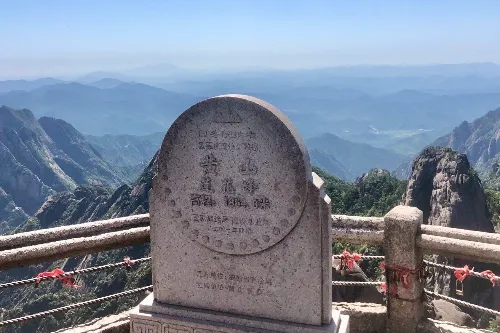
As Huangshan's highest peak at 1,864.8 meters, Lianhua Peak derives its name from its resemblance to a blooming lotus flower. With its steep and towering terrain, the peak offers a magnificent panoramic view of Huangshan, including the spectacular "sea of clouds and Buddha's light" phenomenon. Facing Tiandu Peak across a valley, the two peaks alternate opening to the public every five years. Lianhua Peak is open to visitors from 2023 to 2027.
Guangmingding (Bright Summit)
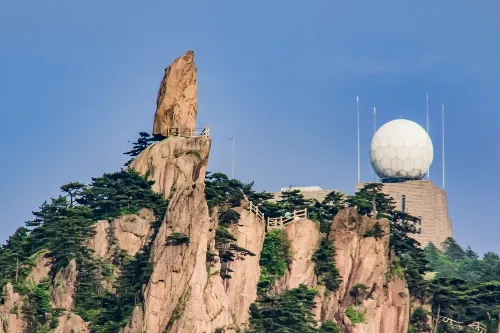
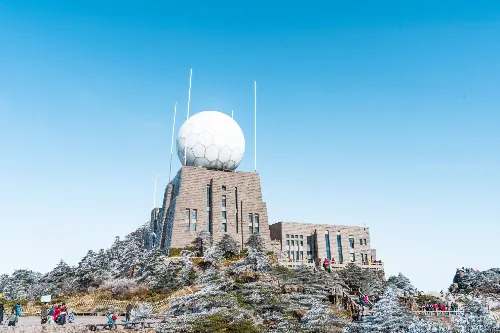
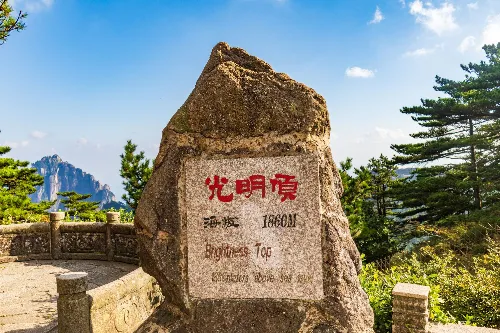
At 1,860 meters above sea level, Guangmingding is Huangshan's second-highest peak. Its name, meaning "Bright Summit," originates from its elevated and open terrain, which receives long hours of sunlight. A prime spot for watching sunrises and sea of clouds, the peak is also home to Huangshan Meteorological Observatory—the highest-altitude meteorological station in East China. Surrounded by attractions like Feilai Stone (Flying Stone) and Bai'e Ridge (White Goose Ridge), Guangmingding serves as a major tourist hub.
Tiandu Peak (Heavenly Capital Peak)
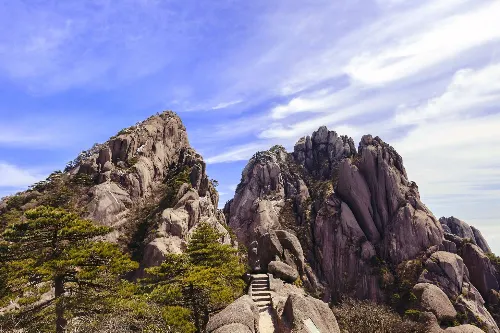
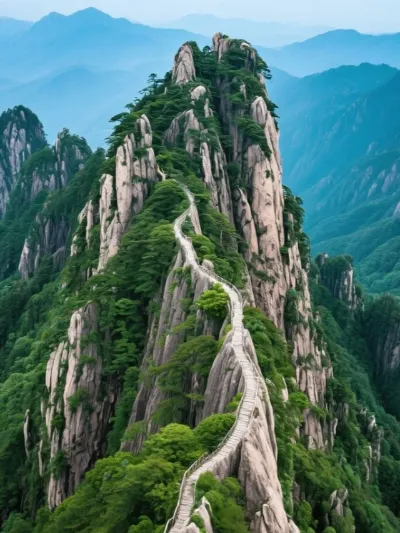
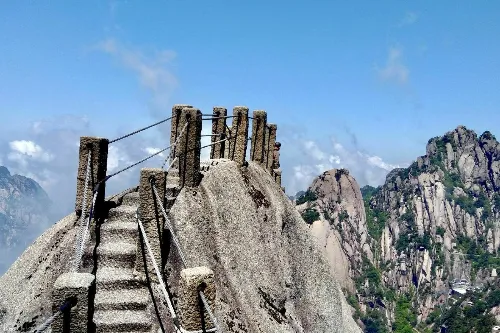
With an altitude of 1,829.5 meters, Tiandu Peak is renowned for its precipitousness. Literally meaning "Capital of Heaven," it was historically regarded as a gathering place for immortals. The peak features dangerous paths such as Jiyu Bei (Crucian Carp Back), a 10-meter-long and 1-meter-wide stone beam flanked by abysses, making it one of Huangshan's most thrilling attractions. Alternating with Lianhua Peak for public access, Tiandu Peak will reopen in 2028.
Welcoming Pine
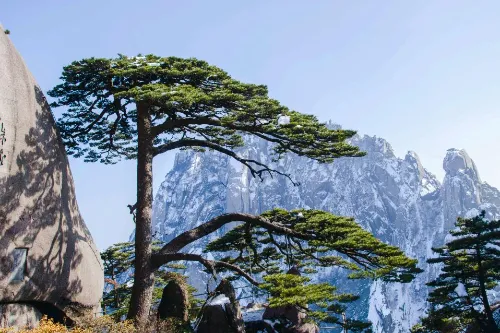
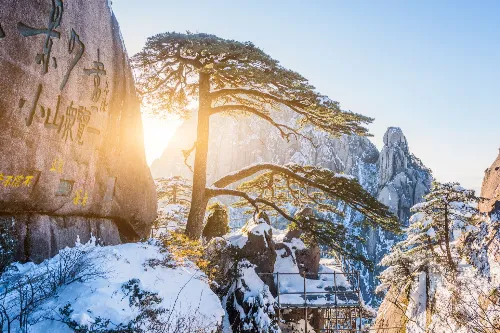
As Huangshan's iconic symbol, the Welcoming Pine stands on the left side of Yuping Building and above Wenshu Cave. Measuring 10.1 meters tall with an estimated age of 1,300 years, the pine's outstretched branch resembles an arm greeting guests from afar, embodying the grace and resilience of Huangshan pines. Listed under the World Natural Heritage protection list, the Welcoming Pine is guarded by dedicated staff.
West Sea Grand Canyon
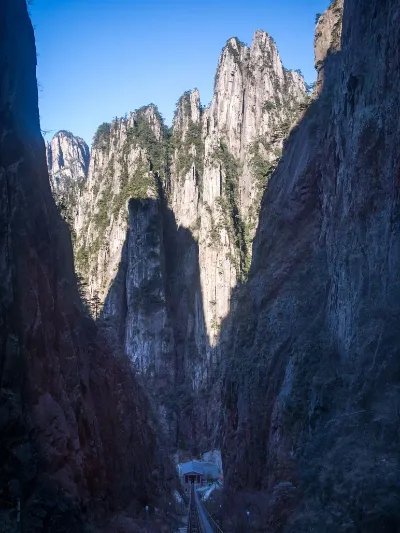
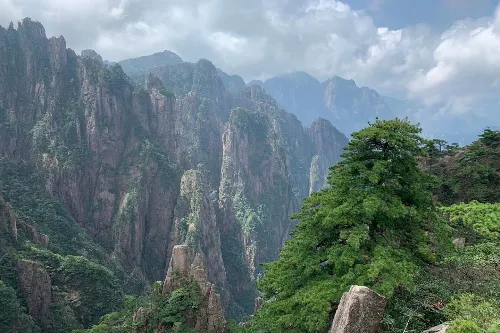
Located in the western part of Huangshan Scenic Area, the West Sea Grand Canyon is one of the mountain's most beautiful and profound gorges. Stretching approximately 15 kilometers in length with an average depth of 1,000 meters (and a maximum depth of 1,300 meters), the canyon is adorned with jagged peaks, exotic rocks, and swirling clouds, resembling a fairyland. Equipped with a sightseeing cable car, visitors can either ride to admire the canyon's scenery or hike through it to experience the "scenery at every step."
Hot Spring Scenic Area
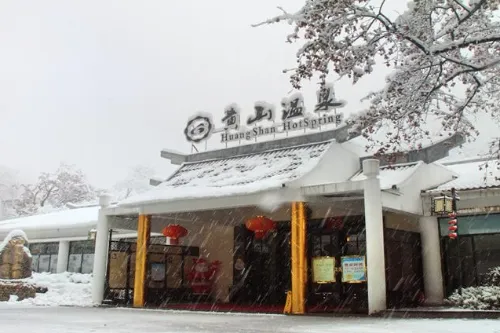
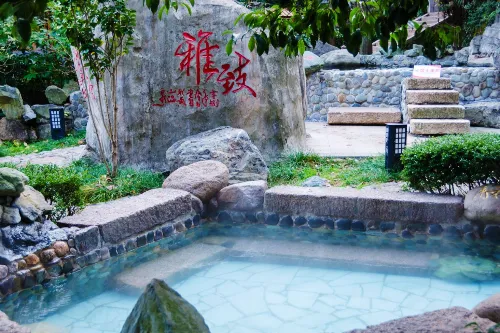
Situated on the southern slope of Huangshan, the Hot Spring Scenic Area is one of the mountain's "Five Wonders." The hot spring water maintains a constant temperature of around 42°C, with clear water containing various minerals that are beneficial for relieving skin conditions and rheumatism. With a history of over 2,000 years of use, the hot spring was developed into a spa resort during the Tang Dynasty, and cliff carvings such as "Famous Spring Under Heaven" still exist today.
Recommended Itineraries
One-Day Tour: Enter via the South Gate, take the scenic area shuttle bus to Ciguang Pavilion, and ride the Yuping Cable Car uphill. Visit attractions such as Yuping Building, Welcoming Pine, Lianhua Peak (if open), and Tiandu Peak (if open), then proceed to Guangmingding. After lunch, explore the West Sea Grand Canyon, take the ground cable car to Baiyun Hotel, and hike via Buxian Bridge and Tianhai to the Yungu Cable Car for the descent. Return to the South Gate by shuttle bus.
Two-Day Tour: Day 1: Enter via the South Gate, take the shuttle bus to Yungu Temple, and ride the Yungu Cable Car uphill. Visit Bai'e Ridge, Shixin Peak, North Sea Scenic Area, and the north entrance of the West Sea Grand Canyon. Hike or take the ground cable car to the canyon bottom, then return to Tianhai and check in at Baiyun Hotel. Day 2: Wake up early to watch the sunrise at Guangmingding. Afterwards, visit Yuping Building, Welcoming Pine, Lianhua Peak (if open), and Tiandu Peak (if open). Take the Yuping Cable Car downhill and return to the South Gate.
Travel Tips
- Recommended duration: 2-3 days to fully experience Huangshan's natural and cultural charm.
- Check the weather forecast in advance; sunny or cloudy days are ideal for viewing the sea of clouds and sunrises.
- Wear comfortable hiking shoes and a windproof jacket. Huangshan features numerous mountain paths, and the peak temperature is relatively low, especially with significant day-night temperature differences.
- Carry sufficient drinking water and snacks. Prices on the mountain are higher, so prepare high-energy foods such as chocolate and beef jerky.
- Follow order when taking cable cars and keep personal belongings secure. Exercise caution while hiking and avoid undeveloped areas.
Notes
- Smoking and littering are prohibited in Huangshan Scenic Area. Protect the environment and keep the area clean.
- Some sections of the scenic area are steep, such as Jiyu Bei on Tiandu Peak and the West Sea Grand Canyon. Exercise caution and travel in groups.
- Huangshan is prone to thunderstorms. Avoid staying on peaks or under trees during thunderstorms and seek shelter promptly.
- Tourist numbers are high during peak seasons (especially holidays). Book accommodation in advance to avoid disrupting your itinerary.
- Respect local customs and traditions. Maintain silence and follow regulations when entering religious sites such as temples.
Transportation
- By Air: Fly to Huangshan Tunxi International Airport, approximately 50 kilometers from the scenic area. Take an airport shuttle bus (20 RMB per person, 1-hour journey) or a taxi.
- By High-Speed Train/Train: - High-Speed Train: Arrive at Huangshan North Station (50 km from the scenic area). Take the high-speed rail special shuttle bus (20 RMB per person, 1-hour journey). - Regular Train: Arrive at Huangshan Station. Take a tourist shuttle bus from outside the station (19 RMB per person, 1.5-hour journey).
- By Car: Drive via the Beijing-Taipei Expressway or Hangzhou-Ruili Expressway. The scenic area has three parking lots (South Gate, North Gate, East Gate). The South Gate Parking Lot is the largest, with fees: 30 RMB/day for small cars, 40 RMB/day for medium cars, and 50 RMB/day for large cars.
- Internal Transportation: Traffic control is implemented within the scenic area. Visitors must take the scenic shuttle bus to access attractions. The one-way fare is 19 RMB per person, and the shuttle bus is required to travel from the South Gate to Ciguang Pavilion and Yungu Temple.
Opening Hours
Open year-round. Peak season (March 1 to November 30): 6:30 AM - 5:30 PM. Off-season (December 1 to February 28 of the following year): 7:30 AM - 4:30 PM. Cable car operating hours: 6:30 AM - 5:40 PM (peak season) and 7:30 AM - 4:40 PM (off-season). The opening hours of the scenic area may be adjusted due to weather, seasons and other factors. Visitors are advised to check the official notice of the scenic area before traveling.
Tickets
Ticket prices start from 95 RMB.
You can search for the official WeChat public account "中国黄山" to get the latest updates or purchase tickets online. There are various types of tickets available; please choose according to your needs.
Online Booking
Click here to jump to the Trip.com ticketing platform for ticket purchase.