
Dunhuang Yardang National Geopark is located within Dunhuang City, Jiuquan City, Gansu Province, around 160 kilometers away from downtown Dunhuang. It is a national 4A-level tourist attraction, as well as a national geopark and one of the core zones of Dunhuang Global Geopark. The park covers a total area of 398.4 square kilometers. Its landform mainly formed in the Late Pleistocene of the Quaternary Period, with an overall altitude ranging from 70 meters to 120 meters. It constitutes a large-scale and typically shaped wind-eroded yardang landform cluster in China. There are no traditional ancient artificial buildings in the scenic area; natural wind-eroded ridges and mounds form the core landscapes. The landforms were jointly shaped by millions of years of wind erosion and intermittent fluvial scouring on lacustrine sediments. The terrain undulates gently against a vast desert Gobi backdrop. Its three core viewing highlights are grand desert yardangs, Gobi sunsets and Gobi starry skies. It boasts multiple values including geological scientific research, desert sightseeing and film shooting. Many movies such as Hero and Chronicles of the Ghostly Tribe were shot here.
History and Culture
In terms of geological evolution, this area was a large inland freshwater lake hundreds of millions of years ago, where thick layers of silt, clay and sandy sediments accumulated continuously. The uplift of the Qinghai-Xizang Plateau altered regional atmospheric circulation and hydrological conditions, leading to gradual drying of the lake. Exposed sedimentary strata endured persistent strong erosion by northwest monsoons, coupled with cutting by torrential floods. After hundreds of thousands of years of sculpting, extensive yardang mound clusters took shape. They fully preserve geological records of wind-eroded landform evolution in arid northwest China, serving as a natural specimen field for researching arid-region landforms and paleoclimate changes.
For humanistic history, the site lies adjacent to the northern route of the ancient Silk Road. Ancient merchants and garrison soldiers often passed through this barren Gobi stretch when traveling to and from the Western Regions. No exclusive name for yardang landforms existed in ancient books. Local Uyghur people called steep wind-eroded mounds "Yardang", which was later transliterated and simplified to "yardang", becoming the universal academic term for such wind-eroded landforms worldwide. In modern times, Chinese and foreign geologists conducted numerous surveys here. Formal geological conservation planning was launched in the late 20th century, and Dunhuang Yardang National Geopark was officially approved for establishment in 2001, initiating a model of standardized conservation alongside tourism development.
Regarding modern cultural tourism and scientific research development, the scenic area has built a supporting geological museum and popular science interpretation system, opening field research access for geological colleges. Relying on its unique desert scenery, it has become a landmark internet-famous desert sightseeing destination in northwest China. The light-pollution-free Gobi environment at night also makes it a well-known stargazing spot in the Hexi Corridor.
Main Scenic Spots
Golden Lion Welcoming Guests
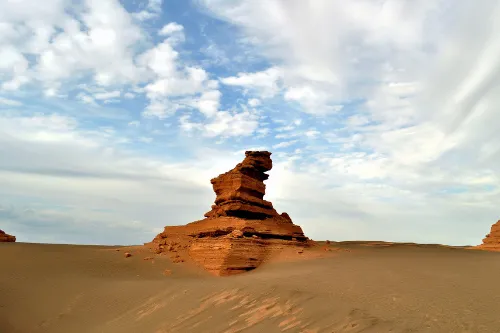
Golden Lion Welcoming Guests is the landmark standalone yardang mound first seen along the sightseeing bus route upon entering the park. Its overall outline resembles a squatting, leaning lion facing the park entrance, standing roughly 20 meters tall. Rich iron oxide impurities tint the rock mass golden russet under sunrise and sunset light, making it the primary check-in spot for tourists. Clear bedding textures on the rock mass intuitively display layered lacustrine sediment structures.
Sphinx
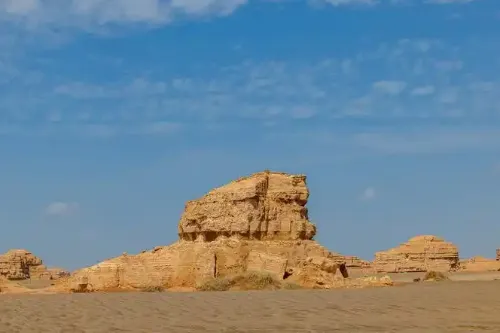
This yardang mound bears a striking resemblance to Egypt’s Sphinx shape, with a towering head and sprawling recumbent body. It stands nearly 30 meters high and stretches over 60 meters long. Formed entirely through differential wind erosion with no artificial carving, its silhouette matches the Sphinx best when viewed from the side. It is a highly recognizable naturally shaped yardang in the park, and sightseeing buses make brief stops here for sightseeing and photography.
Peacock Standing Elegantly
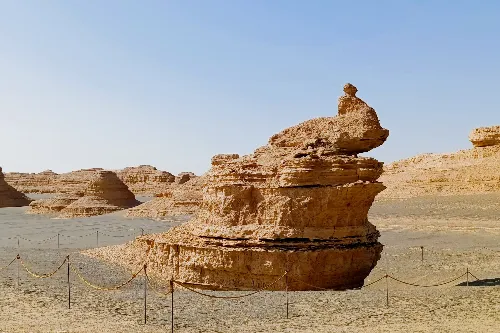
The Peacock Standing Elegantly mound looks like a peacock standing with its tail spread open. Extended ridges form its fanned tail, supported by a tall central pillar roughly 25 meters high. The mound has a pale off-white base hue, showing prominent layered textures against backlight. Scattered small eroded residual mounds surround it, creating strong visual contrast against the yellow Gobi sand backdrop.
West Sea Fleet
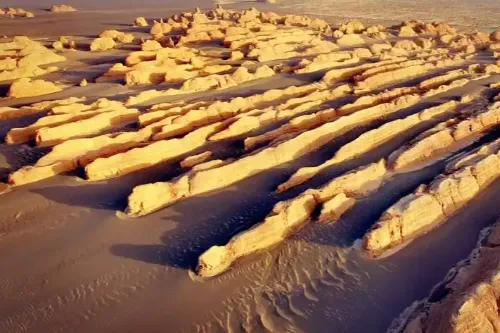
The West Sea Fleet features the largest connected yardang ridge cluster in the park. Dozens of long strip-shaped wind-eroded ridges align parallelly, stretching for several kilometers. Their uneven heights mimic fleets of ships sailing in formation, with ridge heights mostly ranging from 10 to 25 meters. This zone serves as a classic representative of yardang cluster landforms, where visitors can fully observe standard yardang structures of alternating wind grooves and ridges. It also offers the broadest panoramic views deep inside the scenic area.
Yardang Geological Museum
The geological museum is a supporting popular science building of the scenic area, with a construction area of approximately 1500 square meters. Inside, it displays stratum rock cores, landform evolution models and paleontological fossil specimens, equipped with graphic exhibition boards and video playback devices. It systematically explains yardang formation processes, regional geological changes in Dunhuang and desert ecological protection knowledge, acting as a vital venue for research tourists to learn geological knowledge.
Tour Route
Scenic Area Entrance Ticket Check → Sightseeing Bus Waiting Point → Golden Lion Welcoming Guests Viewing Platform → Sphinx Viewing Platform → Peacock Standing Elegantly Viewing Platform → West Sea Fleet Core Viewing Zone → Yardang Geological Museum → Scenic Area Exit
Tour Suggestions
- Prioritize entering the park at sunrise or sunset; soft morning and evening light maximizes color layers of yardang mounds, while harsh midday sunlight washes out landform tones for poorer photography results.
- Ride official scenic sightseeing buses for the entire journey. Yardangs span a vast area; long-distance hiking risks getting lost and drains physical strength heavily. Visitors may only walk short distances within designated viewing platforms.
- Reserve a minimum of 2 to 3 hours for a complete tour, allocating time for museum visits and photography at each spot; rushed one-hour visits are not recommended.
- Tourists wanting star photography may take the last evening entry shuttle. After sightseeing, stargaze in designated safe zones where night light pollution is extremely low.
- Bring geological popular science books to cross-reference with museum physical exhibits, ideal for parent-child groups and college research teams to deepen understanding of landform knowledge.
Precautions
- The Gobi has extreme diurnal temperature differences: summer daytime temperatures can exceed 38°C while nights drop to around 15°C; winter lows can reach -10°C. Pack layered thick and thin clothing accordingly.
- Sandstorms occur frequently in the Gobi. Wear windproof sunglasses, face masks and neck gaiters. Wrap cameras and mobile phones for dust protection, as fine sand easily seeps into electronic device gaps and causes damage.
- No convenience stores or restaurants operate inside the park; only small supply shops sit at the entrance and exit. Bring sufficient drinking water and light snacks before entry; adults are advised to carry at least 1 liter of water each.
- Never stray from bus routes or viewing platform guardrails to venture deep into the Gobi hinterland. Large stretches lack mobile signal, rescue is extremely difficult if lost, and unshaded open ground poses high risks of heatstroke or hypothermia.
- Yardang soil is loose and fragile. Climbing, treading or carving mound rock masses is forbidden; artificially damaged wind-eroded landforms cannot restore naturally, and violators face fines per scenic management regulations.
- Sparse wild creatures such as desert mosquitoes and Gobi lizards inhabit the area. Do not touch or disturb wildlife, and avoid loose sandy steep slopes to prevent collapses while walking.
- Mobile signal is generally weak across the park; faint communication signals only cover the entrance, exit and West Sea Fleet core zone. Plan key itineraries in advance and do not rely on real-time navigation or calls.
Transportation
- Public Shuttle Buses: Dunhuang Bus Station in downtown operates daily tourist shuttle buses round-trip to the yardang geopark, departing mainly between 7:00 and 9:00 with a one-way ride time of roughly 2.5 hours.
- Chartered Vehicles: 5-seat sedans and 7-seat business vehicles can be chartered round-trip from downtown Dunhuang, ideal for families and small groups to flexibly schedule sunrise and sunset visits, with a one-way driving distance of 160 kilometers.
- Self-Driving: Navigate to Dunhuang Yardang National Geopark via fully paved asphalt roads passing the Yumen Pass Ruins. Private vehicles park exclusively in the large outdoor lot outside the park; sightseeing bus transfers are mandatory for park entry.
- Carpool Services: Downtown inns and travel agencies arrange group carpool packages offering better value than solo charters; tour timetables are agreed collectively by carpool passengers.
Opening Hours
The scenic area operates year-round without rest. Regular daily opening hours run from 07:00 to 19:30. Longer daylight hours in summer delay closing to match sunset, with the latest entry time adjusted to 20:00. Shorter winter days bring forward closing to 18:00. Sightseeing buses circulate every 15 to 20 minutes, with the last return shuttle stopping service 30 minutes before closing time; visitors must manage their schedule to catch return transport. The park may suspend operations temporarily during severe gales and sandstorms, with suspension notices posted on-site.
Ticket Fees
Tickets start at 60 RMB per person. Search the official WeChat public account "敦煌雅丹国家地质公园" to access the latest updates.
Online Booking
Click here to jump to the Trip.com ticketing platform for ticket purchase.