
The Summer Palace is located at No. 19 Xinjian Gongmen Road, Haidian District, Beijing. It is a UNESCO World Cultural Heritage site and a national 5A-level tourist attraction. As the most intact imperial garden surviving in China, it is built on the foundation of Kunming Lake and Longevity Hill, incorporating design techniques of Jiangnan gardens. Covering an area of approximately 290 hectares, three-quarters of which is water, the scenic area boasts over 3,000 buildings of various types. Classic structures such as the Tower of Buddhist Incense, the Long Corridor, and the Seventeen-Arch Bridge are symmetrically distributed along the central axis, forming a landscape pattern that "though man-made, resembles natural scenery." First constructed in the 15th year of the Qianlong reign in the Qing Dynasty (1750) and originally named the Garden of Clear Ripples, the Summer Palace has undergone multiple renovations and serves as an important material example for the study of Qing imperial garden art.
History and Culture
The history of the Summer Palace dates back to the Qianlong reign, when it was built as the Garden of Clear Ripples to celebrate the emperor's mother's birthday. It was burned down by the Anglo-French Allied Forces in 1860, then rebuilt in 1888 with funds diverted from the navy by Empress Dowager Cixi and renamed the Summer Palace. Damaged again by the Eight-Nation Alliance in 1900, it was later restored and preserved to this day. As a royal resort for summer retreats and state affairs, the garden witnessed historical events such as Emperor Guangxu's audience with reformists, and officially opened to the public in 1924.
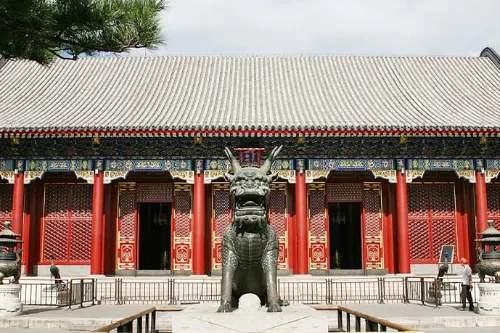
The garden's design embodies profound cultural connotations: Kunming Lake symbolizes the East China Sea, the Six Bridges on the West Causeway imitate those of Hangzhou's West Lake, and the Tower of Buddhist Incense on Longevity Hill was believed to suppress "flood disasters," reflecting the concept of "harmony between man and nature." The 728-meter-long Long Corridor is adorned with over 14,000 Su-style paintings depicting landscapes, flowers, birds, and historical stories such as "The Oath of the Peach Garden" and "Daiyu Burying Flowers." Cultural relics like the "Prodigal Stone" in the Hall of Joyful Longevity and the bronze kylin in the Hall of Benevolence and Longevity carry tales of the imperial court. During the 2008 Beijing Olympic Games, the Summer Palace served as a cultural showcase welcoming guests from home and abroad. In 2018, the protective renovation of the Grand Theater in the Garden of Virtue and Harmony was completed, preserving its historical style for over 270 years.
Major Attractions
Tower of Buddhist Incense (Foxiangge)
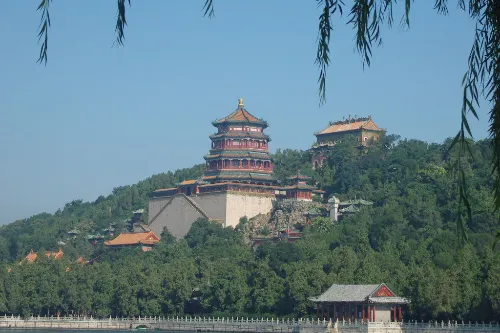
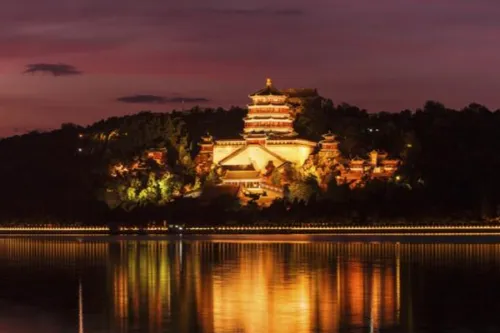
As the core structure of the Summer Palace, the Tower of Buddhist Incense stands on a 20-meter-high stone platform, with a total height of 41 meters. It features an octagonal shape, three stories, and four eaves, covered with yellow glazed tiles. Adopting a "beamless hall" structure, the tower houses a gilded bronze statue of Guanyin (Goddess of Mercy) inside. Surrounded by 16 eaves-supporting pillars, the corridor on the ground floor offers a panoramic view of Kunming Lake. First built during the Qianlong reign, the tower was destroyed in 1860 and rebuilt in its original form during the Guangxu reign, serving as the visual center and religious venue of the garden.
Hall of Dispelling Clouds (Paiyundian)
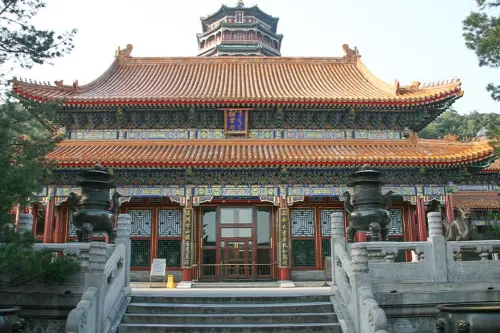
Originally the Mahavira Hall of the Temple of Great Gratitude and Longevity in the Garden of Clear Ripples, it was burned down by the Anglo-French Allied Forces in 1860 (the 10th year of the Xianfeng reign). Rebuilt on its ruins in 1886 (the 12th year of the Guangxu reign), the Hall of Dispelling Clouds served as a venue for celebrating Empress Dowager Cixi's birthday. The exhibits on display in the hall today are the birthday gifts presented by princes, dukes, and ministers of that time.
Bronze Pavilion of Precious Clouds (Baoyunge)
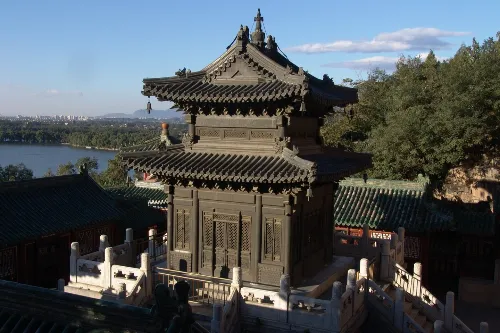
Built in 1755 (the 20th year of the Qianlong reign), this pavilion was a place for Qing emperors and empresses to pray and recite scriptures. With a total height of 7.55 meters and a weight of 207 tons, it is one of the few buildings in the garden that survived the burning of the Garden of Clear Ripples by the Anglo-French Allied Forces in 1860. However, its internal furnishings were looted, and it was further damaged by the Eight-Nation Alliance in 1900, with ten bronze windows stolen and taken abroad. In 1993, the American International Group (AIG) purchased the windows and donated them back to the Summer Palace.
Ziqidonglai City Gate (Ziqidonglai Chengguan)
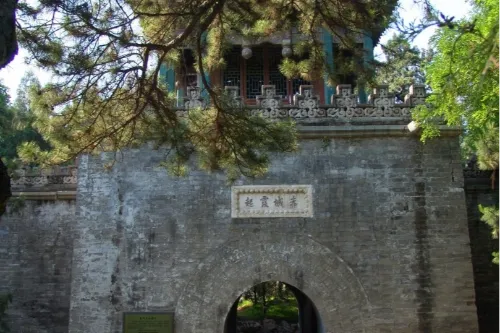
First constructed during the Qianlong reign, the stone tablet on the southern side is inscribed with "Ziqidonglai" ("Purple Qi Comes from the East"), derived from the legend of Laozi leaving Hangu Pass. The tablet on the northern side bears "Chicheng Xiaqi" ("Rosy Clouds Rise Over Chicheng Mountain"), a famous line from "Rhapsody on Tianmen Mountain" by Sun Chuo, a litterateur of the Jin Dynasty.
Long Corridor (Changlang)
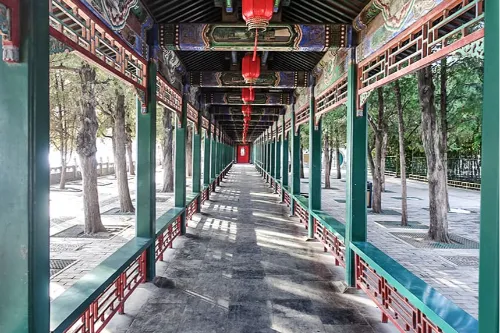
Located at the southern foot of Longevity Hill, the Long Corridor stretches from the Gate of Inviting the Moon in the east to the Stone Tablet Pavilion in the west, with a total length of 728 meters and 273 bays. It is the longest existing covered walkway in China. The corridor's roof features a gabled and hipped roll-up design, and its beams are painted with over 14,000 Su-style artworks, including landscapes, flowers, birds, and character stories such as "The Oath of the Peach Garden" and "Daiyu Burying Flowers." Connecting all scenic spots on the front hill, the corridor provides shade and shelter from rain in summer and blocks wind while offering snow views in winter, combining practicality with artistic value.
Hall of Listening to Orioles (Tingliguan)
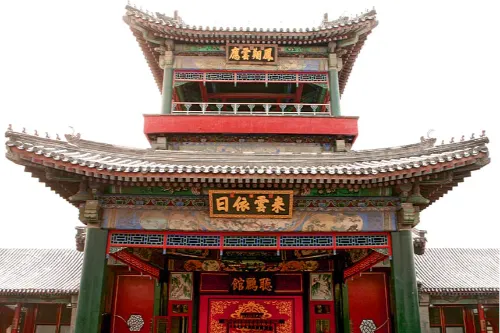
Originally built by Emperor Qianlong for his mother to watch operas, the hall features a two-story stage. It was named "Tingliguan" (Hall of Listening to Orioles) because ancient people often compared the beautiful sound of music to the singing of orioles. Burned down by the Anglo-French Allied Forces in 1860, it was rebuilt during the Guangxu reign. Before the completion of the Grand Theater in the Garden of Virtue and Harmony, Empress Dowager Cixi frequently watched operas and held banquets here. Today, the Hall of Listening to Orioles has become a restaurant specializing in imperial cuisine, having received hundreds of heads of state and government leaders, and is renowned as a famous imperial-style restaurant in China.
Kunming Lake
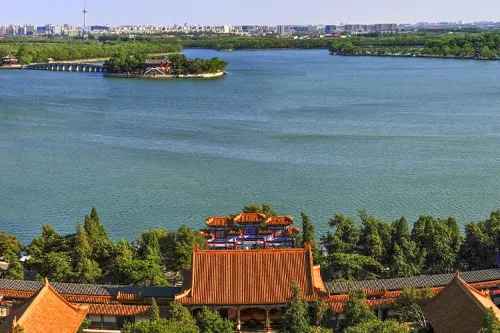
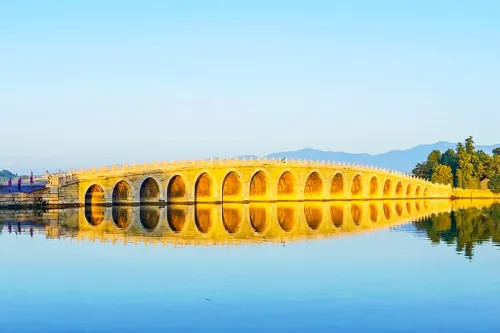
Kunming Lake accounts for 75% of the total area of the Summer Palace, covering approximately 220 hectares of water with an average depth of 1.5 meters and a maximum depth of 3 meters. The lake is divided into three parts by the West Causeway and East Causeway, symbolizing the three sacred mountains in the East China Sea. Modelled after Su Causeway of Hangzhou's West Lake, the West Causeway is equipped with six stone bridges, among which the Jade Belt Bridge has a 10-meter-high arch and an egg-shaped archway, serving as Emperor Qianlong's waterway to Yuquan Mountain. Located on the eastern side of the lake, the Seventeen-Arch Bridge is 150 meters long and 8 meters wide, named after its 17 archways. Around the Winter Solstice every year, the setting sun's afterglow illuminates all the archways, creating the spectacular scene of "Golden Light Piercing the Arches."
Seventeen-Arch Bridge
First constructed in 1750 (the 15th year of the Qianlong reign), the Seventeen-Arch Bridge connects the East Causeway in the east to Nanhu Island in the west, with a total length of over 150 meters. It is the longest surviving bridge in Chinese imperial gardens, named after its 17 archways. More than 500 stone lions of various shapes are carved on the bridge heads and the baluster posts. At both ends of the bridge railings stand four stone-carved mythical beasts, powerful and majestic, which are masterpieces of Qing Dynasty stone carving art.
Hall of Embracing the Void (Hanxutang)
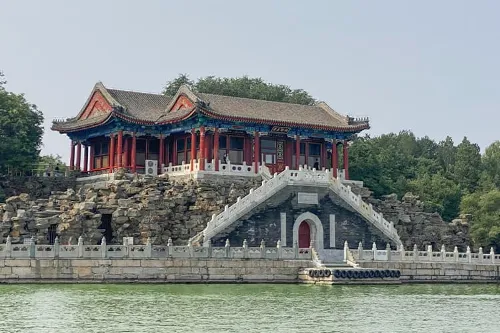
Originally the three-story Pavilion of Watching the Toad (Wangchange), built during the Qianlong reign, it was reconstructed into a one-story hall during the Jiaqing reign and renamed the Hall of Embracing the Void. It served as an ideal place for emperors and empresses to admire the moon in summer and autumn. Emperor Qianlong once reviewed the naval drills of the Xiangshan Jianrui Battalion here. Burned down by the Anglo-French Allied Forces in 1860, it was rebuilt during the Guangxu reign. Empress Dowager Cixi also reviewed the drills of the Naval Academy here.
Hall of Benevolence and Longevity (Renshoudian)
As the political center of the Summer Palace, the Hall of Benevolence and Longevity was originally named the Hall of Diligent Government during the Qianlong reign. Renamed during the Guangxu reign, it takes its name from the concept of "The benevolent live long." The building has seven bays in width, five bays in depth, and a height of 15 meters, with corridors in the front and back. Its roof is a gabled and hipped design covered with yellow glazed tiles. The hall is furnished with red sandalwood furniture and a nine-dragon screen, and a plaque inscribed with "Shouxie Renfu" ("Longevity Aligns with Benevolence") hangs above the throne in the center. During the Guangxu reign, Empress Dowager Cixi received foreign envoys here, and Kang Youwei and Liang Qichao were also granted audiences with Emperor Guangxu here.
Garden of Virtue and Harmony (Deheyuan)
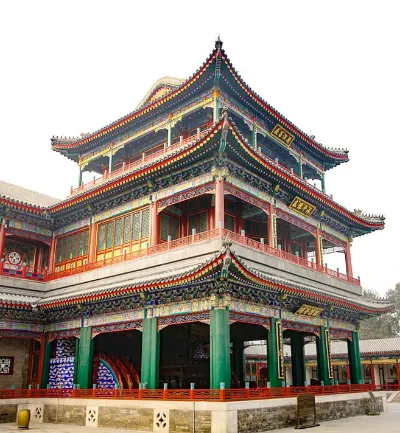
Located north of the Hall of Benevolence and Longevity, the Garden of Virtue and Harmony was constructed in 1891 (the 17th year of the Guangxu reign) and took five years to complete. It was a special venue for Empress Dowager Cixi to watch operas. Its main buildings include the Grand Theater, the Hall of Joyful Music, and the Hall of Celebrating Goodness. The three-story stage in the garden is the largest and best-preserved ancient wooden stage in China, featuring exquisite design, magnificent momentum, and great scientific and artistic value.
Tour Routes
Recommended Half-Day Tour Route: Enter through the East Palace Gate → Visit the Hall of Benevolence and Longevity (30 minutes) → Walk west along the Long Corridor (1 hour, admire the paintings) → Climb the Tower of Buddhist Incense (1 hour, enjoy a panoramic view of the garden) → Walk from Huazhongyou (Painting in the Garden) to the Marble Boat (40 minutes) → Take a boat to Nanhu Island (20 minutes) → Cross the Seventeen-Arch Bridge and exit through the Xinjian Gongmen (Newly Built Palace Gate). The total duration is approximately 3 hours.
For a in-depth one-day tour, you can add Suzhou Street (ticket: 10 yuan, a Qing Dynasty-style water town modeled after Jiangnan, 40 minutes), the Garden of Virtue and Harmony (ticket: 10 yuan, including Peking Opera performances at 10:00 and 15:00 daily, 30 minutes per show), and the Garden of Harmonious Interests (modeled after Wuxi's Jichang Garden, 30 minutes). Walk along the West Causeway to enjoy the scenery. The total duration is about 5 hours. It is recommended to bring your own water and light lunch as there are few catering options in the garden.
Travel Tips
- Recommended visit duration: 4-5 hours. Visit in spring (April-May) to see peach blossoms on the West Causeway, or in autumn (September-October) to admire osmanthus flowers and red leaves. Avoid the high temperatures in July-August (average daily visitors exceed 50,000).
- Wear comfortable and non-slip shoes as there are many mountain roads and stone paths in the garden. Bring a sun hat and sunscreen in summer (no shade on Longevity Hill); prepare a down jacket in winter (strong winds by the lake, average temperature around 2°C).
- Free volunteer-guided tours are available every Tuesday and Thursday at 9:00 AM, gathering at the East Palace Gate Tourist Center.
- Recommended photo spots: Huazhongyou Complex for mountain and water reflections, the Garden of Harmonious Interests for pavilions and terraces, Mirror Bridge on the West Causeway for the "Rainbow Lying on the Wave" scene, and Nanhu Island for a full view of the Seventeen-Arch Bridge.
- Dining options: Experience imperial cuisine at the Hall of Listening to Orioles, or have a picnic by Kunming Lake with your own lunch. There are kiosks selling sausages, mineral water, etc., in the scenic area, but prices are relatively high.
Notes
- The park implements a "one-way tour" system: enter through the East Palace Gate and exit through the Xinjian Gongmen; enter through the North Palace Gate and exit through the West Gate. Tourist maps can be obtained at the Tourist Center.
- Pets and drones are prohibited in the park. Touching cultural relics is not allowed in buildings such as the Tower of Buddhist Incense. Do not use flash when taking photos to avoid damaging the paintings.
- The steps on Longevity Hill are steep, and the platform of the Tower of Buddhist Incense has 108 steps. Elderly visitors and children should pay attention to safety. There are no railings around Kunming Lake; walk along the inner side and do not play in the water.
- Combination tickets are valid for one-time entry to all attractions; re-entry is not allowed after exiting. The last boat departure time is 17:00; those who miss it must exit on foot.
- In case of severe weather such as heavy rain or strong winds, the second-floor platform of the Tower of Buddhist Incense will be temporarily closed, and staff will guide visitors to indoor areas such as the Garden of Virtue and Harmony. The park closes 30 minutes early on snowy days in winter.
Transportation
- Subway: Take Line 4 to "North Palace Gate" Station (Exit D), walk about 500 meters to the North Palace Gate; take Line 16 to "Xiyuan" Station (Exit C2), walk about 1 kilometer to the Xinjian Gongmen (Newly Built Palace Gate).
- Bus: East Palace Gate: Bus No. 718, Special Line 18, Special Line 19 to "Summer Palace East Palace Gate" Station; North Palace Gate: Bus No. 303, 330, 331, 563 to "Summer Palace North Palace Gate" Station; Xinjian Gongmen: Bus No. 74, 374 to "Summer Palace Xinjian Gongmen" Station; West Gate: Bus No. 469, 539 to "Summer Palace West Gate" Station.
- Self-driving: There are parking lots near the park: East Palace Gate Parking Lot (about 200 parking spaces, 10 yuan/hour) and North Palace Gate Parking Lot (about 150 parking spaces, 8 yuan/hour). Parking spaces are in short supply on weekends during peak seasons; public transportation is recommended.
Opening Hours
The park is open year-round. Gate opening hours: 6:30-18:00 (last entry at 17:00) in peak season; 7:00-17:00 (last entry at 16:00) in off-season. Attraction opening hours: 8:30-17:00 (last entry at 16:30) in peak season; 9:00-16:00 (last entry at 15:30) in off-season.
The park is free to the public on the first Saturday of each month (reservation required, excluding attractions). The Tower of Buddhist Incense is free for visitors over 60 years old every Wednesday afternoon.
Ice activities are available on Kunming Lake during the freezing period from December to February every year, with opening hours until 16:30.
Tickets
Combination Ticket (including entry ticket): 60 yuan/person; Entry Ticket: 30 yuan/person.
Search for the official WeChat public account "颐和园" to get the latest updates or purchase tickets online.
Online Booking
Click here to jump to the Trip.com ticketing platform for ticket purchase.