
Lianhuashan Tourist Area is located in Shilou Town, Panyu District, Guangzhou City, Guangdong Province. It is a national 4A‑level tourist attraction, a provincial‑level scenic spot of Guangdong Province and a key cultural relic protection unit of Guangzhou. Composed of 48 low red‑sandstone hills, Lianhuashan covers a total area of about 2.54 square kilometres with its highest peak standing at 108 metres above sea‑level. As a comprehensive tourist resort integrating ancient quarrying culture, religious culture, coastal scenery and leisure vacation, it boasts numerous magnificent and peculiar quarry relics left by more than 2,000 years of quarrying history, including precipices, caves and stone bridges with marvellous craftsmanship. The prosperous Guanyin Sacred Land inside the scenic spot is a well‑known blessing site in Lingnan. Bordering the estuary of the Pearl River, it commands a distant view of the Shizi‑Yang waterway from its summit, where mountain, sea and cultural landscapes set each other off beautifully.
History and Culture
The human history of Lianhuashan can date back to the Western Han Dynasty. From the early Western Han Dynasty, ancestors quarried red sandstone here, and large quantities of stone materials were transported to ancient Guangzhou for constructing city walls, palaces and dwellings. Continuous quarrying activities over more than 2,000 years, spanning the Western Han, Eastern Han, Southern Tang, Song, Yuan, Ming and Qing dynasties, have left a large‑scale ancient quarry site on the mountain, which is a rare and well‑preserved relic of ancient artificial quarrying in China.
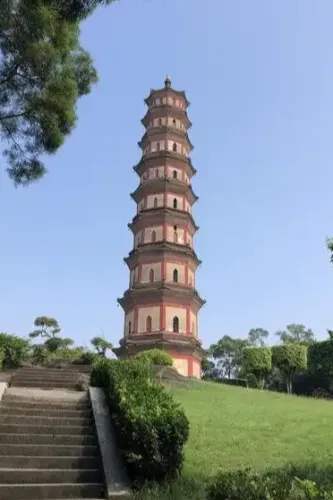
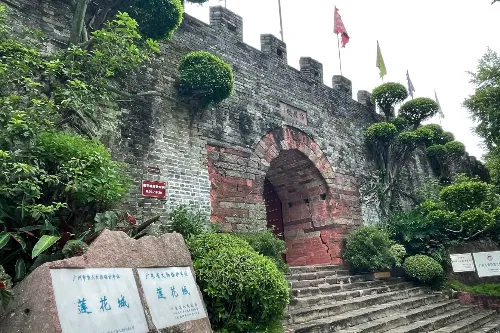
After the Ming Dynasty, Lianhuashan became a coastal defence stronghold owing to its strategic location guarding the Shizi‑Yang waterway of the Pearl River. The Lotus Pagoda was first built during the Wanli reign of the Ming Dynasty as a landmark navigation lighthouse for ships sailing on the Pearl River, earning it the reputation of "Pearl of the Provincial Capital". The Lotus City was constructed in the Qing Dynasty as a coastal‑defence barracks during the Opium War, bearing witness to the coastal‑defence history of modern Guangzhou.
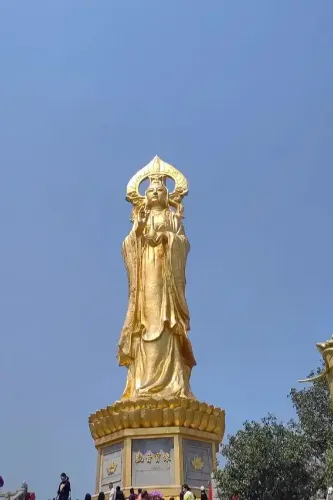
In modern times, Lianhuashan has gradually developed into a famous scenic spot for blessing‑praying and sightseeing. In 1994, the bronze statue of Ocean‑viewing Guanyin was completed and consecrated. Standing at 40.88 metres high, the sacred Guanyin statue has expanded the influence of Guanyin culture in Lianhuashan. Every Guanyin Festival and public holiday, crowds of tourists come here to pray, and Guanyin culture has become an important cultural symbol of Lianhuashan.
Main Attractions
Ocean‑viewing Guanyin
Perched on the summit of Lianhuashan, Ocean‑viewing Guanyin is a gilded bronze statue 40.88 metres in height. Facing the Shizi‑Yang waterway, the Guanyin statue presents a solemn and peaceful look and serves as the landmark of Lianhuashan. Surrounded by the Immortal‑Worshipping Platform, the spacious square always sees thriving incense burning and is a core site for tourists to pray and take photos.
Lotus Pagoda
Also known as Wenchang Pagoda, the Lotus Pagoda was built in the 40th year of the Wanli reign of the Ming Dynasty (1612). Standing more than 50 metres high, it is an octagonal nine‑storey brick pagoda of pavilion style. Rising beside the Shizi‑Yang waterway, its silhouette could be spotted by seagoing vessels from afar in ancient times, hence its title "Pearl of the Provincial Capital". Having undergone renovation over centuries, the pagoda remains well‑preserved today.
Lotus City
Built in the 3rd year of the Kangxi reign of the Qing Dynasty (1664), Lotus City functioned as a coastal‑defence barracks in the Qing Dynasty. Its oval‑shaped city wall was constructed against the hillside with stone blocks. During the Opium War, it served as a garrison site for Qing troops. An exhibition hall inside displays historical materials and cultural relics related to the coastal defence of Lianhuashan.
Ancient Quarry Site
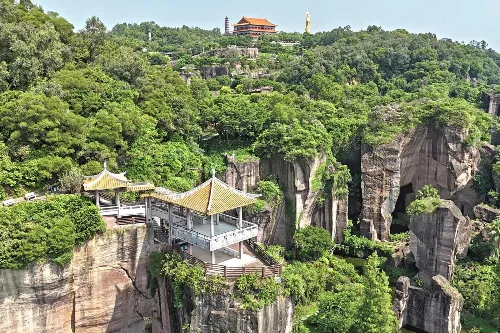
The Ancient Quarry Site is the most representative historical relic of Lianhuashan. More than 2,000 years of artificial excavation has formed unique landscapes including steep cliffs, caves, stone corridors and heavenly pools. Swallow Rock, Sword Gate and Lotus Rock are all parts of the quarry relics. The precipitous red‑sandstone cliffs bear clear traces left by ancient quarrymen.

Swallow Rock
Swallow Rock is a highlight zone of the ancient quarry site, named after the swallows that dwell in its caves all‑year round. It features towering rock faces with a clear pool at the bottom. Criss‑cross excavation marks cover the cliffs, interspersed with grotesque stones. Walking here, visitors can directly perceive the traces left by ancient quarry workers.
Hundred‑Garden
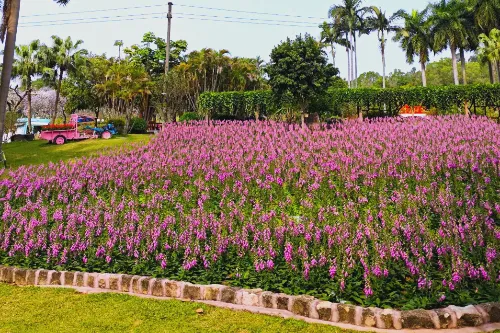
Hundred‑Garden lies on the flat‑lying area of the scenic spot. Planted with seasonal flowers, it is equipped with walking trails and rest pavilions. Lush with flowers and trees, this quiet garden is ideal for leisurely walks and relaxation.
Sight‑seeing Route
Main Entrance → Ancient Quarry Site → Swallow Rock → Sword Gate → Lotus Rock → Lotus City → Lotus Pagoda → Ocean‑viewing Guanyin → Hundred‑Garden → Scenic Exit
Sight‑seeing Suggestions
- It is recommended to spend 3‑4 hours touring the site, reserving enough time for visiting the quarry relics and the Guanyin scenic zone.
- For photographs of the Shizi‑Yang waterway, climb to the Ocean‑viewing Guanyin Square in the morning or at dusk.
- Visitors praying for blessings may bring incense sticks or purchase them in designated areas inside the scenic spot.
- As there are many mountain‑climbing paths, comfortable non‑slip sports shoes are recommended.
- Apply sunscreen and bring drinking water in summer, since shaded rest areas on the mountain are limited.
- Avoid peak hours from 10:00 a.m. to 2:00 p.m. on holidays by travelling off‑peak.
Precautions
- Keep away from cliff edges at the ancient quarry site and never climb over guardrails.
- Keep quiet in the Guanyin blessing area and observe etiquette for religious venues.
- Open‑fire and smoking are strictly forbidden in mountain‑forest zones of the scenic spot.
- Do not climb historical monuments such as Lotus Pagoda and Lotus City to protect cultural heritage.
- Elderly people and children should be accompanied all‑the‑way when climbing sections without shelters on the mountain.
- Pet owners shall comply with scenic‑spot pet regulations; pets are not allowed to enter certain religious areas.
Transportation
- Public Transport: Take Metro Line 4 to Shiqi Station, then transfer to Bus No. Pan‑92 or Pan‑131 to reach Lianhuashan Tourist Area.
- Self‑driving: Navigate to "Lianhuashan Tourist Area". Paid parking lots are available on‑site.
- Water Transport: Take a Pearl‑River water cruise to Lianhuashan Wharf.
Opening Hours
Lianhuashan Tourist Area is open all‑year round. Its regular opening hours are 7:00 a.m.‑5:00 p.m. Temporary adjustments during major public holidays and Guanyin Festival shall be subject to on‑site notices and official announcements.
Ticket Information
The admission ticket costs 54 RMB per person. Scan WeChat to follow the official public account "广州莲花山旅游区" for the latest updates.
Online Booking
Click here to jump to the Trip.com ticketing platform for ticket purchase.