
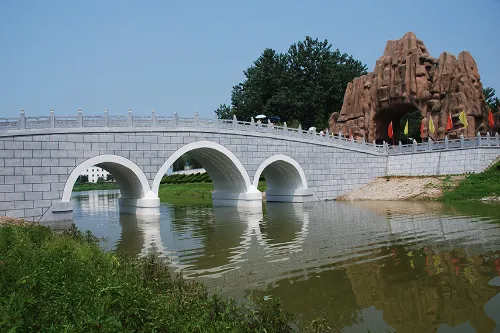
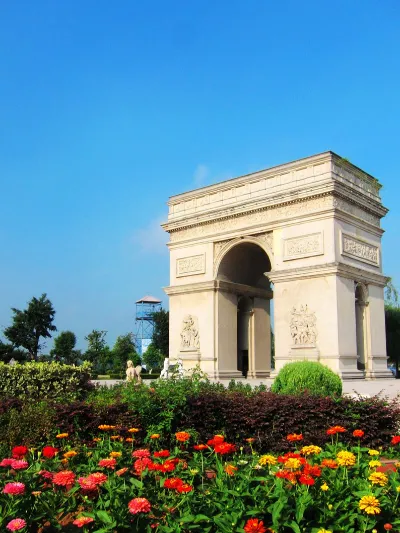
Balihe Scenic Area is located in Balihe Town, Yingshang County, Fuyang City, Anhui Province. It is a national 5A-level tourist attraction, a provincial nature reserve, a provincial study tour base, and a kite-flying base in Anhui Province. It has been awarded the "Global 500 Roll of Honor for Environmental Achievement" by the United Nations Environment Programme. Covering a total area of 3,600 mu, the scenic area is known as the "No.1 Farmer's Park in the World". Its characteristic lies in the ingenious integration of natural scenery and humanistic landscapes, making it a renowned destination for sightseeing, prayer, and health preservation. The scenic area boasts numerous distinctive buildings, including exotic structures such as the Temple of Zeus in Greece, Sacré-Cœur Basilica in Paris, and Arc de Triomphe in France, as well as Chinese-style architectures like blue stone archways, thousand-year-old ancient temples, and Suzhou-style gardens.
History and Culture
Balihe has a long history and has undergone countless changes. According to legend, in the 43rd year of Jiajing in the Ming Dynasty, a lawsuit arose due to disputes over whether Balihe was a "river" or a "lake". Eventually, the government identified it as a lake, but due to historical reasons and people's habitual naming, it is still called Balihe. It is also related to Yu the Great's flood control. Liugou River (the predecessor of Balihe) was once a safe haven for the Huaihe River. During the Sui and Tang dynasties, sluices were built to control the river water. By the late Yuan and early Ming dynasties, due to wars and floods, this place became a desolate marshland, leaving behind many magical legends and historical sites such as the story of Sister Miao becoming a nun, Siwangtai (Longing Platform), and Waizuijing (Crooked Mouth Well).
In addition, Balihe suffered hardships in modern times. In 1938, the dike of Huayuankou on the Yellow River breached, and the floodwater poured south into Balihe, causing catastrophic floods. The devastating flood in 1954 also inflicted severe damage on both banks of Balihe. Later, through the continuous governance and development by the government and the people, the present Balihe Scenic Area came into being.
Main Attractions
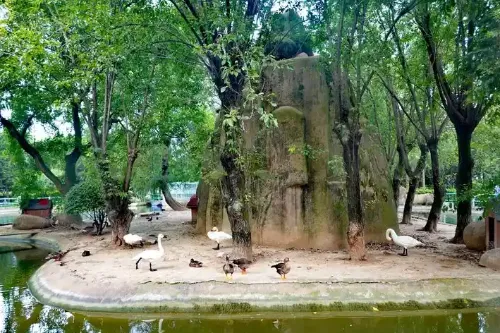
Bird Language Jungle
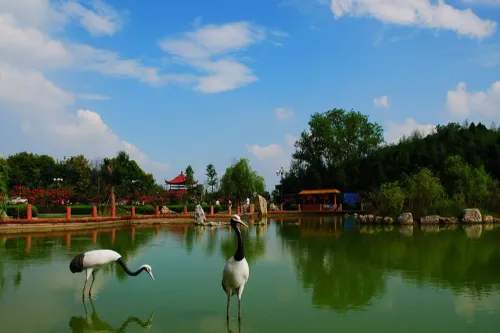
It is home to nearly a hundred species of national first-class protected birds such as peacocks, white cranes, red-crowned cranes, and Steller's sea eagles, as well as second-class protected birds including swans, mandarin ducks, white-naped cranes, swans geese, and vultures.

Exotic Scenery
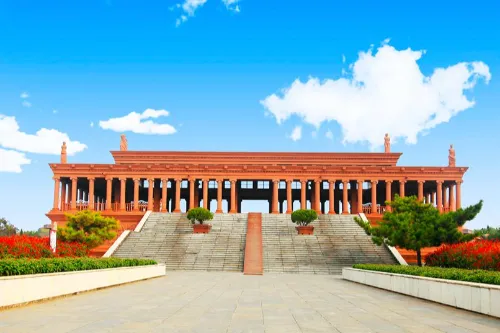
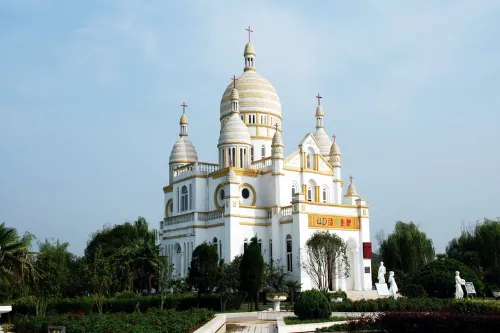
It includes architectures such as the Temple of Zeus in Greece, Sacré-Cœur Basilica in Paris, Arc de Triomphe in France, German rural churches, the Grand Canyon in the United States, Dutch windmills, colorful fountains, and calligraphy and painting corridors, making visitors feel as if they are in a foreign country.
Splendid China
The blue stone archway is magnificent, the halls of the thousand-year-old ancient temple are imposing, the Suzhou-style garden is elegant with an antique flavor, the Nine Heavens Waterfall cascades like a jade curtain, the Nine Dragons Jade Wall is the treasure of the garden, and the People's Monument is majestic.


Blue Lake and Green Islands
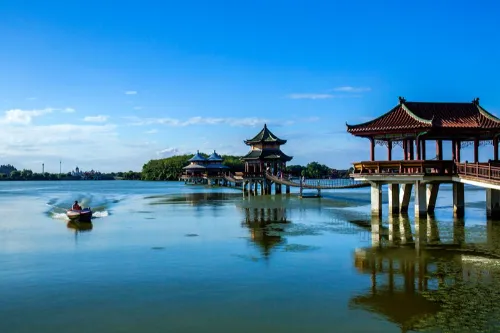
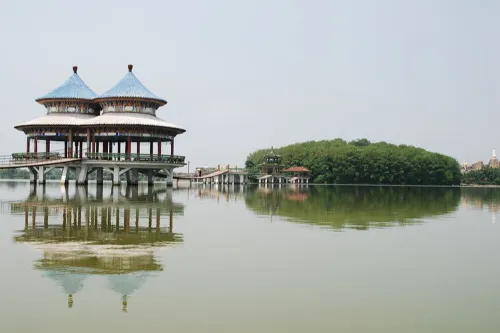
The vast blue lake shimmers with misty waves. Twelve green islands are named after the Chinese zodiac animals, connected by soft bridges and covered corridors. Each island boasts unique flowers that bloom all year round. The Bird Island is particularly beautiful and has been featured on CCTV.
Tour Route
If you arrive at the scenic area in the morning and take a sightseeing bus, it is recommended to first take the bus to the East District to start your tour. The route is: Splendid China (East District) — World Scenery (West District) — Bird Language Jungle. If you arrive in the afternoon, it is recommended to start from the Bird Language Jungle. The route is: Bird Language Jungle — World Scenery (West District) — Splendid China (East District), so you may see a stunning sunset at the iron chain soft bridge in the East District.
Tour Suggestions
- The best time to visit is from April to May (when spring flowers are in full bloom and the climate is pleasant) and from September to October (when the autumn sky is clear and it is suitable for outdoor activities). Avoid visiting during the high-temperature period in summer (July to August) and the cold period in winter (December to February).
- It is recommended to arrange 1 day to visit the core attractions in depth. If you want to fully experience the scenic area and surrounding attractions, you can arrange a 2-day and 1-night trip.
- Attractions in the scenic area are scattered. It is recommended to take the scenic sightseeing bus or rent a bicycle to save travel time and physical strength.
- There are many restaurants in the scenic area. It is recommended to try local specialty foods such as Balihe Whole Fish Feast, Yingshang Gelatiao (a type of local noodle), and Zhentoumo (pillow-shaped steamed bun).
- The World Scenery Area and Splendid China Area are suitable for shooting architectural landscapes. It is recommended to shoot from 9:00 to 11:00 in the morning or 16:00 to 18:00 in the afternoon when the light is soft. The Bird Language Jungle is suitable for shooting close-ups of birds; it is recommended to bring a telephoto lens. The Blue Wave Tourist Area is suitable for shooting lake views and sunsets; you can take a cruise ship to the central island for shooting.
- The Bird Language Jungle and Folk Custom Garden in the scenic area have many parent-child interaction projects, such as bird feeding and handicraft making, which are suitable for children aged 3-12. It is recommended to prepare children's sunscreen and comfortable walking shoes in advance.
Notes
- The scenic area is open from 8:00 to 17:30 (extended to 18:00 in summer). It is recommended to arrive at the scenic area entrance 1 hour in advance to avoid queuing for tickets during peak hours. The last entry time for each attraction in the scenic area is 1 hour before closing. Please arrange your travel sequence reasonably.
- When taking a cruise ship in the Blue Wave Tourist Area, you must abide by the cruise ship safety regulations, wear a life jacket, and not walk or stand casually on the ship. Children must be accompanied by adults. Swimming in non-swimming areas is strictly prohibited to avoid safety accidents.
- Feeding birds with self-prepared food is prohibited in the Bird Language Jungle. If you need to feed the birds, you can buy special bird food at designated places in the park to prevent birds from eating harmful food. Chasing or scaring birds is prohibited; please protect the living environment of birds.
- The scenic area is rich in vegetation. Smoking and outdoor fire use are strictly prohibited. Do not pick flowers and plants or damage vegetation at will. Classify and dispose of garbage in designated trash cans to maintain the environmental hygiene of the scenic area.
- Some attractions in the scenic area (such as ancient buildings in the World Scenery Area and corridors in Splendid China Area) have steps and steep slopes. Elderly people, pregnant women, disabled people and other special groups should walk carefully. It is recommended to bring crutches or use the barrier-free facilities of the scenic area.
- When visiting in summer, please take sun protection measures and bring sun hats, sunscreen, mosquito repellent and other items. There are many water areas in the scenic area with more mosquitoes; it is recommended to wear long-sleeved clothes and long pants.
- There are many public toilets, rest areas and medical points in the scenic area. If you feel unwell or need help, you can contact the scenic area staff at any time.
- There are many tourists in the scenic area during holidays. It is recommended to travel during off-peak hours, such as working days or non-peak periods. Self-driving tourists should plan their parking routes in advance.
- Bringing pets into the scenic area is prohibited. If you need to board your pet, you can contact the pet boarding point at the scenic area entrance.
Transportation
- Self-driving: Starting from Fuyang urban area, drive south along Chuxin Expressway (S12) for about 40 kilometers, get off at Yingshang Exit, then drive along Yingbin Avenue and Balihe Avenue for about 15 kilometers to reach the main entrance of the scenic area. The whole journey takes about 1 hour. Starting from Hefei urban area, drive along Benghe Expressway (S17) and Chuxin Expressway (S12) for about 180 kilometers, get off at Yingshang Exit, then drive to the scenic area along the above route. The whole journey takes about 2.5 hours.
- Public Transportation: Yingshang County Bus Station operates special shuttle buses to Balihe Scenic Area. The departure time is from 7:00 to 17:00, with a frequency of one bus every 30 minutes. The journey takes about 30 minutes. Starting from Fuyang urban area, you can take a bus to Yingshang County at Fuyang South Bus Station, then transfer to the scenic area special shuttle bus at Yingshang County Bus Station.
- High-speed Rail: Take the high-speed rail to Yingshang North Station. After exiting the station, you can take a taxi to the scenic area, with a journey of about 25 kilometers. Alternatively, take Bus No. 6 at Yingshang North Station Bus Stop to Yingshang County Bus Station, then transfer to the scenic area special shuttle bus.
- Internal Transportation: The scenic area is equipped with transportation facilities such as sightseeing buses, cruise ships, and bicycles. Transfer is allowed throughout the journey. The cruise ship fare is divided into short-distance and long-distance routes according to different routes. The rental price of bicycles is 30 yuan per single bike per day and 50 yuan per double bike per day, with a deposit of 100 yuan per bike required.
Opening Hours
Peak season: 8:00 - 18:00; Off-peak season: 8:00 - 17:30.
Ticket Information
The ticket price is 90 yuan per person.
You can search for the official WeChat public account "安徽八里河旅游区" to get the latest updates or buy tickets online.
Online Booking
Click here to jump to the Trip.com ticketing platform for ticket purchase.