
The Cradle of the Republic Scenic Area is located in Ruijin City, Ganzhou City, Jiangxi Province. It is a national 5A-level tourist attraction, a key national cultural relics protection unit, and a national patriotism education demonstration base. With the red revolutionary history as its core feature, the scenic area focuses on displaying the birth process of the Chinese Soviet Republic and the historical relics of early regime construction, and is known as the "Red Ancient Capital" and "Cradle of the Republic". Covering a total area of about 455 hectares, the scenic area consists of the Yeping Revolutionary Sites Group, the Red Well Revolutionary Sites Group, the Second Soviet Congress Sites Group, and the Chinese Soviet Memorial Park. It preserves more than 180 revolutionary sites and memorial buildings, including 33 key national cultural relics protection units, such as the site of the First National Congress of the Chinese Soviet, the former site of the Provisional Central Government of the Chinese Soviet Republic, and the Red Well. It is one of the largest and best-preserved revolutionary site groups in China, and also an important place for patriotism education and red tourism.
History and Culture
On November 7, 1931, the First National Congress of the Chinese Soviet was held in Yeping, Ruijin, proclaiming the establishment of the Provisional Central Government of the Chinese Soviet Republic with Ruijin as its capital. Mao Zedong was elected Chairman of the Provisional Central Government. This was the first nationwide red political power in Chinese history, a prototype of the People's Republic of China, and accumulated valuable experience for the subsequent construction of political power in New China.
During its time in Ruijin, the Communist Party of China led the military and civilians in the Soviet area in carrying out a series of practices in political power construction, economic construction, military construction, and cultural construction. It formulated a series of laws and regulations such as the Constitution Outline of the Chinese Soviet Republic and formed the Soviet spirit characterized by "firm belief, seeking truth from facts, dedication to the people, integrity and incorruptibility, hard work, striving for excellence, and selfless dedication". The revolutionary sites in the scenic area truly record this historical process. Relics such as the Red Well and the Great Hall have become important material carriers of the Soviet spirit, embodying the exploration and practice of the Communist Party of China in early state governance and administration.
Main Attractions
Yeping Revolutionary Sites Group
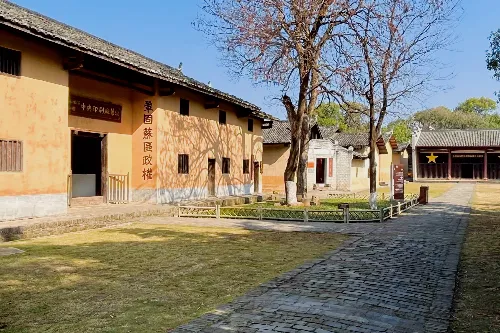
The Yeping Revolutionary Sites Group is the birthplace of the Chinese Soviet Republic, located in Yeping Township, Ruijin City, covering an area of about 160,000 square meters, with 22 revolutionary sites and memorial buildings preserved. Among them, the site of the First National Congress of the Chinese Soviet (Xie Clan Ancestral Hall) is the core attraction. Originally a Qing Dynasty building, it was transformed into a conference venue in 1931. The interior is displayed as it was at that time, with slogans "Workers' and Peasants' Fortress" and "Democratic Dictatorship" hanging on the rostrum, and representative seats placed on both sides, vividly reproducing the scene of the "First Soviet Congress". In addition, there are relics such as the former site of the Provisional Central Government, the Red Army Review Stand, and the Red Army Martyrs Memorial Tower. The Red Army Martyrs Memorial Tower is 13 meters high, composed of a five-pointed star top and a shell-shaped tower body, with the seven characters "Red Army Martyrs Memorial Tower" engraved on the tower body, which is an important place for the military and civilians in the Soviet area to remember the martyrs.
Red Well Revolutionary Sites Group
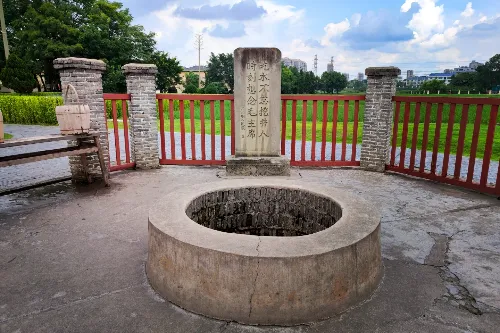
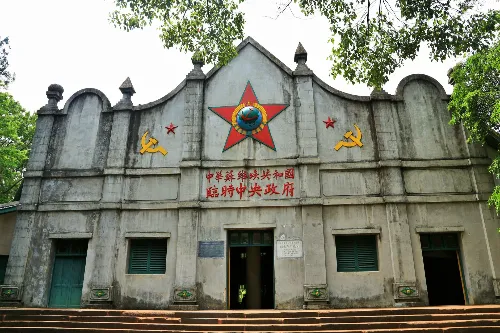
The Red Well Revolutionary Sites Group is located in Shazhouba Town, Ruijin City, named after the "Red Well". It covers an area of about 35,000 square meters, mainly including the Red Well, the former site of the Great Hall of the Provisional Central Government of the Chinese Soviet Republic, and the former site of the Central Executive Committee. The Red Well was dug by Mao Zedong leading the people in 1933, with a diameter of 1.2 meters and a depth of about 5 meters. Next to the well stands a stone stele inscribed with "When drinking water, don't forget those who dug the well; always miss Chairman Mao", which has become a symbol of the fish-and-water relationship between the army and the people. The former site of the Central Executive Committee was originally the Yang Clan Ancestral Hall, where Mao Zedong, Xu Teli and other leaders once lived and worked, and the office utensils and daily necessities of that year are preserved indoors. The former site of the Great Hall was built in 1934, an octagonal building that can accommodate more than 2,000 people. It is the venue for the Second National Congress of the Chinese Soviet. Its architectural style integrates Soviet characteristics and pragmatism, and the five-pointed star logo on the top is highly representative.
Second Soviet Congress Sites Group
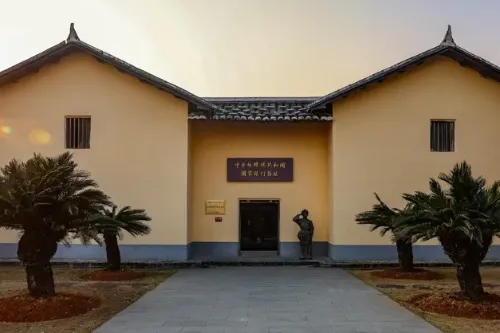
The Second Soviet Congress Sites Group is the location of the site of the Second National Congress of the Chinese Soviet, located in Shazhouba Town, Ruijin City. The core building is the Great Hall of the Provisional Central Government of the Chinese Soviet Republic (adjacent to the Red Well Scenic Area), as well as the surrounding former site of the Central People's Committee and the former site of the Central Workers' and Peasants' Inspection Commission. The Great Hall has a total construction area of about 1,530 square meters and a height of 16 meters, with a brick-wood structure and a red exterior wall. The interior is equipped with a rostrum, representative seats and spectator seats. The "Second Soviet Congress" elected a new Central Executive Committee here, and Mao Zedong was re-elected as the chairman of the Central Executive Committee. The site group also retains ancillary facilities such as air-raid shelters and guard rooms of that year, completely presenting the security and logistics support scenes during the conference.
Chinese Soviet Memorial Park
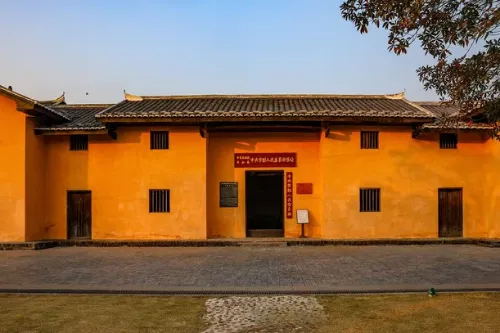
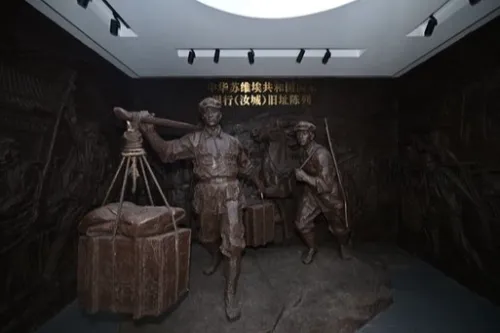
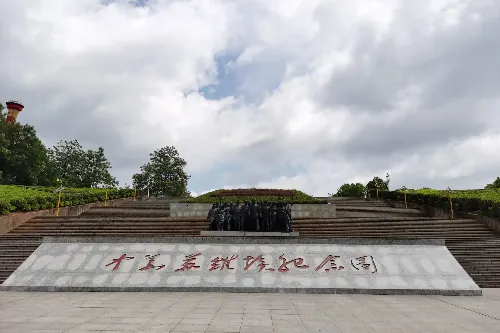
The Chinese Soviet Memorial Park is located in the urban area of Ruijin City, covering an area of about 400 mu. It is a theme park displaying the history of the Soviet area and promoting the Soviet spirit. With the theme of "The People's Republic Came from Here", the memorial park is divided into a memorial square, a historical exhibition hall, a generals' park and other parts. In the center of the memorial square stands a 19.31-meter-high memorial tripod of the Chinese Soviet Republic, symbolizing the establishment of the Chinese Soviet Republic in 1931; the historical exhibition hall displays more than 1,000 cultural relics and more than 2,000 pictures and materials, systematically showing the historical evolution of the Chinese Soviet Republic through scene restoration and multimedia demonstrations; the generals' park houses statues of 56 founding generals from Ruijin, each 2.5 meters high, with the generals' life stories engraved on the pedestals, reflecting Ruijin's contribution to the Chinese revolution.
Tour Route
Recommended One-Day Tour Route
Arrive at the Yeping Revolutionary Sites Group at 8:30 a.m. (about 2 hours), visit the site of the "First Soviet Congress", the Red Army Martyrs Memorial Tower, etc., to understand the founding process of the Chinese Soviet Republic; at 10:30, go to the Red Well Revolutionary Sites Group (about 1.5 hours), visit the Red Well and the former site of the Central Executive Committee, and experience the red story of "When drinking water, don't forget those who dug the well"; at 12:00, have lunch in Shazhouba Town, tasting Ruijin beef soup, stuffed tofu and other specialty dishes.
At 13:30 p.m., visit the Second Soviet Congress Sites Group (about 1 hour), visit the Great Hall, and understand the historical background of the "Second Soviet Congress"; at 14:30, go to the Chinese Soviet Memorial Park (about 2 hours), visit the memorial tripod, the historical exhibition hall, and the generals' park to systematically learn about the history of the Soviet area; at 16:30, buy souvenirs at the red cultural and creative shops around the memorial park; end the trip at 17:00. This route connects the four core attractions, fully covering the red cultural connotation of the scenic area.
Travel Suggestions
- It is recommended to hire a scenic area guide (80 yuan per time) or rent an audio guide (30 yuan per unit). The guide can tell in detail the historical stories behind the revolutionary sites, enhancing the educational significance of the visit.
- The best visiting seasons are spring and autumn (March-May, September-November), with suitable climate, avoiding the impact of high temperatures in summer and severe cold in winter on outdoor activities.
- There are many red-themed experience projects in the scenic area, such as participating in the "Well Digging Experience" (free) at the Red Well and the "Red Army Training" (30 yuan per person) at Yeping, which are suitable for children to participate in, enhancing interactivity.
- For dining, it is recommended to go to "Red Well Restaurant" in Shazhouba Town. The restaurant focuses on Soviet specialty dishes, such as "Red Army Vegetables" (stir-fried local wild vegetables) and pumpkin soup, with an average consumption of about 40 yuan per person. You can also hear the boss tell stories about the dishes and the Red Army.
- If time permits, you can visit other red attractions in Ruijin City, such as Wuyang Bridge (the first bridge of the Red Army's Long March) and Yunshi Mountain (the departure place of the Red Army's Long March), to enrich the red tourism experience.
Matters Needing Attention
- The scenic area is a patriotism education base. During the visit, you need to remain solemn, not make loud noises or chase and play, and respect historical relics and memorial facilities.
- The cultural relics in the revolutionary sites (such as tables, chairs, slogans, etc.) are all precious historical relics. Touching, engraving or moving them at will is prohibited, and using flash when taking photos is not allowed.
- When participating in experience projects, you must follow the guidance of the staff, especially for activities such as "Well Digging Experience" and "Red Army Training", to ensure safety.
- Smoking and littering are prohibited in the scenic area. Keep the environment clean and practice the concept of civilized tourism.
- When buying red cultural and creative products, choose official stores or regular shops in the scenic area, pay attention to distinguishing the historical authenticity of the souvenirs, and avoid buying vulgar or historically inaccurate products.
Transportation
- Public transportation: Take bus No. 1, 2, or 3 in Ruijin to directly reach scenic spots such as Yeping and Red Well, with a bus fare of 1 yuan per person; take bus K1 from Ruijin Railway Station to the urban area, then transfer to a bus to various scenic spots, with a total journey of about 40 minutes and a fare of 2 yuan per person; Ganzhou Bus Station has direct buses to Ruijin, one every 30 minutes, with a journey of about 2 hours and a fare of 50 yuan per person. After arriving at Ruijin Bus Station, transfer to a bus to the scenic area.
- Self-driving: Starting from Ganzhou, take the Jianguang Expressway to Ruijin East Exit, then transfer to Yingbin Avenue and Hongdu Avenue, with a total distance of about 130 kilometers, taking 1.5 hours; starting from Nanchang, take the Shanghai-Kunming Expressway and Jianguang Expressway to Ruijin Exit, with a total distance of about 380 kilometers, taking 4 hours. The charging standard for each scenic area's parking lot is 10 yuan per car per day.
- Internal transportation in the scenic area: The Yeping, Red Well, and Second Soviet Congress Sites Groups are relatively close (about 3 kilometers). You can take the scenic area direct bus, with a fare of 10 yuan per person, traveling between various attractions; the Chinese Soviet Memorial Park is located in the urban area, so it is recommended to go there separately or take a taxi (starting fare 6 yuan).
Opening Hours
The scenic area is open all year round, with daily opening hours from 8:00 to 17:30 (admission stops at 17:00). On major holidays (such as the Spring Festival and National Day), the opening hours are extended to 18:00. For details, please refer to the scenic area's announcement on the day.
Tickets
The ticket price is 80 yuan per person.
You can search for the official WeChat public account "瑞金中央革命根据地纪念馆" to get the latest news or make online reservations.
Online Booking
Click here to jump to the Trip.com ticketing platform for ticket purchase.