
Taohuatan Scenic Area is located in Taohuatan Town, Jingxian County, Xuancheng City, Anhui Province, in the upper reaches of the Qingyi River. It is a national 4A-level tourist attraction. The core feature of the scenic area is the integration of natural landscapes and cultural relics. It is world-famous for the eternal line "The pool is a thousand feet deep, yet not so deep as the love Wang Lun has for me" from the poem To Wang Lun written by Li Bai, a poet of the Tang Dynasty. It combines the elegance of Jiangnan water towns and profound poetic culture. The core tourist area covers about 3.5 square kilometers, with a water area of about 1.5 square kilometers. The core landscape belt stretches about 3 kilometers along Taohuatan. More than a hundred ancient buildings from the Ming and Qing dynasties are preserved in the scenic area, including ancient dwellings, ancestral halls, ferry crossings and bridges, forming a complete historical architectural complex. It is a representative scenic spot integrating ancient villages in southern Anhui and natural landscapes.
History and Culture
The cultural history of Taohuatan dates back to the Sui and Tang dynasties. It was originally an important water transport ferry on the Qingyi River waterway, named for the blooming peach blossoms on both banks and the clear pool water. During the Kaiyuan period of the Tang Dynasty, settlements had formed around Taohuatan with frequent trade, making it a transportation hub connecting Huizhou and the Yangtze River basin in southern Anhui.
The most iconic cultural legacy of the scenic area comes from the fourteenth year of the Tianbao period of the Tang Dynasty, when the great poet Li Bai was invited to visit Taohuatan by Wang Lun, a prominent figure in Jingxian County. Wang Lun entertained Li Bai with fine wine and delicacies. When Li Bai left, Wang Lun saw him off with stamping and singing. Deeply moved, Li Bai wrote To Wang Lun, making Taohuatan a symbol of eternal friendship in China and its most representative cultural landmark.
During the Song, Yuan, Ming and Qing dynasties, Taohuatan was an important area for Huizhou merchants. Clans such as the Zhai and Wan families settled and multiplied here, building ancestral halls, houses, academies and ferry crossings, forming a complete pattern of ancient villages. The preserved Ming and Qing buildings feature the architectural styles of southern Anhui and Huizhou, serving as important physical evidence for the study of clan culture and architectural history in southern Anhui.
In modern times, Taohuatan has retained its original appearance. It was officially developed into a tourist attraction in the 1980s and has been successively listed as a Major Historical and Cultural Site Protected at Anhui Provincial Level and a Member of the Traditional Chinese Villages List. It has become a cultural tourist destination integrating friendship culture, ancient village culture, water transport culture and clan culture.
Major Attractions
Taohuatan Water Area
The Taohuatan water area is the core landscape of the scenic area, a section of the main stream of the Qingyi River, stretching about 3 kilometers long, with a maximum width of about 300 meters and a maximum depth of about 10 meters. The water is clear and green all year round, reaching the national Class II water quality standard. Peach forests, ancient villages and green hills on both banks are reflected in the water, presenting different scenery in four seasons. Tour boats are available on the pool, offering an immersive experience of the artistic conception of "The pool is a thousand feet deep".

Stage of Singing Farewell
The Stage of Singing Farewell is located on the east bank of Taohuatan, the very spot where Wang Lun saw Li Bai off with stamping and singing. It is a landmark cultural attraction of the scenic area. The existing building was rebuilt in the Qing Dynasty, covering an area of about 200 square meters, including a singing platform, a farewell stele and a viewing corridor. A stone stele engraved with the poem To Wang Lun stands on the bank, serving as the core landmark inheriting the culture of eternal friendship.
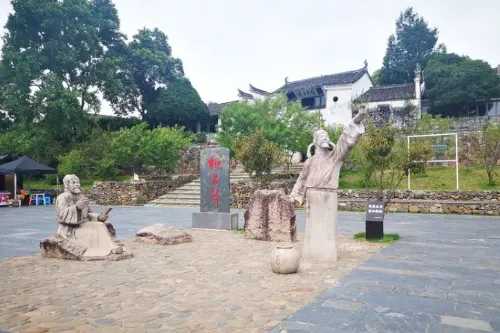
Wenchang Pavilion
Wenchang Pavilion is located in the center of Taohuatan Town. Built in the 35th year of the Qianlong period of the Qing Dynasty, it is a three-story octagonal brick-wood structure with a total height of about 25 meters, one of the best-preserved Wenchang Pavilions of the Qing Dynasty in southern Anhui. The building features exquisitely carved beams and painted rafters with upturned eaves. Inside enshrines the statue of Wenchang Dijun, with a cultural exhibition area nearby showing the local tradition of valuing education and scholars.

Zhai Ancestral Hall
Zhai Ancestral Hall is one of the largest ancient ancestral halls in southern Anhui. Founded in the Jiajing period of the Ming Dynasty and rebuilt in the Guangxu period of the Qing Dynasty, it covers an area of about 1,000 square meters with a construction area of about 680 square meters. It adopts a three-hall, five-bay layout with exquisite materials and superb wood, brick and stone carvings. It is a model of Huizhou-style ancestral hall architecture in the Ming and Qing dynasties and the core carrier of Zhai clan culture.
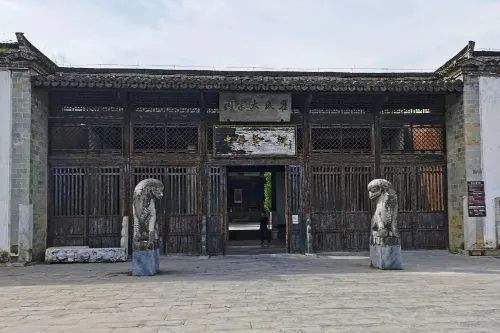
Nanyang Ancient Town
Nanyang Ancient Town is located on the west bank of Taohuatan, a well-preserved ancient village from the Ming and Qing dynasties. There are 86 existing Ming and Qing dwellings in the village, with a total length of ancient streets and alleys of about 1.2 kilometers paved with bluestone slabs. It retains original features such as ancient shops, wells and gate towers. The buildings are built against mountains and beside water, a typical representative of ancient villages in southern Anhui.

Rainbow Bridge
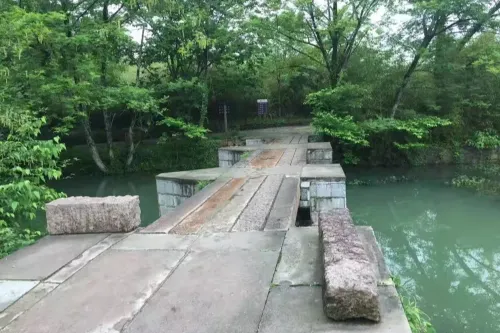
Rainbow Bridge is a stone arch bridge spanning a tributary of Taohuatan, built in the Qing Dynasty. It is about 35 meters long and 4 meters wide, constructed with bluestone blocks. The bridge has an elegant shape. On sunny mornings when mist rises over the pool, the bridge often forms a rainbow view against the mist and sunlight, hence its name. It is a classic photography spot in the scenic area.
Tour Route
The standard classic tour route of Taohuatan Scenic Area is about 3.5 kilometers long and takes about 3 to 4 hours. The route is: Scenic Area Visitor Center → Stage of Singing Farewell → To Wang Lun Poem Stele → Taohuatan Cruise Terminal (boat tour on the pool) → Entrance to Nanyang Ancient Town → Ancient Streets and Alleys → Rainbow Bridge → Zhai Ancestral Hall → Wenchang Pavilion → Scenic Area Exit. The route connects all major cultural and natural attractions without backtracking, suitable for a combination of walking and boating to fully experience the landscape and culture of the scenic area.
Tips for Visiting
- The recommended visiting duration is 3 to 4 hours. Entering the park at 9 a.m. avoids peak crowds and allows you to enjoy the morning mist over the pool.
- Cruise is a must-try experience. The cruise route takes about 20 minutes, offering a panoramic view of both banks of Taohuatan.
- The best visiting seasons are spring (March to April) when peach blossoms bloom and autumn (October to November) with pleasant weather.
- Most ancient streets in the scenic area are paved with bluestone slabs. Wear comfortable flat shoes for easy walking.
- You can plan a one-day joint tour with Zhaji Ancient Village and Shuimo Tingxi Scenic Area in Jingxian County for higher efficiency.
- Rest pavilions and viewing platforms are available in the scenic area. Take a proper rest every hour to complete the tour comfortably.
Notes
- The pool is deep. Do not stand, lean out or play in the water during the cruise; follow safety regulations.
- The Ming and Qing ancient buildings in the scenic area are cultural relics protection units. Do not carve, climb or damage buildings and steles.
- Flammable and explosive items are prohibited in the scenic area. Smoking is not allowed in the ancient village area.
- Fishing, picking flowers and plants, and damaging vegetation are prohibited to protect the natural ecological environment.
- The number of visitors is large during holidays. Book tickets in advance and follow the flow and queuing rules of the scenic area.
- The bluestone roads are slippery on rainy days. Walk slowly to avoid slipping and falling.
- There is no mobile signal in some areas of the scenic area. Download the scenic guide map in advance to plan your trip.
Transportation
- Self-driving: Navigate to Taohuatan Scenic Area, Jingxian County. The scenic area has a large parking lot with about 500 parking spaces.
- High-speed rail: Take the high-speed rail to Jingxian Station, then transfer to the through bus to the scenic area, with a journey of about 40 minutes.
- Bus: Take the bus to Taohuatan Town at Jingxian Bus Passenger Station. Buses run hourly from 7:00 to 17:00.
- Chartered car: Charter a car from Jingxian urban area to the scenic area, with a journey of about 35 minutes, suitable for group travel.
Opening Hours
Peak season is from March 1 to November 30, open from 7:30 to 18:00; off-season is from December 1 to February 28 of the next year, open from 8:00 to 17:30. Cruise hours are consistent with the scenic area's opening hours. Ticket checking stops one hour before closing. Please arrange your entry time reasonably.
Admission
Admission ticket is 65 yuan per person. You can search the official WeChat account "桃花潭旅游度假区" for the latest updates.
Online Booking
Click here to jump to the Trip.com ticketing platform for ticket purchase.