
Suzhou Gardens are located in Suzhou City, Jiangsu Province, and are outstanding representatives of Chinese classical gardens. Among them, many gardens such as Zhuozheng Garden, Liu Garden, Lion Grove, and Canglang Pavilion are national 5A-level tourist attractions. Suzhou Gardens adhere to the gardening concept of "though made by man, it seems as if created by nature", skillfully integrating architecture, landscapes, flowers, and trees, embodying China's traditional view of nature and humanistic spirit. Up to now, there are more than 60 existing gardens in Suzhou, among which the most representative ones include Zhuozheng Garden, Liu Garden, Lion Grove, Canglang Pavilion, Wangshi Garden, and Huanxiu Villa. Zhuozheng Garden is the largest classical landscape garden among Suzhou Gardens, covering an area of about 52,000 square meters; Liu Garden covers an area of about 23,000 square meters and is famous for its exquisite architectural layout; Lion Grove covers an area of about 11,000 square meters and is characterized by its lake stone rockeries. These gardens integrate ornamental, artistic, and practical values, and are the pinnacle of Chinese garden art.
Historical Culture
The history of Suzhou Gardens can be traced back to the Spring and Autumn Period. At that time, the State of Wu established its capital in Gusu (now Suzhou), and imperial gardens had already taken shape. During the Wei, Jin, Southern and Northern Dynasties, literati and scholars began to build private gardens here as places for seclusion and relaxation, and the garden style gradually integrated literati aesthetics.
In the Tang and Song Dynasties, Suzhou Gardens further developed, and gardening techniques became increasingly mature, with gardening methods modeled on natural landscapes. The Ming and Qing Dynasties were the heyday of Suzhou Gardens. Due to the prosperity of the commodity economy, literati, bureaucrats, and merchants rushed to build gardens here, forming a pattern of "gardens within the city, and the city within gardens". According to records, the number of Suzhou Gardens reached more than 200 during the Ming and Qing Dynasties, and gardening techniques reached their peak, forming a unique artistic style that emphasized "learning from nature and surpassing nature" and pursuing the artistic conception of "a small world of mountains and forests".
Suzhou Gardens are not only carriers of architectural art but also contain profound cultural connotations. The plaques, couplets, inscriptions, and other elements in the gardens reflect the influence of Confucianism, Taoism, Buddhism, and other ideologies, and are an important part of traditional Chinese culture. In 1997, Zhuozheng Garden, Liu Garden, Wangshi Garden, and Huanxiu Villa among Suzhou classical gardens were inscribed on the World Heritage List. In 2000, Canglang Pavilion, Lion Grove, Yipu Garden, Ou Garden, and Tuisi Garden were added as extension items, marking that the artistic value of Suzhou Gardens has been internationally recognized.
Main Attractions
Zhuozheng Garden
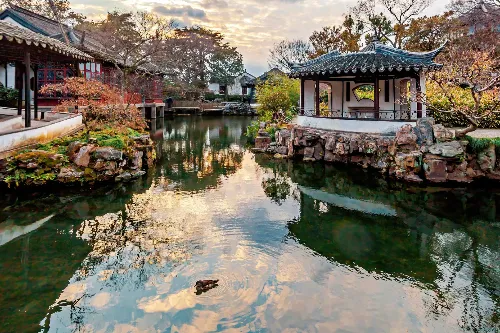
Humble Administrator's Garden was built in the 4th year of Zhengde in the Ming Dynasty (1509) by imperial censor Wang Xianchen. It is the largest garden among Suzhou gardens and one of the four famous gardens in China. The garden is divided into three parts: east, middle and west. The middle part is the core area of the garden, with a pool as the center, surrounded by pavilions, terraces, buildings and pavilions, embodying the gardening pattern of "one pool with three mountains". The main scenic spots in the garden include Yuanxiang Hall, Xiangzhou Pavilion and Hexiang Simian Pavilion. Among them, Yuanxiang Hall is the main building in the middle part. The name of the hall is derived from the meaning of "fragrance spreads far and becomes more pure" in Zhou Dunyi's Ode to the Lotus. With windows opened on all sides, it allows visitors to enjoy different views around, and is praised as a model of "four-sided hall". Humble Administrator's Garden is famous for its water scenery. When lotus flowers are in full bloom in summer, the whole garden is covered with lotus leaves, and the fragrance is overwhelming, reproducing the artistic conception of "enjoying the fun of mountains and forests without leaving the city".
Liu Garden
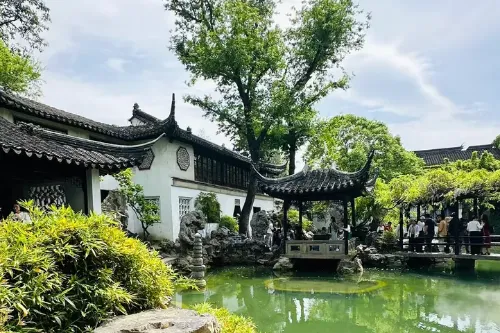
Liu Garden was built in the 21st year of Wanli in the Ming Dynasty (1593) and was renovated and expanded many times in the Qing Dynasty to form its current scale. Liu Garden is famous for its exquisite architectural layout and rich spatial changes. The whole garden is divided into four parts: middle, east, west, and north. The middle part is dominated by landscapes, the east part is known for its architecture, the west part is mostly natural scenery, and the north part is rural scenery. The famous scenic spots in the garden include Guanyun Peak, Nanmu Hall, and Hanbi Mountain House. Guanyun Peak is about 6.5 meters high, a relic of the flower and stone gang in the Song Dynasty, and is the largest lake stone in Jiangnan gardens. It is famous for being "thin, transparent, leaky, and wrinkled", and together with Ruiyun Peak and Xiuyun Peak, it is called "the three peaks of Liu Garden". The architecture and landscapes of Liu Garden are cleverly combined, and through borrowing techniques such as leaky windows and door openings, spaces penetrate each other, creating the effect of "changing scenery with each step".
Lion Grove
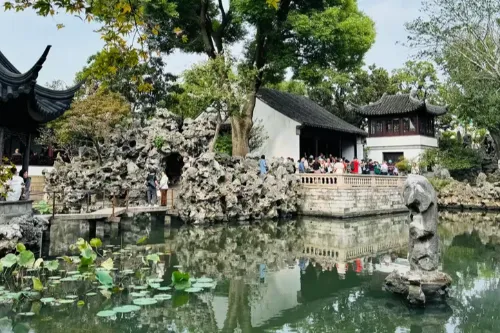
Lion Grove was built in the second year of Zhizheng in the Yuan Dynasty (1342) by Tianru Chan Master to commemorate his teacher Zhongfeng Chan Master. It was initially named "Putuo Zhengzong Temple". Because the lake stone rockeries in the garden are shaped like lions, it is also called "Lion Grove". It is the only garden in Suzhou Gardens built in the Yuan Dynasty, with lake stone rockeries as its biggest feature. The rockeries cover an area of about 1,100 square meters, piled up with a large number of Taihu stones, with crisscrossing caves and winding paths, known as the "Kingdom of Rockeries". There are caves such as "Hanhui", "Tuyue", "Xuanyu", and "Angxiao" in the rockeries in the garden. Visitors walking through them feel like entering a maze. The main scenic spots include Yifeng Zhibai Xuan, Wenmei Pavilion, and Lixue Hall, most of which are related to Buddhist culture, reflecting the combination of gardens and religion.
Canglang Pavilion
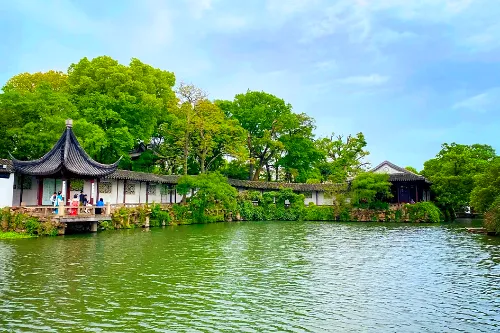
Canglang Pavilion is the oldest existing garden in Suzhou. It was built in the fifth year of Qingli in the Northern Song Dynasty (1045) by the poet Su Shunqin. After several changes of owners, most of the existing buildings were built in the Qing Dynasty. The garden is characterized by "high mounds and wide waters". There is an earthen hill in the garden, and Canglang Pavilion is built on the hill, which is the landmark building of the garden. The plaque "Canglang Pavilion" is engraved on the pavilion, derived from the meaning of "the clear water of Canglang can wash my hat tassel; the turbid water of Canglang can wash my feet" in "Chu Ci", embodying the hermit feelings of the owner. The layout of Canglang Pavilion is unique. Instead of walls, it is separated from the outside by a winding corridor. There are 38 steles from the Song, Yuan, Ming, and Qing dynasties inlaid on the corridor walls, called "Canglang Pavilion Stone Carvings", which have important historical value.
Wangshi Garden
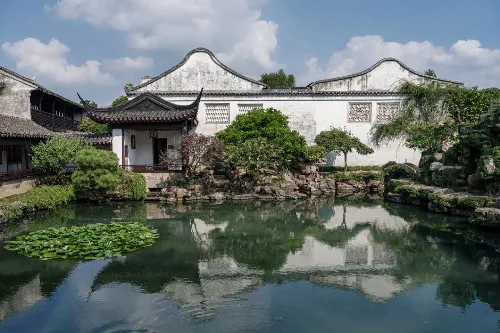
Wangshi Garden was built during the Chunxi period of the Southern Song Dynasty (1174-1189), initially named "Yuyin". It was rebuilt in the Qianlong period of the Qing Dynasty and renamed "Wangshi Garden", taking the meaning of "fisherman" (net master), implying seclusion from the world. Wangshi Garden covers an area of about 8,000 square meters, making it the smallest among Suzhou Gardens. However, it has a compact layout, is exquisite and elegant, and is famous for "seeing the big from the small". The garden is centered on the "Caixia Pool", surrounded by buildings. The main scenic spots include Yuedao Fenglai Pavilion, Zhuoying Water Pavilion, and Kansong Duhua Xuan. Yuedao Fenglai Pavilion is located on the west bank of the pool, facing water on three sides. There is a couplet in the pavilion: "When the moon reaches the center of the sky, when the wind comes to the surface of the water". On the night of the Mid-Autumn Festival, visitors can enjoy the moon reflected in the pool here, with a gentle breeze blowing, and the scenery is extremely beautiful. Wangshi Garden's gardening techniques are exquisite and are regarded as a model of achieving much with little in Suzhou Gardens.
Tour Route
Suzhou Gardens are relatively concentrated and can be visited in 1-2 days. A recommended one-day tour route: in the morning, go to Zhuozheng Garden, visit for about 2-3 hours to feel its grand landscape pattern; then walk to the nearby Lion Grove, visit for about 1.5 hours to experience the fun of the rockery maze; at noon, taste Suzhou-style noodle soup around the garden. In the afternoon, go to Liu Garden, visit for about 2 hours to appreciate its exquisite architectural layout; then go to Wangshi Garden, visit for about 1.5 hours to feel the artistic conception of "seeing the big from the small". If time permits, you can experience the night opening project in Wangshi Garden and enjoy traditional opera performances.
A two-day tour can add scenic spots such as Canglang Pavilion and Yipu Garden on the basis of the one-day tour. On the second day, visit Canglang Pavilion in the morning to feel its simple style, then go to Yipu Garden to experience the tranquility of small gardens; in the afternoon, you can go to Pingjiang Road Historical District to feel the style of Suzhou ancient city and taste local snacks.
Travel Suggestions
- The best seasons to visit are spring (March to May) and autumn (September to November). In spring, the gardens are filled with blooming flowers; in autumn, the climate is pleasant, and you can taste Yangcheng Lake hairy crabs.
- It is recommended to rent an electronic interpreter or hire a tour guide (the guide fee for Zhuozheng Garden is about 100 yuan per trip) to learn about the historical background and gardening techniques of the gardens, so as to enhance the visiting experience.
- There are many stone slab roads in the gardens, so it is advisable to wear comfortable flat shoes and avoid high heels.
- There are many tourists during peak seasons (holidays and weekends). It is recommended to arrive as early as possible (within 1 hour after the garden opens) to avoid the peak flow of people.
- Carry drinking water and a small amount of snacks with you, as there are few catering options in the gardens and the prices are relatively high.
Matters Needing Attention
- Smoking and littering are prohibited in the gardens. Do not climb rockeries, damage flowers and trees, and please take good care of cultural relics and historic sites.
- After entering the gardens, do not make loud noises. Keep quiet and respect other visitors' visiting experience.
- Some gardens (such as Wangshi Garden) require separate tickets for night opening and need to be booked in advance. It is recommended to check the official information in advance.
- When visiting on rainy days, be careful of slippery roads. You can bring a folding umbrella or rent rain gear in the garden (some gardens provide rental services).
- Abide by the opening hours of the scenic spots. Plan your visiting time in advance to avoid missing the closing time and affecting your itinerary.
Transportation
- Subway: Suzhou Metro Lines 1, 2, etc. can reach near the main gardens. There is Metro Line 4 "Beisi Tower Station" near Zhuozheng Garden and Lion Grove, about 10 minutes' walk away; there is Metro Line 2 "Shilu Station" near Liu Garden, about 15 minutes' walk away; there is Metro Line 3 "Wangshi Garden Station" near Wangshi Garden, about 5 minutes' walk away.
- Bus: Many bus routes can reach various gardens, such as Tourist Route 1, Tourist Route 2, Tourist Route 5 and other tourist special lines, covering major scenic spots such as Zhuozheng Garden, Liu Garden, and Lion Grove. Among them, Tourist Route 1 can directly reach Zhuozheng Garden, Lion Grove, and Liu Garden, with a fare of 2 yuan per person.
- Taxi: The starting fare of Suzhou taxis is 10 yuan (within 3 kilometers), and 2 yuan per kilometer after exceeding 3 kilometers. It is about 15-20 yuan from Suzhou Railway Station to Zhuozheng Garden, and about 10-15 yuan to Liu Garden.
- Shared Bikes: Shared bikes are densely distributed in Suzhou ancient city. You can choose shared bikes for short trips to the gardens, which is convenient and flexible, with a fee of about 2 yuan per 30 minutes.
Opening Hours
The opening hours of each scenic spot are slightly different. In the peak season (April 1 - October 31), it is generally 7:30-17:30 (admission stops at 17:00); in the off-season (November 1 - March 31 of the following year), it is generally 7:30-17:00 (admission stops at 16:30).
Among them, Wangshi Garden has night opening hours. During the peak season (April 1 - October 31), the night opening hours are 19:30 - 22:00 (admission stops at 21:00), with performances such as Pingtan (Suzhou storytelling and ballad-singing) and Kunqu opera. For details, please refer to the scenic spot's announcement on the day.
Tickets
A per-scenic-spot ticket system is implemented, with single-scenic-spot tickets starting at 5 yuan, and combined tickets also available starting at 65 yuan.
You can search for the official WeChat public account "苏州园林旅游" on WeChat to get the latest updates or buy tickets online.
Online Booking
Click here to jump to the Trip.com ticketing platform for ticket purchase.