
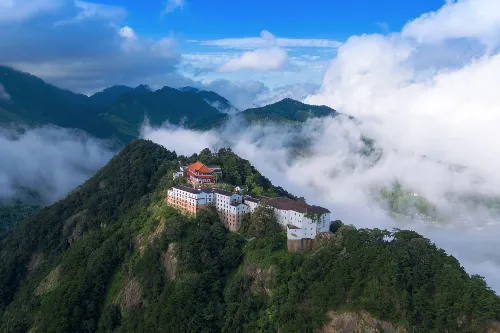
Jiuhua Mountain Scenic Area is located in Qingyang County, Chizhou City, Anhui Province. It is a UNESCO World Heritage Site (combining natural and cultural values), a National 5A-level Tourist Attraction, a National Geopark, a National Forest Park, a National Civilized Scenic Tourist Area, one of China's Four Great Buddhist Mountains, and a world-famous Taoist site of Ksitigarbha Bodhisattva. As a key national scenic area of mountain type, it features Buddhist culture and natural & humanistic sacred landscapes. The scenic area covers a planned area of 120 square kilometers and a protected area of 174 square kilometers, consisting of 11 major scenic zones. Jiuhua Mountain boasts 99 peaks, among which 9 peaks including Tiantai, Shiwang (Ten Kings), Lianhua (Lotus), and Tianzhu (Heavenly Pillar) are the most magnificent. The highest peak, Shiwang Peak, stands at an altitude of 1344.4 meters. Currently, there are 99 existing temples on Jiuhua Mountain, housing nearly 1,000 monks and nuns, and over 10,000 Buddha statues.
History & Culture
Jiuhua Mountain has a long history of Buddhism. In the 5th year of Long'an in the Eastern Jin Dynasty (401 AD), the Indian monk Bodu came to Jiuhua to preach and founded thatched huts, marking the introduction of Buddhism to the mountain. At the end of Kaiyuan in the Tang Dynasty (741 AD), Master Jin Qiaojue from Silla (ancient Korea) settled in Jiuhua Mountain. He passed away peacefully in the 10th year of Zhenyuan (794 AD), and his disciples believed he was the incarnation of Ksitigarbha Bodhisattva, thus establishing Jiuhua Mountain as the Taoist site of Ksitigarbha Bodhisattva. Buddhism on Jiuhua Mountain flourished in the Tang Dynasty, developed in the Song and Yuan Dynasties, and reached its peak in the Ming and Qing Dynasties. By the late Qing Dynasty, the number of temples on the mountain had surged from over 20 in the late Tang Dynasty to more than 150. The enshrinement of physical bodies (mummified remains) in Jiuhua Mountain's Buddhism is a unique phenomenon in Chinese Buddhism, historically known as "Flesh Body Bodhisattvas" or "Complete Sarira". After Master Jin Qiaojue's nirvana, he became the first physical body Buddha, and six such physical bodies are enshrined to this day.
In addition to profound Buddhist culture, Jiuhua Mountain is also rich in landscape culture. In the winter of the 13th year of Tianbao in the Tang Dynasty (754 AD), Li Bai, invited by friends, gathered at the foot of Jiuzhi Mountain. Admiring the exotic peaks, they sang in response to each other and composed the poem "Ode to Renaming Jiuzhi Mountain as Jiuhua Mountain", with the line "The wonderful qi divides into two, the spiritual mountain blooms into nine petals" becoming the defining verse of Jiuhua Mountain. Since then, numerous literati and celebrities have visited Jiuhua Mountain, adding luster to its scenic legends and landscapes with their aesthetic perspectives and artistic brushwork.
Major Attractions
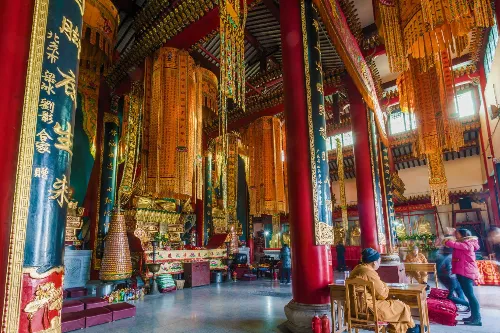
Flesh Body Hall (Roushen Baodian)
The core temple of Jiuhua Mountain, enshrining the physical body of Ksitigarbha Bodhisattva. Inside the hall, five wooden pagodas representing "east, south, west, north, and center" hold hidden mysteries. Wishes made here are believed to be efficacious. After burning incense and worshipping the Buddha, remember to circle the main hall three times clockwise.
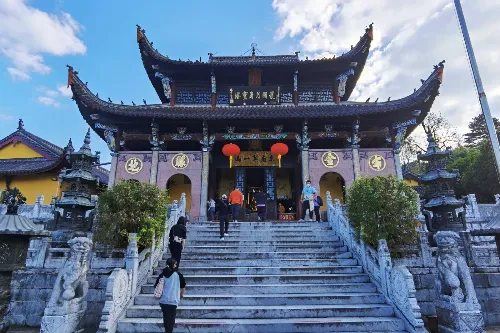

Huacheng Temple
The founding temple of Jiuhua Mountain, with a history of over 1,000 years, resembling a Buddhist culture museum. The temple houses three treasured artifacts of the mountain. The crescent-shaped pool at the entrance is a release pool, and touching the koi fish is believed to bring blessings.
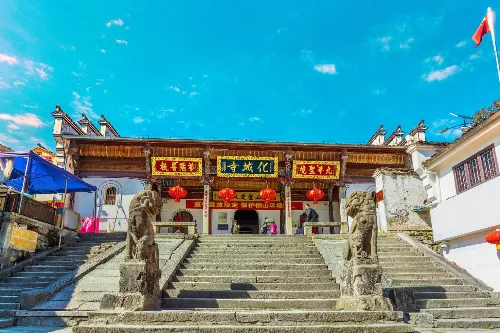

Zhiyuan Temple
One of the largest temples on Jiuhua Mountain and the leader of the "Four Great Monasteries" on the mountain. You can make prayers for blessings here. Light three sticks of incense, hold them in your right hand, grip your right hand with your left, bow at a 45-degree angle, silently recite your wishes towards the main hall first, then bow three times clockwise in each of the four directions.
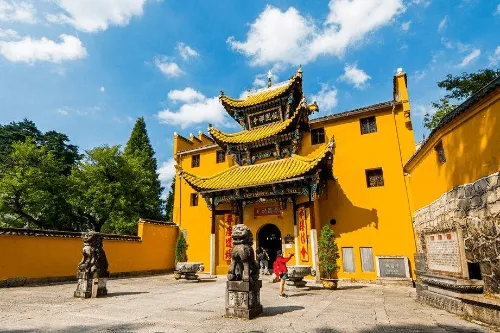
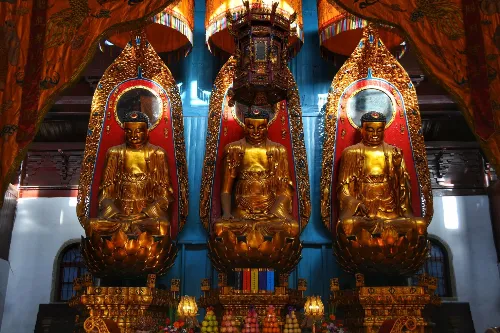
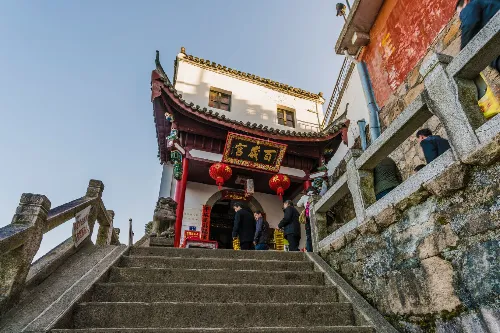
Baisui Palace (Hundred-Year-Old Palace)
Enshrining the physical body of Monk Wuxia from the Ming Dynasty, it is believed to be highly efficacious for prayers of peace and health. On the way to the palace, you can also see the natural Sleeping Buddha. If you are not physically strong enough, you can take the cable car up and down.
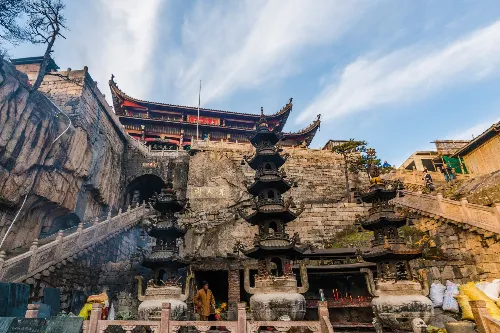
Tiantai Temple
Located at an altitude of 1306 meters, it is the highest temple on Jiuhua Mountain. After taking the cable car up the mountain, you need to climb more than 800 steps to reach it. Wishes made here are particularly efficacious, and making wishes amidst the swirling clouds and mist creates a very immersive atmosphere.
Travel Route
If you have enough time, it is recommended to spend two days exploring Jiuhua Mountain in depth.
Day 1: Flesh Body Hall → Huacheng Temple → Zhiyuan Temple → Baisui Palace (by cable car). Head straight to Flesh Body Hall in the morning to avoid crowds; the cable car to Baisui Palace stops operating at 4 PM.
Day 2: Tiantai Scenic Area (Tiantai Peak + Ancient Scripture-Chanting Platform) → Phoenix Pine → Min Garden Bamboo Sea. It is recommended to depart at 7 AM; the round trip takes about 4 hours, so bring plenty of water and snacks.
Transportation
- High-Speed Rail: Arrive at Jiuhuashan Railway Station, where free shuttle buses are available to the scenic area.
- Self-Driving: On weekdays, vehicles with fewer than 7 seats can drive directly to Jiuhua Street. On weekends and holidays, vehicles must be parked in the ground parking lot, and you need to purchase a 50-yuan round-trip scenic area shuttle bus ticket to go up the mountain.
Travel Tips
- It is advisable to hire a professional tour guide to learn about temple stories and Buddhist culture.
- For accommodation, prioritize Jiuhua Street for convenient travel.
- Carry some change for making merit donations at will.
- If you plan to climb Tiantai Peak, remember to wear comfortable shoes and bring sufficient water and snacks.
Notes
- Dress appropriately and avoid revealing clothing to show respect for the Buddha.
- Maintain silence, refrain from discussing trivial worldly matters, and do not use disrespectful language.
- Do not step on the thresholds, do not turn your back to the Buddha statues, do not point at the Buddha statues, and do not take photos without permission.
- Follow relevant rituals when taking incense and worshipping in the temples.
Opening Hours
Open 24 hours a day, but the opening hours of individual attractions may vary slightly.
Ticket Information
Ticket price: 160 yuan per person.
You can search for the official WeChat public account "九华山风景区" to get the latest updates or purchase tickets online.
Online Booking
Click here to jump to the Trip.com ticketing platform for ticket purchase.