
Longchuan Scenic Area is located in Longchuan Village, 11 kilometers east of Jixi County seat in Xuancheng City, Anhui Province, situated in a small basin in the southeastern part of Jixi County. Surrounded by mountains on all sides, it features distinct four seasons and suitable light conditions, with an average annual temperature of 15.99℃. The Longchuan Stream winds eastward through the village and flows into the Dengyuan River. Longchuan Village is formed by the merger of three villages: Kengkou, Xuli, and Hengchuan.
In 1988, Longchuan was designated as a National Key Cultural Relic Protection Unit, and in 2012, it was approved as a National 5A-level Tourist Attraction. With a boat-shaped layout, the village is a typical ancient Huizhou village. The entire scenic area consists of numerous attractions, including the National Key Cultural Relic Protection Units such as the Hu Family Ancestral Hall, Yishi Shangshu Archway, and the Former Residence of Hu Bingheng (a Huizhou merchant), as well as the Huizhou Merchant Memorial Hall, Hu Zongxian Shao Bao Mansion, Xiangxian Shrine, Chengxin Hall Paper Workshop, Water Street, and Lingshan Nunnery.
History and Culture
Longchuan has a long history and profound cultural heritage. It is the ancestral home of Comrade Hu Jintao, former General Secretary of the Communist Party of China Central Committee, President of the People's Republic of China, and Chairman of the Central Military Commission.
During the Ming and Qing dynasties, when the population of Jixi County was only over 81,000, more than 340 ancestral halls were built—averaging one hall for every 50-odd households or 230 people. By 1982, over 160 ancestral halls still remained in the county. At that time, those who were highly respected locally for their moral character, academic achievements, or political merits would, after their passing, be recommended by local officials to have their tablets placed in the county's Xiangxian Shrine (Shrine of Worthies) for worship in spring and autumn. According to the Jixi County Chronicle of the Jiaqing Reign (published in 1810), the Xiangxian Shrine of Jixi County enshrined 15 worthies, 3 of whom were from Longchuan.
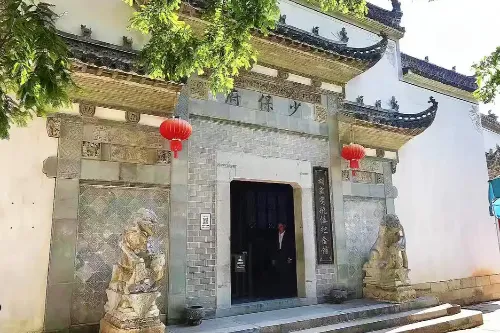
Longchuan once had the "Sijing Hall," a sacred place for clansmen to honor their ancestors. Today, it has been renovated to its original appearance, with the names of virtuous and respected clansmen who benefited the village throughout Longchuan's history recorded here. Paintings depicting the life stories of eight of these individuals have also been created, making it a local education base for Longchuan.
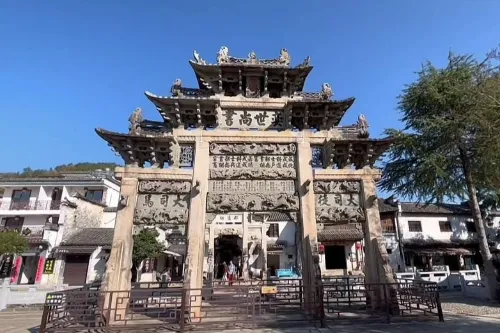
The archway culture in the scenic area is also prominent. Originating from the Wutou Gate (Black Head Gate), archways served to praise virtue, condemn evil, promote righteousness, and symbolize social status and hierarchy. At its peak, Longchuan Village in Jixi had 14 archways. The best-preserved one today is the Yishi Shangshu Archway, which commemorates Hu Fu and Hu Zongxian—two scholars who passed the imperial examination with a 60-year interval between their achievements. A total of 13 archways were built in their honor, 7 of which are located in Longchuan.
Major Attractions
Longchuan Hu Family Ancestral Hall
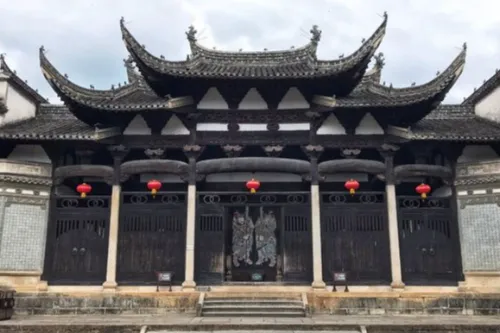
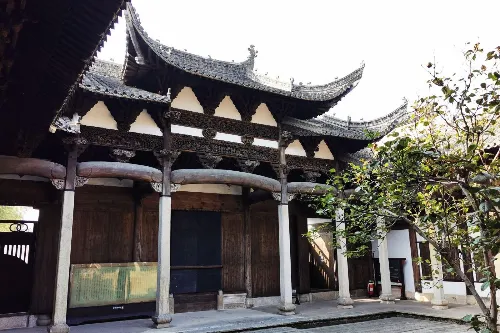
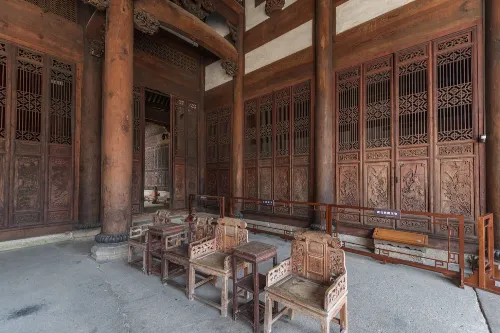
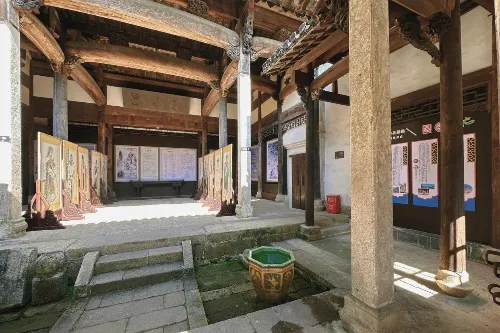
Known worldwide as the "Palace of Wood Carvings" and the "Museum of National Art," the Longchuan Hu Family Ancestral Hall was designated as a National Key Cultural Relic Protection Unit in 1988. The existing ancestral hall, constructed in the 25th year of the Jiajing reign of the Ming Dynasty (1547), covers a land area of 1,729 square meters and a total building area of 1,564 square meters. Composed of ten parts—including a screen wall, a pan pool, a terrace, a gate tower, a courtyard, corridors, a main hall, side rooms, a sleeping building, and a special memorial hall—it adopts an architectural style of east-west symmetry along the central axis, forming a complete building complex. The preserved wood carving "Four Harmonies Diagram" (harmony, smoothness, beauty, and melodiousness) in the ancestral hall has become a symbol of a harmonious society.
Xiangxian Shrine (Shrine of Worthies)
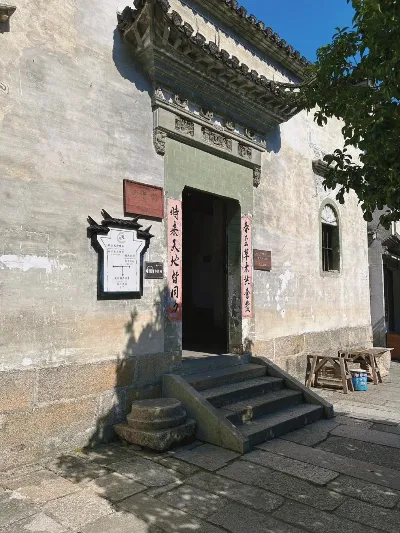
During the Ming and Qing dynasties, 3 worthies from Longchuan were enshrined and worshipped in the county's Xiangxian Shrine. The former "Sijing Hall" of Longchuan has been renovated and restored to its original appearance as the Xiangxian Shrine, where the names of virtuous and respected clansmen from Longchuan's history are recorded. Paintings depicting the life stories of eight of these individuals are also displayed here. The words "Remembering Ancestors" are inscribed on the east wall, and "Honoring the Clan" on the west wall, making it a local education base for Longchuan.
Longchuan Water Street
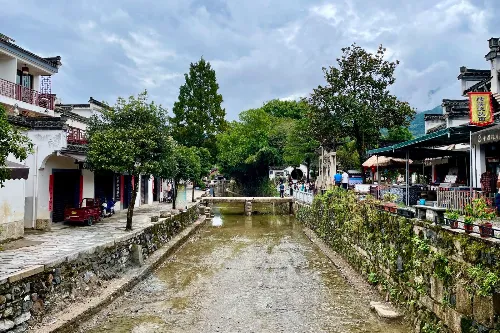
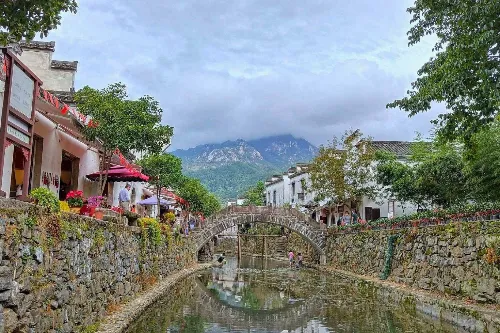
Longchuan Water Street refers to the section of the Longchuan Stream flowing through the village, embodying the typical layout of ancient Huizhou villages nestled against mountains and facing water. The Hu clansmen used the riverbanks on both sides as streets, commonly known as "Water Street." The stone slabs paved vertically in the middle of the embankment represent the "dragon's spine," while the cobblestones laid on both sides symbolize the "dragon's scales." Opposite it, Phoenix Street is paved horizontally with white phoenix granite, representing phoenix feathers—together, the two streets are called "Dragon and Phoenix Bringing Prosperity." The Dragon Embankment is higher than Phoenix Street, reflecting the feudal ethical concept of male superiority over females and conforming to the principle of "harmony between yin and yang." The walls of the residences on both sides of the Water Street are horse-head walls, a characteristic of Huizhou architecture, which serve fireproof, windproof, and anti-theft purposes.
Lingshan Nunnery
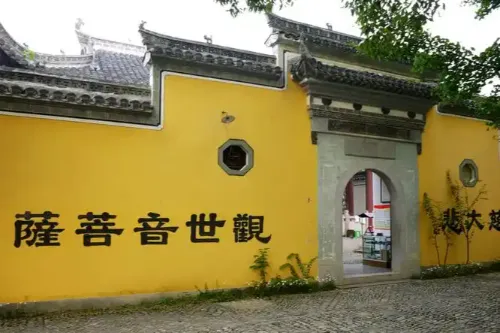
The hill where Lingshan Nunnery is located was historically known as Hengshan, and due to its fish-like shape, it was called "Upstream Golden Fish." Nestled among dense forests, the nunnery is accompanied by melodious bell sounds and ethereal Buddhist chants. Legend has it that Hu Zongxian studied literature and practiced martial arts here in his youth. In the past, it attracted devout believers from the six counties of Huizhou and neighboring counties such as Chun'an for pilgrimage. During the Yuan Dynasty, a "Kengkou Office" was set up here to collect taxes on papermaking and other industries, hence the nunnery is also commonly known as "Mountain Official Fort."
Yishi Shangshu Archway
As a stone archway from the flourishing Ming Dynasty, the Yishi Shangshu Archway is a typical representative of Huizhou stone carving. "Yishi" means "from generation to generation," and the archway commemorates Hu Fu and Hu Zongxian. With a 60-year interval between their imperial examination successes, their feudal official careers brought great honor to the Hu clan of Longchuan.
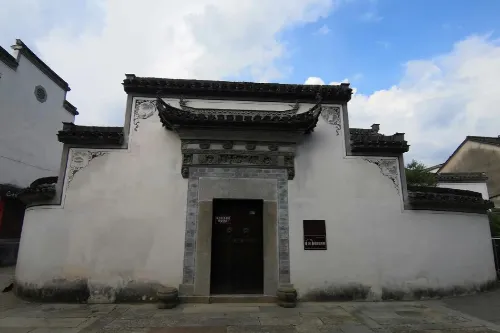
Former Residence of Hu Bingheng (Huizhou Merchant)
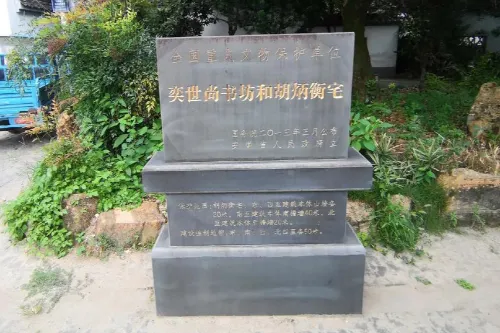
As a National Key Cultural Relic Protection Unit, the Former Residence of Hu Bingheng showcases the living scenes and architectural style of Huizhou merchants, holding great significance for the study of Huizhou merchant culture.
Hu Zongxian Shao Bao Mansion
Related to Hu Zongxian, this attraction displays relevant historical culture and personal deeds, allowing visitors to learn about Hu Zongxian's life and his role in history.
Chengxin Hall Paper Workshop
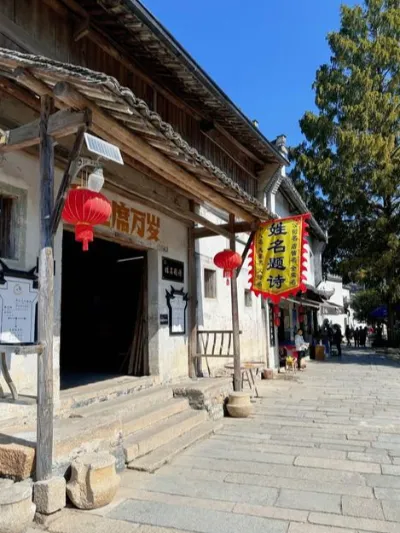
Here, visitors can learn about the traditional papermaking process of Chengxin Hall paper and experience the charm of ancient traditional craftsmanship.
Tour Routes
Recommended One-Day Tour Route: Visitor Center → Longchuan Water Street → Yishi Shangshu Archway → Hu Family Ancestral Hall → Xiangxian Shrine → Hu Zongxian Shao Bao Mansion → Former Residence of Hu Bingheng → Huizhou Merchant Memorial Hall → Chengxin Hall Paper Workshop → Lingshan Nunnery. The entire tour takes approximately 5-6 hours, allowing visitors to fully appreciate the main attractions and cultural connotations of the scenic area.
Recommended Two-Day Tour Route: On the first day, visit the Visitor Center → Longchuan Water Street → Yishi Shangshu Archway → Hu Family Ancestral Hall → Xiangxian Shrine, then taste local cuisine and experience local life around the scenic area. On the second day, visit Hu Zongxian Shao Bao Mansion → Former Residence of Hu Bingheng → Huizhou Merchant Memorial Hall → Chengxin Hall Paper Workshop → Lingshan Nunnery. In the afternoon, you can choose to stroll leisurely in the scenic area and enjoy the peaceful atmosphere of Longchuan. This arrangement allows for a more relaxed appreciation of the scenic beauty and an in-depth understanding of its culture.
Travel Tips
- It is recommended to wear comfortable sports shoes, as the scenic area has many stone roads and steps, making walking easier.
- You can bring some snacks and drinking water. Although there are shops in the scenic area, the prices may be relatively higher.
- When visiting attractions such as the Hu Family Ancestral Hall, you can rent an audio guide or hire a tour guide to better understand the historical culture behind the attractions. The rental fee for an audio guide is about 20 yuan per time, and the tour guide fee varies according to the group size—usually around 100 yuan for groups of less than 10 people.
- Spring or autumn is the best time to visit, as the weather is pleasant and the scenery is very beautiful. In spring, you can admire rapeseed flowers and other blossoms around the area; in autumn, the climate is cool, making it suitable for walking tours.
- If you are interested in Huizhou merchant culture and Huizhou architecture, you can arrange a two-day tour to deeply experience the scenic area's culture.
Notes
- Some cultural relics and historical sites in the scenic area are very precious. Please do not touch or carve on them, and keep the scenic area clean and tidy.
- When walking on Longchuan Water Street, pay attention to your steps, as the stone roads may be slippery due to moisture or other reasons.
- When taking transportation within the scenic area, follow the instructions of the staff and board/disembark in order.
- When purchasing local specialties around the scenic area, pay attention to distinguishing the quality and price to avoid buying counterfeit or shoddy goods.
- During peak tourist seasons, the scenic area is crowded. Please take good care of your personal belongings to prevent loss.
- Mobile phone signal may be poor in some areas of the scenic area. It is recommended to inform your family of your travel plans in advance.
Transportation
- By Air: The nearest airport to Longchuan Scenic Area is Huangshan Tunxi International Airport, approximately 110 kilometers away. From the airport, take the airport shuttle bus to Jixi County, then transfer to a shuttle bus or taxi to the scenic area. The entire journey takes about 2-3 hours.
- By Train: Take the train to Jixi Railway Station. After exiting the station, you can take Bus No. 1 to Longchuan Scenic Area Station, which takes about 30 minutes; alternatively, take a taxi, which takes approximately 20 minutes and costs around 30-40 RMB.
- By Self-Driving: Departing from Hefei, drive along Wuhe Expressway, Xuantong Expressway, and Linning Expressway. The total distance is about 300 kilometers, and the journey takes roughly 4 hours. Departing from Hangzhou, drive along Hangrui Expressway and Linning Expressway. The total distance is about 240 kilometers, and the journey takes approximately 3 hours. The scenic area has a parking lot with the following charging standards: 10 RMB/day for small vehicles, 15 RMB/day for medium-sized vehicles, and 20 RMB/day for large vehicles.
- By Intercity Bus: There are frequent shuttle buses from Jixi Bus Station to the scenic area. The journey takes about 20 minutes, and the fare is approximately 5 RMB.
Opening Hours
The scenic area is open daily from 8:00 AM to 5:30 PM. Opening hours may be adjusted according to seasons or special circumstances.
Tickets
The ticket price is 65 RMB per person.
You can search for the official WeChat public account "龙川景区" to get the latest updates or purchase tickets online.
Online Booking
Click here to jump to the Trip.com ticketing platform for ticket purchase.