
Guangdong Science Center is located at No. 168 Kepu Road, Xiaoguwei Subdistrict, Guangzhou Higher Education Mega Center, Panyu District, Guangzhou City, Guangdong Province. It is a National 4A-level tourist attraction and a national popular science education base. Integrating four major functions including popular science education, sci-tech achievement exhibition, academic exchange and leisure tourism, it was certified by Guinness World Records in 2018 as the world's largest science and technology museum/science center. The project covers a total land area of 453,900 square meters with a construction area of 140,700 square meters and a total investment of approximately 1.9 billion RMB. Shaped after kapok, the city flower of Guangzhou, and a technological aircraft carrier, the building boasts a highly recognizable appearance and stands as one of Guangzhou’s landmark buildings. Inside the center are 13 permanent theme exhibition halls and multiple temporary special exhibition zones, alongside 5 professional science and technology cinemas. Supporting facilities include an 80,000-square-meter ecological lake, an outdoor science exploration park and thousands of Lingnan native plants. There are more than 700 exhibits in total, most of which allow visitors to operate and interact. It serves as an important public welfare base for popular science research and study in the Guangdong-Hong Kong-Macao Greater Bay Area.
History and Culture
In 1996, Guangdong Province formally put forward the idea of constructing a large-scale comprehensive venue for science activities to improve provincial popular science infrastructure and implement the strategy of revitalizing Guangdong through science and education. In 1997, the People’s Government of Guangdong Province approved the preparation of Guangdong Science Center. Preparation work officially kicked off, and an international competition for architectural design proposals was launched worldwide. The design scheme of "Kapok Technology Aircraft Carrier" by Central South Architectural Design Institute was finally selected.
The foundation-laying ceremony of Guangdong Science Center was held on March 28, 2004. After nearly five years of construction, it was completed and officially opened to the public on September 26, 2008. Since its opening, the venue has continuously hosted popular science exhibitions, science experiment shows, youth research and study activities, academic forums and other events, and gradually become a member institution of the Asia Pacific Network of Science & Technology Centres and the World Association of Science Centres.
In 2018, Guangdong Science Center successfully obtained Guinness World Records certification, establishing its status as a world-class large-scale popular science venue. The center has won hundreds of honors including the Tien-yow Jeme Civil Engineering Prize and the National Advanced Collective for Popular Science Work. It has long been committed to disseminating basic science and cutting-edge technological knowledge to the public, promoting the scientific spirit, and facilitating the exchange of popular science resources as well as the development of youth science education across the Guangdong-Hong Kong-Macao Greater Bay Area.
Major Attractions
Children’s World Exhibition Hall
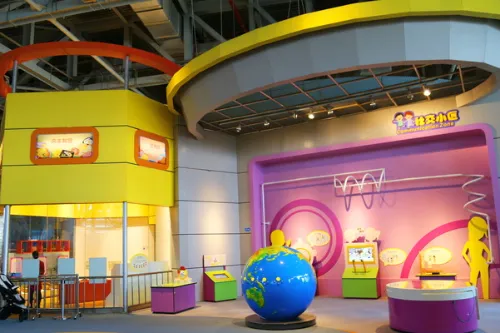
Designed for scientific enlightenment of young children, the exhibition hall consists of multiple zones: Hands-on Workshop, My Home and Residential Community, My City, My World and My Studio. Through interactive games such as simulated urban transportation, construction sites, mini supermarkets and water-based science experiments, children aged 3 to 10 can perceive scientific phenomena in daily life during play, and cultivate awareness of exploration, safety and environmental protection.
Experiment and Discovery Exhibition Hall
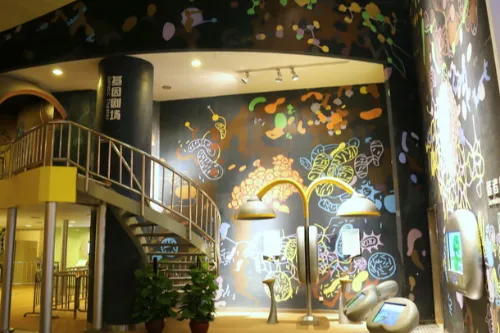
The exhibition hall is divided into the Science Discovery Plaza, Mechanics Laboratory, Electromagnetism Laboratory, Optics Laboratory, Life Science Laboratory and other areas, showcasing classic physics and basic science experimental devices. All exhibits encourage visitors to operate by themselves to directly observe scientific phenomena related to mechanics, electromagnetism and optics, and understand principles of basic disciplines. It is suitable for primary and secondary school students to carry out immersive scientific practice.
Transportation World Exhibition Hall
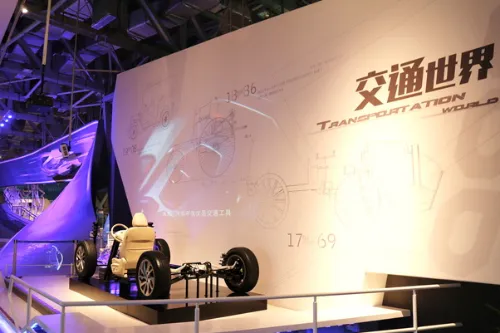
Centered on land, sea and air vehicles, the exhibition hall carries out popular science activities. It displays knowledge of automotive engineering technology, rail transit, ships and aircraft, and offers interactive experiences including simulated traffic driving, vehicle structure demonstration and traffic safety education. A variety of vehicle simulation models are displayed to help visitors understand the engineering science behind modern transportation systems.
Human and Health Exhibition Hall
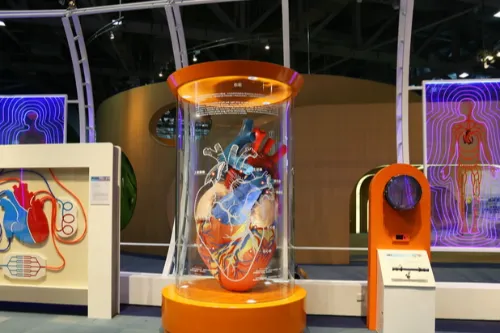
The exhibition hall is split into three sections: Mysteries of the Human Body, Technology and Health, and My Healthy Lifestyle, with a total of 42 exhibits. Using human organ models and interactive health testing devices, it introduces human body structure, modern medical technologies, balanced diet, exercise and daily schedules, guiding visitors to develop a scientific and healthy lifestyle.
Perception and Mind Exhibition Hall
The exhibition hall focuses on scientific topics about human brain cognition, optical illusions and psychological perception. Numerous light and mirror installations create interesting illusion scenarios. Visitors can experience various visual traps, learn about human senses and the brain’s information processing mechanism, and explore basic knowledge in cognitive science.
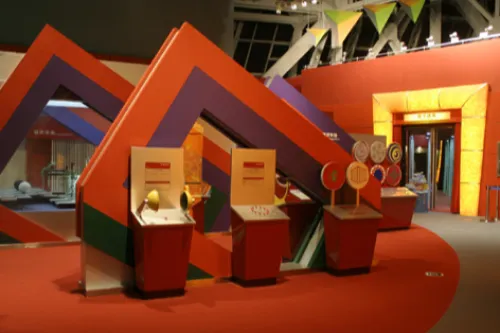
Journey to the Stars Exhibition Hall
This newly built immersive space-themed exhibition hall is equipped with a 360° star dome, C919 passenger aircraft simulator, Mars rover operation console and other facilities. It features interactive programs such as simulated rocket launching, space life experience and astronaut training simulation, comprehensively presenting cutting-edge technologies in deep space exploration and manned spaceflight.
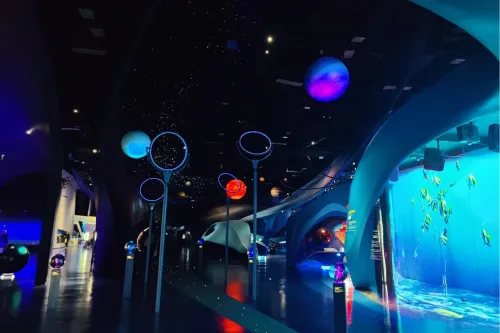
Ocean Exploration Exhibition Hall
Taking human ocean exploration as the main line, the exhibition hall consists of four zones: Origin of the Ocean, Ocean World, Ocean Exploration and Ocean Conservation. Supported by a surround-screen theater, deep-sea equipment simulation models and holographic images, it introduces marine geology, marine organisms, polar scientific research and deep-sea exploration technologies, and spreads knowledge of marine ecological protection.
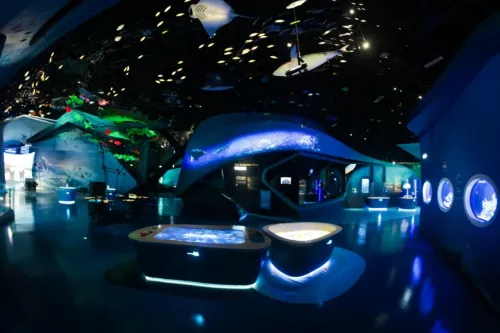
Science Cinema Cluster
The venue houses 5 professional popular science cinemas: IMAX Giant Screen Cinema, Dome Cinema, 4D Cinema, 3D Cinema and Virtual Flight Motion Cinema. Science films themed on nature, astronomy, ocean and aerospace are screened regularly to bring immersive audio-visual experiences. Separate tickets are required for cinema shows.
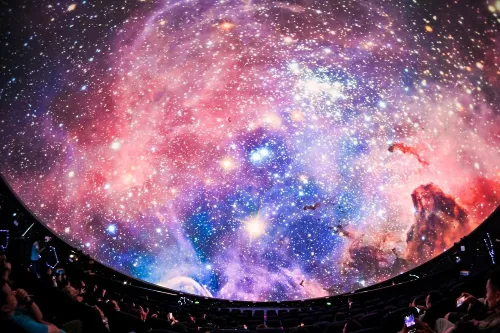
Outdoor Science Exploration Park
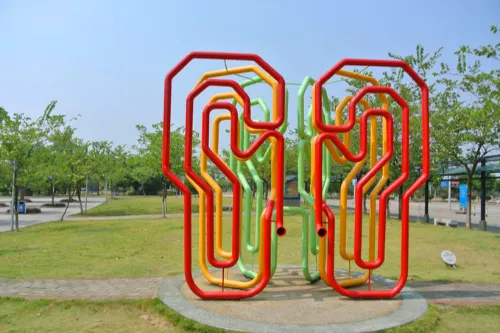
Adjacent to the 80,000-square-meter ecological lake, the park hosts dozens of outdoor interactive science exhibits and more than 2,000 varieties of native Lingnan plants. Combining scientific experience and leisure sightseeing, visitors can stroll around the lake and try outdoor popular science facilities after touring indoor exhibition halls.
Tour Route
Enter from North Gate → Journey to the Stars Exhibition Hall → Ocean Exploration Exhibition Hall → Transportation World Exhibition Hall → Human and Health Exhibition Hall → Perception and Mind Exhibition Hall → Experiment and Discovery Exhibition Hall → Children’s World Exhibition Hall → Outdoor Science Exploration Park
Travel Suggestions
- Suggested visiting duration: 6 to 8 hours. Arrive in the morning to reserve sufficient time for interactive exhibits.
- Popular interactive facilities including the C919 simulator and space experience projects require advance reservation via the official WeChat official account.
- Family visitors with young children are recommended to visit Children’s World Exhibition Hall in the morning to avoid afternoon crowds.
- If you plan to watch films in science cinemas, check screening schedules upon arrival and arrange your itinerary reasonably.
- Simple restaurants are available inside. Visitors may bring drinking water and light snacks; food with strong odors is not recommended.
- Pick up venue guide maps to plan routes between floors and reduce unnecessary detours.
- Crowds surge during holidays. Avoid visiting between 10:00 and 14:00 on weekends.
Notes
- The venue closes regularly every Monday for maintenance. It opens normally if Monday falls on a public holiday.
- Follow staff instructions to experience interactive exhibits. Do not strike or damage any exhibits violently.
- Large suitcases and bulky luggage can be stored. Large trolleys are not recommended due to narrow internal passages.
- Cinemas and some motion-sensing activities have height and age restrictions. Please read notice signs before participation.
- Flying drones is prohibited inside the venue. Do not use flash when photographing precision exhibits at close range.
- If you need to leave temporarily for meals, get a re-entry stamp before exiting so you may re-enter the venue on the same day.
- Children’s World Exhibition Hall has age entry restrictions; adults cannot enter the zone unaccompanied by children.
Transportation
- Bus: Take Bus No.35, 801, Fan 202 or 383 to University Town Science Center Terminal directly.
- Metro: Take Guangzhou Metro Line 4 to Higher Education Mega Center North Station, exit via Exit D, then transfer to bus or ride shared bicycles.
- Intercity Railway: Alight at Guangzhou Higher Education Mega Center Station on East Ring Intercity Railway, and walk about 400 meters to the main entrance.
- Self-driving: Navigate to North Gate No.2 Parking Lot of Guangdong Science Center. Paid parking lots are available with charges following official standards.
- Ride-hailing: Set destination as North Gate No.2 pick-up and drop-off point. Temporary stops on main roads are not allowed.
Opening Hours
Tuesday to Friday: 09:30–16:30, last admission at 16:00; Saturday, Sunday and public holidays: 09:30–17:00, last admission at 16:30. The venue closes every Monday for routine equipment maintenance, and will open normally if Monday is a public holiday. Any special temporary closure will be announced in advance via official platforms. Screening times of science cinemas are independent of exhibition hall opening hours, subject to daily schedules released on the official WeChat official account.
Tickets
Ticket price: 60 RMB per person. Search the WeChat service account "广东科学中心" for updates and online ticket reservations.
Online Booking
Click here to jump to the Trip.com ticketing platform for ticket purchase.